
Account Management in 2026 Has No Table-Stakes Technical Skill
That is not a weakness. It is the most revealing fact in 47,450 postings.
In data engineering, three skills (Python, SQL, Data Pipelines) each appear in roughly seven out of ten postings. They're the filter before anything else. Account Manager hiring doesn't work that way. The most commonly demanded skill, CRM platform experience, shows up in only 1 in 4 postings (25.8%). The second most demanded skill, Forecasting, sits at 22.0%. Nothing else clears 15%.
We analyzed every active Account Manager posting on the InterviewStack.io job board as of May 2026, 47,450 in total, with skills extracted from descriptions and synonyms collapsed. Account Manager is the largest single role in our dataset by posting count, which makes the skill-flexibility finding even more striking: this is what the market looks like at real scale, with real variation across industries, company sizes, and sales motions. A note on dataset scope: job boards classify a wide range of titles under "Account Manager," including B2B SaaS and enterprise account managers, Technical Account Managers (TAMs), medical device and pharmaceutical sales representatives, and financial-services relationship managers. The skill frequencies and salary figures below reflect that full mix rather than any single AM archetype.
Key Findings
- 47,450 active Account Manager postings analyzed across the live job board as of May 2026, the largest single-role dataset in this series.
- No skill clears the 50% table-stakes threshold: CRM leads at 25.8% (12,221 of 47,450 analyzed), and Forecasting follows at 22.0% (10,434).
- Median US base salary is $100,000 (n=10,138 postings with US salary disclosed).
- The most common skills pay below the median: CRM postings have a median of $95,000 and Excel postings have $82,000; analytical skills pay more, including Forecasting ($113,000) and Automation ($109,400).
- 85.2% of postings are mid-level (40,417 of 47,450); only 2.5% are entry-level (1,199) and only 1.4% are staff (682).
- HubSpot and Salesforce co-occur at lift 3.30, the highest pair signal in the dataset: the two appear together 3.3 times more often than chance would predict.
- Onsite is the dominant work mode at 57.0% of postings; remote is only 23.4%.
- The US accounts for 45.7% of postings (21,684 of 47,450), one of the highest US concentrations in our 2026 series.
What Skill Families Define an Account Manager Role in 2026?
Account Manager is not a technical role, but it has a distinct skill architecture. The umbrella view makes the shape visible.
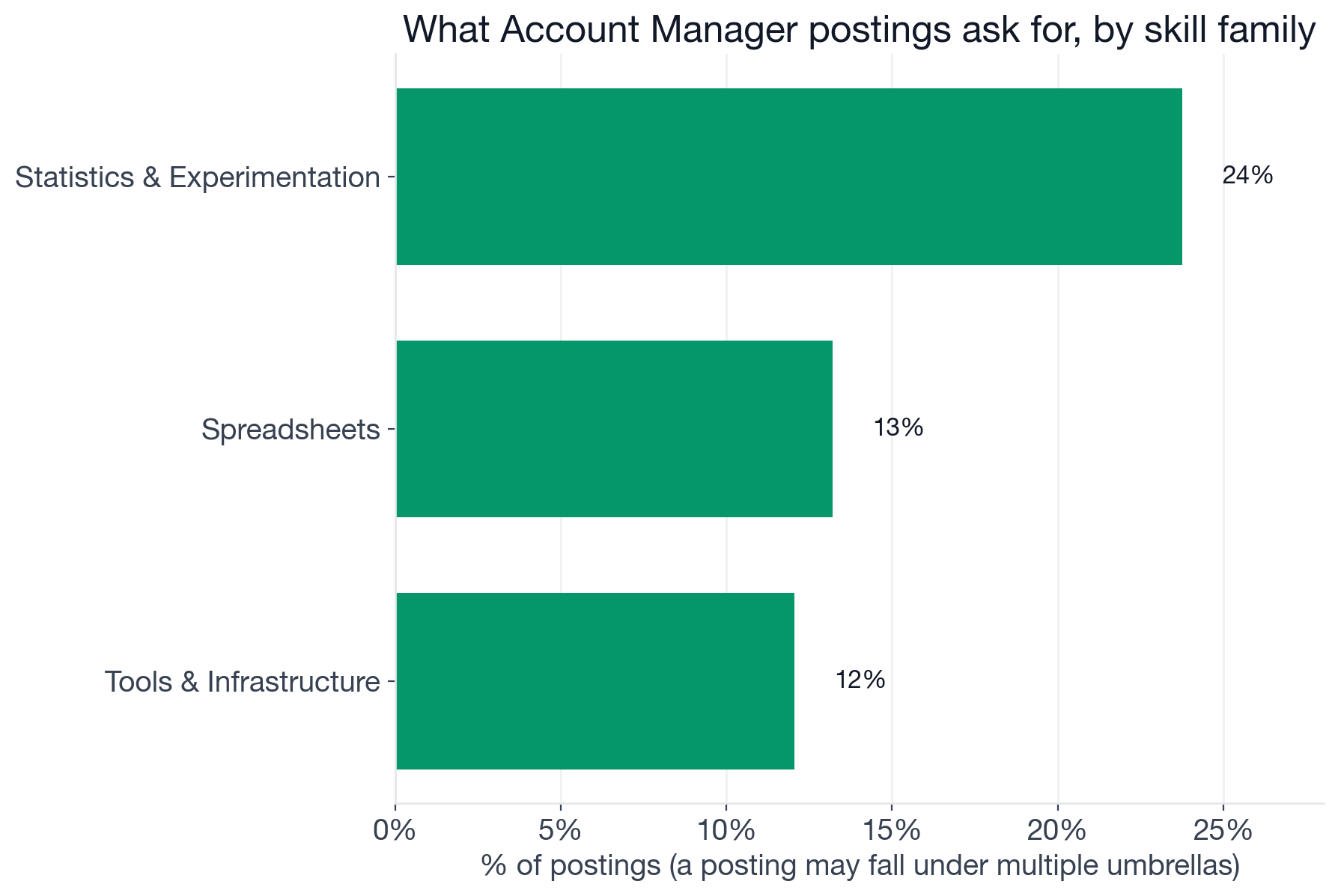
Share of Account Manager postings that ask for at least one skill in each family. The "Other" category encapsulates CRM platforms, sales-process tools, and compliance skills. A posting that mentions both Salesforce and HubSpot counts once under that family.
Four families tell the role's story:
- CRM and Sales Tools ("Other"): 44.7%. This umbrella covers CRM platforms (Salesforce, HubSpot), funnel analysis, GDPR compliance, and sales-process tools. The catchall label does a disservice to what's actually here: these are the core skills that define Account Management as a discipline.
- Statistics and Experimentation: 23.8%, driven almost entirely by Forecasting (22.0%). Pipeline forecasting is not optional in this role; roughly 1 in 4 postings calls it out by name.
- Spreadsheets: 13.2%, essentially Excel. The spreadsheet hasn't been replaced by the CRM; the two coexist, particularly in mid-market and enterprise environments where reporting still happens outside the platform.
- Tools and Infrastructure: 12.0%, covering automation platforms and monitoring tools. Account managers in tech and SaaS environments are increasingly expected to set up automated outreach sequences and track account health metrics systematically. "Monitoring" as a keyword spans two distinct contexts in this dataset: account-health and KPI tracking in traditional sales roles, and application or infrastructure monitoring in Technical Account Manager and IT-adjacent sales roles. The umbrella figure reflects both.
The near-absence of Cloud Platforms (1.5%), Coding Languages (1.3%), and Modern Data Stack (0.9%) confirms the role's character. An account manager who can build a Snowflake pipeline is a curiosity, not a baseline requirement. The differentiating skills are relationship-management, pipeline discipline, and the analytical maturity to own a number.
What Are the Three Tiers of Individual Account Manager Skills?
Drill into individual skills and three bands emerge, though with an important caveat for this role: the top tier is empty.
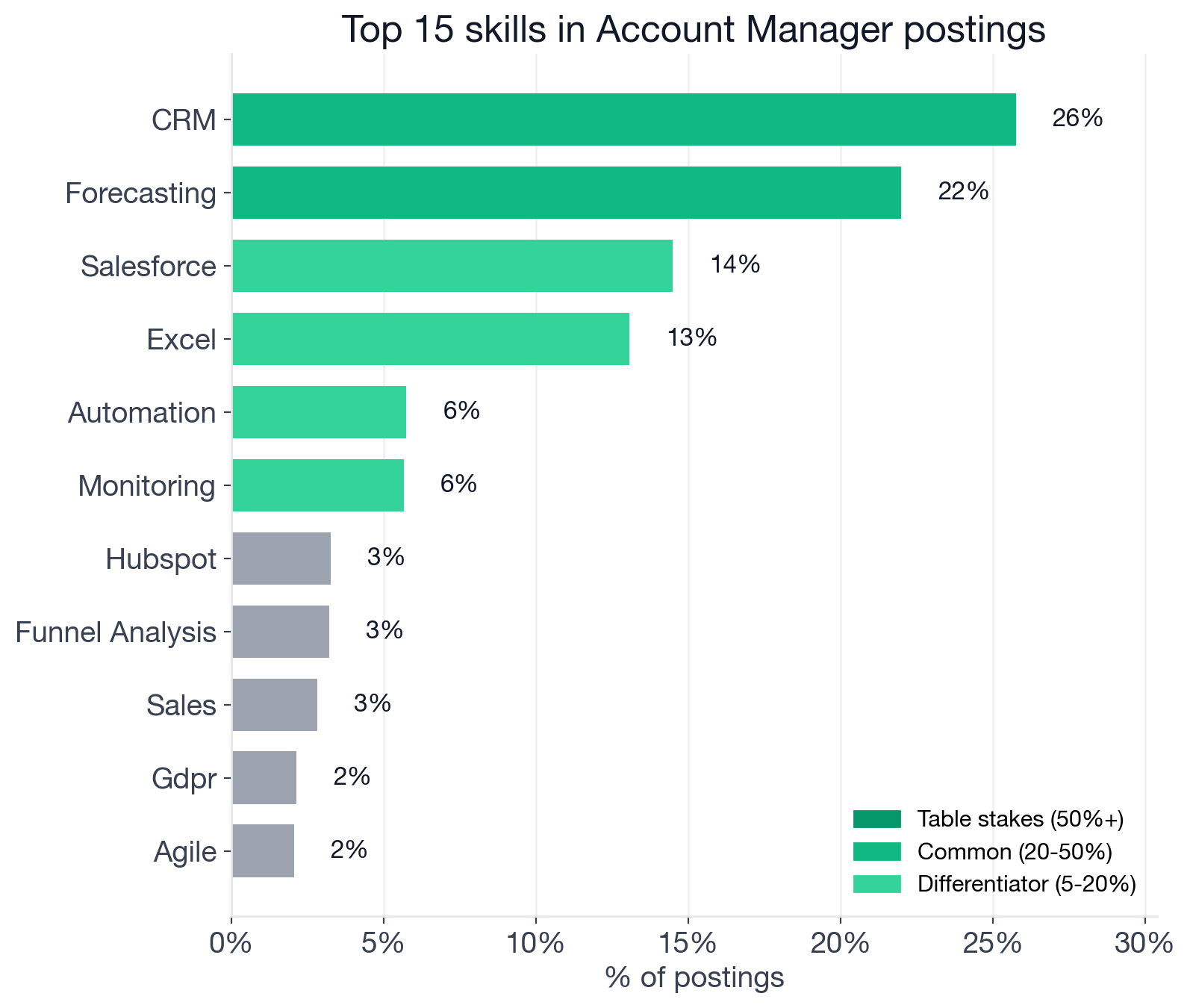
Top individual skills in Account Manager postings, by share of listings that mention them. Skills above 50% are table stakes; 20-50% are common; 5-20% are differentiators. No skill cleared the table-stakes threshold in this role.
Table Stakes (50%+)
None. This is the defining structural fact about Account Manager hiring: no single technical skill appears in more than half of postings. Every other role in this series has at least one. The Account Manager role is genuinely skill-flexible at the technical level, which means hiring managers are screening more on demonstrated experience and competency than on specific tool knowledge.
Common Expectations (20-50% of postings)
Two skills form the shared baseline:
- CRM: 25.8% (browse Account Manager openings that mention CRM)
- Forecasting: 22.0%
CRM fluency is the most universal explicit signal, but appearing in only 1 in 4 postings means many companies assume it rather than state it. Forecasting at 22% is more deliberate: companies that put it in the job description are specifically signaling that they want someone who can own pipeline visibility and deliver a defensible number to leadership. This skill separates quota-carrying AMs from relationship-managers who rely on gut estimates.
Differentiators (5-20% of postings)
Four skills occupy this tier:
- Salesforce: 14.5% (Account Manager + Salesforce openings)
- Excel: 13.1%
- Automation: 5.7%
- Monitoring: 5.7%
Salesforce (the CRM platform, not the company) is the only named platform that reaches differentiator territory. HubSpot (a CRM and marketing automation suite) sits at 3.3%, below the 5% differentiator floor. Excel at 13% reflects how persistent spreadsheet-based reporting remains, particularly in industries that haven't fully centralized their operations inside a CRM. Automation at 5.7% signals more analytically sophisticated sales roles: companies that want account managers who can build outreach workflows and manage pipeline programmatically. Monitoring at 5.7% is more context-dependent. In traditional AM postings it often means KPI tracking and account-health dashboards, but the skill is anti-correlated with Salesforce in this dataset (co-occurrence lift 0.69), suggesting a meaningful share of these postings are Technical Account Manager or IT/networking sales roles where "monitoring" refers to application and infrastructure observability tools rather than sales-pipeline oversight.
Which Account Manager Skills Pay More Than the Baseline?
Salary numbers below are restricted to US postings only (where wage-transparency laws produce consistent disclosure) and represent base salary only: equity, bonuses, RSUs, and sign-on are not disclosed in postings and are not in the data. Total compensation at top employers runs meaningfully higher than what we report.
The median US base salary for Account Manager postings is $100,000 (n=10,138). Among postings with salary data, the range is wide: entry-level and inside-sales postings skew well below six figures, while enterprise and strategic account roles push well above.
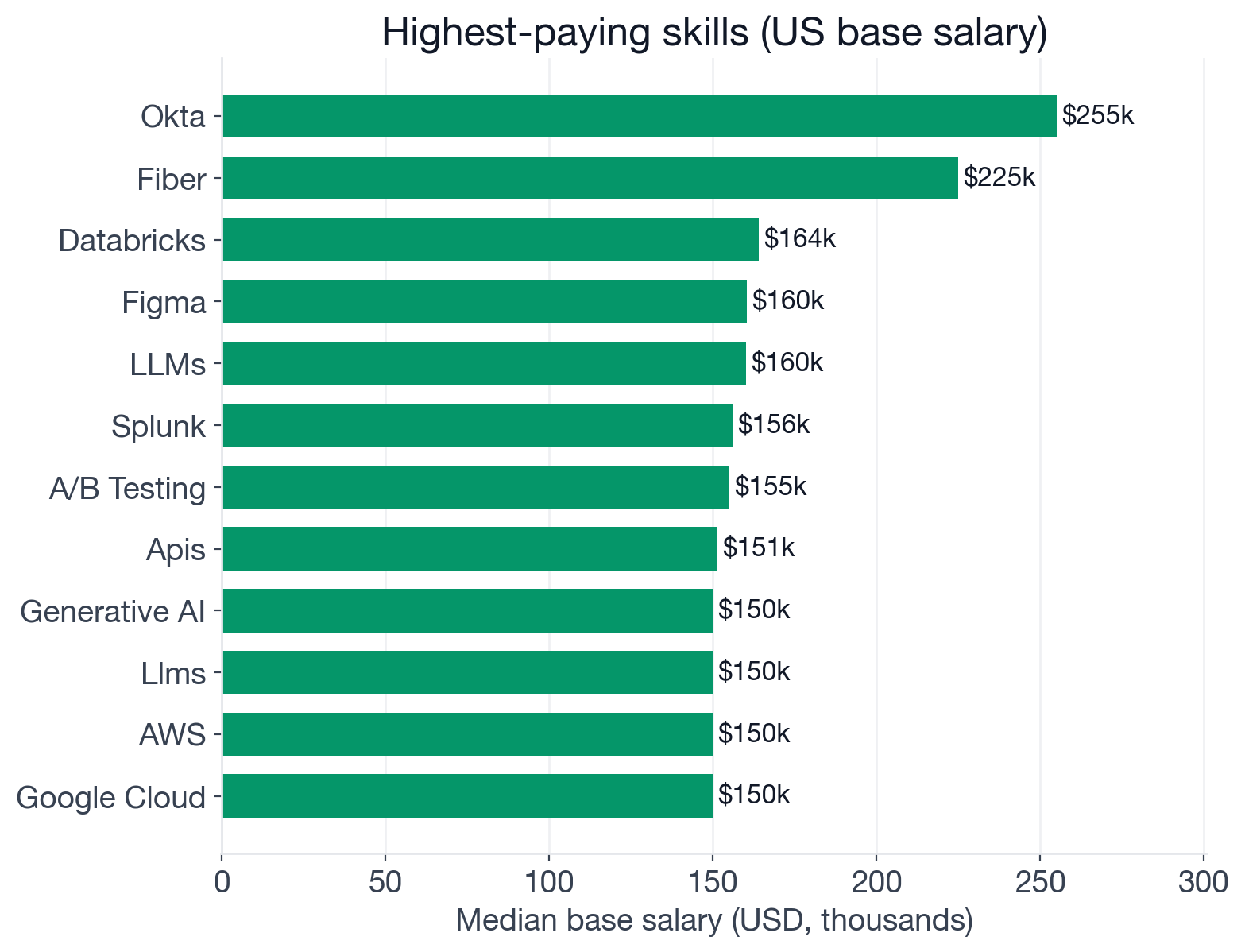
Median US base salary in USD for postings that mention each skill, among US Account Manager postings with structured salary data. All figures are base salary only.
The most important finding in the salary data is which skills pay below the baseline:
- CRM: $95,000 (n=2,844), $5,000 below the $100,000 baseline
- Excel: $82,000 (n=1,515), $18,000 below baseline
CRM fluency is priced as the minimum viable requirement. Excel signals operational work, often in lower-paying market segments. Both are necessary but neither moves the offer upward.
The premium goes to analytical and process skills:
| Skill | Median US Base | Premium over $100K baseline | Sample size |
|---|---|---|---|
| Role baseline | $100,000 | (reference) | n=10,138 |
| Sales Forecasting | $120,000 | +$20,000 | n=30 |
| Business Development | $120,000 | +$20,000 | n=30 |
| Agile | $117,300 | +$17,300 | n=207 |
| Forecasting | $113,000 | +$13,000 | n=2,671 |
| Monitoring | $110,000 | +$10,000 | n=590 |
| Automation | $109,400 | +$9,400 | n=823 |
| SQL | $107,500 | +$7,500 | n=66 |
| Stakeholder Management | $105,000 | +$5,000 | n=131 |
Sales Forecasting and Business Development each have n=30, the minimum threshold for inclusion: treat those medians as directionally correct but not definitive. Forecasting (n=2,671), Automation (n=823), and Agile (n=207) are the most statistically robust entries in the premium tier.
The pattern is the market's signal about what it actually values: account managers who can forecast accurately, automate intelligently, and navigate complex internal processes (Agile signals tech-company environments) command a premium. CRM fluency is the floor. Analytical maturity above that floor is what moves the offer.
What Is the Dominant Account Manager Skill Stack?
Co-occurrence analysis across the top skills shows the combinations that appear together more often than their individual frequencies would predict.
| Skill pair | Postings | % of market | Lift |
|---|---|---|---|
| HubSpot + Salesforce | 740 | 1.6% | 3.30 |
| CRM + HubSpot | 1,203 | 2.5% | 3.02 |
| CRM + GDPR | 775 | 1.6% | 2.95 |
| Automation + Funnel Analysis | 242 | 0.5% | 2.77 |
| CRM + Salesforce | 3,898 | 8.2% | 2.20 |
| Forecasting + Funnel Analysis | 638 | 1.3% | 1.91 |
| Forecasting + Salesforce | 2,676 | 5.6% | 1.77 |
| Automation + Forecasting | 1,047 | 2.2% | 1.75 |
| CRM + Forecasting | 4,133 | 8.7% | 1.54 |
Each pair reveals a distinct type of Account Manager role:
- HubSpot + Salesforce (lift 3.30) is the clearest role-type signal. HubSpot (a CRM and marketing automation platform) and Salesforce appear together 3.3 times more often than chance. This is the "multi-platform environment" pattern, common in mid-market SaaS companies that run HubSpot for marketing and Salesforce for sales, or in companies mid-migration between platforms.
- CRM + HubSpot (3.02) captures the most HubSpot-native context: a posting that mentions generic CRM experience and then specifically names HubSpot is likely at a company where HubSpot is the primary system of record.
- CRM + GDPR (2.95) is a European-flavored cluster. Postings that pair CRM with GDPR compliance appear at nearly 3x expected frequency, signaling roles where managing customer data correctly under privacy regulation is a named accountability, not just assumed good practice.
- Automation + Funnel Analysis (2.77) points to the analytically sophisticated end of Account Management: companies that want someone who can build automated workflows and also diagnose conversion performance through the funnel. This is closer to a Revenue Operations mindset than a traditional relationship-management one.
- CRM + Salesforce (2.20) is the dominant pair by volume: 3,898 postings, 8.2% of the market. Postings that name CRM experience are 2.2x more likely to also name Salesforce specifically.
- Forecasting + Salesforce (1.77) is the Salesforce forecasting use case: roles that pair these two are asking for account managers who build and maintain pipeline forecasts inside Salesforce, not just use it as a contact database.
- Automation + Forecasting (1.75) pairs the two most clearly premium-paying analytical skills. Roles that ask for both are likely at growth-stage tech companies with defined sales processes and a data-forward approach to pipeline management.
- CRM + Forecasting (1.54) is the highest-volume pair in the dataset (4,133 postings, 8.7% of the market). It captures the foundational expectation that account managers own pipeline visibility: not just using the CRM as a contact log but deriving accurate forecasts from it.
Who's Hiring at Which Seniority Level?
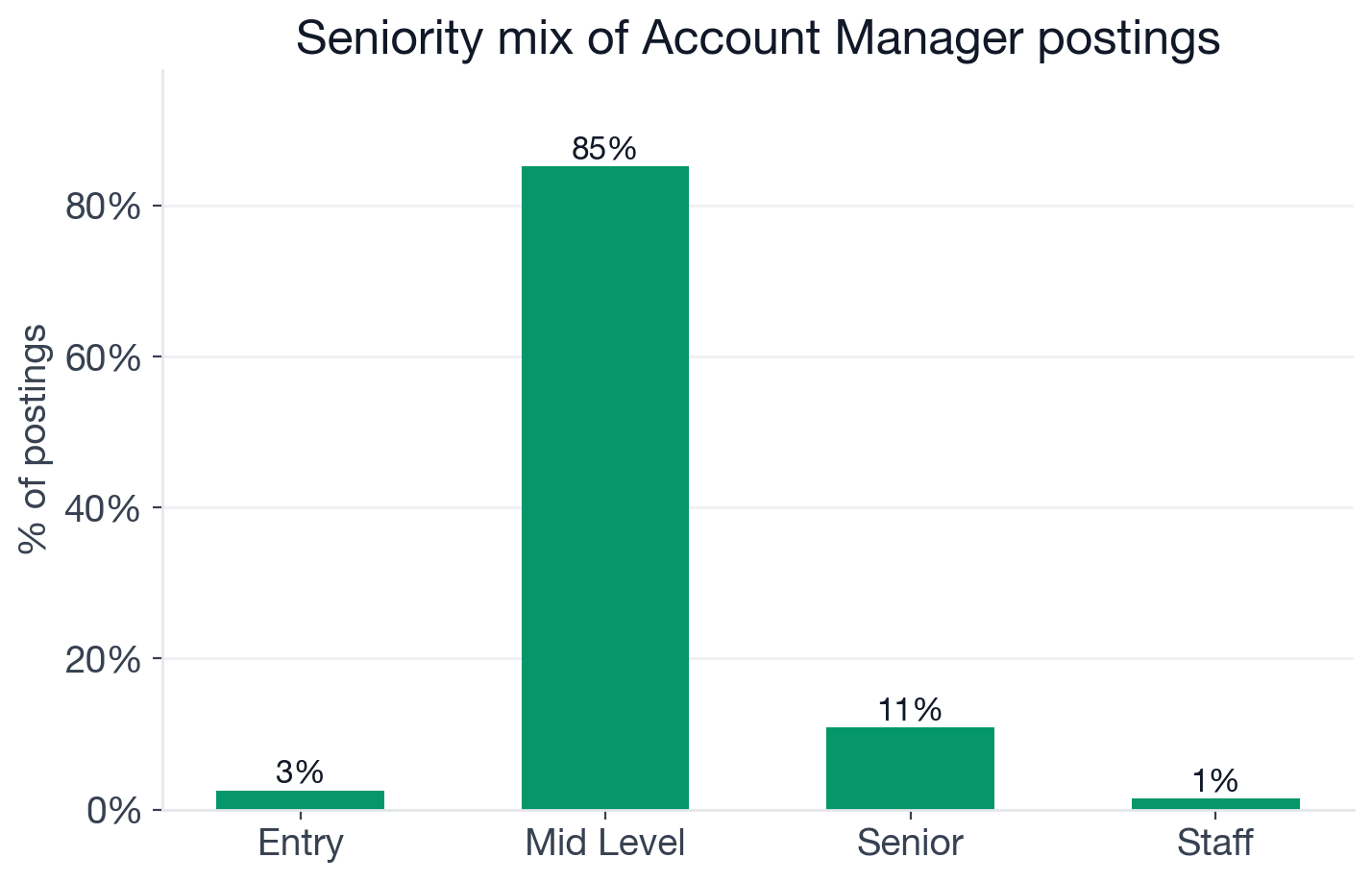
Seniority distribution of Account Manager postings. Postings with no explicit seniority signal (no "Senior," "Junior," or equivalent title keyword) default to mid-level.
The seniority distribution is among the most concentrated in our 2026 series:
- Mid-level: 85.2% (40,417 postings)
- Senior: 10.9% (5,152) (senior Account Manager openings)
- Entry: 2.5% (1,199)
- Staff: 1.4% (682)
85.2% mid-level is extraordinarily concentrated compared to other roles in this series: Data Engineer sits at 52.1% and Data Analyst at 62.8%. One methodological note: postings without an explicit seniority signal in the job title (no "Senior," "Junior," "Entry Level," or equivalent keyword) default to mid-level. Many Account Manager postings that would qualify as early-career carry a plain "Account Manager" title with no qualifier, so the true entry-level share is likely somewhat higher than the 2.5% explicit figure. Even accounting for that, the signal is clear: Account Manager postings are overwhelmingly targeted at candidates who can manage a pipeline, run forecasts, and close against a quota from day one. Companies posting explicitly entry-level titles are genuinely rare.
Only 1 in 40 postings is explicitly entry-level, meaning the on-ramp into Account Management runs through adjacent roles rather than entry-level AM titles. The standard path: SDR (Sales Development Representative) or BDR (Business Development Representative) roles first, where you build pipeline generation experience over 12 to 24 months, then step into a full AM seat. That timeline is typically shorter than the path into Data Engineering, which often requires years of production engineering experience.
Staff-level Account Manager postings (1.4%) are also thin, and for a structural reason: the career escalator for this role typically runs toward Director of Sales, Regional VP, or VP of Customer Success tracks rather than individual-contributor staff roles. The IC ceiling is lower here than in engineering.
Where Are Account Manager Jobs Located, and How Remote-Friendly Are They?
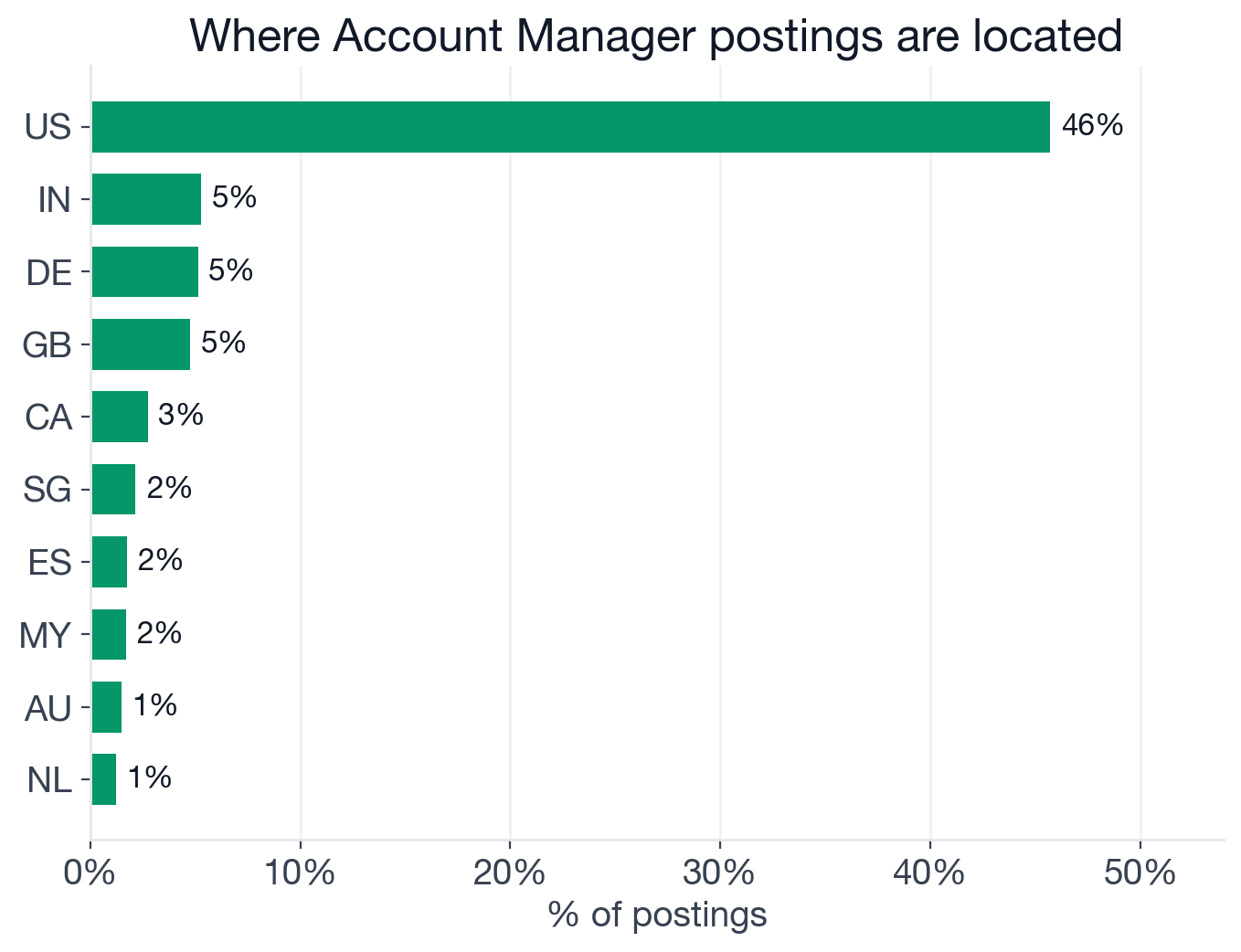
Top countries by share of Account Manager postings.
The US accounts for 45.7% of active Account Manager postings (21,684 of 47,450). Among roles in our 2026 series, that is one of the highest US concentrations: Data Engineer is at 29.2% and Data Analyst at 38.9%, both well below Account Manager's share. The explanation: Account Manager is a role where local market knowledge, language, and face-to-face client relationships matter. Companies don't globally distribute customer-facing roles the way they do pipeline-building or data-processing work.
The global distribution outside the US:
- India: 5.3% (2,510)
- Germany: 5.1% (2,434)
- UK: 4.8% (2,263)
- Canada: 2.8% (1,308)
- Singapore: 2.2% (1,030)
- Spain: 1.7% (829)
- Malaysia: 1.7% (809)
- Australia: 1.5% (708)
- Netherlands: 1.2% (588)
Germany and the UK together at roughly 10% reflects the scale of Europe's B2B technology and financial services markets. Both countries have active Account Manager hiring in enterprise software, healthcare, and insurance, three of the industries with the most postings in this dataset.
The work-mode picture matches the role's relationship-driven nature:
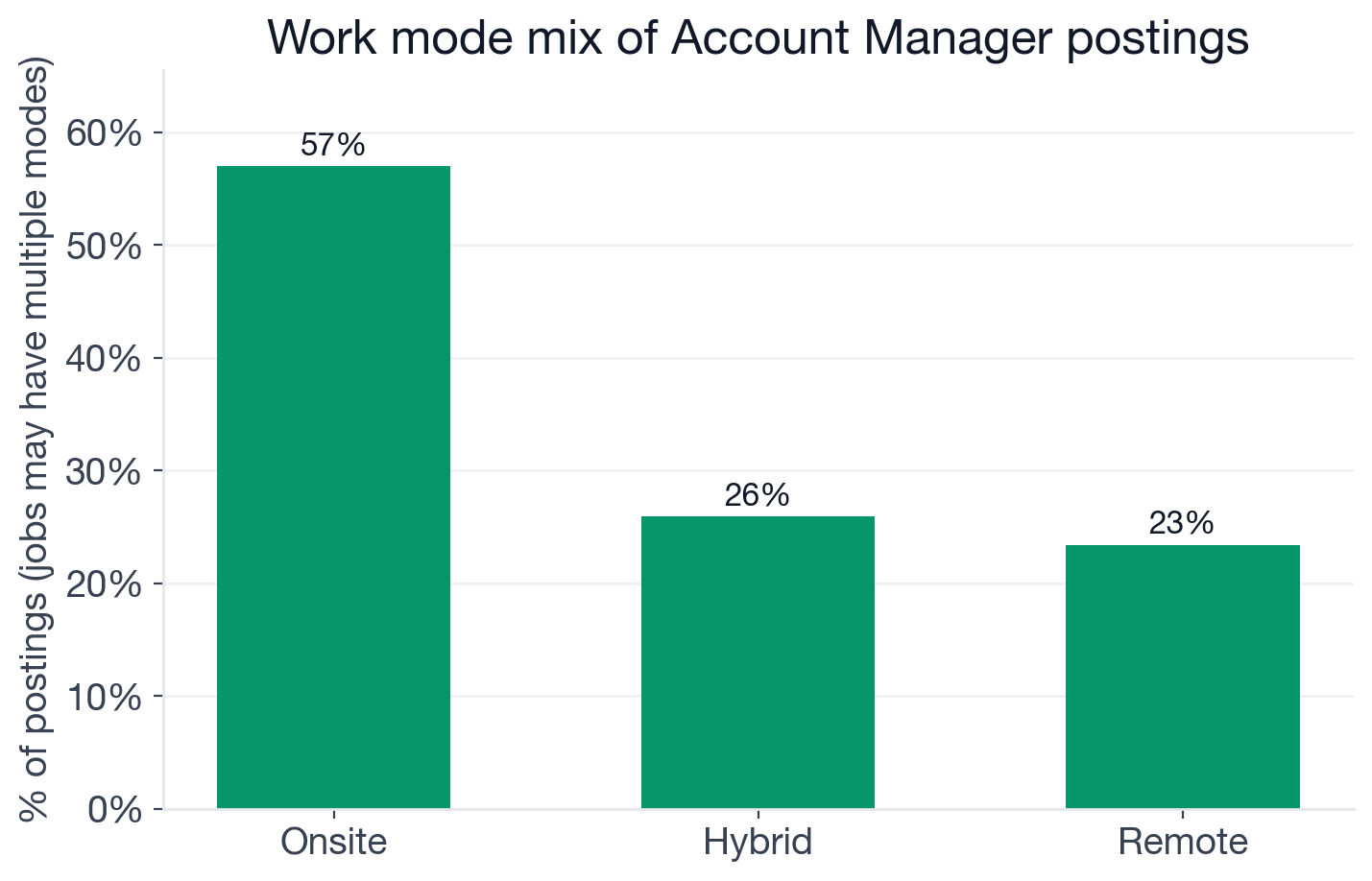
Work mode distribution for Account Manager postings. Some postings carry multiple tags (e.g., "Hybrid or Remote"), so shares can sum above 100%.
- Onsite: 57.0% (27,045 postings)
- Hybrid: 25.9% (12,285)
- Remote: 23.4% (11,105) (fully-remote Account Manager openings)
57% onsite is among the highest onsite rates in our 2026 series. Even in a market that has normalized remote work for technical roles, companies hiring account managers want them in proximity to customers, in client offices, or at company headquarters. Remote Account Manager roles do exist, and they concentrate in SaaS companies with distributed customer bases and inside-sales motions, but they are the exception, not the norm.
Candidates targeting US-based remote roles have a more favorable market than the global averages suggest: remote-forward tech employers disproportionately post US-only listings. The Account Manager job board filter for US roles lets you filter to that specific segment directly.
Who's Hiring Account Managers in 2026?
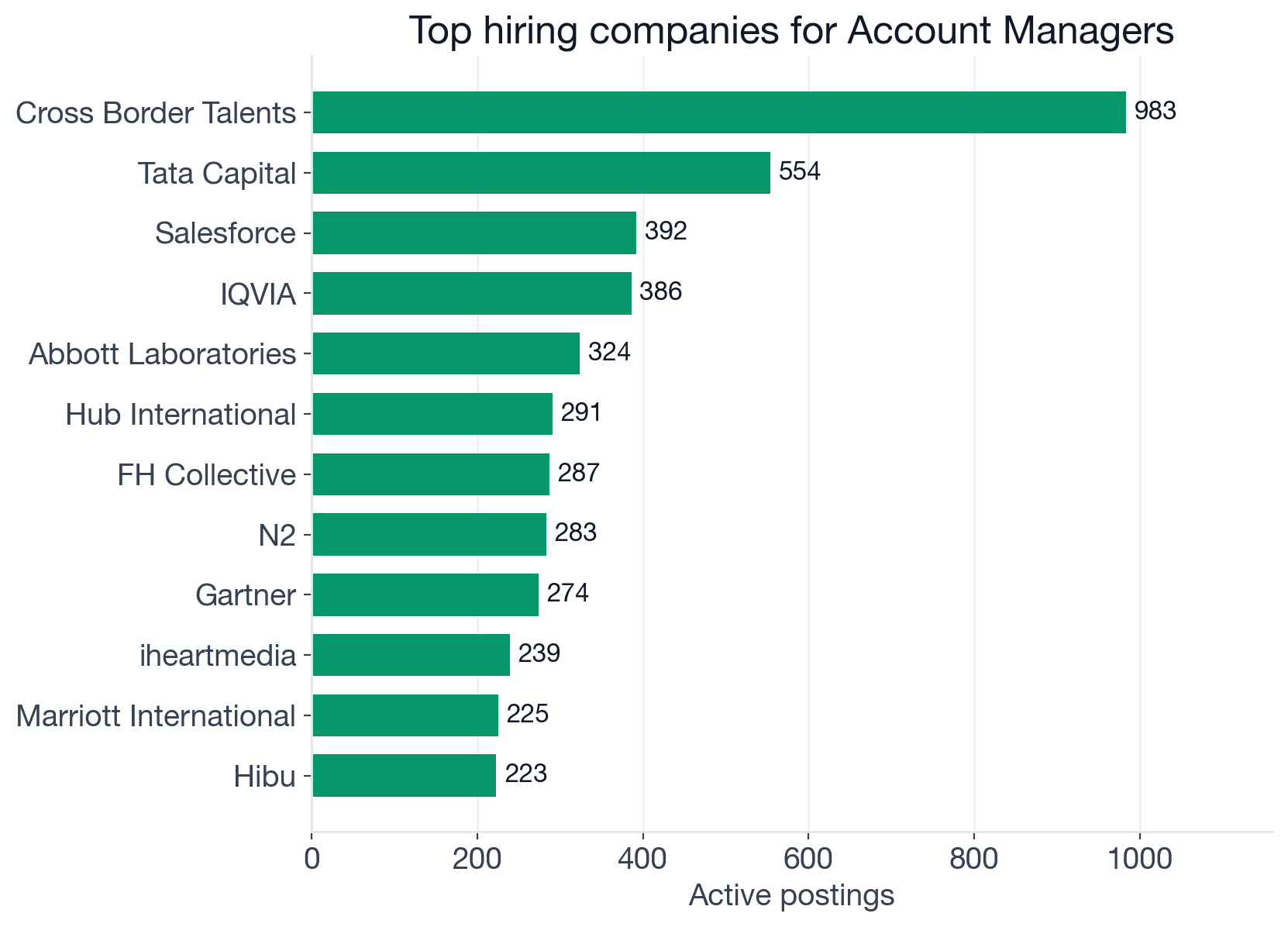
Top companies by active Account Manager postings on the InterviewStack.io job board as of May 2026.
The top employers span a wider range of industries than any technical role in this series:
- Cross Border Talents: 983 postings (staffing and recruitment)
- Tata Capital: 554 (financial services)
- Salesforce: 392 (enterprise CRM/SaaS)
- IQVIA: 386 (healthcare analytics)
- Abbott Laboratories: 324 (medical devices and healthcare)
- Hub International: 291 (insurance brokerage)
- FH Collective: 287 (media and marketing)
- N2: 283 (local media)
- Gartner: 274 (research and advisory)
- iHeartMedia: 239 (media and broadcasting)
- Marriott International: 225 (hospitality)
- Hibu: 223 (digital marketing for local businesses)
The breadth of this list reflects the breadth of the role. Account Management is the function that every company with complex sales or client relationships needs, regardless of industry. Healthcare (Abbott, IQVIA), financial services (Tata Capital, Hub International), media (iHeartMedia, N2, FH Collective), enterprise tech (Salesforce, Gartner), and hospitality (Marriott) all rank near the top.
Three staffing and recruitment firms rank in the top 20: Cross Border Talents (983), Intalentasia (219), and Cbtalents (203). Staffing firms both hire account managers for their own operations and place account managers at client companies, which amplifies their posting volume. Their presence in the rankings is expected for a high-volume role like Account Manager, but it also means some skill signals in the dataset reflect generic requirements across multiple client industries rather than any single company's specific stack.
For company-specific interview processes and what to expect in sales-focused rounds, our interview preparation guides cover how leading employers structure their hiring.
How to Use This in Your Job Search
If you're targeting Account Manager roles in 2026, the data points to a clear strategy built around two layers.
Layer one: CRM fluency plus Forecasting. CRM gets you past the initial filter for postings that require it, but it's priced as table stakes. The skill that consistently pairs with higher-paying roles is Forecasting: postings that ask for it show a $13,000 premium over the role baseline ($113,000 vs $100,000). Being able to articulate how you build a pipeline forecast, how you track accuracy against actuals, and how you communicate forecast changes to leadership puts you in the premium tier of candidates. The question bank includes behavioral and situational questions specifically around sales process and pipeline management.
Layer two: Salesforce fluency. Salesforce appears in 14.5% of postings explicitly and co-occurs with generic CRM requirements at a lift of 2.20. When a company posts "CRM experience required," Salesforce is the most likely underlying platform. At minimum, you should be able to speak to how Salesforce structures opportunity stages, pipeline views, and forecasting reports. Browse Account Manager plus Salesforce openings to calibrate which companies are explicitly requiring it.
The entry-level path. With only 2.5% of postings explicitly entry-level, the standard route runs through SDR or BDR roles first. Target companies with structured sales development programs where you'll carry a pipeline generation quota and build forecasting habits. That's the experience that unlocks the mid-level AM seat. Practice with AI mock interviews to prepare for the behavioral rounds and pipeline-management questions that come up in AM interviews at growth-stage companies.
Pick the right industry for your goals. Healthcare and financial services (Abbott, IQVIA, Hub International) offer stable demand, often with onsite or hybrid roles and enterprise sales cycles. SaaS and advisory companies (Salesforce, Gartner) tend toward faster cycles, better remote options, and more explicit skill requirements around CRM and forecasting. The pay structures and culture differ significantly; the underlying AM skills transfer. Our interview-prep courses cover negotiation frameworks, presentation skills, and stakeholder management competencies that apply across industries. Browse current Account Manager openings and layer work-mode and location filters to find the specific segment that fits your goals.
FAQ
Q. What skills do companies want for Account Manager roles in 2026?
No skill crosses the 50% table-stakes threshold, making Account Manager one of the most skill-flexible roles in hiring. CRM appears in 25.8% of postings (12,221 of 47,450 analyzed) and Forecasting in 22.0% (10,434), forming the common tier. Salesforce (14.5%), Excel (13.1%), Automation (5.7%), and Monitoring (5.7%) form the differentiator tier. Analytical skills like Forecasting and Automation pay meaningfully above the role baseline salary.
Q. What is the median Account Manager salary in 2026?
The median US base salary across 10,138 Account Manager postings with US salary disclosed is $100,000. That figure excludes equity, bonuses, and sign-on, so total compensation at top employers is higher. Postings that require Sales Forecasting or Business Development show medians of $120,000, a $20,000 premium over the role baseline.
Q. Which skills pay the highest premium for Account Managers in 2026?
Among US postings, the largest premiums attach to analytical and process skills rather than the most common tools. Sales Forecasting ($120,000, n=30) and Business Development ($120,000, n=30) each add about $20,000 to the $100,000 baseline. Agile adds $17,300 ($117,300, n=207), Forecasting adds $13,000 ($113,000, n=2,671), Monitoring adds $10,000 ($110,000, n=590), and Automation adds $9,400 ($109,400, n=823). CRM itself ($95,000, n=2,844) and Excel ($82,000, n=1,515) pay below the role baseline.
Q. How hard is it to break into Account Management at the entry level?
Entry-level Account Manager postings are scarce. Only 2.5% of the 47,450 postings analyzed are explicitly entry-level (1,199 postings), and 85.2% are tagged mid-level. Companies almost universally expect candidates who can manage a pipeline, run forecasts, and close deals independently, making prior experience in SDR, BDR, or inside-sales roles more important than credentials alone.
Q. Where are most Account Manager jobs located, and how remote-friendly are they?
The United States is the dominant market at 45.7% of postings (21,684 of 47,450), far ahead of India (5.3%), Germany (5.1%), and the UK (4.8%). The role skews strongly onsite: 57.0% of postings are onsite, 25.9% are hybrid, and 23.4% are remote. Remote Account Manager roles exist but are less common than for most technical roles, reflecting the relationship-driven nature of the work.
Q. What is the dominant Account Manager skill stack in 2026?
The strongest combination by lift is HubSpot plus Salesforce (lift 3.30, 740 postings): when a posting asks for HubSpot, it is 3.3 times more likely than chance to also ask for Salesforce. CRM plus Salesforce is the core pair by volume (3,898 postings, 8.2% of the market, lift 2.20). CRM plus Forecasting is the most common pair overall (4,133 postings, 8.7%, lift 1.54), capturing the foundational expectation that account managers own pipeline visibility.
Q. Which companies hire the most Account Managers in 2026?
Cross Border Talents leads active Account Manager postings (983), followed by Tata Capital (554), Salesforce (392), IQVIA (386), Abbott Laboratories (324), Hub International (291), FH Collective (287), N2 (283), Gartner (274), iHeartMedia (239), Marriott International (225), and Hibu (223). The list spans staffing firms, enterprise tech, healthcare, media, and financial services.
Final Thoughts
Account Manager hiring in 2026 is honest about what it values: the ability to forecast accurately, automate intelligently, and own a number with discipline. The most commonly required skills (CRM, Excel) are priced as commodity; the analytical layer on top is where the premium lives. With 85.2% of postings targeting mid-level candidates and only 2.5% explicitly entry-level, the role is a mid-career position by design, built for people who have already carried a quota somewhere. The path in runs through SDR or BDR experience, not credentials. The path up runs through demonstrating that you can do more with your pipeline data than just log it.
We'll refresh this analysis quarterly so the numbers stay current.
Topics
Ready to practice?
Put what you've learned into practice with AI mock interviews and structured preparation guides.