
You have 40,000 support messages, 18 routing intents and a model idea ready before the interviewer finishes reading the prompt. That readiness is the trap. In a mid-level AI Engineer NLP interview, "fine-tune an encoder and report accuracy" sounds complete and quietly loses the points that matter: the ones for knowing which mistakes the business cannot afford.
This is a simulated mock interview built on one AI interview blueprint, with illustrative mistakes and coaching. It is not a transcript of a real person or of any company's actual questions.
Key Findings
- The interview is scored out of 100 points across 4 dimensions, and Technical Proficiency is only 20 of them.
- Interviewer Objectives Alignment and Level-Specific Expectations carry 30 points each, 60 of 100 combined.
- The 30 minutes split into 3 phases: problem framing (minutes 0 to 7), model and data design (7 to 19) and evaluation and iteration (19 to 30).
- Model and data design gets the longest slot, 12 minutes, and the longest checklist, 6 of the blueprint's 15 items.
- Only 6k of 40k messages (15%) carry reliable intent labels, and just 1.5k have token-level entity annotations.
- About 30% of traffic is non-English or mixed-language, and one prepared follow-up assumes the labeled data is mostly English.
- The interviewer has 6 prepared follow-ups; this walkthrough dramatizes 4 of them.
The Scenario Punishes a Single Accuracy Number
Read the constraints before the ask. Every line is a hint about where a generic answer breaks.
The interview question
You are supporting a customer-support assistant for a large consumer product with users in multiple countries. Incoming support messages are short to medium-length, often noisy, and may include code-switching, typos, emojis, abbreviations, screenshots transcribed by OCR, and account-specific identifiers. The product team wants to automatically route each message to the right support workflow and extract key details such as product surface, issue type, plan tier, and relevant entities from the message text.
Current constraints:
- You have about 40k historical support messages.
- Only 6k have reliable intent labels from prior agent actions.
- Only 1.5k have token-level entity annotations.
- There are 18 routing intents, with strong class imbalance.
- About 30% of traffic is non-English or mixed-language.
- Some messages are long because users paste logs or long email threads.
- The team cares about both overall automation rate and avoiding high-cost misroutes.
- This system will be used to assist human agents first, not fully automate all cases.
Design an NLP approach for this support-routing system using the context above, and walk me through how you would build, evaluate, and improve it for production use by support agents.
What Is This AI Engineer NLP Interview Really Probing?
The interviewer wants an end-to-end design a mid-level engineer could own: framing, text representation, an intent model and an entity model, then evaluation, annotation and error analysis under real constraints. The first 7 minutes decide a lot. The framing checklist expects you to say out loud that this is two tasks (intent routing plus entity extraction), that noisy multilingual text is a first-class problem, that a misroute costs more than a handoff to a human, and that success means more than accuracy.
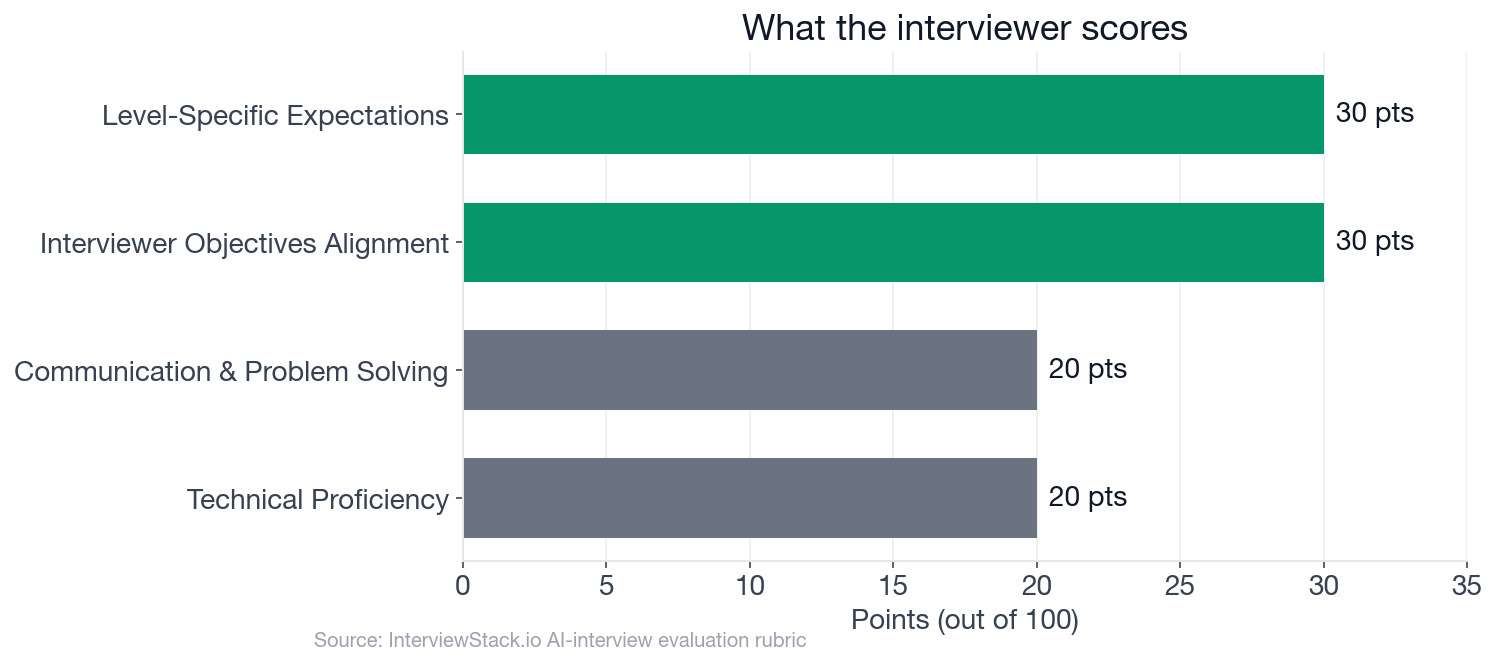
The four rubric dimensions by point weight, out of 100.
The rubric explains why model knowledge alone does not pass. Sixty points ride on meeting the stated objectives and on the mid-level bar: structuring the problem without heavy guidance and connecting modeling choices to annotation and error analysis.
Four Follow-Ups Where Tomas Loses Points
Tomas is our illustrative candidate: solid on encoders and fine-tuning, and weaker on the product side of the question. Each turn below shows a typical answer, what it costs, and a stronger move.
Turn 1: Labels mostly in English
Interviewer: "How would you handle multilingual and code-switched messages when your labeled data is mostly English?"
Turn 2: The long tail fails
Interviewer: "If the long tail of rare intents performs poorly, what would you change in data strategy or modeling before asking for a large new annotation effort?"
Turn 3: Price the misroute
Interviewer: "What evaluation setup and metrics would you use if the business is much more sensitive to misrouting high-value enterprise tickets than to sending extra tickets to humans?"
Turn 4: Spend 500 labels well
Interviewer: "If you could only label 500 additional examples next quarter, how would you choose them and what would you annotate?"
Why Can't You Just Memorize the Fixes?
You now know where Tomas went wrong, and on the page every fix looks obvious. In the room it is different. The interviewer will not ask these four in this order, they will push on whatever you said last, and the clock keeps moving while you decide whether to talk about thresholds or tokenizers. Under that pressure it is easy to fall back on the first thing you would build, which is a model, not a cost matrix. The only reliable fix is reps against follow-ups you did not script.
What Does a Strong 30-Minute Answer Cover?
This is the blueprint a strong candidate hits, and it is exactly what the AI mock interview tracks you against in real time. Notice how much of it is about data, slices and fallbacks rather than architecture.
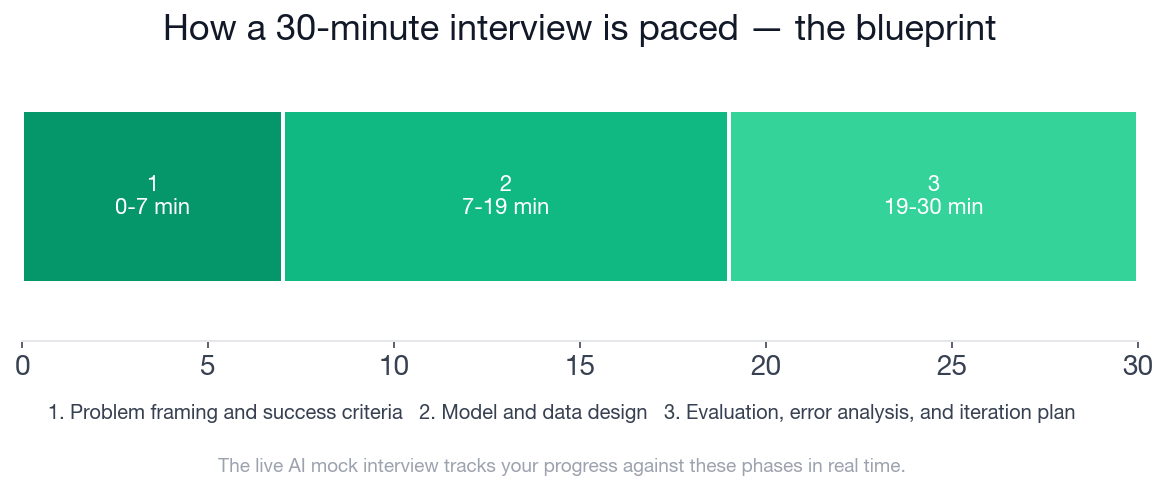
The three phases of the 30-minute interview, by minute.
- ✓States that this is at least a multi-task or two-stage NLP problem: routing/intent classification plus entity extraction
- ✓Recognizes noisy multilingual user-generated text as a first-class challenge, not an afterthought
- ✓Asks or explicitly reasons about error costs, especially misroutes versus deferring to humans
- ✓Proposes success criteria beyond accuracy, such as precision/recall by critical intents, fallback/abstention behavior, and extraction quality
- ✓Proposes robust preprocessing for Unicode, typos, OCR artifacts, identifiers, and long pasted content without over-normalizing away signal
- ✓Chooses sensible tokenization and representation approaches for multilingual noisy text, such as subword tokenization and pretrained multilingual/contextual encoders
- ✓Outlines a viable intent model and a viable entity extraction model, such as encoder-based classifier and BIO tagging sequence labeler, optionally with CRF or constrained decoding reasoning
- ✓Addresses class imbalance with observable tactics like weighted loss, resampling, thresholding, hierarchical labels, or intent grouping
- ✓Suggests a credible strategy for limited annotations, such as active learning, distant supervision from support metadata, pseudo-labeling with care, or prioritizing annotation for high-impact intents/entities
- ✓Provides some plan for long messages, such as truncation policy, chunking, field-aware splitting, or using subject/header versus body differently
- ✓Defines task-appropriate metrics: e.g., macro/micro F1 or per-class recall for intents, span/entity-level F1 for extraction, and business-weighted routing metrics
- ✓Describes segmentation of evaluation slices such as language, message length, OCR presence, rare intents, and enterprise/high-value users
- ✓Mentions confidence thresholds, abstention, or routing-to-human fallback to reduce costly automation errors
- ✓Proposes a concrete error analysis loop tied to taxonomy updates, annotation fixes, and data collection rather than only changing models
- ✓Gives an incremental launch plan appropriate for agent assist, such as top-N suggestions, extracted slot display, and monitoring disagreement with human agents
Take the Support-Routing Scenario Into a Live Session
Reading the blueprint is the warm-up. Start the AI mock interview for a mid-level AI Engineer on natural language processing and answer this scenario out loud against the clock. The AI interviewer asks its own follow-ups, watches which checklist items you hit, and scores you on the same 100-point rubric.
Want to warm up on single concepts first? Work through the NLP question bank for AI Engineers for tokenization, sequence labeling and evaluation questions, or browse the preparation guides for the wider topic map. When you are ready to apply, the AI Engineer job board lists current openings.
FAQ
Q. What does an AI Engineer NLP interview test?
It tests whether you can design a practical NLP system for a real product, not whether you can recite model names. In this 30-minute blueprint you frame the problem, pick representations and models for noisy multilingual text, then plan evaluation, annotation and error analysis. Technical Proficiency is 20 of 100 points; Interviewer Objectives Alignment and Level-Specific Expectations are worth 30 each.
Q. Should intent classification and entity extraction be one model or two?
Either can be defended; the trade-off is what gets scored. Two models (an encoder-based intent classifier and a BIO sequence labeler) are simpler to debug and let each task improve on its own labels, which matters when only 1.5k messages have entity annotations. A joint setup with a shared encoder can help both tasks, but couples their failures. Say which you would launch first and why.
Q. Which metrics should you use when misroutes are expensive?
Not overall accuracy. Use per-class precision and recall (or macro F1) for intents, span-level F1 for entities, and a business-weighted routing metric where a high-value misroute costs more than a handoff to a human. Report every metric by slice: language, message length, OCR presence, rare intents and plan tier.
Q. How do you handle long messages with pasted logs or OCR text?
Set an explicit policy instead of letting the tokenizer truncate silently. Options in the blueprint include chunking, a truncation policy (for example, one that keeps the user's own words first), and field-aware splitting that treats the subject or header differently from a pasted log. Then check the long-message slice in your evaluation to confirm it helped.
Q. How do you build an NLP model with only a few thousand labels?
Start from a pretrained encoder so the labels teach the task, not the language. Then add weak labels from support metadata, use active learning to send uncertain and rare cases to annotators, and handle imbalance with weighted loss, thresholds or intent grouping. In this scenario only 6k of 40k messages carry reliable intent labels.
Q. How do I practice this kind of interview?
Run it live. The AI mock interview for this role, level and topic asks unscripted follow-ups and tracks you against the same three-phase blueprint in real time. The question bank is a good warm-up for single NLP questions on tokenization, sequence labeling and evaluation.
Start With the Misroute You Cannot Afford
A strong answer here opens with error costs and a human fallback, then let the model follow from them. Practice saying that first, under time pressure, until it is the reflex and not the afterthought.
Topics
Ready to practice?
Put what you've learned into practice with AI mock interviews and structured preparation guides.