
The Short Answer
Machine Learning Engineer pays more and hires more; AI Engineer is the wider entry door and the faster-growing title. Among US postings, the median ML Engineer base salary is $165,000 versus $145,000 for AI Engineer (a $20,000, 13.8% gap), and ML Engineer postings outnumber AI Engineer roles 4,781 to 4,091 on the InterviewStack.io job board in May 2026. The two skill sets share about 67% of their top-30 skills, so the real question is which third of the stack you specialize in: LLM-application engineering or production model engineering.
| AI Engineer | Machine Learning Engineer | |
|---|---|---|
| Median US base salary | $145,000 (n=680) | $165,000 (n=1,087) |
| Active postings | 4,091 | 4,781 |
| Top skill | Python (68%) | Machine Learning (71%) |
| Entry-level share | 5.8% | 4.8% |
| Remote share | 24% | 28% |
| Skill overlap (Jaccard) | 67% | 67% |
Key Findings
- Median US base salary is $165,000 for ML Engineer (n=1,087) versus $145,000 for AI Engineer (n=680), a $20,000 (13.8%) gap.
- ML Engineer has 4,781 active postings versus 4,091 for AI Engineer; about 1.17 ML Engineer roles for every AI Engineer role.
- The two roles share 67% of their top-30 skill sets, one of the highest overlaps between any two AI/ML titles we have compared.
- Neither role is entry-friendly: 5.8% of AI Engineer postings are entry-level (236 of 4,091) versus 4.8% for ML Engineer (230 of 4,781).
- JAX ($204,000, n=87) and C++ ($186,000, n=119) carry the largest ML Engineer premiums; Distributed Systems ($183,200, n=40) leads for AI Engineer.
- ML Engineer is more US-anchored (44% of postings versus 34%) and slightly more remote-friendly (28% versus 24%).
What Does Each Role Actually Do?
AI Engineer is an LLM application role. The work is wiring foundation models into shippable software: building retrieval pipelines on top of vector databases, calling LLM APIs from an application server, designing prompt and tool-use logic, and operating the resulting inference service. The exclusive-skill list (LangChain at 25%, OpenAI at 20%, Vector Databases at 18%, Embeddings at 13%, TypeScript at 12%) reads like a backend or full-stack engineer's resume with the LLM-application layer added on top. The output is usually a working feature in a product.
Machine Learning Engineer is a production model role. The week typically includes training, fine-tuning, and evaluating models, packaging them for deployment, and operating them at scale. The exclusive list (scikit-learn at 14%, Computer Vision at 13%, Apache Spark at 12%, Statistics at 11%, MLflow at 11%, Java at 10%) signals a broader model surface area that includes classical ML and computer vision, not only LLMs, with model-lifecycle tooling like MLflow tracking experiments end to end. Think of ML Engineer as the reliability engineer for models; AI Engineer as the product engineer for LLM features.
What Skills Do Both Roles Require?
Python anchors both stacks (68% for AI Engineer, 65% for ML Engineer), and Machine Learning itself shows up in 38% of AI Engineer postings versus 71% of ML Engineer ones. AWS sits at 34-36% in both, and the rest of the shared cluster (Monitoring, CI/CD, Generative AI, RAG, Azure, Google Cloud, APIs, Data Pipelines) keeps roughly two-thirds of the toolkit transferable in either direction.
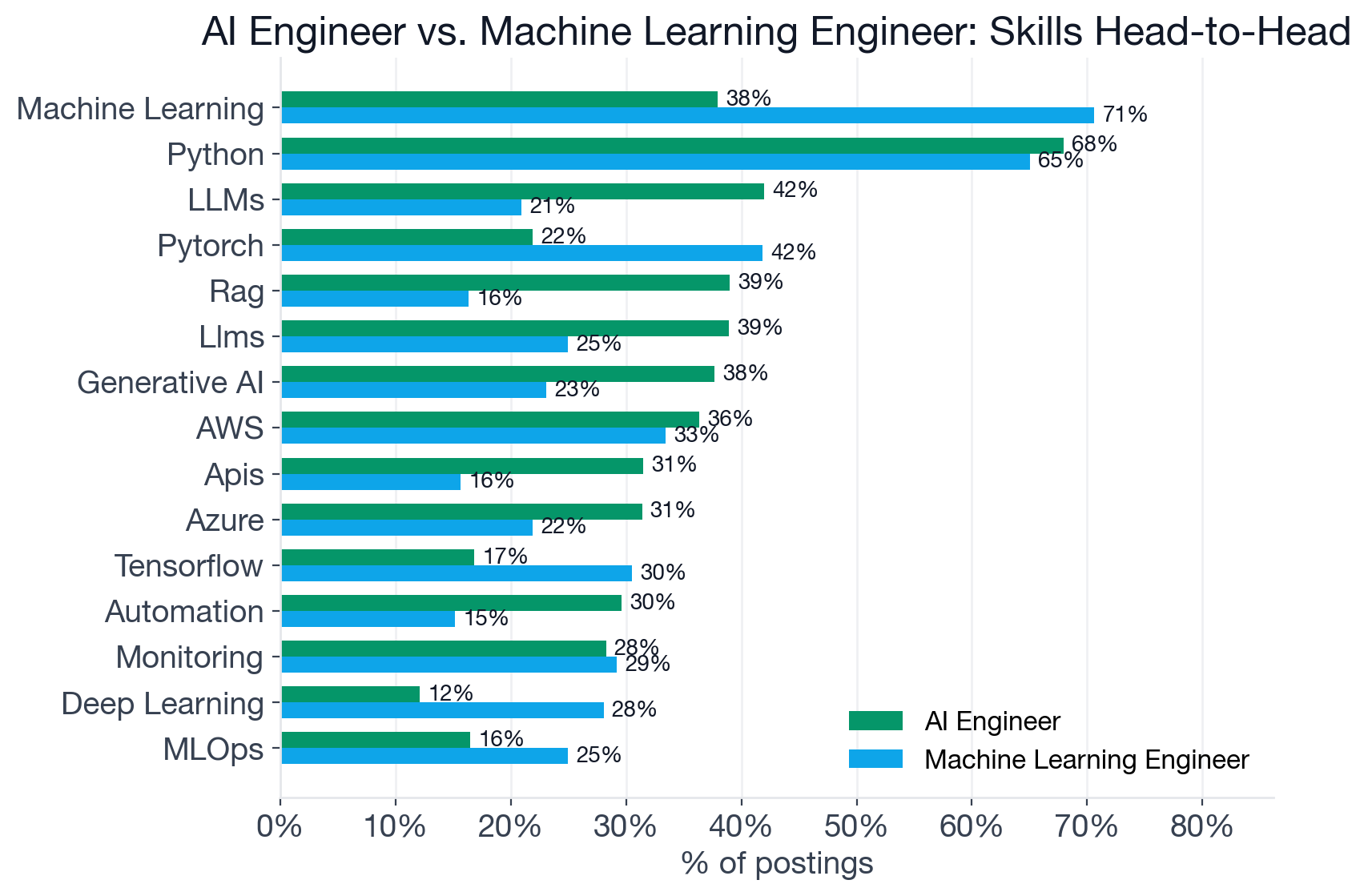
Share of postings that ask for each skill, comparing AI Engineer (n=4,091) to Machine Learning Engineer (n=4,781). Skills shown are drawn from the union of each role's top set.
Several shared skills have asymmetric weight. PyTorch appears in 42% of ML Engineer postings but only 22% of AI Engineer postings, a clean signal that custom-model training is daily work for one role and occasional for the other; TensorFlow flips the same way (31% versus 17%). The signal inverts on the LLM side: RAG shows up in 39% of AI Engineer postings versus 16% of ML Engineer, and standalone LLM mentions roughly double in AI Engineer. Someone fluent in Python plus ML plus one cloud already has more than half the toolkit for either role.
Where Do the Roles Diverge?
Exclusive to AI Engineer
The AI Engineer side of the fork is dominated by LLM-application tooling and product-engineering surface area.
- LangChain: 25%
- OpenAI: 20%
- Vector Databases: 18%
- Embeddings: 13%
- TypeScript: 12%
- Agile: 12%
This cluster describes a job that lives in application servers, retrieval-augmented-generation pipelines, and inference endpoints. A posting that asks for LangChain plus vector databases is almost always describing a RAG system in production: the engineer builds the pipeline, deploys it, and keeps it running. The TypeScript signal is worth flagging too; it shows that a meaningful share of AI Engineer roles bleed into the application layer rather than staying on the backend. For the full per-role breakdown, see the AI Engineer skills deep dive.
Exclusive to Machine Learning Engineer
The ML Engineer side is dominated by classical ML, deep-learning specializations, and model-lifecycle tooling.
- scikit-learn: 14%
- Computer Vision: 13%
- Apache Spark: 12%
- Statistics: 11%
- MLflow: 11%
- Java: 10%
Statistics and scikit-learn signal that classical modeling is still core work, not a legacy concern. Computer Vision (13%) tells you a meaningful slice of ML Engineer postings come from autonomy, robotics, and visual-recognition teams (Waymo, Motional, NVIDIA, and General Motors all sit in the top hiring list). MLflow and Apache Spark together describe the production model lifecycle: experiments tracked and reproducible, training jobs scaled across a cluster, models packaged with their training context attached.
Which Pays More?
Among US postings, ML Engineer leads at a $165,000 median base salary (n=1,087) versus $145,000 for AI Engineer (n=680), a $20,000 (13.8%) gap. Salary numbers below are US-only base salary. Equity, RSUs, bonus, and sign-on are not disclosed in postings and are not in this dataset, so total compensation at top employers runs meaningfully higher than these figures, especially in tech and finance.
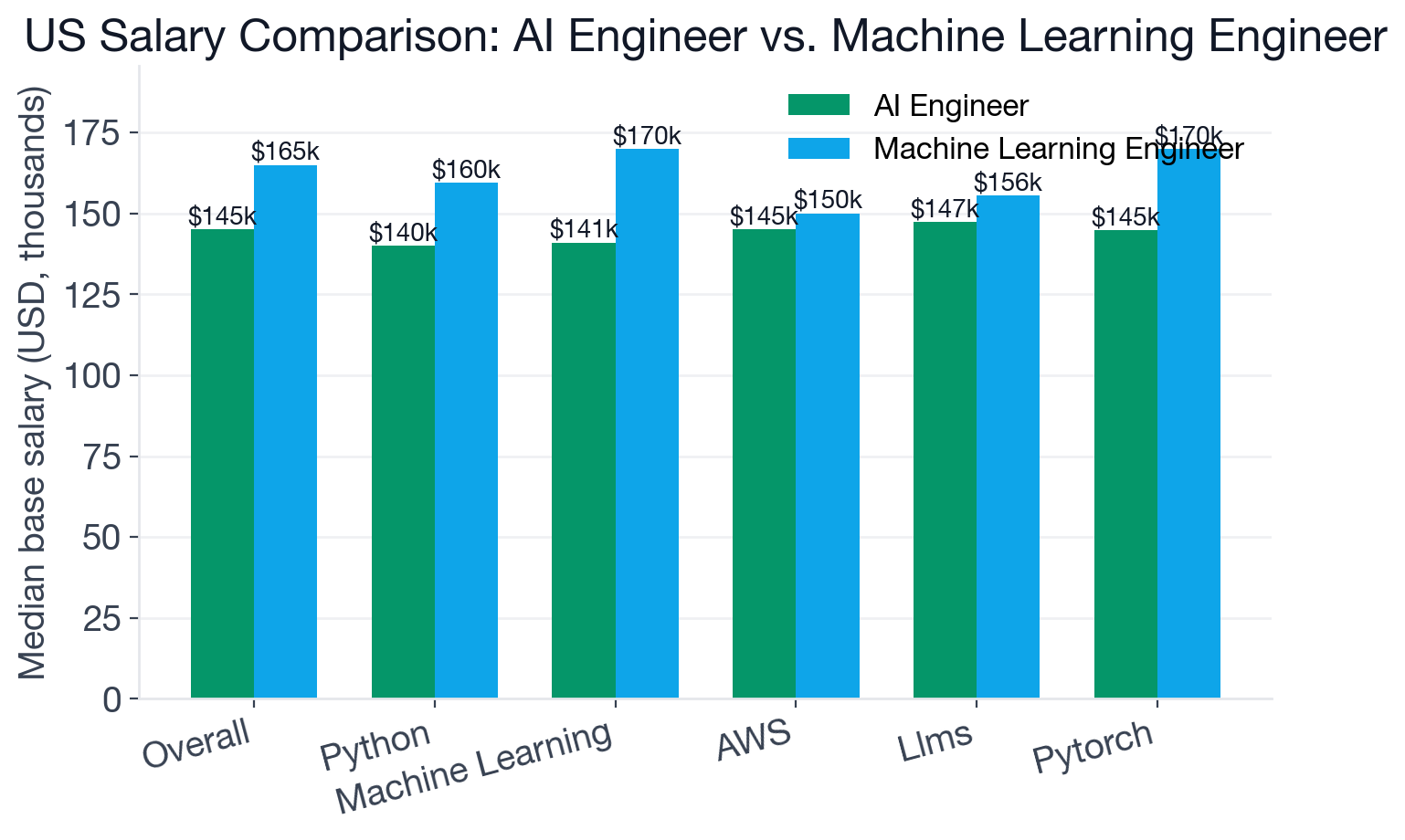
Median US base salary in USD for postings that mention each skill, restricted to US postings with structured salary data.
The premium is best read as a depth premium. ML Engineer postings consistently expect the candidate to have built and operated custom models, and the highest-paying skills reflect that. The top three: JAX at $204,000 (n=87, about $39K above baseline), C++ at $186,000 (n=119, about $21K above), and Transformers at $177,300 (n=87, about $12K above). All three reward low-level performance work or deep-learning depth. Computer Vision ($171,800, n=150) and PyTorch ($170,000, n=509) sit just above baseline as broader specializations.
For AI Engineer, the largest premiums attach to adjacent infrastructure and full-stack work, not to LLM tooling itself. Distributed Systems at $183,200 (n=40, about $38K above baseline) and Apache Spark at $170,000 (n=42, about $25K above) signal that the highest-paid AI Engineer roles are running inference at meaningful scale. React at $158,400 (n=48, about $13K above) confirms a real full-stack slice: the same engineer ships the application and the LLM behind it. Core production-tooling skills (Observability, MLOps, Scalability, FastAPI) cluster around $150,000, about $5K above the AI Engineer baseline.
The headline gap shrinks fast with specialization. A senior AI Engineer who can credibly own a distributed-inference platform earns at or above the ML Engineer median; a Transformers-fluent ML Engineer with a JAX background clears the AI Engineer median by a wide margin.
Which Has More Job Openings?
ML Engineer is the larger market by 690 postings (4,781 versus 4,091, a 1.17x ratio). The title has been around longer, the role is well-understood across industries, and most large companies already have an ML function. AI Engineer is the faster-growing newcomer, concentrated in companies actively shipping foundation-model-powered products.
Neither role is genuinely entry-friendly. 5.8% of AI Engineer postings are explicitly entry-level (236 listings), versus 4.8% for ML Engineer (230): roughly one entry-level AI Engineer role for every 17 postings, and one entry-level ML Engineer role for every 21. The senior-plus-staff share is 38% for AI Engineer and 42% for ML Engineer, so demand on either path is heavily concentrated in the upper half of the ladder.
Geography diverges meaningfully. ML Engineer is more US-anchored at 44% of postings versus 34% for AI Engineer; India sits as the second market for both at 13%. ML Engineer is also slightly more remote-friendly (28% remote, 30% hybrid, 52% onsite) than AI Engineer (24% remote, 33% hybrid, 51% onsite). Top ML Engineer employers skew toward product-tech and autonomy companies (Adobe, NVIDIA, Waymo, Spotify, General Motors); AI Engineer demand leans more toward consulting firms supporting enterprise rollouts (PricewaterhouseCoopers, Accenture) plus a long tail of LLM-first startups.
Which Should You Choose?
Choose AI Engineer if you:
- Want to ship LLM-powered features in production: retrieval pipelines, vector stores, prompt and tool-use logic, inference APIs.
- Already have backend, application, or full-stack engineering experience and want to add the LLM-application layer on top rather than learn deep learning from scratch.
- Are willing to trade the higher median for the slightly wider entry door (5.8% versus 4.8%) and the steepest recent growth curve of any AI/ML title.
Choose Machine Learning Engineer if you:
- Want to train, fine-tune, evaluate, and operate models, including classical ML, deep learning, and computer vision systems, not only LLM applications.
- Have or want to build research depth: PyTorch, Transformers, MLflow, Apache Spark, statistics, and ideally low-level performance work (JAX, C++) where the salary curve climbs fastest.
- Care about market breadth: 17% more openings, a higher US share (44% versus 34%), and a more remote-friendly mix.
If the choice still isn't clean, the shared 67% is your hedge. Build Python plus ML plus one cloud plus one of the deep-learning frameworks (PyTorch is the safer pick: 42% of ML Engineer postings, 22% of AI Engineer postings) and let the work you find yourself drawn to make the decision. Our interactive courses cover the foundations across Python, ML, and system design, the question bank lets you drill ML, statistics, and distributed-systems topics one at a time, and AI mock interviews put you under realistic conditions for either track.
FAQ
Q. What's the salary difference between AI Engineer and Machine Learning Engineer in 2026?
The median US base salary is $165,000 for Machine Learning Engineer (n=1,087) versus $145,000 for AI Engineer (n=680), a $20,000 (13.8%) premium for the ML Engineer role. Both figures are base only and exclude equity, RSUs, and bonuses, so total compensation at top employers runs meaningfully higher for either path.
Q. How much do AI Engineer and Machine Learning Engineer skills overlap?
About 67% (Jaccard similarity on each role's top-30 skills), one of the highest overlaps between any two distinct AI/ML titles. Python, Machine Learning, AWS, LLMs, Generative AI, PyTorch, TensorFlow, and major clouds appear in both stacks. The remaining third is where the roles fork: AI Engineer pulls toward LangChain, OpenAI, vector databases, and embeddings; ML Engineer pulls toward scikit-learn, computer vision, Apache Spark, MLflow, and statistics.
Q. Which role has more job openings?
Machine Learning Engineer has roughly 1.17x more active postings: 4,781 versus 4,091 for AI Engineer on the InterviewStack.io job board in May 2026, a difference of 690 listings. The ML Engineer market is older and more established; AI Engineer is the newer title that emerged with the LLM-application boom and is still ramping in absolute volume.
Q. Which role is easier to enter at the junior level?
Neither is genuinely entry-friendly. About 5.8% of AI Engineer postings are explicitly entry-level (236 of 4,091) versus 4.8% for ML Engineer (230 of 4,781). AI Engineer has the slightly wider door, but both roles overwhelmingly expect production experience: ML Engineer wants shipped models in production, AI Engineer wants shipped LLM-powered applications.
Q. Should I become an AI Engineer or a Machine Learning Engineer in 2026?
Pick AI Engineer if you want to ship LLM-powered features in production: retrieval pipelines, vector stores, prompt and tool-use logic, inference APIs. Pick Machine Learning Engineer if you want to train, tune, and operate custom models, including deep learning and computer vision systems. ML Engineer pays a $20K higher median and has more openings; AI Engineer has the wider entry door and a steeper recent growth curve.
Q. Which specific skills give the biggest salary premium in each role?
For Machine Learning Engineer, the highest-paying skills sit in low-level performance and deep-learning specializations: JAX ($204,000, +$39K above the $165K baseline), C++ ($186,000, +$21K), Transformers ($177,300, +$12K), and Computer Vision ($171,800, +$7K). For AI Engineer, the biggest premiums attach to adjacent infrastructure and full-stack work: Distributed Systems ($183,200, +$38K above the $145K baseline) and Apache Spark ($170,000, +$25K), with React ($158,400, +$13K) signaling that AI Engineer is sometimes a full-stack title.
Q. Where are the jobs and how remote-friendly is each role?
ML Engineer is meaningfully more US-concentrated (44% of postings versus 34% for AI Engineer); India is the second-largest market for both at about 13%. ML Engineer is also slightly more remote-friendly: 28% remote versus 24% for AI Engineer. Both roles are dominated by onsite work (52% and 51%) with hybrid in the 30-33% range.
Bottom Line
ML Engineer is the larger, higher-paying, more model-depth-focused half of the modern AI hiring market. AI Engineer is the faster-growing, slightly more accessible, more LLM-application-flavored half, with a meaningful full-stack slice. The two skill sets share two-thirds of their tooling, so the choice is really a choice about which third you want to specialize in: deep learning, computer vision, and the model lifecycle on one side; LLM applications, retrieval pipelines, and production inference on the other. Browse live AI Engineer postings or Machine Learning Engineer postings on the InterviewStack.io job board, or read the deeper AI Engineer skills analysis for the full per-role breakdown.
Topics
Ready to practice?
Put what you've learned into practice with AI mock interviews and structured preparation guides.