
The Demo Works. Now Prove It Is Worth Anything.
You are in a mid-level Applied Scientist interview and the prompt sounds like a gift: leadership at a large marketplace is excited about generative AI for customer support, and you have one quarter, one scientist (you), and two engineers to decide whether it is real. It is tempting to spend the whole interview on retrieval and prompts. The rubric weighs something else: 60 of 100 points go to meeting the interviewer's objectives and showing level-appropriate judgment, and 20 to technical proficiency.
This is an illustrative simulation built from one InterviewStack.io AI interview blueprint, not a transcript of a real company's interview. Below, a candidate we will call Mateo gives answers many candidates give, and you see what each one costs. Want to skip the reading? Start the live mock interview.
Key Findings
- The rubric is 100 points: Interviewer Objectives Alignment 30, Level-Specific Expectations 30, Technical Proficiency 20, Communication & Problem Solving 20.
- 60 of 100 points reward judgment and scoping; 20 reward technical accuracy.
- The interview runs 30 minutes in 3 phases: framing (0-8), experiment design (8-20), trade-offs and recommendation (20-30).
- Experiment design is the longest phase at 12 minutes and carries 5 of the 13 tracked checklist items.
- The scenario gives you 1 applied scientist, 2 engineers, and 1 quarter, so the bar is a narrow MVP, not a transformation program.
- Of 4 level-specific expectations, none asks you to invent novel research methods.
- The interview ends with 1 decision: an explicit go/no-go or phased-next-step recommendation.
What Is an Applied Scientist Emerging Tech Interview Really Scoring?
It scores whether you treat a new technology as a business bet, not a capability to admire. The interviewer is probing whether you can name a credible opportunity, separate value from hype, plan a measurable experiment, and respect operational and model risk.
The interview question
You are interviewing for an Applied Scientist role on a large e-commerce marketplace platform. The customer support organization handles millions of contacts per month across chat, email, and call deflection flows. Leadership is excited about recent advances in generative AI and wants to know whether the company should invest in an AI assistant that helps resolve post-purchase customer issues such as late deliveries, damaged items, refunds, and return-policy questions.
Today, support costs are high, resolution quality varies by region, and policy changes happen frequently. There is also concern about hallucinated answers, compliance with company policies, and inconsistent customer experience.
Your team has 1 applied scientist, 2 software engineers, and access to historical support transcripts, policy documents, and customer outcome data. You have one quarter to determine whether this is a real opportunity worth scaling.
How would you evaluate and propose an approach for deciding whether this emerging technology investment is worthwhile for the business?
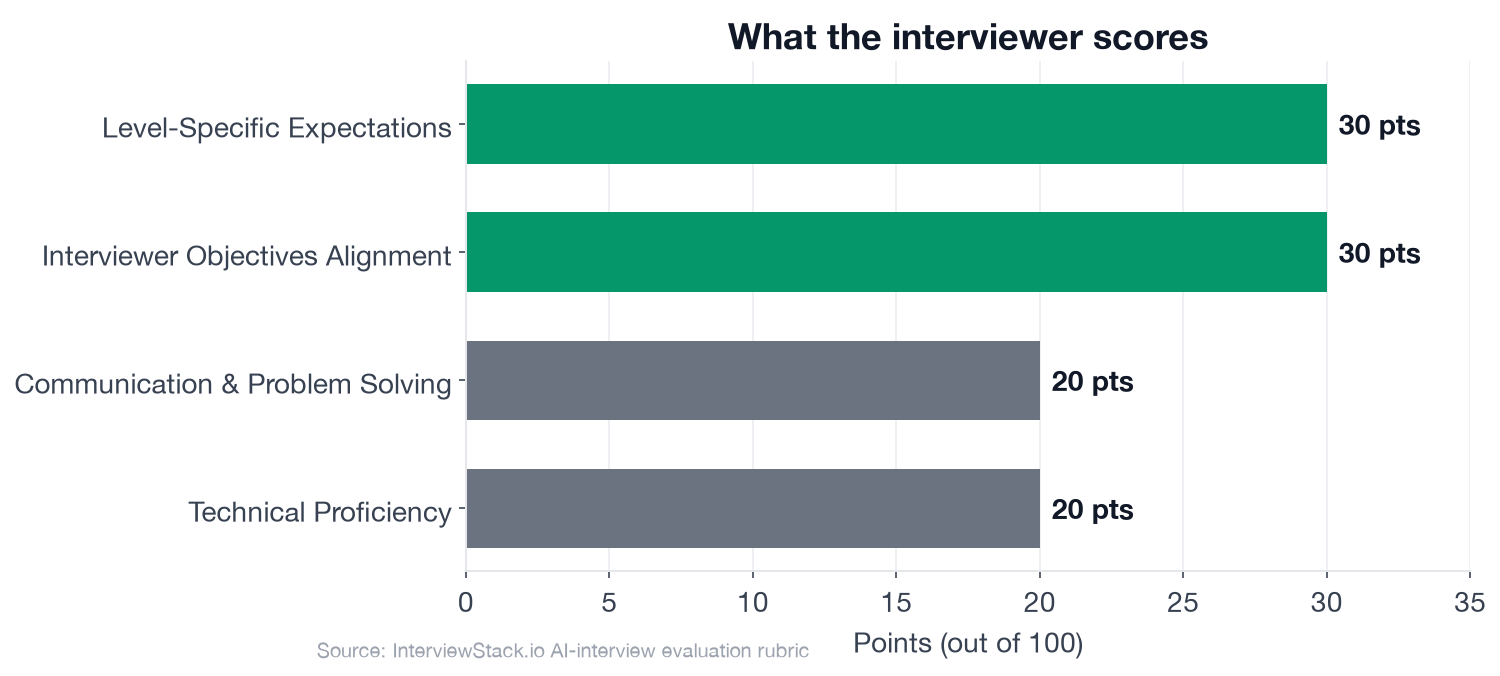
Judgment dominates the scoring, so a polished architecture with no stop criteria can still leave the two largest slices of the rubric unclaimed.
Four Turns Where a Prepared Candidate Slips
Turn 1: Choosing the first use cases
Interviewer: "How would you choose the first support use cases to target, and which ones would you explicitly avoid in the first quarter?"
Turn 2: Evaluating beyond model quality
Interviewer: "What evaluation framework would you use before launch and after launch, given that model quality alone is not the business outcome?"
Turn 3: Pressure for full automation
Interviewer: "If leadership pushes for full automation quickly, how would you reason about the right level of human involvement and the associated trade-offs?"
Turn 4: Faster but slightly wrong
Interviewer: "Suppose the initial prototype reduces handle time but slightly increases incorrect resolutions. How would you decide whether to continue, pivot, or stop?"
Why Isn't Reading This Enough?
Spotting these mistakes on the page is easy. Avoiding them live is the actual skill. In the room, the interviewer asks one question at a time, interrupts, and pushes on whatever you glossed over, and you have 30 minutes, not a re-read. That only improves with reps against follow-ups you cannot predict.
Which 13 Checklist Items Is the Interviewer Tracking Live?
This is the blueprint a strong candidate hits, and exactly what the AI mock interview tracks you against in real time: 4 items in framing, 5 in experiment design, and 4 in trade-offs and recommendation.
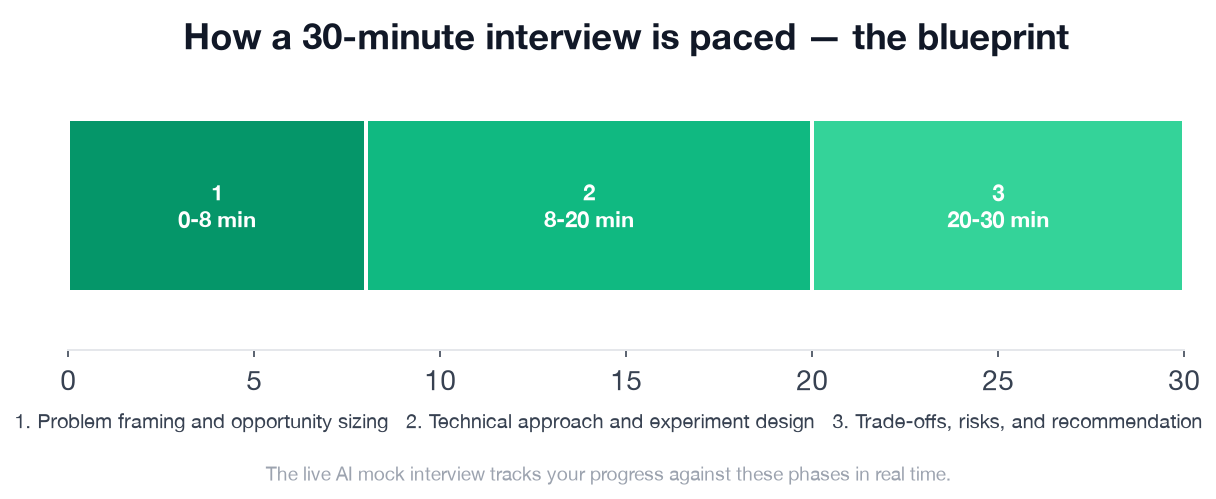
The middle phase is the longest, so a strong candidate arrives there with the problem already framed.
- ✓Restates the objective as a decision problem: whether and where generative AI can create business value within a quarter
- ✓Identifies stakeholders and business outcomes such as support cost, resolution quality, CSAT, repeat contacts, and policy compliance
- ✓Segments possible use cases by risk and value, for example agent assist versus fully autonomous customer resolutions
- ✓Calls out that not all support intents are equally suitable and that policy-sensitive flows need tighter controls
- ✓Proposes a scoped architecture appropriate for the quarter, such as retrieval-augmented generation over policy docs and historical resolutions, or agent-assist draft responses
- ✓Describes what data is needed and notes issues like transcript quality, label quality, policy versioning, regional differences, and privacy constraints
- ✓Defines offline metrics beyond generic accuracy, such as groundedness, policy adherence, resolution correctness, escalation appropriateness, and summarization/helpfulness if using agent assist
- ✓Includes human evaluation or expert review for high-risk cases rather than relying only on automated metrics
- ✓Explains an online test plan with target populations, control/treatment, success metrics, and guardrails like escalation rate, complaint rate, and bad-resolution audits
- ✓Clearly articulates when to use human-in-the-loop versus automation and ties this to customer risk and policy sensitivity
- ✓Identifies major failure modes such as hallucinated policies, unsupported edge cases, prompt injection through customer text, and model drift after policy updates
- ✓Suggests mitigations such as constrained action spaces, retrieval from approved sources, confidence-based fallback, and continuous monitoring
- ✓Provides a recommendation with explicit go/no-go or phased-next-step criteria instead of staying purely exploratory
Run This Interview Live
Start the Applied Scientist AI mock interview on Innovation and Emerging Technology. You get the same 30-minute, three-phase blueprint, follow-ups you did not see here, and feedback against the four rubric dimensions. Then drill adjacent topics in the Applied Scientist question bank, study the preparation guides, or browse current Applied Scientist openings to see what employers ask for.
FAQ
Q. What does an Applied Scientist emerging technology interview test?
It tests whether you can separate business value from hype. In this mock interview, 30 minutes run across three phases (framing 0-8, experiment design 8-20, trade-offs and recommendation 20-30), and 60 of 100 rubric points reward meeting the interviewer's objectives and showing level-appropriate judgment.
Q. How is the mock interview scored?
Out of 100 points: Interviewer Objectives Alignment 30, Level-Specific Expectations 30, Technical Proficiency 20, and Communication & Problem Solving 20. Judgment and scoping together outweigh pure technical accuracy three to one.
Q. Do I need to design a model architecture in this interview?
No. Whiteboard coding of model architectures, transformer derivations, and low-level distributed systems details are out of scope. You are expected to propose a scoped approach, such as retrieval-grounded answers or agent-assist drafts, and a credible way to evaluate it.
Q. What should a mid-level Applied Scientist recommend for a support AI assistant?
A narrow, high-signal MVP rather than a company-wide transformation. That means starting with lower-risk intents, keeping humans in the loop for policy-sensitive cases, and ending with explicit go/no-go or phased-next-step criteria.
Q. How long is the interview and how many checklist items are tracked?
The interview runs 30 minutes. The blueprint tracks 13 checklist items: 4 in problem framing, 5 in technical approach and experiment design, and 4 in trade-offs and recommendation.
Q. How can I practice this exact interview?
Start the AI mock interview for the Applied Scientist role at mid-level on Innovation and Emerging Technology. It follows the same three-phase blueprint and tracks you against the checklist in real time, with unscripted follow-ups.
Your Quarter Starts With One Rep
The candidates who stand out are not the ones with the fanciest model. They scope a narrow bet, measure what the business cares about, and commit to a decision. Practice that out loud once, and the real thing feels familiar.
Topics
Ready to practice?
Put what you've learned into practice with AI mock interviews and structured preparation guides.