
Keeping the Junior Scientist as Owner Is the First Test, Not a Courtesy
A junior researcher on your team just ran an experiment with real gains and real problems: a leaky evaluation, a weak baseline, and a write-up that skips the failure cases and the rollout risk. Your manager wants you to get the project into good shape without taking over the work yourself. That instruction, buried in one sentence, is the actual interview. Say the wrong thing here and you spend the rest of the interview fighting an impression you already lost.
This walkthrough follows the same interview package InterviewStack.io's AI mock interviewer runs live for a mid-level Applied Scientist (2-5 years) on Research Mentorship and Team Development, scored against the same 100-point rubric a real session would use. The scenario, the follow-ups, and the scoring checklist below are pulled directly from that package, not invented for this post.
Key Findings
- Interviewer Objectives Alignment and Level-Specific Expectations each carry 30 of 100 points, so 60 points ride on how you frame the coaching approach, not on technical polish alone.
- Phase 1, the first 8 minutes, holds 4 checklist items, including an explicit expectation that you state you will not rewrite the junior scientist's analysis yourself.
- Phase 2 runs from minute 8 to minute 20, the longest of the four phases, and carries 5 checklist items spanning specific methodology gaps to a defined launch-readiness threshold.
- Phase 3 (minutes 20 to 27) requires at least one reusable team mechanism, such as an experiment review checklist, not a one-off fix for a single project.
- Technical Proficiency and Communication & Problem Solving each add 20 points, so up to 40 points still depend on execution and clarity, not just framing.
- The full interview is 30 minutes across 4 phases, with the last 3 minutes reserved for a wrap-up that checks whether your plan holds up at mid-level scope.
- Forbidden territory includes whiteboard coding, deep infrastructure design, and organization-wide people-management topics like compensation, keeping the conversation scoped to one project and one scientist.
What Is This Applied Scientist Research Mentorship Interview Actually Testing?
The interview question
You are on an applied science team that builds ranking and recommendation models for a large consumer product. A newly hired Applied Scientist with about 1 year of industry experience owns an offline experiment for a new modeling approach and is excited about early gains. They want to launch quickly, but when you review the work, you notice several issues: the evaluation setup may have leakage, the baseline comparison is weak, and the write-up does not clearly explain failure cases or rollout risk. The team is under pressure to improve a key engagement metric this quarter, and your manager asks you to help this scientist get the project into good shape without taking over the work yourself.
How would you handle this situation?
The interviewer is not grading your machine learning knowledge here. They are watching whether you can raise someone else's research rigor without taking the pen out of their hand: giving actionable feedback on methodology, protecting a minimum quality bar while the business wants speed, and building something that outlasts this one project. A candidate who nails the diagnosis but solves it personally has still failed the actual objective.
The Follow-Ups That Actually Move the Score
The base question sets the scene. The follow-ups are where the interviewer finds out whether your first answer was a script or an actual approach. Here are four of the six follow-ups this package uses, and the mistake most candidates make on each one.
Turn 1: The First-Week Plan
Interviewer: "What would you do in the first week to help them improve the work while still keeping them as the owner?"
Turn 2: The Deadline Squeeze
Interviewer: "Suppose the launch deadline is close and there is not enough time to fully redo the study. How would you decide what is essential before launch versus what can wait?"
Turn 3: Beyond One Scientist
Interviewer: "How would you turn this into a repeatable improvement for the broader team rather than solving it as a one-off coaching case?"
Turn 4: When Coaching Alone Stalls
Interviewer: "If the scientist continues to miss important rigor issues even after feedback, how would you escalate or adjust your support?"
Why Isn't Spotting These Mistakes on the Page Enough?
Reading these four mistakes in order, each one looks obvious. That is the trap of reading a walkthrough: hindsight makes every misstep look avoidable. Live, under a 30-minute clock, with an interviewer asking unscripted follow-ups and no red box telling you what you just gave away, the instinct to just fix the leakage yourself, or to let a shaky launch slide because the deadline is real, shows up fast and feels reasonable in the moment. The skill this interview measures is not knowing that ownership matters. It is holding that line while you are also under real pressure to solve the actual technical problem. That only gets built through reps, which is exactly what a live AI mock interview on this same scenario gives you: unscripted follow-ups, a clock, and scored feedback against the same rubric.
What Does the Full 30-Minute Blueprint Reward?
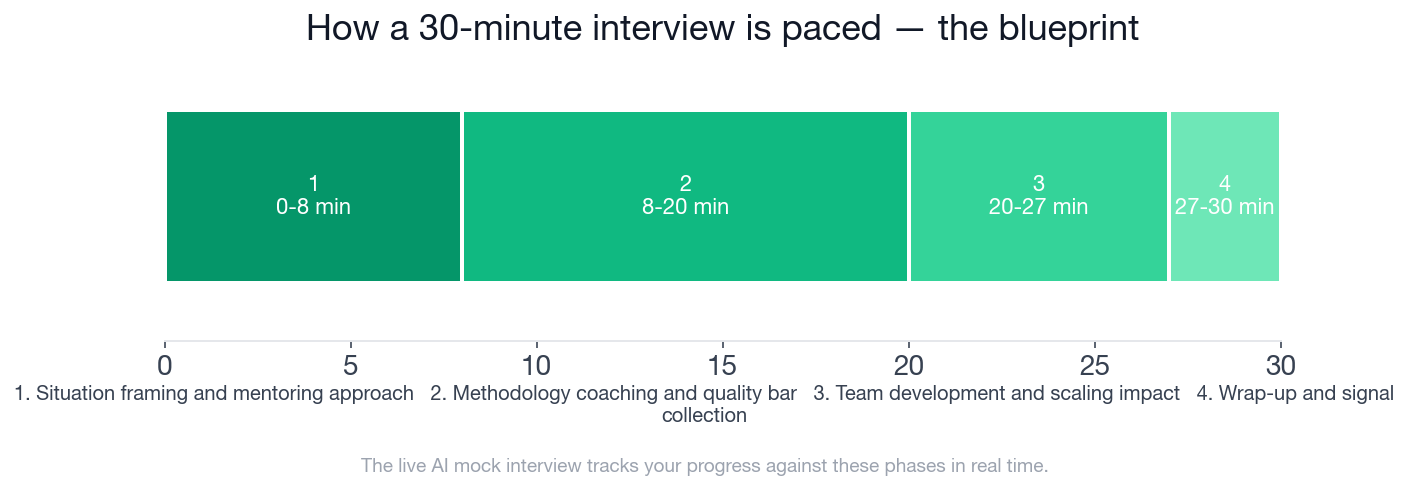 The interview is paced, not open-ended: each phase has a window and a specific job, and the clock keeps moving whether or not you have covered it.
- ✓Clarifies the junior scientist’s current state: goals, evidence, deadline, and specific gaps in the work
- ✓Explicitly states intent to preserve ownership rather than rewriting the analysis personally
- ✓Outlines a near-term plan such as review meeting, prioritized feedback, and clear next checkpoints
- ✓Acknowledges business urgency while protecting minimum scientific quality
- ✓Names specific methodological concerns such as leakage, poor baseline choice, invalid split strategy, missing ablations, or insufficient error analysis
- ✓Converts concerns into concrete asks for the junior scientist with rationale and priority order
- ✓Describes how to handle disagreement or defensiveness constructively through evidence-based discussion and questions
- ✓Defines a threshold for launch readiness, including must-have validation and acceptable risk if some work is deferred
- ✓Mentions documenting assumptions, caveats, and rollback or monitoring considerations
- ✓Proposes at least one reusable team mechanism such as experiment review templates, pre-launch checklists, peer reviews, office hours, or exemplar write-ups
- ✓Describes how they would calibrate the level of support to the junior scientist’s needs
- ✓Mentions observable success metrics such as improved independence, stronger write-ups, fewer review cycles, or better experiment quality
- ✓Recognizes when patterns indicate a need for stronger intervention or manager involvement
- ✓Summarizes a coherent plan with clear priorities
- ✓Shows balanced judgment rather than perfectionism or excessive speed
- ✓Demonstrates mid-level scope: strong project-level mentorship with practical team-bar improvements
This is the blueprint a strong candidate hits, phase by phase, and it is the exact structure InterviewStack's AI mock interviewer tracks you against in real time during a live session, not just at the end.
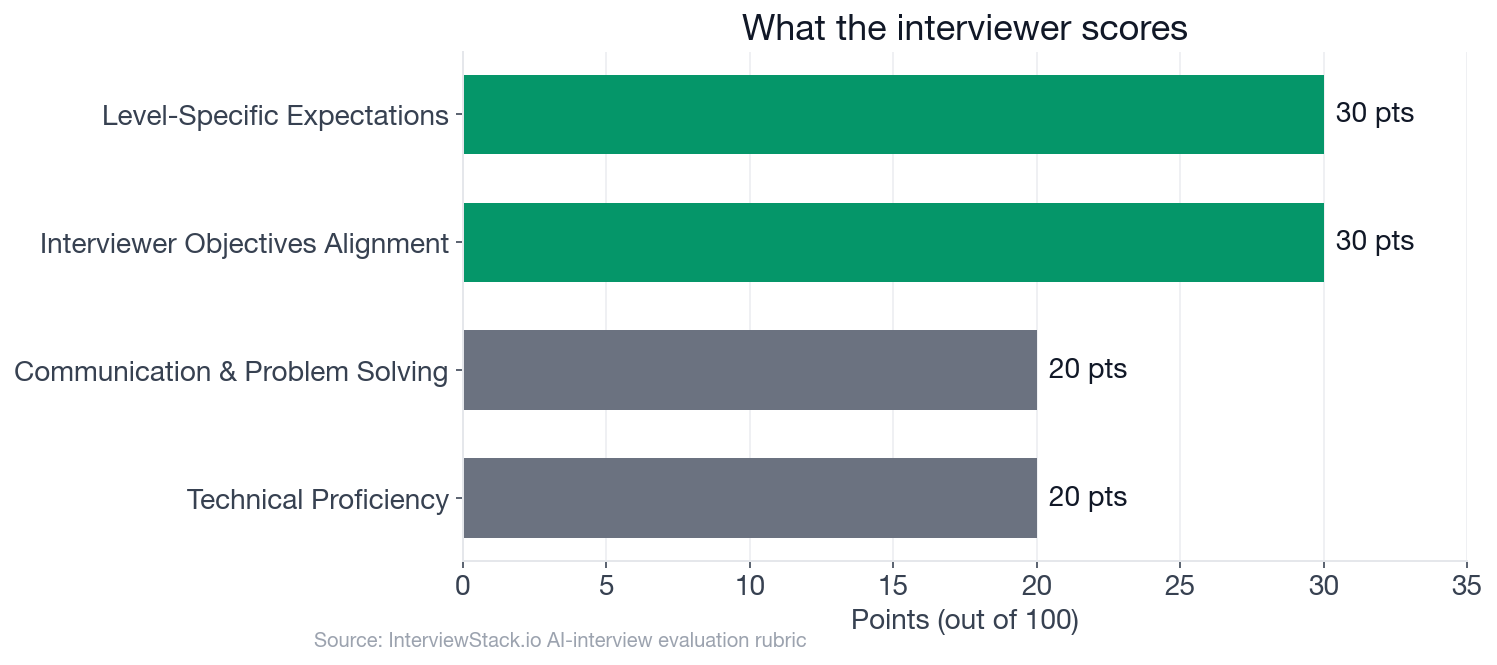 Interviewer Objectives Alignment and Level-Specific Expectations together account for 60 of the 100 points, which is why framing the coaching approach correctly throughout the conversation matters more than any single technical detail later on.
Take This Exact Scenario Into a Live Mock Interview
Everything above is a preview. The real test is answering these four follow-ups out loud, in order, without knowing what comes next, while a clock runs and an AI interviewer adapts to what you actually say. Start the AI mock interview on this Applied Scientist Research Mentorship and Development scenario and get scored against the same rubric used in this post: Interviewer Objectives Alignment, Level-Specific Expectations, Technical Proficiency, and Communication & Problem Solving. If you want to drill the underlying concepts first, the Research Mentorship and Development question bank breaks the topic into individual practice questions, and InterviewStack's interactive courses cover experiment design and evaluation fundamentals if leakage and baseline selection are still fuzzy.
FAQ
Q. What does the Applied Scientist Research Mentorship and Development interview actually test?
It tests whether you can grow another researcher's ability rather than just diagnosing their mistakes yourself. The rubric splits 100 points across four dimensions: Interviewer Objectives Alignment and Level-Specific Expectations at 30 points each, and Technical Proficiency and Communication & Problem Solving at 20 points each, so how you frame the coaching approach carries as much weight as getting the methodology right.
Q. Why is not fixing it yourself such a common trap in this interview?
Because the interviewer's Phase 1 checklist, covering the first 8 minutes of the 30-minute interview, explicitly expects you to state that you are preserving the junior scientist's ownership rather than rewriting the analysis personally. A technically sharp answer that quietly takes over the work still misses this specific expectation.
Q. What methodology issues should you name in this scenario?
The scenario plants three concrete gaps: possible evaluation leakage, a weak baseline comparison, and a write-up that does not explain failure cases or rollout risk. Phase 2 (minutes 8 to 20) rewards naming these specifically, then turning each into a prioritized ask with a rationale rather than a vague instruction to redo the analysis.
Q. How should you handle a launch deadline with incomplete validation?
Draw a line between what must be validated before any launch and what can wait, and pair a compressed timeline with a monitored, reversible rollout rather than either blocking the launch outright or shipping an unverified number. This is one of five checklist items in Phase 2, and skipping it costs Interviewer Objectives Alignment points regardless of how sharp the technical critique is.
Q. What turns individual coaching into a team-level answer?
Phase 3 (minutes 20 to 27) expects at least one reusable mechanism, such as an experiment review checklist, a pre-launch rubric, or a peer-review rotation, that would help the next scientist too, not just fix this one project.
Q. How long is the interview and how is the time split?
The interview runs 30 minutes across four phases: situation framing and mentoring approach (0 to 8 minutes), methodology coaching and quality bar (8 to 20 minutes), team development and scaling impact (20 to 27 minutes), and a wrap-up (27 to 30 minutes) that checks whether your plan holds together at mid-level scope.
Q. What is off-limits in this interview?
The scenario stays scoped to project-level mentoring. It excludes whiteboard coding or algorithm implementation, deep infrastructure or distributed-systems design, product strategy unrelated to research quality, and organization-wide people-management topics like compensation or formal performance processes.
The Real Skill Is the Conversation, Not the Diagnosis
Naming leakage, a weak baseline, and a missing rollout plan is the easier part of this interview. The harder part is having that conversation out loud, in real time, with someone who is confident in their result, while a deadline sits in the background and the interviewer keeps pushing with follow-ups you have not rehearsed. That is what a live mock interview is for.
Topics
Ready to practice?
Put what you've learned into practice with AI mock interviews and structured preparation guides.