
The Code Is Done at Minute 20. The Interview Isn't.
Marcus, a mid-level Backend Developer, writes a clean event aggregator in about 14 minutes: a loop, a json.loads, a set for duplicates, a defaultdict for totals. It passes the sample input on the first run. Then the interviewer asks what happens when the input no longer fits in memory, and the interview changes shape. The points were never in the happy path.
This post walks one 30-minute Python interview turn by turn, built from a real AI mock interview blueprint. The candidate answers are dramatized and illustrative, not a transcript of any real person or company's questions.
Key Findings
- The interview is scored out of 100 points, and 60 of them (Interviewer Objectives Alignment and Level-Specific Expectations, 30 each) reward judgment over syntax.
- Technical Proficiency, the code-quality dimension, is only 20 of the 100 points.
- The blueprint runs 30 minutes in 3 phases: 6 minutes of framing, 14 minutes of implementation, and 10 minutes of validation and extension.
- The task has 3 input hazards to handle: out-of-order events, duplicate event_ids, and malformed lines.
- The expected complexity is linear in the number of lines, with space driven by 3 things: users, event types, and seen event_ids.
- The 3 phases carry 16 checklist items in total, and 1 of the 5 phase-one items is stating the memory cost of tracking seen IDs before writing any code.
What Is This Python Interview Actually Probing?
It is probing whether you write Python you would be comfortable shipping, not whether you can produce output that matches the sample. The interviewer is checking for safe JSON parsing, idiomatic collections, honest complexity reasoning, and clean function boundaries, at the bar of someone who needs only minor prompting.
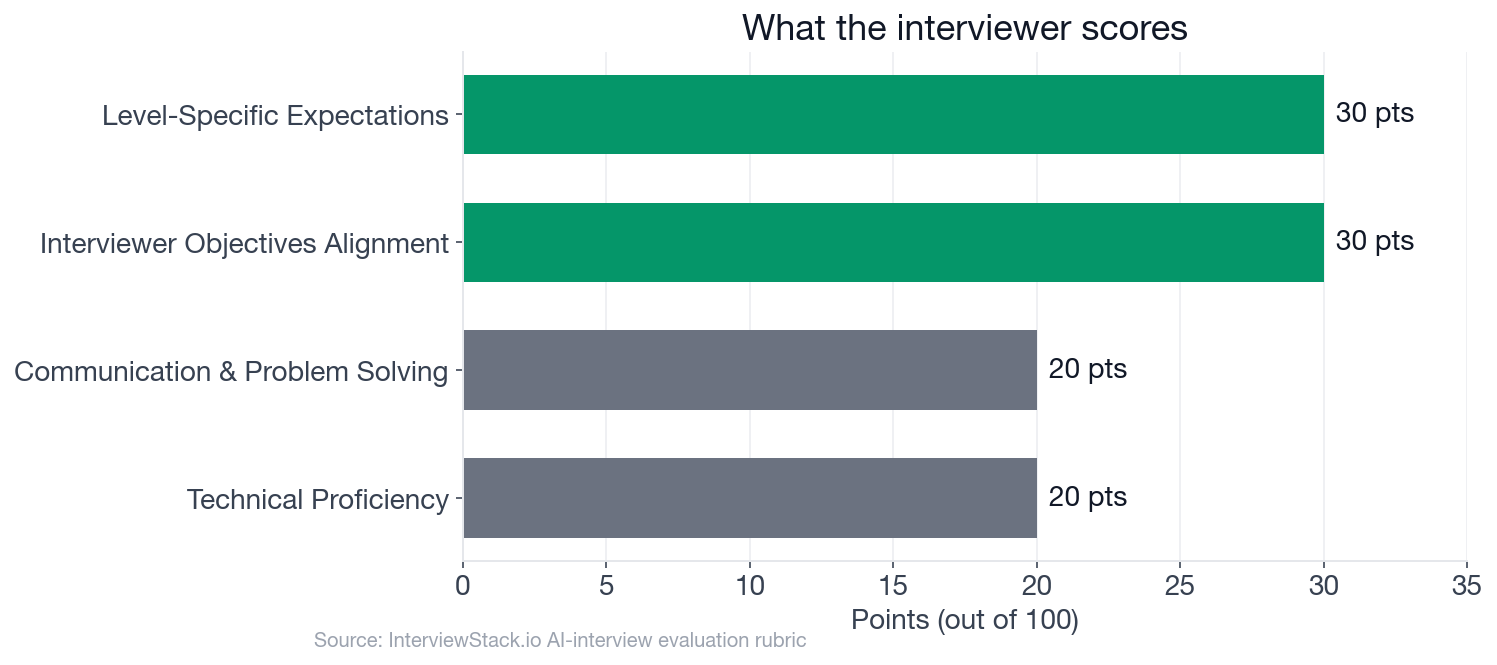
Notice what the chart implies: code quality is one 20-point slice, so flawless code with no trade-off talk can leave a large share of the points on the table.
The interview question
You are working on an internal backend service that consumes newline-delimited JSON events from multiple producers. Events may arrive slightly out of order, may contain duplicate event_ids, and some lines may be malformed. Your function receives an iterable of strings, one raw line each. Ignore malformed lines, count only the first occurrence of each event_id, and assume value is an integer when present.
event line: {"event_id": "evt_123", "user_id": "u_42", "event_type": "click", "ts": 1710000123, "value": 7}

lines = [
  '{"event_id":"e1","user_id":"u1","event_type":"click","ts":100,"value":2}',
  '{"event_id":"e2","user_id":"u1","event_type":"purchase","ts":105,"value":20}',
  'not json',
  '{"event_id":"e1","user_id":"u1","event_type":"click","ts":100,"value":2}',
  '{"event_id":"e3","user_id":"u2","event_type":"click","ts":103,"value":1}'
]
expected = {
  "u1": {"total_events": 2, "total_value": 22, "by_type": {"click": 1, "purchase": 1}},
  "u2": {"total_events": 1, "total_value": 1, "by_type": {"click": 1}}
}
Implement and explain a Python solution that produces the per-user aggregation in a way you would be comfortable shipping in a backend codebase.
The stated goal is a correct, maintainable single-process solution that handles production-style edge cases and explains its memory, correctness, and extensibility trade-offs. Distributed design, SQL tuning, and ML modeling are explicitly out of bounds.
The Backend Developer Python Interview, Turn by Turn
The baseline solution is on screen. These four follow-ups are where a prepared candidate quietly loses points.
Turn 1: The Input Won't Fit
Interviewer: "If this input were too large to fit in memory, how would you structure the code so it still works efficiently with a streaming source?"
Turn 2: Duplicates Hours Apart
Interviewer: "What would you change if duplicate event_ids could reappear hours later, so keeping every seen ID forever was too expensive?"
Turn 3: Messy Fields Without Mess
Interviewer: "How would you make the function robust to missing optional fields or unexpected event_type values without making the code messy?"
Turn 4: Tests That Stay Cheap
Interviewer: "How would you test this in Python so that correctness around malformed lines, duplicates, and edge cases is easy to maintain?"
Why Isn't Reading This Enough?
Spotting these four mistakes on a page took seconds. Avoiding them live is a different skill: the interviewer asks one question at a time, nothing is labeled, and you are typing while talking. Marcus knew what a generator was. The list() call still happened, because the follow-up arrived while attention was on the loop just written. That gap closes only with reps against unscripted follow-ups.
The Blueprint the AI Interviewer Tracks You Against
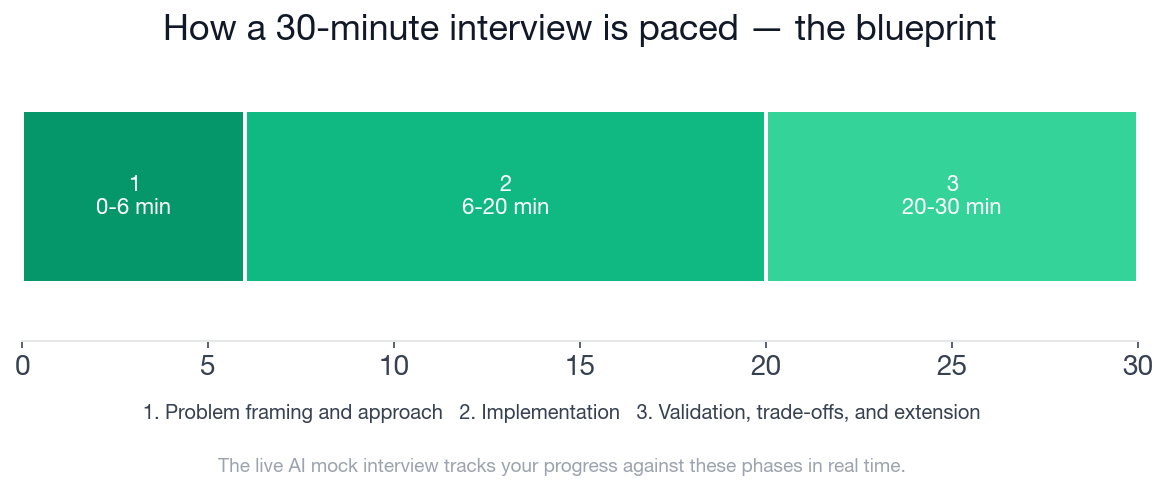
This is the blueprint a strong candidate hits, and it is exactly what the AI mock interview tracks you against in real time, phase by phase.
- ✓Restates that input is an iterable of raw lines, not necessarily a list
- ✓Identifies malformed JSON should be ignored rather than failing the whole function
- ✓Identifies deduplication key as event_id and only first occurrence counts
- ✓Proposes a per-user aggregation structure before writing code
- ✓Mentions expected memory cost of tracking seen event_ids
- ✓Implements a function with a clear signature
- ✓Uses try/except around json parsing in a narrow, appropriate scope
- ✓Tracks seen event_ids in a set or clearly justified alternative
- ✓Builds per-user aggregates with correct updates to total_events, total_value, and by_type
- ✓Avoids unnecessary multiple passes over the input
- ✓Writes code that is easy to read, with sensible naming and limited incidental complexity
- ✓Walks through sample input and explains why duplicate and malformed lines are handled correctly
- ✓States time complexity is linear in number of lines processed, excluding JSON parse cost details
- ✓Explains space complexity in terms of users, event types, and seen event_ids
- ✓Suggests a realistic approach for streaming input without assuming all lines are preloaded
- ✓Proposes a few targeted unit tests covering empty input, malformed lines, duplicate IDs, and missing fields
Run This Interview Live
The most useful next step is to start the AI mock interview for this exact scenario. You get 30 minutes, unscripted follow-ups, and the same four-dimension scoring, so you find your own list() moment before a real interviewer does. If you want warm-up reps first, the Backend Developer Python question bank has focused questions, and the Backend Developer job board shows what teams are hiring for.
FAQ
How long is the Backend Developer Python mock interview?
The blueprint runs 30 minutes in three phases: problem framing and approach (minutes 0-6), implementation (6-20), and validation, trade-offs, and extension (20-30).
How is a Backend Developer Python interview scored?
Out of 100 points: 30 for Interviewer Objectives Alignment, 30 for Level-Specific Expectations, 20 for Technical Proficiency, and 20 for Communication and Problem Solving. Production judgment carries more weight than syntax.
Should I load all input lines into a list before aggregating?
No. The input is an iterable of raw lines, so a single pass over the iterator keeps memory tied to users, event types, and seen event_ids instead of total input size. Calling list() on the input is an easy way to fail the streaming follow-up.
What do I do when duplicate event_ids can reappear hours later?
Name the trade-off out loud. Keeping every ID forever grows without bound, so bound the dedup state to a time window sized to how late a duplicate can arrive, and state what you accept when an ID falls outside it.
Where should try/except go when parsing malformed JSON lines?
Narrowly, around json.loads only, catching json.JSONDecodeError. A broad except around the whole loop body silently swallows real bugs such as a valid event with a missing key.
What unit tests should I propose for this Python task?
A few targeted cases: empty input, a malformed line, a duplicate event_id where the second copy has a different value, and an event with a missing field. Because the function takes an iterable, tests pass plain lists of strings with no files.
Where to Put the Next Thirty Minutes
A working loop earns you the right to be asked the hard questions. Spend your next half hour answering them out loud, once, under a clock.
Topics
Ready to practice?
Put what you've learned into practice with AI mock interviews and structured preparation guides.