
One Shared Counter Can't Serve Two Different Limits
Picture a mid-level Backend Developer interview on rate limiting and quota management. Thirty minutes, one scenario: a public API platform with a free tier at 100 requests per minute, a pro tier at 1,000, and an enterprise tier with custom limits plus a separate daily quota. Most candidates handle the first two tiers without much trouble. The place they lose real points is the third: the moment "quota" and "rate limit" show up in the same sentence, a lot of candidates quietly design one counter to handle both.
This walkthrough is built from a real interview package blueprint, the same structure InterviewStack.io's AI interviewer scores against, not a generic study guide. Every mistake below maps to a specific rubric line the interviewer is actually watching.
Key Findings
- Interviewer Objectives Alignment and Level-Specific Expectations each carry 30 of the 100 rubric points, together 60% of the score, before Technical Proficiency (20) or Communication and Problem Solving (20) even factor in.
- The 30-minute interview runs across 4 phases: problem framing (0-6 min), core design and algorithm selection (6-18 min), failure modes and client semantics (18-26 min), and trade-offs and wrap-up (26-30 min).
- The scenario sets a 10x jump between tiers: the free tier caps at 100 requests per minute per API key, the pro tier at 1,000, and the enterprise tier gets custom limits plus a separate daily quota.
- Phase 3 alone packs 5 checklist items into an 8-minute window (18-26 min), covering hot keys, 429 semantics, datastore failure behavior, quota separation, and monitoring.
- The blueprint carries 6 follow-up questions in total; this walkthrough dramatizes 4 of them, chosen for the sharpest scoring gaps.
- 4 skills are explicitly out of scope for this interview, including machine learning model design and blockchain or cryptographic protocol design, keeping the round focused on backend distributed-systems reasoning.
What Is the Backend Developer Rate Limiting and Quota Management Interview Really Testing?
The interviewer is evaluating whether you can choose the right algorithm and enforcement point, reason about correctness and fairness across a distributed fleet, handle HTTP throttling semantics correctly, and make pragmatic trade-offs rather than design something research-grade. Here's the exact prompt a candidate would see.
The interview question
You are working on a public API platform used by third-party developers. The platform serves mobile and web clients across multiple regions through an API gateway and a fleet of stateless backend services. Requests from the same client may hit different gateway instances and different backend instances over time.
Current business requirements: a free tier capped at 100 requests per minute per API key, a pro tier capped at 1,000 requests per minute per API key, and an enterprise tier with custom limits plus a separate daily quota. Some endpoints are more expensive to serve and need tighter protection. Over-limit clients should get standard HTTP throttling responses, and the system needs to keep working through traffic spikes or partial datastore failures.
Design a rate limiting and quota management system for the API platform above.
Notice what the prompt does not say: it never tells you rate limits and quotas are the same mechanism. It just puts them next to each other and waits to see if you notice the difference.
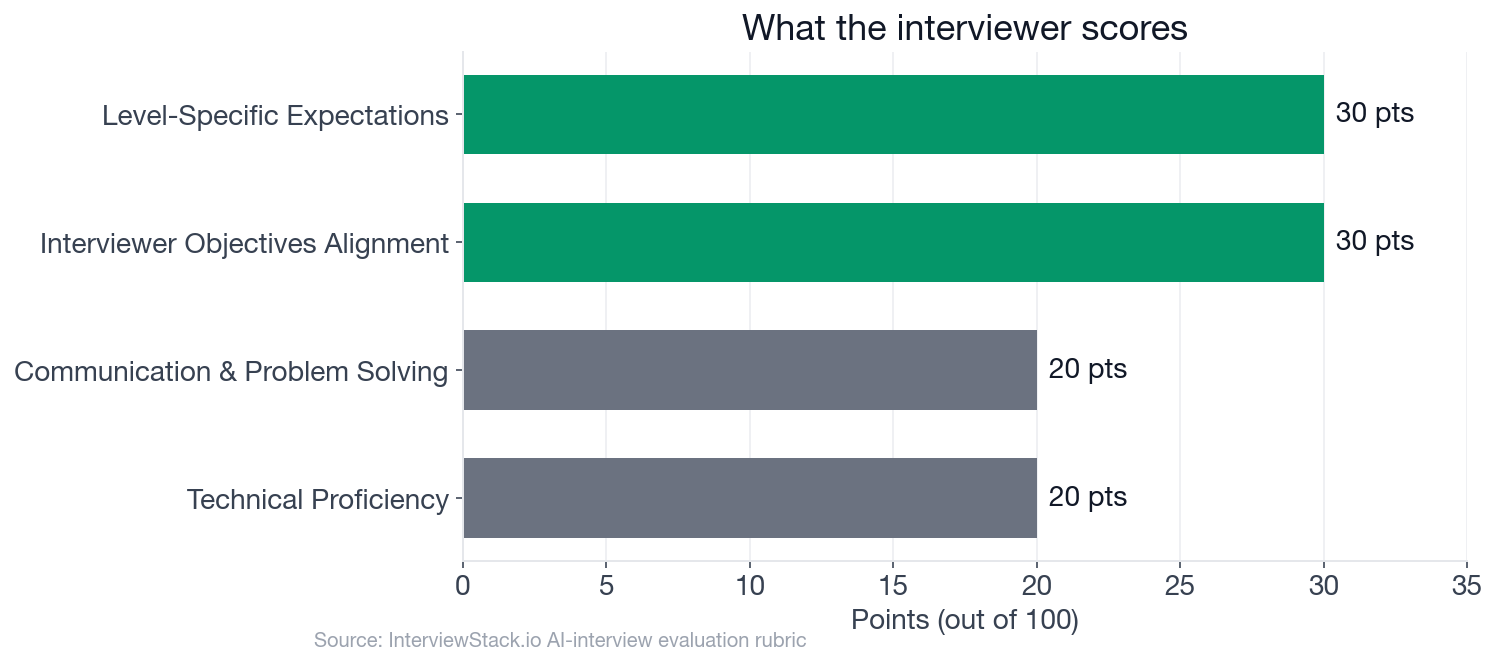
The scoring weights above explain why Turn 3 below is the highest-leverage moment in the whole interview: the daily-quota question sits squarely inside the two dimensions worth 60 of the 100 points.
Four Turns, One Recurring Trap
Below are 4 of the 6 follow-up prompts from the real blueprint, picked because they build on each other. Each one hands "Micah," a composite stand-in for common mid-level answers, a chance to either separate two structurally different concerns or quietly merge them. Watch the pattern repeat.
Turn 1: Where the Checks Actually Happen
Interviewer: "Where would you enforce the limits in this architecture, and what would you keep at the gateway versus inside individual services?"
Turn 2: Sharing a Counter Without Slowing Every Request
Interviewer: "How would you implement counters consistently across multiple gateway instances without making every request too expensive?"
Turn 3: Why the Daily Quota Needs Its Own Path
Interviewer: "How would you handle daily quotas for enterprise customers alongside per-minute rate limits?"
Turn 4: Degrading Two Different Ways
Interviewer: "If your centralized counter store becomes slow or partially unavailable during a spike, how would you degrade gracefully?"
The Interviewer Won't Wait for You to Notice the Shared Counter
Each of Micah's four answers looks reasonable in isolation. That's the point: on the page, with the mistake already labeled red, the fix is obvious. In a real 30-minute room, nothing is labeled. You're tracking a tier table, a clock, and three earlier answers while the interviewer casually asks about daily quotas, and reusing the counter you just built feels efficient, not wrong. Noticing "this is structurally different from what I just designed" in real time, without a hint, is a different skill than reading a critique after the fact. That gap only closes with reps under real time pressure and unscripted follow-ups, which is exactly what a live Backend Developer rate limiting mock interview forces you to practice.
How Do the Four Phases Turn Into One Complete Design?
A strong candidate doesn't just avoid Micah's four mistakes individually. They keep the phases separate the whole way through: framing decisions made in the first 6 minutes stay framing decisions, and the daily quota never quietly merges back into the per-minute counter twelve minutes later just because both happen to live in the same store. Below is the exact blueprint used to grade this interview, phase by phase.
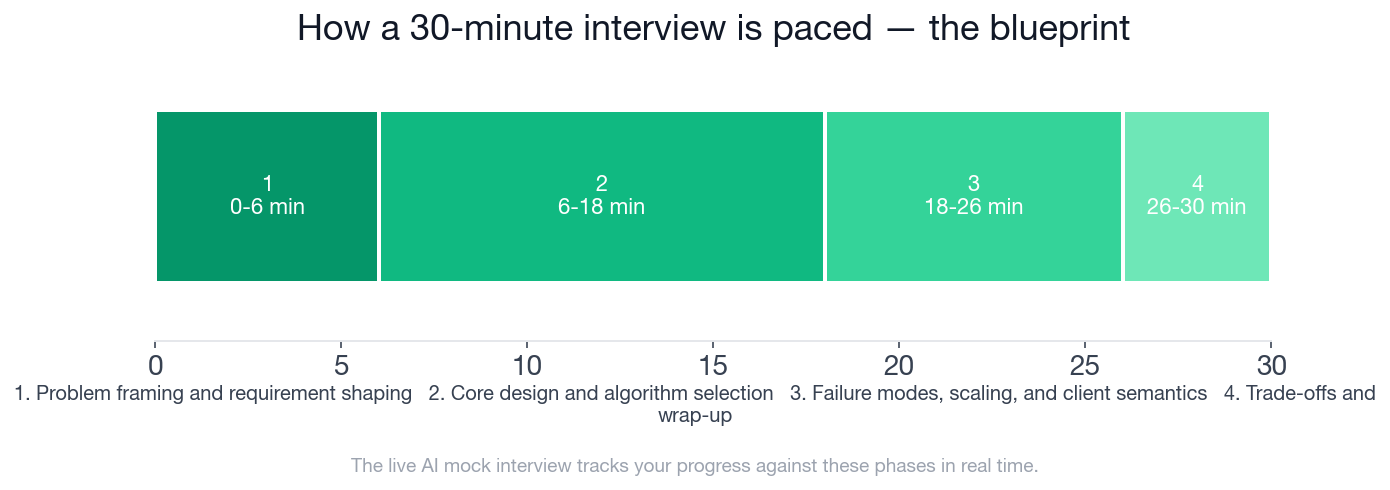
The 30-minute session is paced into four phases, from requirement framing through the trade-off wrap-up, each with its own checklist.
- ✓Asks who the limiter keys on, such as API key, account, endpoint, or IP fallback
- ✓Clarifies whether bursts should be allowed or smoothed
- ✓Clarifies difference between per-minute rate limit and daily quota semantics
- ✓States assumptions about scale or acceptable approximation if exact scale is not given
- ✓Defines where requests are checked, such as gateway-first with optional service-level protections for expensive endpoints
- ✓Explains a reasonable policy model including tier, endpoint class, and custom enterprise overrides
- ✓Chooses an algorithm and ties it to behavior, for example token bucket for burst handling or sliding window for smoother fairness
- ✓Describes how counters are stored or updated across instances, such as Redis or another low-latency shared store
- ✓Explains what happens on allow versus deny paths in request processing
- ✓Addresses hot keys, gateway fan-out, or high-cardinality client traffic in some practical way
- ✓Describes 429 behavior with at least one useful response header such as Retry-After
- ✓Discusses datastore or cache failure behavior and whether the system fails open, fails closed, or uses degraded local protection
- ✓Mentions daily quota implementation separately from per-minute limits, not as the exact same counter path
- ✓Includes at least basic monitoring signals like throttle rate, allow rate, latency, and error rate
- ✓Summarizes a recommended design and why it fits this API platform
- ✓Identifies one limitation of the design and a realistic follow-up improvement
- ✓Keeps the solution within mid-level scope and operationally plausible
This is the same blueprint InterviewStack.io's AI interviewer tracks in real time. Miss a checklist item and it shows up in your phase-by-phase feedback, not just a final score.
Ready to Run This Scenario Live?
Reading Micah's four mistakes is the easy 20 minutes. The Backend Developer Rate Limiting and Quota Management AI mock interview runs you through this exact scenario for real: the interviewer adapts its follow-ups to what you actually say, tracks the blueprint above in real time, and hands you rubric-mapped feedback the moment you finish. If you want to drill the underlying concepts first, algorithms, distributed counters, HTTP throttling semantics, before taking the full session, the Backend Developer question bank covers rate limiting and quota management questions by difficulty. If distributed systems trade-offs are your weaker spot generally, we also walked through a Backend Developer distributed caching interview. And if you want to see what backend teams are hiring for right now, browse current Backend Developer openings or the broader preparation guides library.
FAQ
Q. What does the Backend Developer Rate Limiting and Quota Management interview actually cover?
The 30-minute interview covers where to enforce limits (gateway versus service), choosing a rate limiting algorithm (token bucket, leaky bucket, fixed window, or sliding window), keeping counters consistent across gateway instances, 429 response semantics including Retry-After, handling daily quotas for enterprise customers separately from per-minute limits, and degrading gracefully when the counter store is slow or unavailable. It is scored across four rubric dimensions: Interviewer Objectives Alignment (30 points), Level-Specific Expectations (30 points), Technical Proficiency (20 points), and Communication and Problem Solving (20 points).
Q. Should I use a token bucket or a sliding window for API rate limiting?
Either can work, and the interview is testing whether you can justify the choice rather than name-drop an algorithm. A token bucket tends to fit tiered per-minute limits well because it tolerates short bursts without extra bookkeeping, while a sliding window gives smoother, fairer enforcement at a slightly higher storage cost. The stronger answer ties the choice back to this scenario's actual requirement, per-API-key limits with reasonable burst tolerance, rather than defaulting to whichever algorithm you remember best.
Q. What should a 429 response include?
At minimum, a clear 429 Too Many Requests status and a Retry-After header telling the client when it is safe to try again. Many designs also add rate-limit-remaining and rate-limit-reset headers so well-behaved clients can self-throttle before they hit the wall. The interview rewards candidates who mention this proactively rather than only after being asked what the client sees when it is over its limit.
Q. Can the same counter handle both a per-minute rate limit and a daily quota?
No, and this is the single most common point loss in this interview. A per-minute limit needs a fast, frequently resetting counter, while a daily quota needs a cumulative counter tied to a calendar-day boundary with different durability expectations, since enterprise customers may treat it as a billing-relevant number. Reusing the same counter path for both, for example by just widening the window, misses the checklist item that explicitly expects the two to be handled separately.
Q. What level is this interview calibrated for, and how long does it run?
It runs 30 minutes and is calibrated for a mid-level Backend Developer (2 to 5 years of experience). You are expected to clarify a few key requirements up front, propose a practical design using common infrastructure patterns, and recognize at least one accuracy-versus-latency trade-off, but you are not expected to design a globally perfect, provably correct quota system.
Q. How can I practice this exact interview?
The Backend Developer Rate Limiting and Quota Management AI mock interview runs the same scenario with an interviewer that adapts its follow-ups to your actual answers and scores you against the blueprint above. If you want to drill specific concepts first, the Backend Developer question bank breaks the topic down by difficulty.
The Two Limits Were Never the Same Problem
A free-tier rate limit and an enterprise daily quota look related because they both cap requests, but they run on different clocks, different durability requirements, and different failure tolerances. The interview isn't testing whether you know Redis. It's testing whether you notice that "quota" and "rate limit" are two different problems wearing the same word, before you've already built one counter for both.
Topics
Ready to practice?
Put what you've learned into practice with AI mock interviews and structured preparation guides.