
No Language Owns the Backend in 2026
Backend development is one of the most fragmented roles in software engineering. Java accounts for 39% of postings. Python follows at 34%. TypeScript has grown to 17%, JavaScript sits at 15%, Go holds 10%, and C# takes 8%. Not one of these languages clears the 50% threshold that would make it universally expected. For comparison, Data Engineer postings show Python at 71% and SQL at 71%: both clearly table stakes. Backend Developer has no equivalent.
We analyzed 7,305 distinct active Backend Developer postings on the InterviewStack.io job board as of June 2026, with skills extracted from descriptions and synonyms normalized across equivalent terms.
The shared layer that cuts across every language specialization is infrastructure: AWS (42%), CI/CD (37%), Kubernetes (35%), Docker (32%). But here is what the salary data reveals about that shared layer: it does not earn a premium. Java, the most common language at 39% of postings, has a median US base salary of $132,300, nearly $14,000 below the $146,000 role baseline. Docker sits $5,100 below baseline. CI/CD sits $10,200 below. The skills that command real premiums (Terraform at $164K, Go at $160K, LLMs at $165K) appear in fewer than one in eight listings.
Common does not mean high-value. It means expected.
Key Findings
- 7,305 distinct active postings analyzed, with no single skill appearing in more than 43% of them: no table-stakes tier exists.
- Java leads at 39.3% but carries a US median salary of $132,300, roughly $13,700 below the $146,000 role baseline.
- Go (10.3% of postings) earns a US median of $160,000: $14K above baseline and $27.7K above Java's median.
- OpenAI API integration ($183K, n=27) tops the salary table; Data Modeling ($167.3K, n=34), LLMs and Prometheus (both $165K), and Terraform ($164K) carry premiums of $18K to $37K above baseline.
- Only 2% of postings are entry-level (148 of 7,305); senior and staff together make up 51.7% of the market.
- 31.6% of postings are remote, making Backend Developer one of the more flexible roles in the dataset.
- Docker plus Kubernetes co-occur with a lift of 2.12: the tightest skill pair in the entire market.
- The market is genuinely global: the US holds only 18.7% of postings, with India (11.0%), Germany (4%), Canada (3.8%), and the UK (3.2%) all substantial markets.
What Skill Families Cut Across Every Stack?
Group every individual skill into the higher-level family it belongs to and count how many postings ask for at least one skill in that family. The role's actual shape emerges.
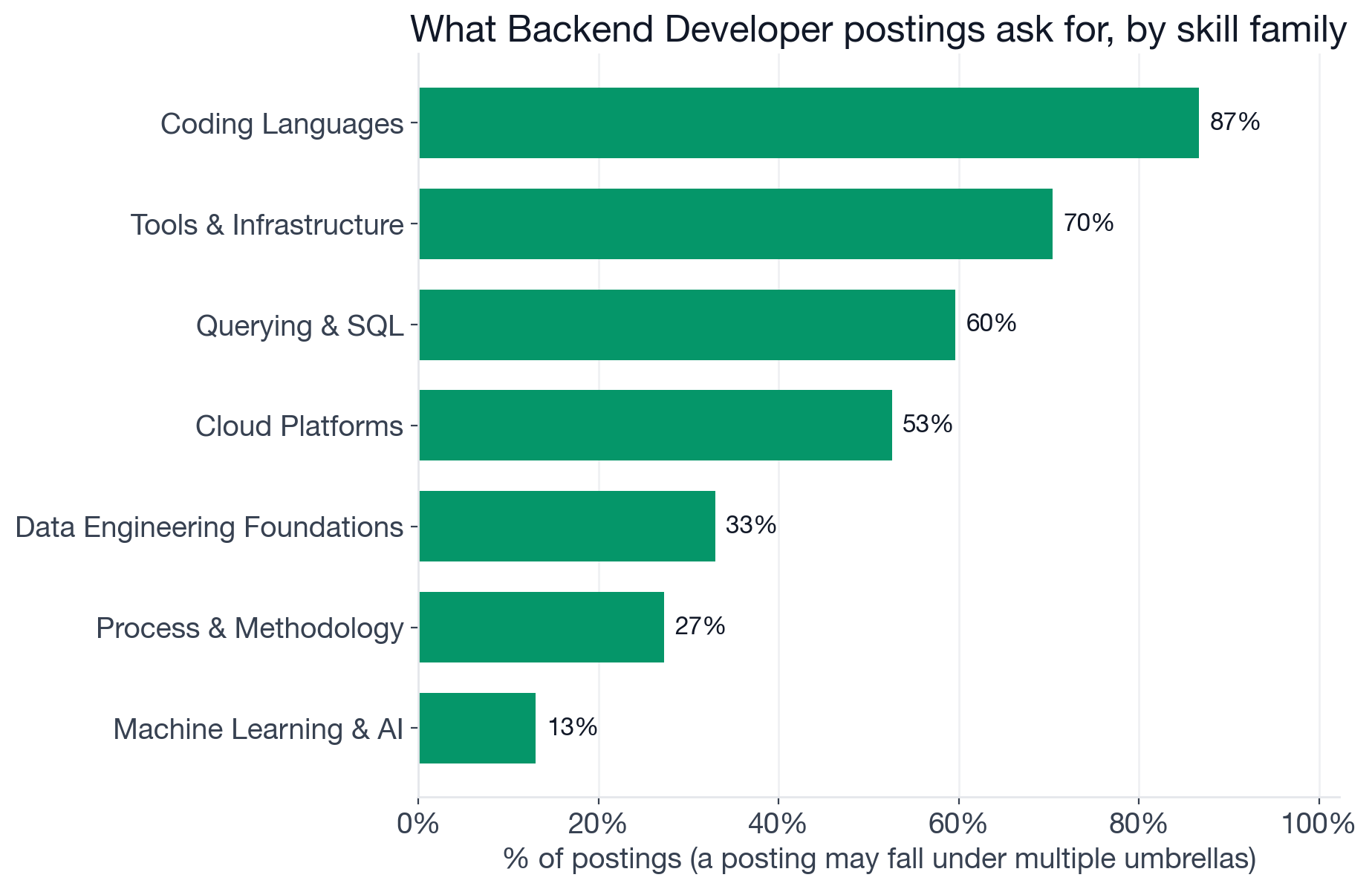
Share of Backend Developer postings that ask for at least one skill in each family. A posting that mentions both Python and Java counts once under "Coding Languages."
Nearly every posting touches the engineering patterns layer: APIs, CI/CD, microservices, distributed systems, REST, and observability appear across 94.9% of listings. That near-universality is what "backend" means at the job-description level, regardless of language or stack.
The Coding Languages family, at 86.7%, confirms that Backend Developer is still fundamentally a programming role, not a configuration or tooling role. Tools and Infrastructure (70.4%) reflects the reality that backend work now includes owning the deployment and runtime, not just the code. Querying and SQL at 59.6% tells you that most backend engineers are still expected to know how to write and optimize database queries, even if they are not the primary owner of the data layer.
Cloud Platforms at 52.6% is the dividing line: just over half of postings explicitly name a cloud. The other half assumes it implicitly or operates in on-premises environments. Among those that do name a cloud, AWS dominates at 42% of all postings.
The Machine Learning and AI family at 13.0% requires careful framing. That figure measures postings where building or integrating AI systems is an explicit job requirement: large language model APIs, retrieval-augmented generation pipelines, generative feature work. It does not capture how many Backend Developers use AI tools in their day-to-day work. The JetBrains State of Developer Ecosystem 2025 found 90% of developers regularly use at least one AI tool at work; the Pragmatic Engineer AI Tooling Survey 2026 found 95% using AI tools at least weekly. For Java, the most common backend language, GitHub Octoverse 2025 reports that Copilot generates 61% of code written by Java developers. The 13% explicit rate measures who is building AI systems. The ambient rate of AI-assisted backend work is close to universal.
The Three Tiers (and the Missing One)
The standard tier analysis produces a surprise: there is no table-stakes tier. No individual Backend Developer skill appears in 50% or more of postings.
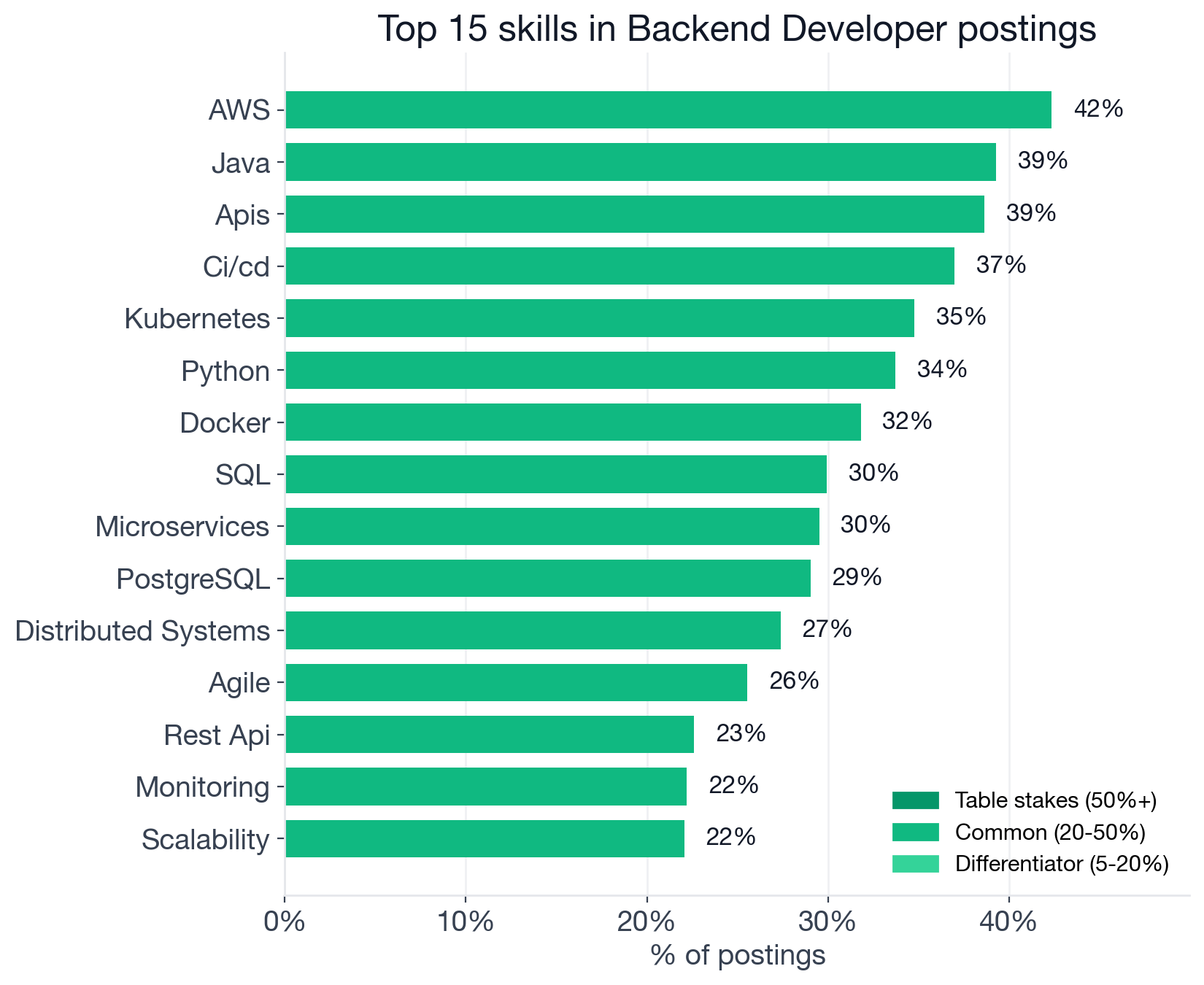
Individual Backend Developer skills by share of listings. No skill exceeds 50%. Skills in the 20-50% range are the common tier; 5-20% are differentiators.
Common tier (20-50% of postings):
Seventeen skills sit in this band. AWS leads at 42.3%, but even at that frequency it is not universal. Java and APIs are both near 39%. Kubernetes (35%), CI/CD (37%), Docker (32%), SQL (30%), Microservices (29.5%), and PostgreSQL (29%) form the cloud-and-data layer. Below them: Distributed Systems (27.4%), Agile (25.5%), REST API (22.6%), Monitoring (22.2%), Scalability (22.1%), Kafka (21.3%, the open-source distributed event-streaming platform), and Observability (20.6%).
A few signals worth naming: PostgreSQL appears in 29% of postings versus MySQL's 14.5%, a 2:1 gap that reflects the current default choice in new backend projects. Kafka at 21.3% tells you event-driven architecture has crossed from specialization into common expectation. Observability at 20.6% signals that companies are explicitly asking engineers to instrument, not just build. Agile at 25.5% carries the steepest salary discount among common-tier skills ($119.3K, a $26.7K drag below baseline): a high Agile count often correlates with IT-services or outsourced work rather than product engineering, where compensation is structurally lower.
Differentiator tier (5-20% of postings):
Thirty-three skills sit in this band, ranging from Azure (19.8%) to Jenkins (6.7%). The ones that matter most for compensation are covered in the next section, but the language and framework choices here reveal the market's distinct niches:
- Node.js: 19.7% (Backend Developer + Node.js openings)
- Go: 10.3% (browse Backend Developer + Go openings)
- TypeScript: 17.1% (Backend Developer + TypeScript openings)
- Spring (the dominant Java application framework): 14.5%
- Redis (an in-memory data structure store used for caching and message brokering): 13.0%
- GraphQL (a query language for APIs, an alternative to REST): 9.1%
- Terraform (infrastructure-as-code tooling): 8.1% (Backend Developer + Terraform openings)
- Grafana (a visualization and dashboarding tool for metrics): 6.9%
These skills appear in a minority of postings. Their salary numbers are the highest in the dataset.
Why the Most Common Skills Don't Pay the Most
These figures are US-only base salary, where wage-transparency laws produce consistent, directly comparable disclosure. Equity, bonuses, RSUs, and sign-on are not included; total compensation at growth-stage tech companies runs meaningfully higher than these figures.
The overall US base salary median for Backend Developers is $146,000 (n=610 postings with disclosed salary data).
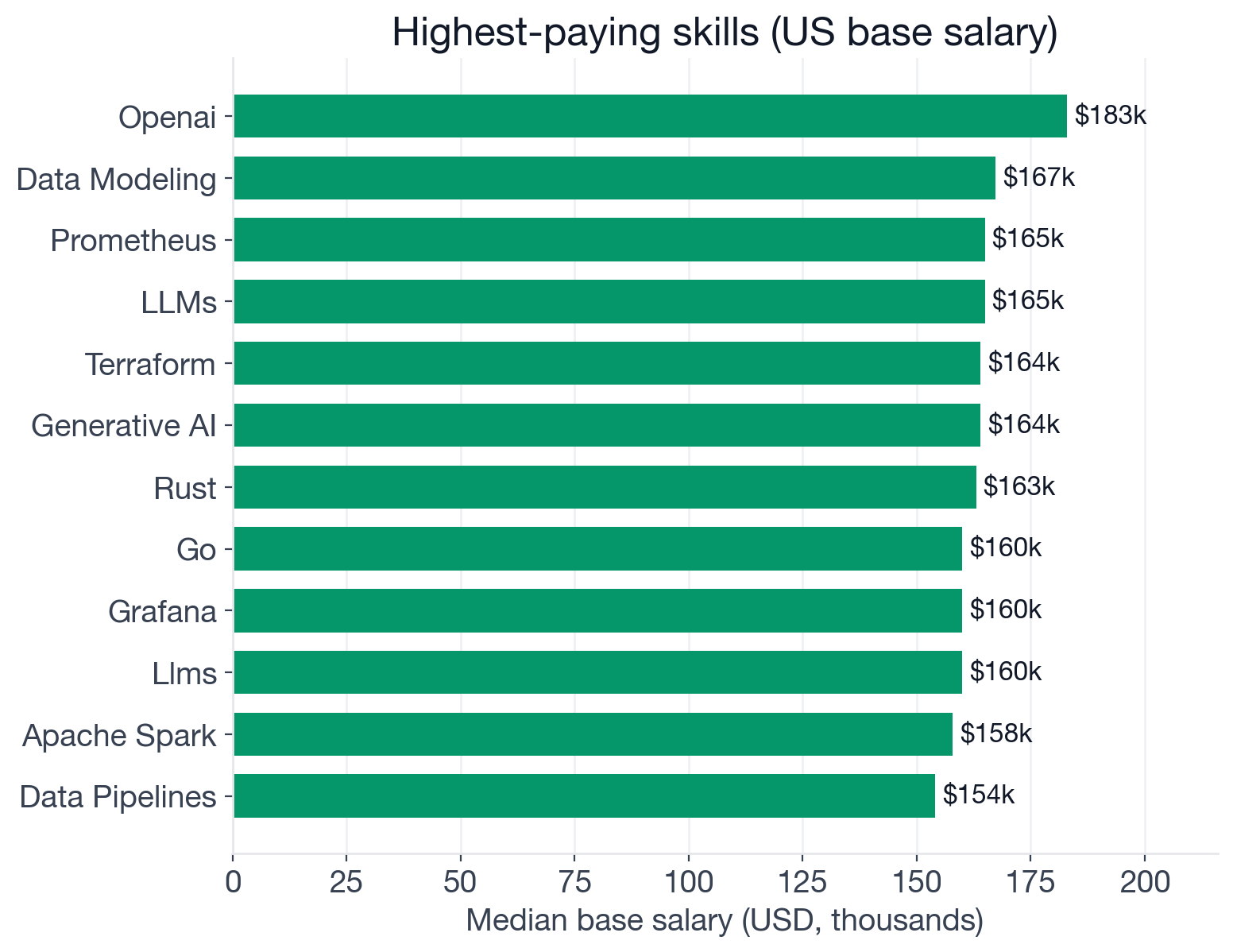
Median US base salary for Backend Developer postings that mention each skill. Skills require n≥25 US data points to appear. Baseline: $146,000.
The pattern inverts what most job seekers expect. The skills that dominate the hiring volume sit at or below the $146K baseline:
| Skill | Frequency | US Median | vs. Baseline |
|---|---|---|---|
| Java | 39.3% | $132,300 | -$13,700 |
| CI/CD | 37.0% | $135,800 | -$10,200 |
| Docker | 31.8% | $140,900 | -$5,100 |
| Agile | 25.5% | $119,300 | -$26,700 |
| Python | 33.7% | $148,500 | +$2,500 |
| AWS | 42.3% | $148,300 | +$2,300 |
The premium-earning skills appear in far fewer postings:
| Skill | Frequency | US Median | vs. Baseline |
|---|---|---|---|
| OpenAI API | < 5% | $183,000 | +$37,000 |
| Data Modeling | < 5% | $167,300 | +$21,300 |
| Prometheus | < 5% | $165,000 | +$19,000 |
| LLMs | < 5% | $165,000 | +$19,000 |
| Terraform | 8.1% | $164,000 | +$18,000 |
| Go | 10.3% | $160,000 | +$14,000 |
| Apache Spark | < 5% | $157,900 | +$11,900 |
| Data Pipelines | 10.2% | $154,100 | +$8,100 |
| Observability | 20.6% | $152,000 | +$6,000 |
| Distributed Systems | 27.4% | $152,000 | +$6,000 |
Skills marked "< 5%" fall below the 5% frequency reporting threshold; salary figures are verified with n≥25 US postings.
OpenAI API integration leads the table at $183K (n=27), a $37K premium over the $146K baseline. Postings that list this skill are building AI-native features directly on top of LLM APIs: a small slice of the Backend Developer market by volume, but the highest-compensating one. Data Modeling at $167.3K (n=34) reflects engineers who own schema design end-to-end at data-intensive companies, where a poorly chosen data structure cascades into system-wide performance problems.
The Go vs. Java gap deserves a direct interpretation. Java is the language of enterprise: large-scale e-commerce, banking, insurance, and outsourced software services. Those market segments often pay at or below the general tech median. Go is the language of infrastructure and platform engineering at companies like cloud providers, developer tooling vendors, and high-throughput services teams, where compensation ceilings are higher. The $27,700 gap between them ($160K for Go, $132,300 for Java) is real, but it is partly a market-composition gap: Go postings are concentrated in a higher-compensation segment of the industry.
Terraform's $18K premium follows the same logic. An engineer who writes Terraform to provision production infrastructure is operating at the intersection of software engineering and reliability, a profile that commands platform-engineering compensation. The skill itself is a proxy for the kind of company and role it signals.
The Observability signal is particularly trustworthy: $152,000 at n=188, a large and stable sample. Companies that explicitly list observability tools in a backend job description are generally running complex distributed systems at scale, where operational experience earns real money. The Distributed Systems premium ($152K, n=252) is the largest-sample premium in the entire dataset and the most reliable individual signal in the salary data. Browse Backend Developer + Distributed Systems openings to see the kinds of companies that post these roles.
The Container-Cloud-Delivery Cluster
The strongest co-occurrence signal in the data is between Docker and Kubernetes: 23.5% of postings list both, with a lift of 2.12. That means seeing Docker in a posting nearly doubles the probability of also seeing Kubernetes. These two tools have effectively fused into a single containerization requirement in backend hiring.
| Skill pair | Postings | % of market | Lift |
|---|---|---|---|
| Docker + Kubernetes | 1,715 | 23.5% | 2.12 |
| AWS + Google Cloud | 1,026 | 14.0% | 1.74 |
| AWS + Azure | 1,041 | 14.2% | 1.70 |
| CI/CD + Docker | 1,430 | 19.6% | 1.66 |
| Kubernetes + Microservices | 1,165 | 15.9% | 1.55 |
| AWS + Kubernetes | 1,520 | 20.8% | 1.41 |
| Java + Microservices | 1,145 | 15.7% | 1.35 |
| AWS + CI/CD | 1,533 | 21.0% | 1.34 |
Co-occurrence lift > 1 means the pair appears together more often than individual frequencies would predict. All pairs drawn from skillPairs in the underlying analytics.
Two patterns emerge from these pairs.
The container-cloud-delivery stack runs through nearly every high-lift pair: Docker plus Kubernetes (2.12), CI/CD plus Docker (1.66), AWS plus Kubernetes (1.41). This is the canonical cloud-native delivery loop: containerize the service, run it on managed Kubernetes (EKS, GKE, or AKS), and ship through automated pipelines. The fact that this cluster dominates the pair list tells you it is the dominant architectural pattern in backend hiring right now, regardless of language choice.
The multi-cloud pattern (AWS plus Google Cloud at 1.74, AWS plus Azure at 1.70) has higher lift than most single-cloud pairs. Companies requiring multiple clouds are typically platform-engineering or consulting teams where the engineer needs cloud breadth rather than cloud depth. The Java plus Microservices pair (lift 1.35) confirms Java's dominant role in decomposed service architectures: Spring Boot and its ecosystem remain the enterprise default for microservices. Browse Java-focused Backend Developer openings to see how those roles compose the full stack.
Breaking In and Moving Up: The Seniority Divide
Backend Developer is one of the harder roles to enter, and one of the better roles to advance in.
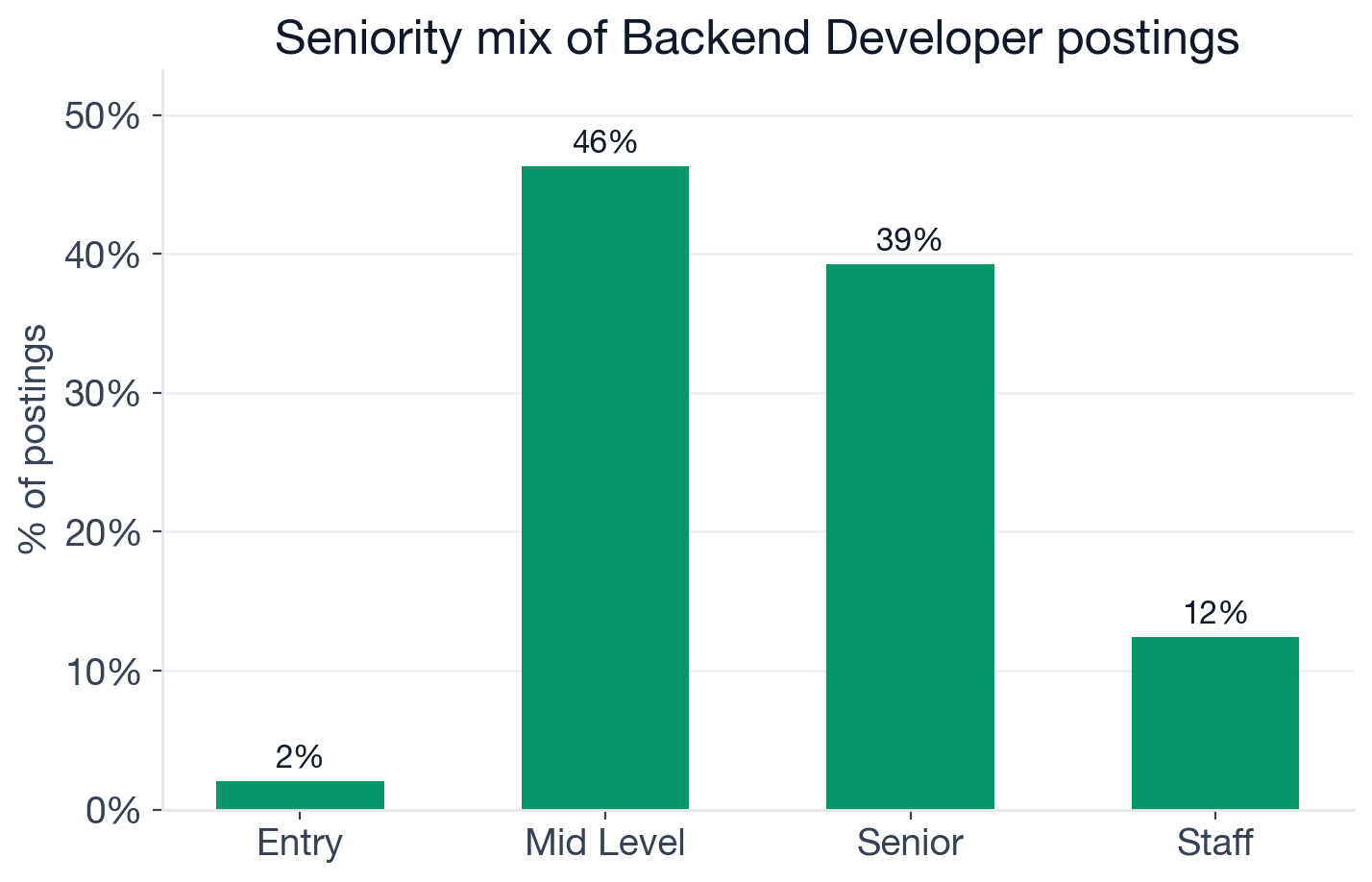
Seniority distribution inferred from job-title keywords. Postings without an explicit signal default to mid-level.
- Mid-level: 46.3% (3,384 postings)
- Senior: 39.3% (2,869)
- Staff / Principal: 12.4% (907)
- Entry: 2.0% (148)
The 2% entry share is low. Companies hiring Backend Developers want production experience with distributed systems, and the interview process reflects it: system design rounds, failure-mode discussions, database performance questions, and hands-on debugging challenges are standard at mid-level and above. Engineers coming from frontend, analytics, or academic backgrounds typically need an intermediate role (junior full-stack, QA engineering, data engineering) before they can pass the Backend Developer onsite bar at serious companies.
The upside is that the senior-and-above tiers together account for 51.7% of the market. The individual-contributor track runs long and deep: staff Backend Developer roles that own large-scale platform architecture are common, not rare, and the salary data shows the ceiling climbs with specialization. Browse senior Backend Developer openings or entry-level Backend Developer openings filtered by level.
Where Are the Jobs, and How Remote-Friendly Is the Role?
Backend Developer is a genuinely global market. The United States holds only 18.7% of postings, a lower share than most senior tech roles.
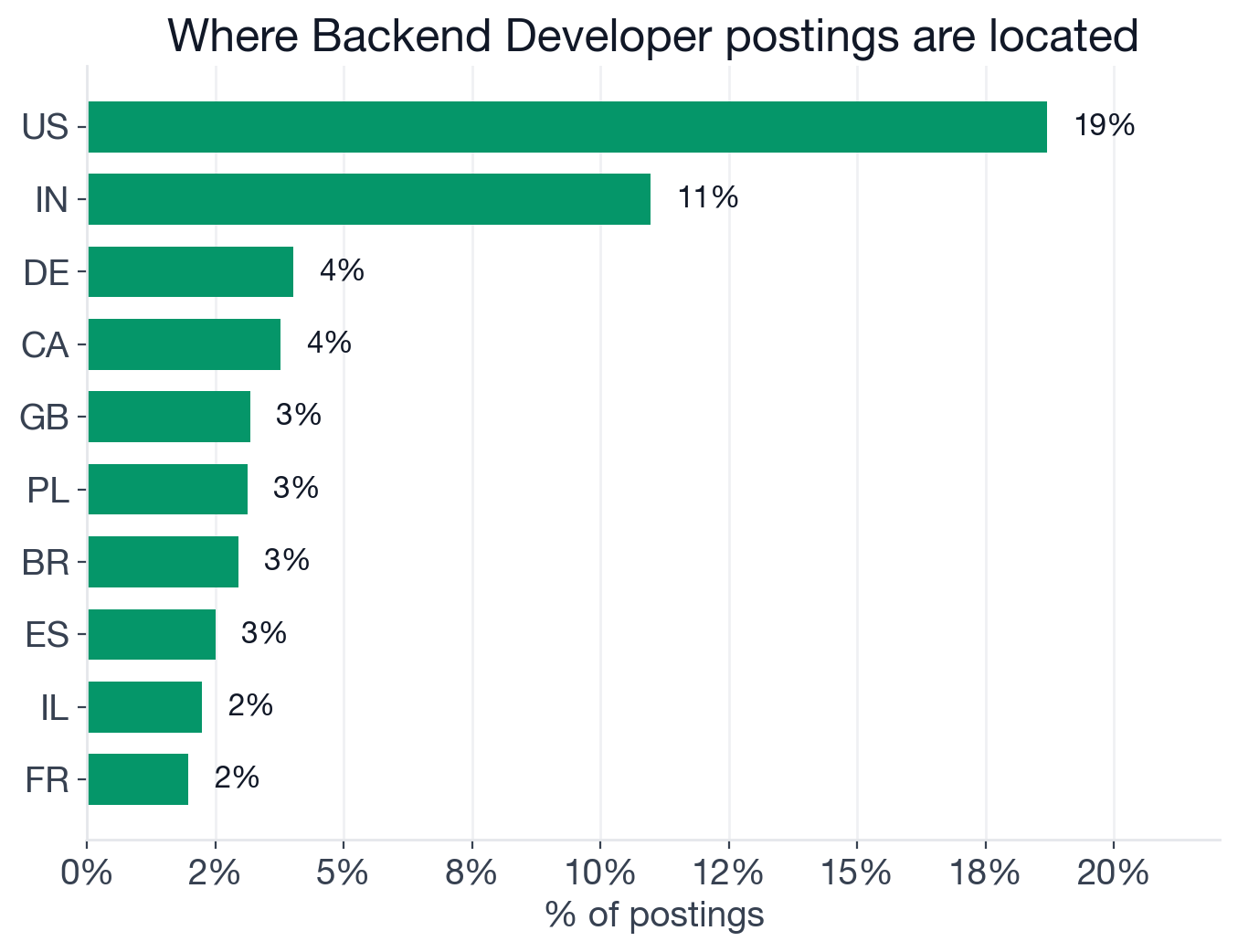
Top countries by share of Backend Developer postings as of June 2026.
- United States: 18.7% (US Backend Developer openings)
- India: 11.0%
- Germany: 4.0%
- Canada: 3.8%
- United Kingdom: 3.2%
- Poland: 3.1%
- Brazil: 2.9%
The distribution is more geographically dispersed than most specialized tech roles. India at 11.0% is a substantial share, reflecting how much backend engineering capacity flows through global software services firms supporting US and UK clients. This geography, combined with the salary geography of those firms, helps explain part of the below-baseline signal for common-tier skills: a Java + CI/CD + Agile listing from a services firm in India or Poland is structurally different from a Java + Kubernetes + Distributed Systems listing from a Series B in Austin.
On work mode, Backend Developer is notably remote-friendly:
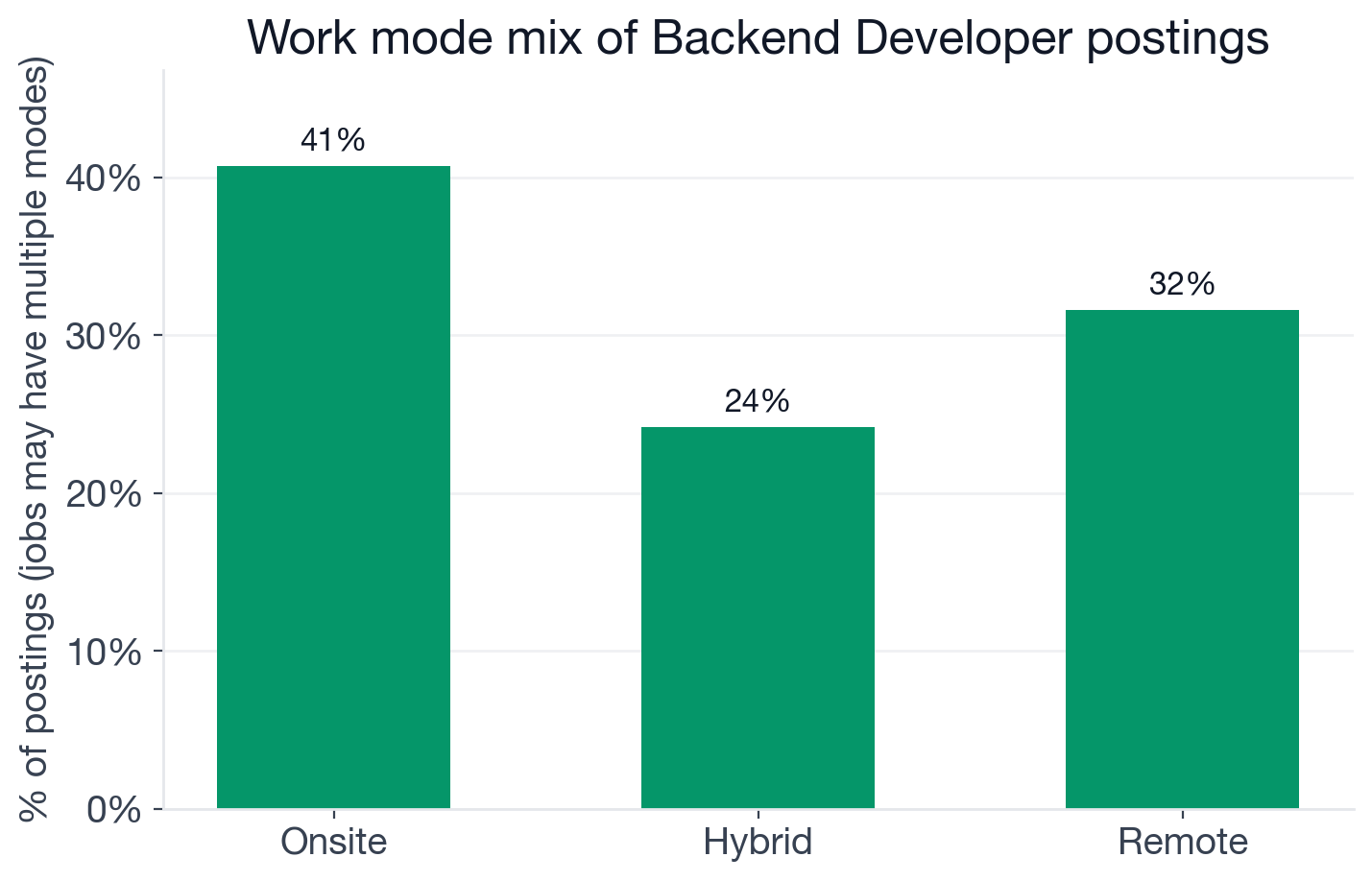
Work mode distribution for Backend Developer postings. Remote (31.6%), hybrid (24.2%), and onsite (40.7%). Additionally, 12.5% of postings had no work-mode tag.
- Onsite: 40.7% (2,976)
- Remote: 31.6% (2,311) (fully-remote Backend Developer openings)
- Hybrid: 24.2% (1,769)
The 31.6% remote share is higher than the Data Engineer role at 27% and meaningfully above typical engineering roles. Backend development, involving asynchronous collaboration on cloud-hosted codebases, translates well to distributed teams. The remote segment concentrates in product-led SaaS, fintech, and developer-tools companies, which is also the segment where Go, Terraform, and observability skills cluster, and where compensation ceilings are highest.
How to Use This in Your Job Search
The data points to a clear split in how to use it, depending on where you are in your progression.
Targeting entry to mid-level: The container-and-cloud layer is the clearest path into the market. AWS, Docker, Kubernetes, and CI/CD collectively appear in 32-42% of postings. No one skill gets you past every filter, but missing all of them filters you out of the majority of the market. Pick one cloud to know well, get hands-on with containers and orchestration at least to the "can explain the trade-offs" level, and make sure your system design fundamentals cover distributed systems basics. The question bank has backend-specific system design and database questions that reflect what these interviews actually test.
Targeting salary growth: The salary table above is unusually clear about direction. Java, Docker, and CI/CD are widely distributed across lower-compensation market segments, which pulls their medians below the role baseline. The premium is in the specialized platform layer: Go, Terraform, LLM integration, observability tooling (Prometheus, Grafana), and distributed systems experience. None of these are quick additions, but each represents a real move up the compensation curve. Distributed Systems experience at $152K and n=252 US data points is the most statistically reliable premium signal in the dataset.
For interview preparation: Backend Developer interviews test system design at scale, API design, database schema and query performance, and distributed systems failure modes. AI mock interviews let you practice full rounds under realistic conditions with on-demand feedback. Our interactive courses cover the most commonly tested foundational areas: algorithms, SQL and database design, and system design principles.
For the job search itself: Browse current Backend Developer openings on the InterviewStack.io job board, with filters for language, cloud platform, work mode, and seniority level. The board updates daily from active company career pages.
FAQ
Q. What skills do Backend Developers need in 2026?
No single skill appears in more than 43% of Backend Developer postings. The shared layer across all language specializations is cloud infrastructure: AWS (42%), CI/CD (37%), Kubernetes (35%), and Docker (32%). Individual language stacks split between Java (39%), Python (34%), TypeScript (17%), Go (10%), and C# (8%). Observability, microservices, distributed systems, and scalability all appear in 20-28% of postings.
Q. What is the median salary for a Backend Developer in 2026?
The median US base salary for Backend Developer postings with disclosed salary data is $146,000 (n=610). That figure is base pay only; equity, bonuses, and sign-on are not included. Total compensation at growth-stage tech companies runs meaningfully higher.
Q. Which Backend Developer skills pay the highest salary in 2026?
The highest-paying Backend Developer skills in US postings are OpenAI API integration ($183K, n=27), Data Modeling ($167.3K, n=34), Prometheus and LLMs (both $165K, n=28 and n=47), and Terraform ($164K, n=69). These carry premiums ranging from $18K to $37K above the $146K role baseline. Go ($160K, n=50) adds $14K. Observability ($152K, n=188) and Distributed Systems ($152K, n=252) offer the most statistically reliable premiums.
Q. Is Go worth learning for Backend Developer jobs in 2026?
Yes. Go appears in 10.3% of Backend Developer postings, a smaller slice than Java or Python, but commands a US median salary of $160K: $14K above the $146K role baseline and $27.7K above Java's $132.3K median. Go postings cluster in growth-stage and high-scale infrastructure teams, where the compensation ceiling is higher.
Q. How hard is it to get an entry-level Backend Developer job in 2026?
Genuinely difficult. Only 2% of Backend Developer postings are explicitly entry-level (148 of 7,305 analyzed). Mid-level is the dominant tier at 46.3%, and senior-plus roles make up 51.7% of the market. Companies hiring at the senior and staff levels expect production-grade distributed systems experience, which is hard to acquire without prior backend work.
Q. Are Backend Developer jobs remote-friendly in 2026?
More than most roles. 31.6% of Backend Developer postings are tagged remote, versus roughly 27% for Data Engineer roles. The market is also genuinely global: the US accounts for only 18.7% of postings, with significant volume in India (11.0%), Germany (4%), Canada (3.8%), and the UK (3.2%).
Q. What is the dominant skill combination for Backend Developers in 2026?
Docker and Kubernetes are the tightest pair in the data: 23.5% of postings list both, with a co-occurrence lift of 2.12, meaning Docker nearly doubles the likelihood of Kubernetes appearing in the same listing. Above that container layer, AWS plus CI/CD (lift 1.34), AWS plus Kubernetes (lift 1.41), and Kubernetes plus Microservices (lift 1.55) form the cloud-native delivery cluster that defines modern backend infrastructure.
What This Means for Your Next Move
Backend Developer in 2026 is a market that rewards specialization more than breadth. Java, Docker, and CI/CD are necessary: they get you past the initial filter in most postings. But they are not sufficient for the upper half of the compensation range because they are too widely distributed to differentiate one candidate from another. The pay premium lives in the overlap between infrastructure depth (Terraform, Kubernetes at real scale, observability tooling) and the highest-growth architectural patterns (distributed systems, AI integration). Pick a specialization that matches the companies you actually want to work for, build it to the point where you can discuss failure modes and trade-offs from real experience, and let the fragmentation of the language market work in your favor: Go, TypeScript, and Python each open distinct market segments with distinct compensation profiles. Choosing is not limiting.
Topics
Ready to practice?
Put what you've learned into practice with AI mock interviews and structured preparation guides.