
Which Role Should You Pick in 2026?
Backend Developer is the role that builds the product; DevOps Engineer is the role that builds the platform the product runs on. Among US postings, Backend pays a $150,000 median base salary versus $131,500 for DevOps (an $18,500, 14.1% gap), but the two markets are nearly the same size at 7,257 and 6,908 active postings on the InterviewStack.io job board in May 2026. The skill sets share about 43% of their top-30 entries (cloud, containers, CI/CD, Python, monitoring), so the choice is less about learning a new universe and more about which side of the wire you want to live on: writing the application logic, or operating the infrastructure underneath it.
| Backend Developer | DevOps Engineer | |
|---|---|---|
| Median US base salary | $150,000 (n=545) | $131,500 (n=1,103) |
| Active postings | 7,257 | 6,908 |
| Top skill | AWS (43%) | CI/CD (63%) |
| Entry-level share | 2.0% | 2.0% |
| Remote share | 30% | 23% |
| Skill overlap (Jaccard) | 43% | 43% |
Key Findings
- Median US base salary is $150,000 for Backend Developer (n=545) versus $131,500 for DevOps Engineer (n=1,103), an $18,500 (14.1%) premium for Backend.
- Backend Developer has 7,257 active postings versus 6,908 for DevOps Engineer, a 1.05x volume ratio that makes these two of the most evenly-matched career markets in tech.
- The two roles share about 43% of their top-30 skill sets, dominated by AWS, Kubernetes, Docker, CI/CD, Python, monitoring, and observability.
- Entry-level access is equally narrow: 2.0% of postings on each side are explicitly entry-level, one of the tightest doors in tech.
- Backend is more remote-friendly (30% vs 23%) and more globally distributed; DevOps is 29% US-anchored and leans more hybrid (33% vs 23%).
- Pulumi ($170,000) leads DevOps premiums; Rust ($179,500) leads Backend, with LLM-related skills paying $20-25K above baseline on both sides.
What Does Each Role Actually Do?
Backend Developer is an application-engineering role. The week is writing API services in Java, Python, or TypeScript that talk to PostgreSQL, Redis, and Kafka, designing the REST or gRPC contracts other teams consume, modeling data so that the database does not become the bottleneck, and shipping features through CI/CD into containers that run on someone else's Kubernetes cluster. The exclusive-skill list (Microservices 31%, Distributed Systems 26%, PostgreSQL 25%, Kafka 19%, Node.js 18%, TypeScript 16%, Spring 14%) is the modern web-services stack. The output is product functionality that an end user or another team's service actually consumes.
DevOps Engineer is a platform-engineering role. The work is provisioning and maintaining the cloud accounts, Kubernetes clusters, CI/CD pipelines, observability stacks, and secrets management that every application team depends on. The exclusive list reads like an operations playbook: Infrastructure as Code at 35%, Linux at 30%, Bash at 27%, Jenkins at 25%, Ansible at 23%, GitLab at 20%, Prometheus at 20%, Grafana at 19%. The output is a paved road: a Terraform module that spins up a service, a GitOps pipeline that deploys it, a Prometheus dashboard that watches it, and an on-call rotation that keeps it healthy at 3 a.m. Think of Backend as the team writing the code that ships; DevOps as the team building the conveyor belt and runway it ships on.
What Skills Do Both Roles Require?
Both roles share the modern cloud and operations core: AWS, Kubernetes, Docker, CI/CD, Python, monitoring, and observability all appear in both top-30 lists. The Jaccard overlap of 43% is the second-clearest signal in this comparison, and the practical translation is that an engineer who has spent two years on either side already has a head start on the other.
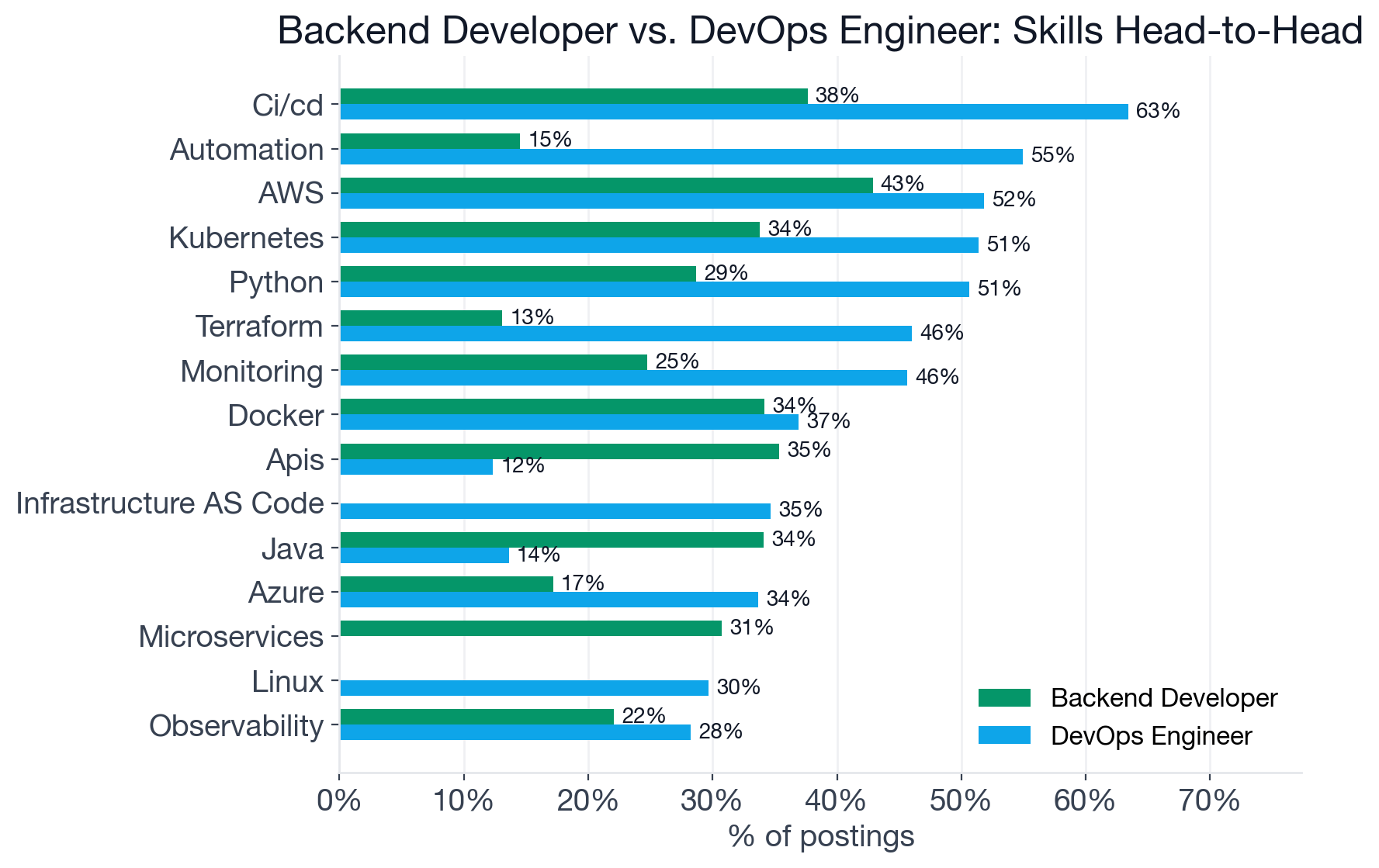
Share of postings that ask for each skill, comparing Backend Developer (n=7,257) to DevOps Engineer (n=6,908). Skills shown are drawn from the union of each role's top set.
The weights are not symmetric. The top five shared skills (CI/CD, AWS, Kubernetes, Python, monitoring) sit in roughly half of DevOps postings or more (46-63%) while Backend tops out at AWS's 43% across the same set. The gap widens on platform-defining tooling: CI/CD splits 63% versus 38%, automation 55% versus 15%, Terraform 46% versus 13%. Each gap tells the same story: DevOps owns the platform, Backend ships against it. On Docker (37% vs 34%) and observability (28% vs 22%) the two come closer to parity, but the framing still differs: DevOps builds the cluster and the dashboards; Backend writes code that runs inside them and emits metrics into them.
Where Do the Roles Diverge?
Exclusive to Backend Developer
The Backend side of the fork is the web-services and data-layer stack that does not show up on a DevOps job description.
- Microservices: 31%
- Distributed Systems: 26% (Backend + Distributed Systems openings)
- PostgreSQL: 25%
- Kafka: 19% (Backend + Kafka openings)
- Node.js: 18%
- TypeScript: 16%
- NoSQL: 15%
- JavaScript: 15%
- Spring: 14%
- MySQL: 13%
Backend owns the service boundary and the data underneath it. A posting that asks for Microservices (31%), Distributed Systems (26%), PostgreSQL (25%), and Kafka (19%) expects the candidate to reason about consistency, latency, partial failure, and event flow as daily design work. The day is spent inside a service codebase in Java, Node.js, TypeScript, Spring, or Python, not inside a Terraform module.
Exclusive to DevOps Engineer
The DevOps side is the infrastructure-as-code, CI, configuration-management, and observability stack that defines platform engineering.
- Infrastructure as Code: 35% (DevOps + IaC openings)
- Linux: 30%
- Bash: 27%
- Jenkins: 25%
- Ansible: 23%
- GitLab: 20%
- Prometheus: 20%
- Grafana: 19%
- GitHub Actions: 18%
- Azure DevOps: 13%
DevOps roles assume the platform is defined in repeatable text, not clicked through a console (IaC at 35%), and the day-to-day tooling lives at the shell (Linux 30%, Bash 27%). The presence of Jenkins, GitLab, GitHub Actions, and Azure DevOps in the same exclusive list signals that DevOps engineers are expected to be portable across CI vendors. Prometheus and Grafana at 20% and 19% mean a real share of postings want a candidate who can stand up an observability stack from scratch, not just read existing dashboards.
Which Pays More?
Among US postings, Backend Developer leads at a $150,000 median base salary (n=545) versus $131,500 for DevOps Engineer (n=1,103), an $18,500 (14.1%) gap. Salary numbers below are US-only base salary. Equity, RSUs, bonus, and sign-on are not disclosed in postings and are not in this dataset, so total compensation at top employers runs meaningfully higher than these figures, particularly at large product companies for Backend and at hyperscalers and finance for DevOps.
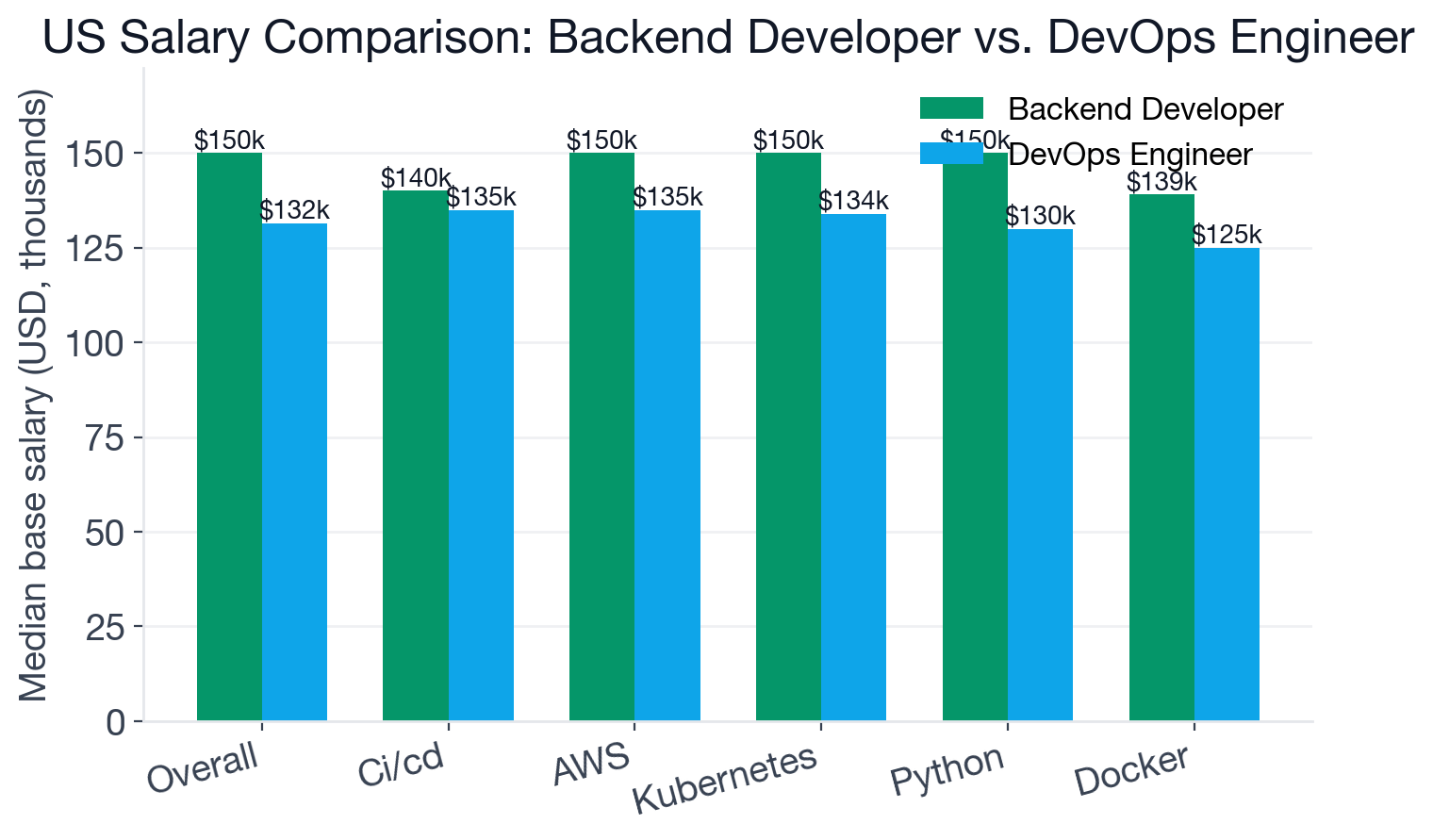
Median US base salary in USD for postings that mention each skill, restricted to US postings with structured salary data.
The 14% headline gap is best read as a product-versus-platform premium. The companies bidding hardest for Backend talent are product companies whose revenue depends on shipping application features; the companies bidding for DevOps talent include those same employers plus a long tail of services firms and large enterprises where the platform team is a cost center. The wider DevOps sample (n=1,103 versus 545) pulls the median toward the enterprise middle of the market, while the Backend sample is more concentrated in product-first employers paying at the high end.
At the skill level, the premium pattern flips for specialists. The biggest Backend premiums attach to systems and AI specialties: Rust at $179,500 (n=38, about $29.5K above baseline), Data Modeling and Generative AI both at $175,000 (about $25K above), LLMs, OpenAI, and Machine Learning all at $170,000 (about $20K above), and Observability at $168,900 (n=149, about $18.9K above). C++ at $168,000 and Terraform at $167,000 round out the top tier, both signals that Backend roles paying at the top of the band expect engineers who can drop into systems work or own their own infrastructure.
For DevOps, the biggest premiums attach to modern infrastructure tooling and SaaS observability. Pulumi leads at $170,000 (n=39, about $38.5K above the $131,500 baseline), the steepest single-skill premium in the comparison, reflecting how new the multi-language IaC category still is. OpenTelemetry and PagerDuty both clear $160,000 (about $28.5K above), and Datadog at $159,400 (n=88) sits just below. The AWS-serverless cluster (Lambda $155K, ECS $154,100) and the AI cluster (LLM $152,100, Machine Learning $151,200, LLMs $150,900, RAG $150,100) all land near $150-155K. Notice that GitOps ($150,000), Distributed Systems ($150,000), and IAM ($150,000) match the Backend baseline exactly: a DevOps engineer with those specialties earns at the Backend median rate.
Which Has More Job Openings?
The volume question has an unusually flat answer. Backend Developer's 7,257 active postings edge out DevOps Engineer's 6,908 by just 349 listings, a 1.05x ratio that makes these two of the most evenly-matched roles in tech. The structural reason is symmetric demand: every company that runs a software product needs Backend engineers to build it and DevOps engineers to operate the platform it runs on. Where many comparisons feature a clearly larger pool, here the choice does not penalize you on volume either way.
The accessibility picture is identically narrow on both sides. Entry-level postings make up 2.0% of Backend Developer listings (144 of 7,257) and 2.0% of DevOps Engineer listings (139 of 6,908), one of the tightest entry doors in tech. Companies expect production experience for both: shipping a service for Backend, owning infrastructure for DevOps. Career switchers typically route through associate-engineer, support-engineer, or platform-intern roles before stepping into either title. The senior tiers tell different stories: Backend splits almost evenly between mid-level and senior individual contributors (43% each, plus 12% staff), while DevOps is sharply mid-heavy (56% mid-level, 30% senior, 12% staff), which says DevOps teams tend to scale by adding mid-level operators while Backend teams scale by adding senior engineers who can own a service end-to-end.
Geography reflects the buying patterns. DevOps is 29% US with India (13%), the UK (5%), Germany (4%), Canada (3%), Australia (3%), and Poland (3%) trailing, mirroring where large enterprise IT spend concentrates. Backend is only 17% US, with a wider European and Latin American long tail (Germany 4%, Poland 3%, Brazil 3%, Canada 3%, UK 3%, Spain 3%, Portugal 3%). Work-mode reads the same way: 30% of Backend postings are remote versus 23% for DevOps, and DevOps leans more hybrid (33% vs 23%) because platform teams need office access for incident response and on-call. The top hiring lists look more alike than different at the very top. Backend's leaders are staffing and services firms placing engineers at product companies (AgileEngine at 519 postings, PradeepIT at 103, Nexthire at 84), with product employers like Coupang (65), Tether (46), and Encora further down the list. DevOps is also led by staffing firms (Softtest Pays Pty Ltd at 101 postings and AgileEngine at 91 take the top two slots, with recruiter Boardroom Appointments at 52 in fifth), but large enterprises and consultancies show up far higher on the DevOps list than on the Backend one: Accenture (76), Booz Allen Hamilton (62), ING (50), PricewaterhouseCoopers (49), Barclays (49), and Thales Group (42) all rank in the top nine. The signal is not that DevOps hiring is enterprise-dominated, but that platform work is centralized inside Fortune 500 IT and big-four consulting practices more visibly than Backend work is.
Which Should You Choose?
Choose Backend Developer if you:
- Want to build the product itself: design APIs, model data, and ship application features that an end user or another team consumes.
- Prefer working inside a service codebase in Java, Python, TypeScript, or Node.js, with PostgreSQL or Kafka as your data layer and microservices as your architecture default.
- Care about the higher median pay (14% premium) and the more remote-friendly mix (30% vs 23%), and you want a career ladder that rewards depth in distributed systems, data modeling, and increasingly AI-integration specialties like LLMs and generative AI.
Choose DevOps Engineer if you:
- Want to build and run the platform every other team ships on: Terraform modules, Kubernetes clusters, CI/CD pipelines, observability stacks, and the on-call rotation that keeps them healthy.
- Are comfortable at the shell, in YAML, and inside Linux, and you enjoy automation work that pays off across dozens of downstream teams rather than a single product surface.
- Care about a US-anchored market (29% of postings) with strong demand at large enterprises and consultancies, and you want a path where modern IaC, observability SaaS, and AWS-serverless specializations (Pulumi, Datadog, Lambda, ECS) can push your offer $20-38K above the role baseline.
If the choice is close, the data points to a useful tiebreaker: the highest-paying specialties on both sides converge around observability, distributed systems, and AI-integration work. An engineer who picks either role and invests in those areas closes most of the median-pay gap. Our interactive courses cover the foundations across systems, distributed systems, and cloud; the question bank lets you drill API design, scalability, CI/CD design, and infrastructure topics one at a time; and AI mock interviews put you under realistic onsite conditions for either track.
FAQ
Q. What's the salary difference between Backend Developer and DevOps Engineer in 2026?
The median US base salary is $150,000 for Backend Developer (n=545) versus $131,500 for DevOps Engineer (n=1,103), an $18,500 (14.1%) premium for the Backend role. Both figures are base only and exclude equity, RSUs, and bonuses, so total compensation at top employers runs meaningfully higher than these numbers, especially at large product companies for Backend and at hyperscalers and finance for DevOps.
Q. How much do Backend Developer and DevOps Engineer skills overlap?
About 43% (Jaccard similarity on each role's top-30 skills), a moderate overlap that reflects how much cloud and operations work has bled into application engineering. Both roles share AWS, Kubernetes, Docker, CI/CD, Python, monitoring, and observability. The weights diverge most sharply on the top of the stack: DevOps demands these shared skills in 28-63% of postings (CI/CD at 63% leads, then AWS, Kubernetes, and Python near 51-52%) while Backend asks for them in 22-43% (AWS at 43% leads). On Docker and observability the two roles are closer to parity. Beyond the cloud core, Backend pulls toward Java, APIs, microservices, PostgreSQL, and Kafka; DevOps pulls toward Terraform, Linux, Bash, Jenkins, and Ansible.
Q. Which role has more job openings?
Backend Developer is the slightly larger market: 7,257 active postings versus 6,908 for DevOps Engineer on the InterviewStack.io job board in May 2026, a 1.05x volume ratio and a difference of just 349 listings. These are two of the most heavily-hired roles in tech, and they sit within a few percent of each other on the demand side.
Q. Which role is easier to enter at the junior level?
Neither role is easy to break into. Both sit at almost exactly 2% entry-level share: 144 of 7,257 Backend Developer postings (2.0%) and 139 of 6,908 DevOps Engineer postings (2.0%). Companies overwhelmingly expect production experience for both. Career switchers typically route through associate-engineer, support-engineer, or platform-intern roles before stepping into either title.
Q. Should I become a Backend Developer or a DevOps Engineer in 2026?
Pick Backend Developer if you want to build the product itself: write Java or Python services, design APIs, model relational and NoSQL data, and ship features that users see, with the higher median pay and the larger code-craft career ladder. Pick DevOps Engineer if you want to build and run the platform that everyone else ships on: Terraform-managed infrastructure, Kubernetes clusters, CI/CD pipelines, observability stacks, and a US-anchored market where 56% of postings are mid-level and most large enterprises have a dedicated platform team.
Q. Which specific skills give the biggest salary premium in each role?
For Backend Developer, the highest-paying skills are systems and AI specialties: Rust ($179,500, +$29.5K above the $150K baseline), Data Modeling ($175,000, +$25K), Generative AI ($175,000, +$25K), LLMs ($170,000, +$20K), and Observability ($168,900, +$18.9K). For DevOps Engineer, the biggest premiums attach to modern infrastructure and observability tooling: Pulumi ($170,000, +$38.5K above the $131,500 baseline), OpenTelemetry ($160,000, +$28.5K), PagerDuty ($160,000, +$28.5K), Datadog ($159,400, +$27.9K), and serverless AWS skills like Lambda ($155,000, +$23.5K) and ECS ($154,100, +$22.6K).
Q. Where are the jobs and how remote-friendly is each role?
DevOps Engineer is markedly more US-concentrated: 29% of postings are in the US versus 17% for Backend Developer. Backend has a slightly smaller Indian presence (12% versus 13%) and a more globally distributed long tail across Germany, Poland, Brazil, Canada, and the UK. Backend is the more remote-friendly of the two: 30% of postings are tagged remote versus 23% for DevOps; onsite share is nearly identical at 52% and 53%, but DevOps leans more hybrid (33% versus 23%) because platform teams often need office access for incident response and on-call rotations.
Final Thoughts
Backend Developer and DevOps Engineer share a cloud-operations core, not a job. Backend writes the product: APIs, microservices, distributed systems, and data layers in Java, Python, and TypeScript. DevOps builds and runs the platform: Terraform-managed infrastructure, Kubernetes, CI/CD pipelines, and observability stacks. Backend pays 14% more at the median; DevOps is a slightly smaller but nearly equal market, more US-concentrated, and more hybrid by default. Both have unusually narrow entry doors at 2% entry-level share, and both reward modern observability, distributed-systems, and AI-integration specialties at the top end. Browse live Backend Developer postings or DevOps Engineer postings on the InterviewStack.io job board.
Topics
Ready to practice?
Put what you've learned into practice with AI mock interviews and structured preparation guides.