
The Join That Passes Review and Still Inflates Revenue
Your query runs. The row counts look plausible. Then the interviewer asks one quiet question about orders with two payment attempts, and your daily revenue is double what finance expects. This is a mid-level Business Intelligence Analyst interview on SQL joins and set operations, and prepared candidates lose points here they never see coming. Below is a simulated run built from a real InterviewStack.io mock interview blueprint; every answer is illustrative, not a transcript. If you want the live version first, start the mock interview.
Key Findings
- The rubric is 100 points, and 60 of them (30 + 30) go to objectives and level expectations, not raw SQL.
- Technical Proficiency is only 20 points, the same weight as Communication and Problem Solving.
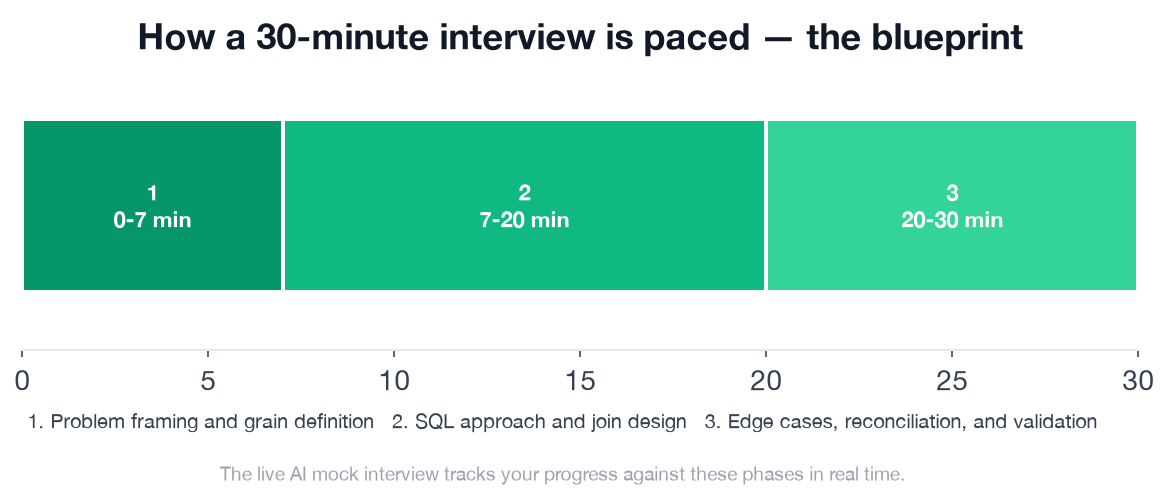
- The interview runs 30 minutes: 7 minutes on framing, 13 on join design, 10 on edge cases and validation.
- The schema has 4 tables, and 2 of them (payments, shipments) are one-to-many against orders.
- Phase 1 has 4 checklist items, phase 2 has 5, and phase 3 has 4: 13 behaviors in total.
- A mid-level candidate is held to 4 level-specific expectations, starting with spotting fan-out unprompted.
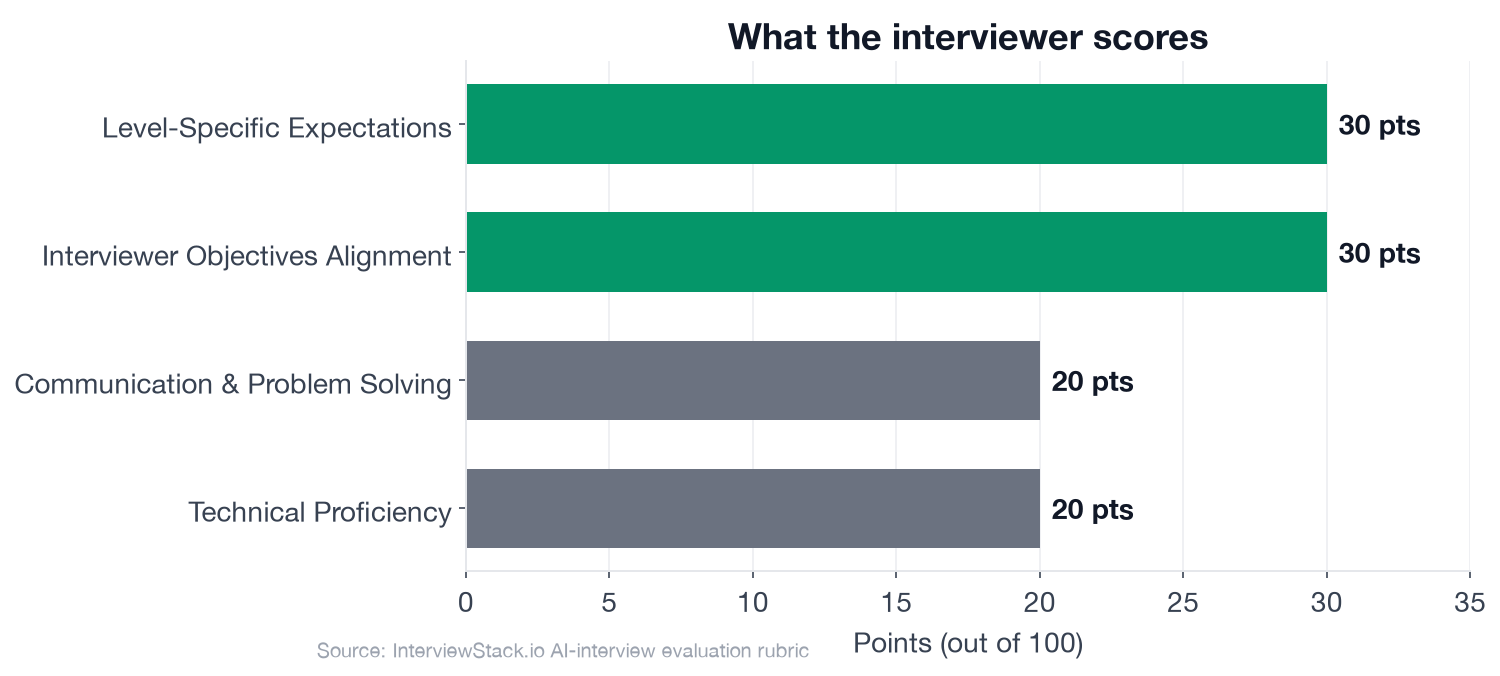
The chart shows where points live: understanding the problem and showing seniority outweigh syntax.
What Does a Business Intelligence Analyst SQL Joins Interview Actually Test?
The question below is a reporting task disguised as a SQL task. The interviewer is checking whether you pick a grain, choose join types by business intent, and reconcile systems without silently dropping records.
The interview question
You join a marketplace analytics team. Four tables describe orders, payments, shipments, and CRM contacts.
-- Marketplace analytics team schemaCREATE TABLE orders ( order_id BIGINT, customer_id BIGINT, seller_id BIGINT, order_ts TIMESTAMP, country_code STRING, order_status STRING, gross_amount NUMERIC );
CREATE TABLE payments ( payment_id BIGINT, order_id BIGINT, payment_ts TIMESTAMP, payment_status STRING, paid_amount NUMERIC, payment_method STRING );
CREATE TABLE shipments ( shipment_id BIGINT, order_id BIGINT, shipped_ts TIMESTAMP, delivered_ts TIMESTAMP, carrier STRING, shipment_status STRING );
CREATE TABLE crm_contacts ( crm_contact_id BIGINT, customer_id BIGINT, email STRING, country_code STRING, is_marketing_opt_in BOOLEAN, snapshot_date DATE );
Using the schema above, how would you write a SQL query to produce a daily country-level report for the last 30 days that the finance and operations teams could use to monitor fulfilled orders, payment collection, and shipment completion, while making sure the logic is robust to missing records and one-to-many relationships across the tables?
The objectives behind it: correct join selection, awareness of grain and row multiplication, sensible use of UNION, INTERSECT, or EXCEPT, and clear assumptions about status definitions. Dashboards, ML, and pipeline code are out of scope.
Walking Through the Interview, Turn by Turn
Turn 1: Name the Grain
Interviewer: "What would you define as the reporting grain, and how would you make sure each joined table is aligned to that grain before aggregating?"
Turn 2: Stop the Double Counting
Interviewer: "Suppose some orders have multiple payment attempts and multiple shipment records. How would you prevent double counting in your result?"
Turn 3: Compare Systems with EXCEPT
Interviewer: "How would you use a set operation to identify orders present in shipments but missing from payments, or vice versa?"
Turn 4: Handle the CRM Snapshot
Interviewer: "If the CRM table is a daily snapshot with multiple rows per customer over time, how would you safely incorporate opt-in coverage by country without introducing incorrect duplication?"
Could You Catch This Live, With the Clock Running?
Spotting these mistakes on the page is easy, because the question is frozen and the mistake is labeled. Live, the interviewer interrupts, the status field is ambiguous, and you have 13 minutes to design joins while talking. Avoiding fan-out under that pressure is a habit, and habits come from reps with follow-ups you did not script.
What Does the Full Blueprint Look Like?
This is the blueprint a strong candidate hits, and exactly what the AI mock interview tracks you against in real time. Phase 2 gets the most minutes, yet phases 1 and 3 hold the items candidates skip.
- ✓States or asks what date should define the daily report, such as order date versus payment date versus delivery date
- ✓Identifies that orders is likely the business entity but payments and shipments are one-to-many relative to orders
- ✓Calls out that fulfilled, paid, and shipped/completed may need explicit status mappings
- ✓Proposes an intermediate order-level dataset or separate metric-specific aggregates before final rollup
- ✓Builds or describes pre-aggregated payments data at order_id grain, such as a successful payment flag or sum of successful paid_amount
- ✓Builds or describes pre-aggregated shipments data at order_id grain, such as delivered flag or latest shipment outcome
- ✓Uses LEFT JOIN from an intentional base when unmatched operational records should still be visible
- ✓Avoids joining raw payments and raw shipments directly to orders and then aggregating without safeguards
- ✓Explains how final daily country metrics are computed, for example count distinct orders, paid orders, delivered orders, and monetary sums
- ✓Uses UNION, INTERSECT, or EXCEPT appropriately for presence/absence checks across systems, or clearly explains equivalent logic
- ✓Mentions handling orders with missing payment or shipment rows without silently dropping them
- ✓Suggests concrete validation checks, such as comparing order counts before and after joins or checking that paid orders do not exceed total orders
- ✓Can explain how CRM snapshot data would need separate deduplication by latest snapshot_date before joining by customer or aggregating by country
Run This Interview Yourself
The fastest way to close the gap is to start the AI mock interview on SQL joins and set operations and get scored against the rubric above. Then drill the underlying patterns in the SQL joins and set operations question bank. If you are mapping the wider market, browse current Business Intelligence Analyst openings and see company-specific rounds in the preparation guides.
FAQ
Q. What does a Business Intelligence Analyst SQL joins interview test?
It tests whether you can build a correct daily report from several one-to-many tables. Interviewers look for a stated reporting grain, pre-aggregation before joining, deliberate LEFT JOINs, and a validation step, not clever syntax.
Q. What is fan-out in SQL joins?
Fan-out is row multiplication: joining an order to several payment and shipment rows repeats the order, so sums and counts inflate. The fix is to aggregate each child table to one row per order before joining.
Q. How is a SQL joins interview scored?
The AI mock interview uses a 100-point rubric: 30 points for interviewer objectives, 30 for level-specific expectations, 20 for technical proficiency, and 20 for communication and problem solving.
Q. When should I use EXCEPT or INTERSECT instead of a join?
Use set operations for presence and absence checks across systems, such as orders in shipments but missing from payments. EXCEPT returns one side only, and INTERSECT returns what both share.
Q. How should I handle a CRM snapshot table with many rows per customer?
Deduplicate to the latest snapshot_date per customer before joining or aggregating by country. Joining the raw snapshot repeats every customer once per snapshot day and corrupts coverage numbers.
Q. How long is the mock interview and how is it paced?
It runs 30 minutes in three phases: problem framing and grain (0-7), SQL approach and join design (7-20), and edge cases, reconciliation, and validation (20-30).
Your Next Join Rep
Fan-out is not a syntax problem; it is a grain problem, and interviewers reward the candidate who says so first. State the grain, collapse the children, join from an intentional base, and validate the totals. Then say it all out loud under a clock.
Topics
Ready to practice?
Put what you've learned into practice with AI mock interviews and structured preparation guides.