
Warehouse or Lake Was Never the Real Question
A mid-level Business Intelligence Analyst walks into a system-design-style interview expecting to defend one architecture: warehouse or lake. That framing is a trap. The scenario hands over a company running nightly warehouse loads that are already straining under raw event volume, mixed governance needs, and analysts who want both curated dashboards and messy historical access, and a candidate who picks a single winner has already missed the point before the first follow-up lands.
This walkthrough follows the same interview package InterviewStack.io's AI mock interviewer runs live for a mid-level Business Intelligence Analyst (2-5 years) on Data Warehousing and Data Lakes, scored against the same 100-point rubric a real session would use. The scenario, the follow-ups, and the scoring checklist below come directly from that package, not invented for this post.
Key Findings
- Interviewer Objectives Alignment and Level-Specific Expectations each carry 30 of the interview's 100 points, so 60 points reward how you frame and sequence the platform, not which storage product you name.
- Technical Proficiency and Communication & Problem Solving split the remaining 40 points evenly, 20 each.
- The interview runs a fixed 30 minutes across three phases: 0-8 minutes on architecture framing, 8-20 minutes (the longest stretch, 12 minutes) on data layering and governance, and 20-30 minutes on trade-offs and rollout sequencing.
- Phase 2 alone holds 6 expected-checklist items, more than either of the other two phases.
- 5 separate level-specific expectations define the mid-level bar, from comparing warehouse, lake, and lakehouse patterns to recognizing where BI, data engineering, security, and regional compliance ownership has to cross teams.
- 4 skills are explicitly off-limits for this scenario: machine learning model design, deep distributed-systems internals, leetcode-style coding, and vendor-specific infrastructure tuning.
- The scenario asks one design to satisfy 3 requests leadership names in the same breath: near-real-time operational dashboards, lower-cost storage for raw event data, and better governance for analysts' self-serve datasets.
What's Actually Being Graded in This Business Intelligence Analyst Warehouse vs. Lake Interview?
The interviewer's objective, pulled directly from the package, is to see whether you can choose an architecture appropriate for BI use cases, explain storage-compute separation and layered data design, identify governance requirements, and make practical trade-offs, all while keeping the proposal something a Business Intelligence Analyst could actually influence alongside data engineering. Here is the scenario as the AI interviewer presents it.
The interview question
Your company runs a consumer subscription product with web and mobile clients across 20+ countries. The BI team supports finance, growth, product analytics, and operations. Today, reporting comes from a cloud data warehouse loaded nightly from application databases, Stripe, Salesforce, and CSV exports from regional partners. Leadership wants to expand the platform to support near-real-time operational dashboards, lower-cost storage for raw event data, and better governance for analysts creating self-serve datasets.
Current pain points:
- Product event volume is growing quickly and raw logs are too expensive to keep long-term in the warehouse.
- Different teams define core metrics like active users and net revenue differently.
- Some regional data includes PII and has country-specific retention requirements.
- Analysts need curated tables for dashboards, but data science and experimentation teams also want access to less-modeled historical data.
How would you design the next version of this company's analytics data platform, and what architecture would you recommend?
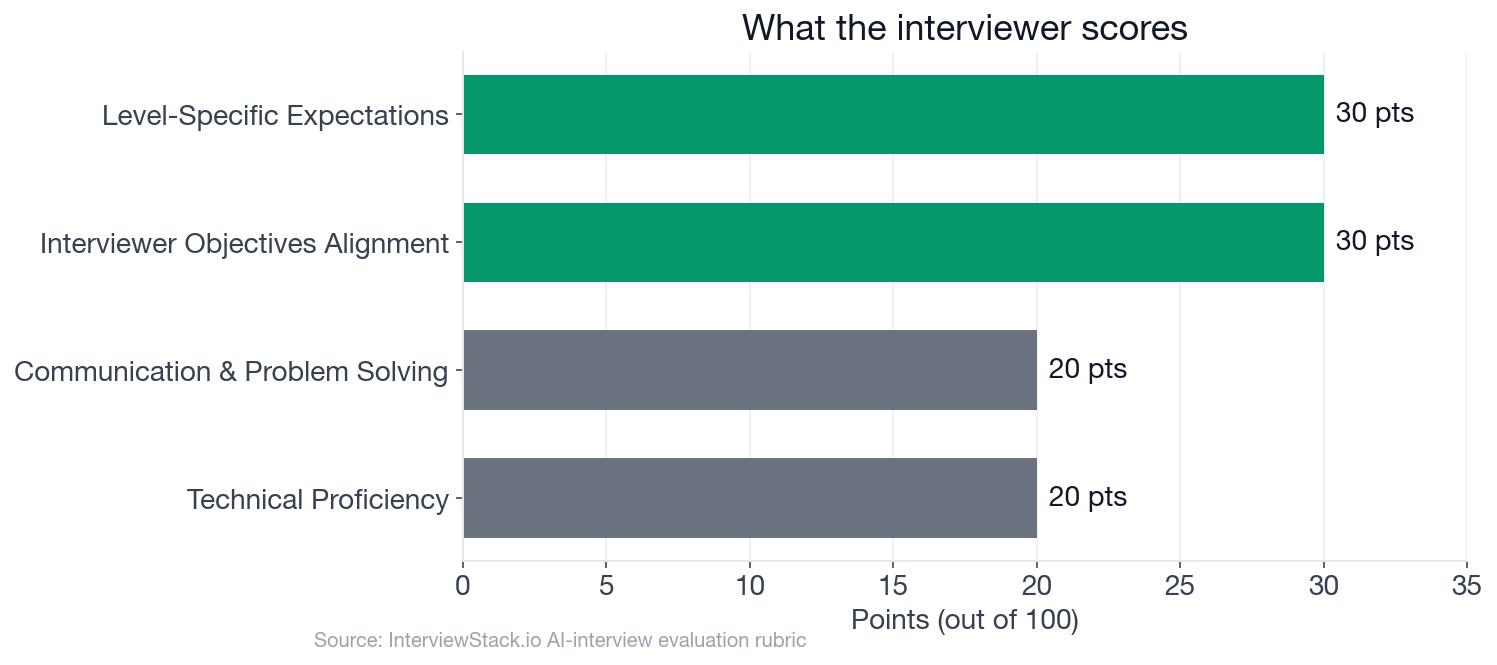 Interviewer Objectives Alignment and Level-Specific Expectations carry 30 points apiece, one and a half times the weight of Technical Proficiency or Communication & Problem Solving individually.
Every follow-up below probes a piece of that objective: whether you can frame the architecture decision, organize data into usable layers, put real governance behind PII and metric consistency, and sequence a realistic rollout instead of a rewrite.
The Follow-Ups That Test Whether Both Sides Actually Coexist
Arjun is a capable mid-level candidate who knows the vocabulary: bronze, silver, gold, PII, lakehouse. Vocabulary is not the test. Here is where Arjun's answers start costing points, and what a stronger version sounds like.
Turn 1: Picking a Side Too Fast
Interviewer: "If leadership asks whether this should remain warehouse-first or move to a lake-first or lakehouse approach, how would you frame that decision for this company?"
Turn 2: Layers Without Owners
Interviewer: "How would you organize the data across raw, cleaned, and business-ready layers, and who should be allowed to use each layer?"
Turn 3: Governance as a Buzzword
Interviewer: "What governance controls would you put in place for PII, metric consistency, and country-specific retention requirements?"
Turn 4: One Clock for Two Jobs
Interviewer: "Suppose operations wants dashboards with data no more than 15 minutes old while finance still needs highly reconciled month-end reporting. How would your design support both?"
Could You Hold the Warehouse-Plus-Lake Line With the Clock Running?
Every mistake above is easy to see once it is highlighted in red. None of them are easy to catch in your own mouth, mid-sentence, twenty minutes into a live interview with the next follow-up already landing before you have finished your last thought. Reading Arjun's answers is not the same skill as building your own answer under a ticking clock, with governance, freshness, and cost trade-offs all competing for the same two sentences. That gap only closes with reps against a real, unscripted interviewer, not another pass over a scenario you already know the ending to. If you want a broader plan before you go live, the preparation guides cover structured prep beyond a single scenario.
What Does a Strong Answer Look Like Across All Three Phases?
Here is the complete blueprint a strong candidate hits, phase by phase. This is the exact structure the AI mock interviewer tracks your answer against in real time, not a simplified summary of it.
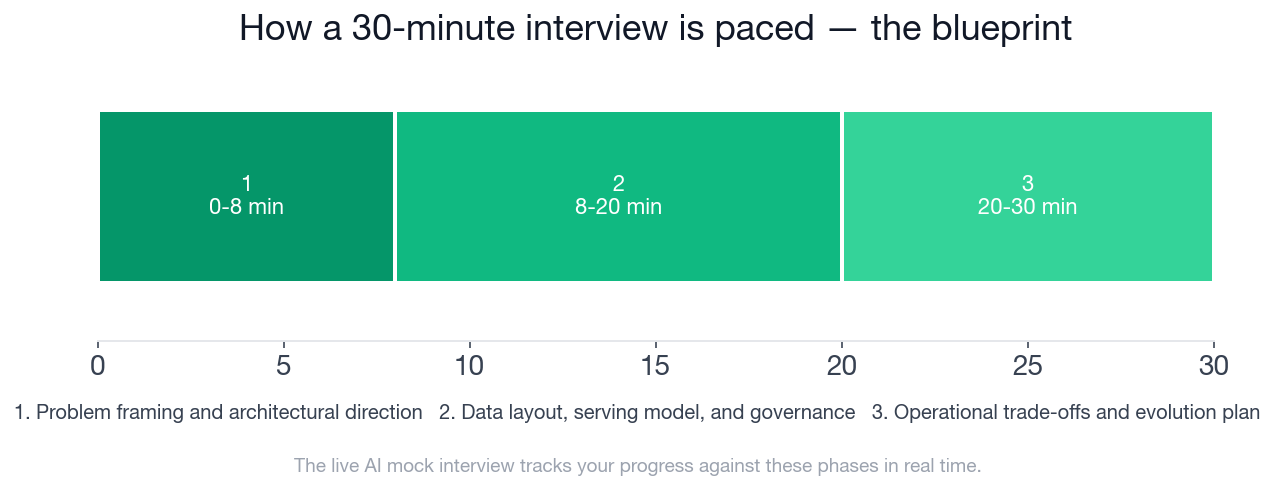 Phase 2 runs the longest, 12 of the 30 minutes, because layering and governance carry the most checklist items of any phase.
- ✓Clarifies at least 2-3 key requirements or states explicit assumptions, such as freshness, cost pressure, governance, or user groups
- ✓Identifies that the current warehouse-only setup is strained by raw event retention and mixed workload needs
- ✓Recommends a plausible target state such as warehouse plus lake, or lakehouse-oriented platform, with a reason tied to the scenario
- ✓Differentiates curated BI reporting needs from exploratory or historical raw-data access
- ✓Describes a layered flow such as raw/bronze, cleaned/silver, curated/gold or equivalent
- ✓States what data lands in low-cost storage versus warehouse-hosted serving tables or marts
- ✓Explains how dashboards, finance reporting, and self-serve analysis consume curated datasets
- ✓Addresses metric consistency through shared definitions, certified models, semantic layer, or governed marts
- ✓Covers PII access controls and retention/deletion handling in a concrete way, not just 'add governance'
- ✓Mentions discoverability or lineage through cataloging/documentation
- ✓Explains how different freshness tiers could coexist, for example near-real-time operational datasets versus reconciled finance datasets
- ✓Makes a practical recommendation for what to implement first, such as raw data landing zone plus curated marts and governance standards
- ✓Shows awareness of cost controls like tiered storage, retention windows, or moving infrequently queried raw data out of the warehouse
- ✓Discusses how the operating model prevents sprawl, such as dataset ownership, review standards, or certified shared tables
- ✓Keeps the proposal realistic for a company evolving from an existing warehouse rather than proposing a full rewrite without migration thinking
See If Your Design Would Survive a Live Interview
You have now seen every trap in this scenario laid out in red and green. The only way to know if you would actually avoid them is to run the same interview live. Start this Business Intelligence Analyst Data Warehousing and Data Lakes mock interview and get scored against this exact rubric, phase by phase, with follow-ups that adapt to what you actually say. If you want to drill the underlying concepts first, the Data Warehousing and Data Lakes question bank breaks the topic into individual practice questions, InterviewStack's interactive courses cover data architecture fundamentals if warehouse-versus-lake trade-offs are still new territory, and the Business Intelligence Analyst job board shows what teams asking these questions are actually hiring for.
FAQ
Q. What does the Business Intelligence Analyst Data Warehousing and Data Lakes interview actually test?
It tests whether you can recommend and sequence an analytics architecture, warehouse, lake, or lakehouse, based on this company's cost, freshness, and governance needs, not whether you can name the newest storage product. Interviewer Objectives Alignment and Level-Specific Expectations each carry 30 of the interview's 100 points, so 60 points reward that judgment over tool trivia.
Q. Is this interview really about choosing between a data warehouse and a data lake?
No. The scenario is built so that a pure either/or answer loses points. The expected answer keeps a warehouse for curated BI serving while adding a lake or lakehouse layer for raw and exploratory data, because both jobs exist inside the same company at the same time.
Q. How long is the mock interview and how is the time split?
It runs 30 minutes across three phases: 0 to 8 minutes on architecture framing, 8 to 20 minutes, the longest stretch, on data layering and governance, and 20 to 30 minutes on trade-offs and rollout sequencing.
Q. What seniority level is this interview calibrated for?
Mid-level, roughly 2 to 5 years of experience. Candidates are expected to compare warehouse, lake, and lakehouse patterns at a practical level and make sensible sequencing calls, not to reason about distributed-systems internals or vendor-specific engine tuning.
Q. What mistake does this interview's checklist penalize most directly?
Treating the architecture decision as a single either/or choice, or describing a governance plan without naming a single concrete mechanism for PII, retention, or metric consistency. Both mistakes cost points against explicit checklist items in the interview's rubric.
Q. What skills are off-limits or not tested in this interview?
Machine learning model design, deep distributed-systems internals, leetcode-style coding, and vendor-specific infrastructure tuning are explicitly excluded, so the interview stays focused on architecture judgment and governance reasoning.
Q. How can I practice this exact interview?
Start the same scenario as a live AI mock interview, which times each phase and scores your answer against the same rubric used in this walkthrough, then review the feedback against the checklist items you may have missed.
Both Systems Have to Ship, Not Just One
The interview ends, but the platform does not. A real Business Intelligence Analyst who wins this argument still has to ship a warehouse that keeps working, a lake that does not turn into an unmanaged swamp, and a governance layer that survives the next country's retention rule. The mock interview will not build that for you, but it will show you, in real time, exactly which of those pieces your answer is currently missing.
Topics
Ready to practice?
Put what you've learned into practice with AI mock interviews and structured preparation guides.