
Business Operations Manager Is the Most Fragmented Role We've Analyzed
Most tech roles converge on a recognizable stack. Data Engineer reduces to Python plus SQL plus pipelines. Data Analyst reduces to SQL plus a BI tool. Business Operations Manager refuses to reduce. The role spans revenue operations at a SaaS company, store operations at a fitness chain, healthcare operations at a hospital network, and logistics operations at a freight carrier, and the resulting skill demand spreads across so many distinct profiles that no single skill is required by half of postings.
To put numbers on it, we looked at every active Business Operations Manager posting on the InterviewStack.io job board as of May 2026, 4,355 listings in total, with skills extracted from descriptions and synonyms collapsed (so dashboards and BI reporting count once under "data visualization", Salesforce and CRM count separately because postings often distinguish them).
The headline: the most common skill in the role, Excel, appears in just 26.7% of postings. The next six skills (Monitoring, Automation, Forecasting, Data Visualization, SQL, Salesforce) each show up in 6-17%. Read the data right and you can see the role splitting into two sub-archetypes hiding behind a single title.
Key findings
- 4,355 active Business Operations Manager postings analyzed across the live job board as of May 2026.
- No skill is table stakes: the most common, Excel, appears in 26.7% of postings (1,163 of 4,355). The role has no single skill that more than half of employers require.
- The differentiator tier (5-20%) is where the role gets defined: Monitoring (16.6%), Automation (11.7%), Forecasting (11.4%), Data Visualization (10.8%), SQL (8.0%), and Salesforce (5.8%).
- Median US base salary is $90,000 (n=1,132), about $38,300 below the comparable Data Engineer median and $2,800 above the Data Analyst median.
- Differentiator skills add $25K to $40K to median US base salary: Salesforce ($128,300), Automation ($127,800), Forecasting ($125,000), Tableau ($125,000), and CRM ($125,000) all sit roughly $35K to $38K above the $90,000 baseline.
- Monitoring is a salary discount, not a premium: postings that ask for monitoring pay a median of $65,000 (n=242), $25,000 below the baseline, because the keyword concentrates in physical-operations and facility-monitoring roles.
- Mid-level dominates at 76.4% (3,328 postings); senior and staff combined are only 13.8%, the flattest seniority pyramid we have measured.
- The US is 60.9% of postings, and onsite work is 77.0%, by far the most onsite-heavy role we have analyzed.
What Skills Define a Business Operations Manager in 2026?
Group every individual skill into the higher-level family it belongs to and count how many postings ask for at least one skill in that family. For most tech roles this exercise produces one or two dominant families at 70-90%. For Business Operations Manager, the largest family barely clears 28%, and the top six families crowd between 8% and 28% with no clear winner.
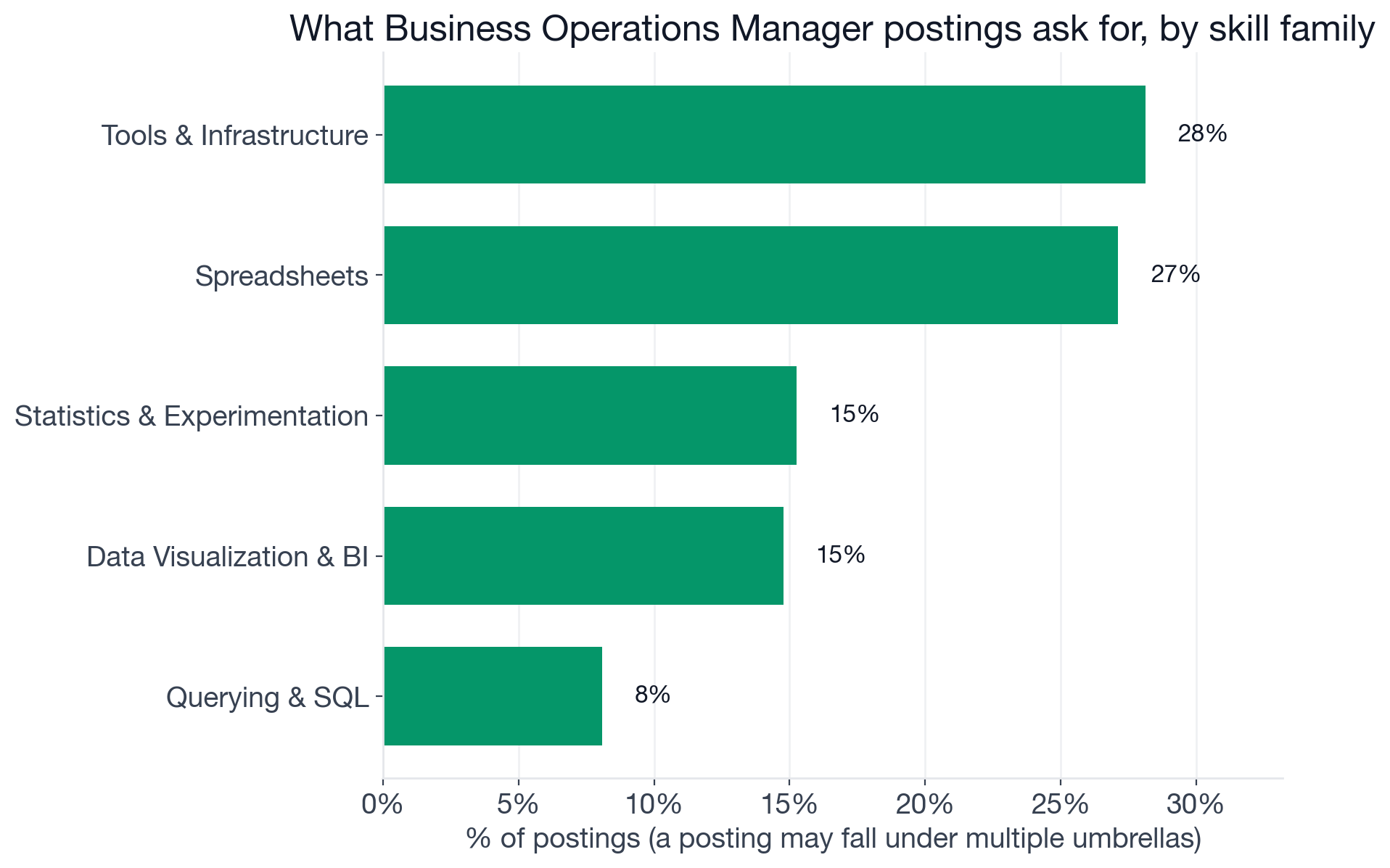
Share of Business Operations Manager postings that ask for at least one skill in each family. A posting that mentions both Tableau and Power BI counts once under "Data Visualization & BI".
The six families that actually shape the role:
- Tools & Infrastructure: 28.1% (overwhelmingly Monitoring and Automation as standalone competencies)
- Spreadsheets: 27.1% (almost entirely Excel, with a long Google Sheets tail)
- Other: 24.2% (Salesforce, CRM, and scalability, the revenue-and-platform side of the role)
- Statistics & Experimentation: 15.3% (Forecasting at 11.4%, A/B Testing at 3.1%)
- Data Visualization & BI: 14.8% (Data Visualization as a concept at 10.8%, Tableau 4.4%, Power BI 4.3%, Looker 2.3%)
- Querying & SQL: 8.1% (almost entirely SQL itself)
Everything below 8% is informational rather than structural: Coding Languages at 3.7%, Machine Learning & AI at 3.2%, Process & Methodology at 2.3%. The Data Engineering Foundations, Modern Data Stack, and Cloud Platforms families combined account for under 3% of postings, which is the opposite of what a Data Engineer or Data Analyst search returns. Read alongside the Data Engineer skills analysis, the Business Operations Manager profile is much closer to a generalist operations role than to a technical analytics role.
The big tell: the top two families (Tools & Infrastructure and Spreadsheets) are at 28% and 27%, and the third (Other, which is the Salesforce-and-CRM bucket) is at 24%. Three families clustered that close together mean the role really is three different roles wearing the same title, and a job hunter targeting this title needs to know which sub-archetype they are actually applying for.
What Are the Three Tiers of Individual Business Operations Manager Skills?
Drill into individual skills and the picture sharpens. The standard tiering (table stakes above 50%, common 20-50%, differentiator 5-20%) puts almost nothing at the top.
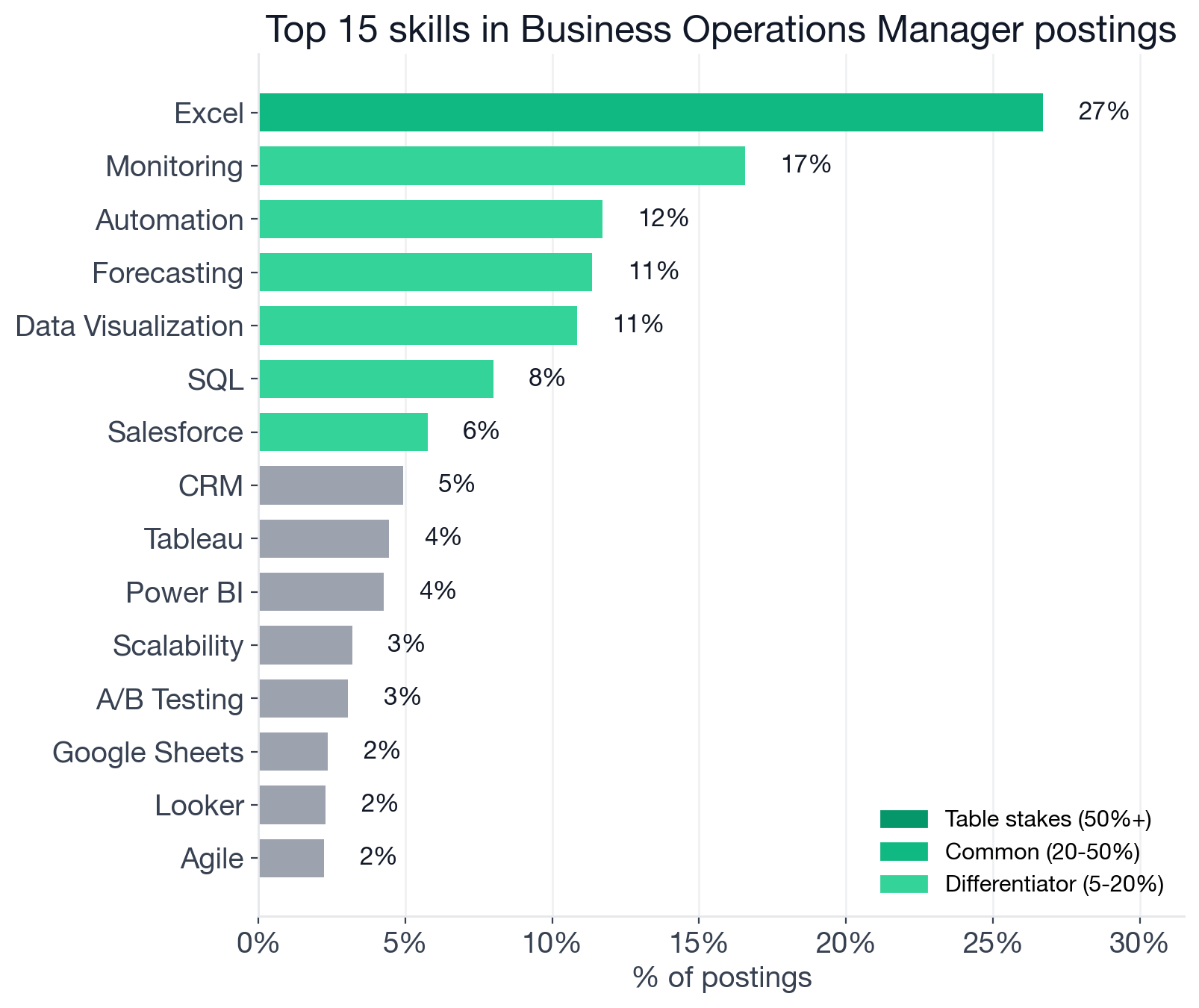
Top individual skills in Business Operations Manager postings, by share of listings that mention them. The role has no table-stakes (50%+) skills. Excel sits alone in the common tier at 26.7%; the differentiator band (5-20%) is where the role's actual character emerges.
Table Stakes (50%+ of postings)
Nothing. Not Excel. Not Salesforce. Not Monitoring. No single skill clears the 50% line, which is unusual enough to be the headline finding of this analysis. Hiring managers do not all agree on what a Business Operations Manager is supposed to know, because the underlying job is genuinely different at a SaaS company than at a fitness chain. A candidate who is excellent at Excel passes the filter at roughly one in four postings; the other three out of four are looking for something else entirely.
Common Expectations (20-50% of postings)
Just one entry:
- Excel: 26.7% (1,163 postings) (browse Business Operations Manager openings that ask for Excel)
Excel is the closest thing the role has to a baseline. If you read it as "comfortable with spreadsheets, pivot tables, and formula-driven analysis", that's the one consistent expectation. Even so, it is missing from nearly three-quarters of postings, which says less about Excel and more about how loosely the role is defined.
Differentiators (5-20% of postings)
This is the band where the role's actual character lives.
- Monitoring: 16.6% (721 postings)
- Automation: 11.7% (510)
- Forecasting: 11.4% (495)
- Data Visualization: 10.8% (472)
- SQL: 8.0% (348) (Business Operations Manager + SQL openings)
- Salesforce: 5.8% (251) (Business Operations Manager + Salesforce openings)
Monitoring leads this tier by frequency but, as we will see in the salary section, it is also the one skill in the entire dataset that carries a negative premium. The keyword is doing two very different jobs in two different posting populations: in analytical-ops contexts it means observability and reporting, in physical-ops contexts it means watching cameras, sites, and shift schedules. The salary data lets us tell those apart.
Automation, Forecasting, Data Visualization, SQL, and Salesforce are the analytical core of the role. Add CRM (4.9%), Tableau (4.4%), and Power BI (4.3%) just below the cutoff and you have a coherent "revenue-and-analytics ops" profile that pays meaningfully better than the baseline. The next section makes that explicit.
Long Tail (under 5% of postings)
Below the 5% line, individual skill mentions become harder to read as signal:
- CRM: 4.9%
- Tableau: 4.4%
- Power BI: 4.3%
- Scalability: 3.2%
- A/B Testing: 3.1%
- Google Sheets: 2.4%
- Looker: 2.3%
- Agile: 2.2%
These are not noise; they are the markers of specialized sub-archetypes. A posting that names both Tableau and Power BI (lift 10.8, the highest co-occurrence in our dataset) is almost certainly a "BI-flexible" analytical operations role, regardless of how few of those postings exist overall. A posting that names CRM plus Salesforce (lift 7.95) is a revenue operations role. We come back to those pairs in the skill-stack section.
Which Business Operations Manager Skills Pay More Than the Baseline?
Salary numbers below are restricted to US postings only (where wage-transparency laws produce consistent disclosure) so they're directly comparable. The numbers are base salary: equity, bonuses, RSUs, and sign-on are not disclosed in postings, so total compensation at top employers is meaningfully higher than what we report here, especially at tech and finance employers in this dataset.
The overall median US base salary for Business Operations Manager postings is $90,000 (n=1,132). That is roughly $38,300 below the comparable Data Engineer median ($128,300) and about $2,800 above the Data Analyst median. Two things are pulling the baseline down: the role is more onsite, lower-wage, and physical-operations-heavy than tech analytical roles, and a meaningful share of postings are at fitness, food-service, and retail-operations employers paying near the regional operations-manager floor.
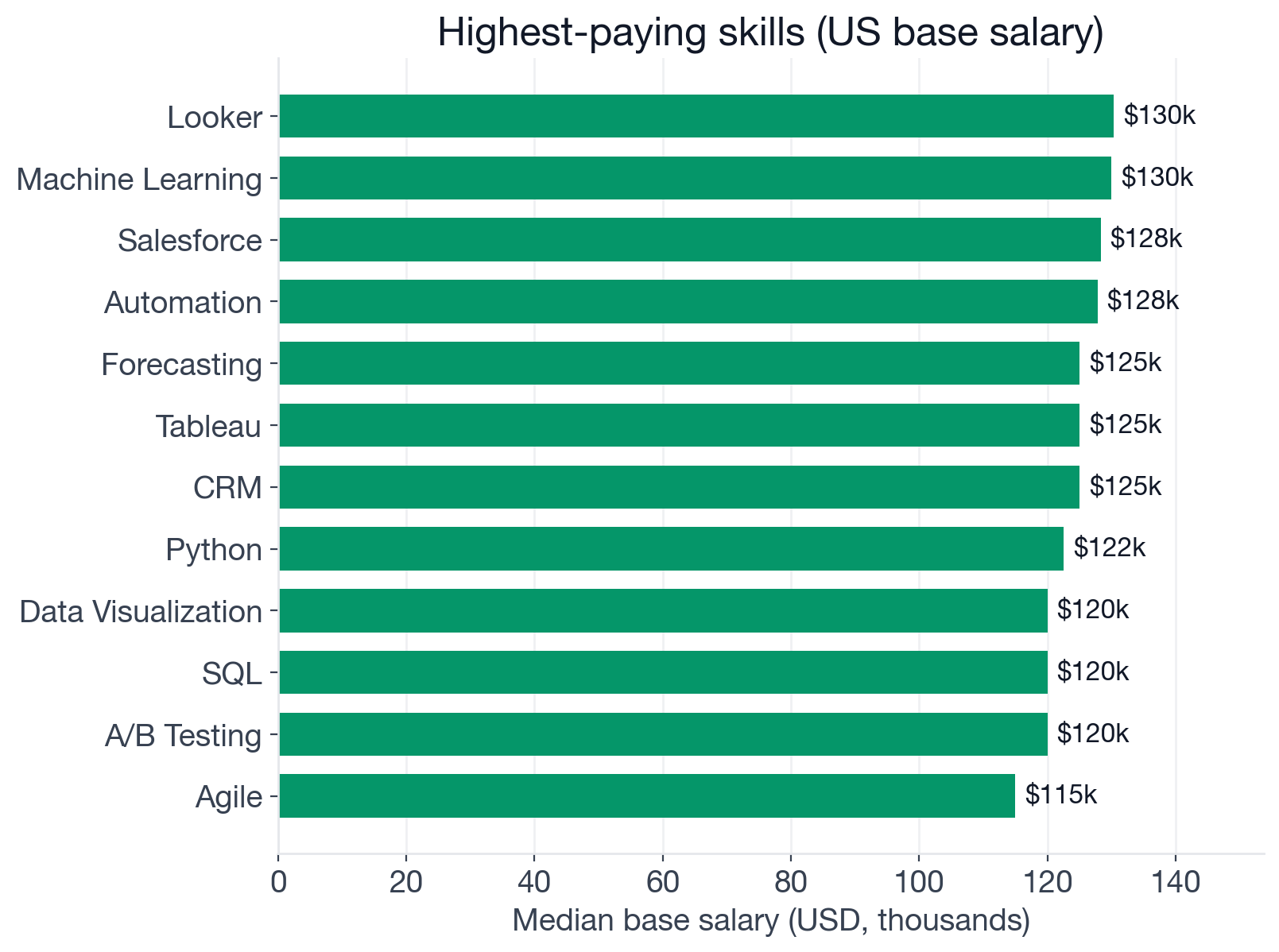
Median US base salary in USD for postings that mention each skill, among US Business Operations Manager postings with structured salary data. Monitoring is the only differentiator-frequency skill that sits below the role baseline.
The salary spread is wide. Differentiator-tier skills sit $25K to $40K above the $90,000 baseline because the role's analytical sub-archetype concentrates at higher-paying employers.
Largest premiums, roughly $35K to $40K above baseline:
- Looker: $130,300 (n=30), about $40,300 above baseline. Small sample; treat as suggestive.
- Machine Learning: $130,000 (n=25), about $40,000 above. Very small sample; the few postings that name ML are specialized revenue-ops or growth-ops roles.
- Salesforce: $128,300 (n=92), about $38,300 above. The most reliable revenue-ops signal in the data.
- Automation: $127,800 (n=130), about $37,800 above.
- Forecasting: $125,000 (n=162), about $35,000 above. (Business Operations Manager + Forecasting openings)
- Tableau: $125,000 (n=70), about $35,000 above.
- CRM: $125,000 (n=78), about $35,000 above.
Premiums of roughly $30K to $33K:
- Python: $122,500 (n=30), about $32,500 above. Small sample.
- Data Visualization: $120,000 (n=151), about $30,000 above.
- SQL: $120,000 (n=137), about $30,000 above.
- A/B Testing: $120,000 (n=53), about $30,000 above.
Premiums in the $20K to $25K band:
- Agile: $115,000 (n=29), about $25,000 above.
- Scalability: $110,600 (n=40), about $20,600 above.
Modest premiums, near baseline:
- Google Sheets: $100,000 (n=31), about $10,000 above.
- Power BI: $98,600 (n=67), about $8,600 above.
- Excel: $91,000 (n=319), about $1,000 above. The most common skill is also the lowest-premium one because it concentrates at every employer in the dataset, including the lower-paying ones.
The negative-premium outlier:
- Monitoring: $65,000 (n=242), about $25,000 below baseline.
Monitoring is the one skill in the entire dataset where adding it to your resume correlates with a lower US base salary, not a higher one. The likely reason is keyword overlap: "monitoring" in this dataset is doing double duty, capturing both observability and reporting in analytical-ops contexts and physical site, shift, and facility monitoring in operations-floor contexts. The latter cluster pays much less, and the sample size is large enough (n=242) that it drives the median down. Read it as "monitoring on its own is not a salary signal", and pair it with another differentiator before drawing conclusions.
The practical pattern: the role rewards specialization. Excel by itself moves the median by about $1,000. Salesforce, Automation, Forecasting, Tableau, or CRM each move it by $35,000 or more, because each anchors a posting in a sub-archetype that hires from a smaller, better-paid pool. Picking up one revenue-ops tool (Salesforce or CRM) and one analytical tool (SQL, Tableau, or Forecasting) is the most defensible single move a candidate in this role can make.
What Is the Dominant Business Operations Manager Skill Stack?
We computed every two-skill co-occurrence among the top 25 skills to find combinations that appear together more often than chance. Lift greater than 1 means two skills appear together more than their individual frequencies would predict; lift below 1 means they avoid each other.
The most over-represented pairs (highest lift):
| Skill pair | Postings | % of postings | Lift |
|---|---|---|---|
| Power BI + Tableau | 89 | 2.0% | 10.8 |
| Looker + SQL | 72 | 1.7% | 9.1 |
| CRM + Salesforce | 98 | 2.3% | 8.0 |
| SQL + Tableau | 102 | 2.3% | 6.6 |
| A/B Testing + SQL | 59 | 1.4% | 5.6 |
| Data Visualization + Tableau | 113 | 2.6% | 5.4 |
| Data Visualization + Power BI | 104 | 2.4% | 5.2 |
| Data Visualization + SQL | 133 | 3.1% | 3.5 |
| Excel + Google Sheets | 85 | 2.0% | 3.1 |
| Excel + Power BI | 133 | 3.1% | 2.7 |
The largest pairs by raw volume tell a different story:
| Skill pair | Postings | % of postings | Lift |
|---|---|---|---|
| Data Visualization + Excel | 207 | 4.8% | 1.6 |
| Excel + SQL | 181 | 4.2% | 2.0 |
| Automation + Excel | 167 | 3.8% | 1.2 |
| Excel + Forecasting | 163 | 3.7% | 1.2 |
| Automation + Data Visualization | 146 | 3.4% | 2.6 |
Read together, the two tables show two coherent sub-archetypes:
- The Excel-first generalist ops stack. Excel pairs with Data Visualization (207 postings), SQL (181), Automation (167), and Forecasting (163) in the largest co-occurrences by volume. The lift on most of these is modest (1.2 to 2.0), which is what you would expect if Excel is the "always-on" skill that other skills get layered onto in a generalist coordinator profile.
- The analytical-and-revenue ops stack. Power BI + Tableau (lift 10.8), CRM + Salesforce (lift 8.0), SQL + Tableau (lift 6.6), Looker + SQL (lift 9.1), and A/B Testing + SQL (lift 5.6) all sit at much higher lifts. These pairs are rare overall but, when they appear, they appear together, which is the signature of a specialized sub-population.
The CRM + Salesforce pair (lift 8.0, 98 postings) is the clearest revenue-ops marker in the data. The Power BI + Tableau and SQL + Tableau pairs are the clearest BI-analytical-ops markers. A candidate who can credibly speak to both an analytical tool and a CRM is hitting two of the highest-paying sub-archetypes simultaneously.
Note: co-occurrence statistics here cover only the top 25 skills in the role. Pairs involving smaller-tail skills exist but are not in the dataset above.
Who's Hiring at Which Seniority Level?
We tagged each posting's seniority based on title keywords (Senior, Lead, Principal, Junior, Intern). Postings with no explicit signal default to mid-level.
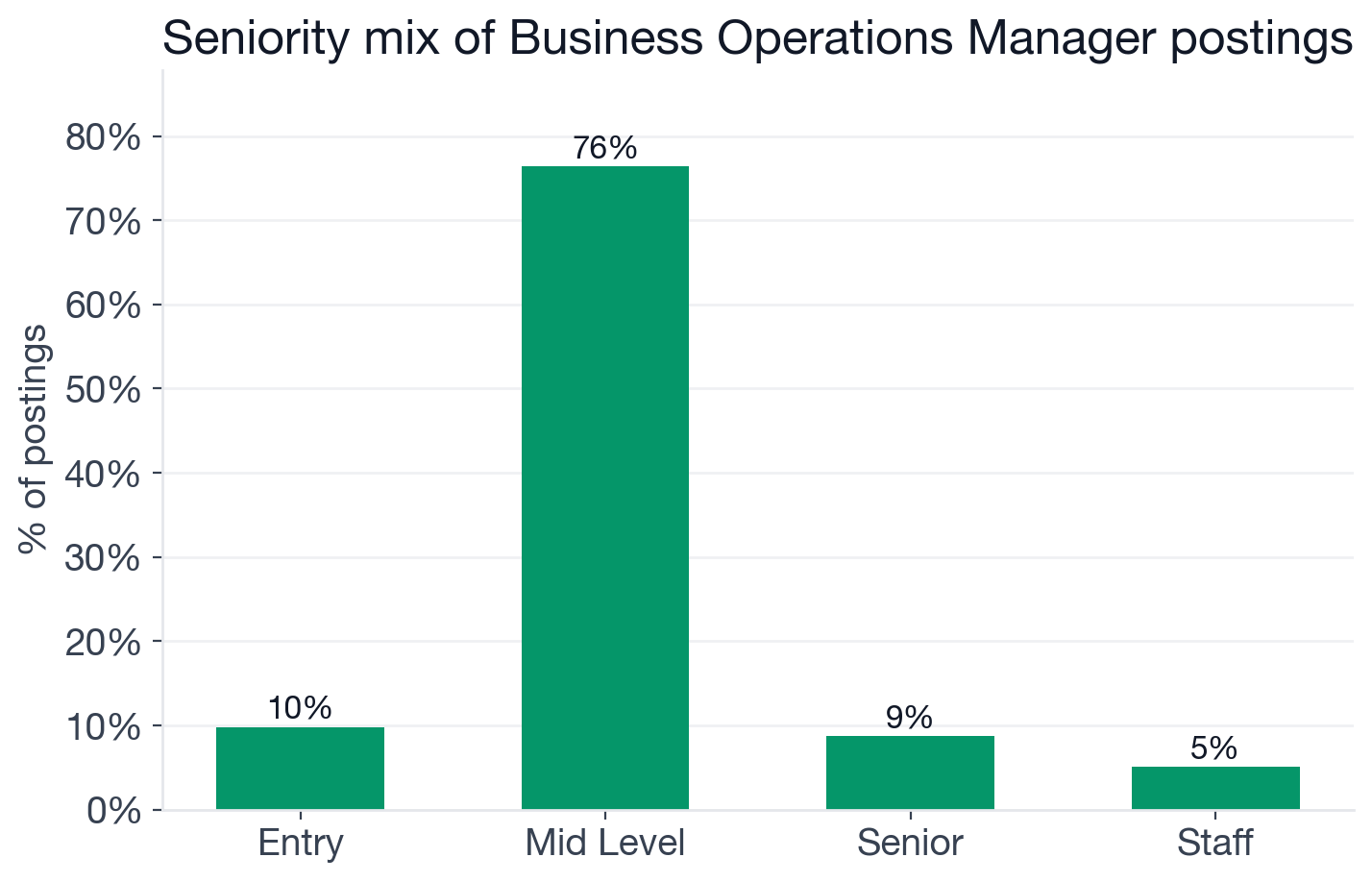
Seniority distribution of Business Operations Manager postings.
- Mid-level: 76.4% (3,328 postings)
- Entry: 9.8% (427) (entry-level Business Operations Manager openings)
- Senior: 8.7% (379)
- Staff / Lead / Principal: 5.1% (221)
The distribution is unusually flat at the top and unusually wide in the middle. Three out of four postings carry no explicit seniority signal at all, defaulting to mid-level, which suggests "Manager" in this title is often a descriptor of scope rather than a step on a people-management ladder. Many Business Operations Manager postings are individual-contributor jobs whose holder coordinates work across teams without managing anyone directly.
Two implications for job hunters:
- The entry door is real. Roughly 10% of postings are explicitly entry-level, about three times the share for Data Engineer (3%). For career-switchers from non-technical backgrounds, Business Operations Manager is one of the more open doors into a role that touches data, analytics, and process work.
- The senior ladder is thin. Only 13.8% of postings combined are senior or staff. If you are targeting a director-track career, this title is a stepping stone rather than a destination; the named "Director of Operations" and "VP of Operations" roles sit in different listings on the board.
Where Are Business Operations Manager Jobs Located, and How Remote-Friendly Are They?
Geography is far more US-concentrated for this role than for any tech role we have analyzed, and the work mode is far more onsite.
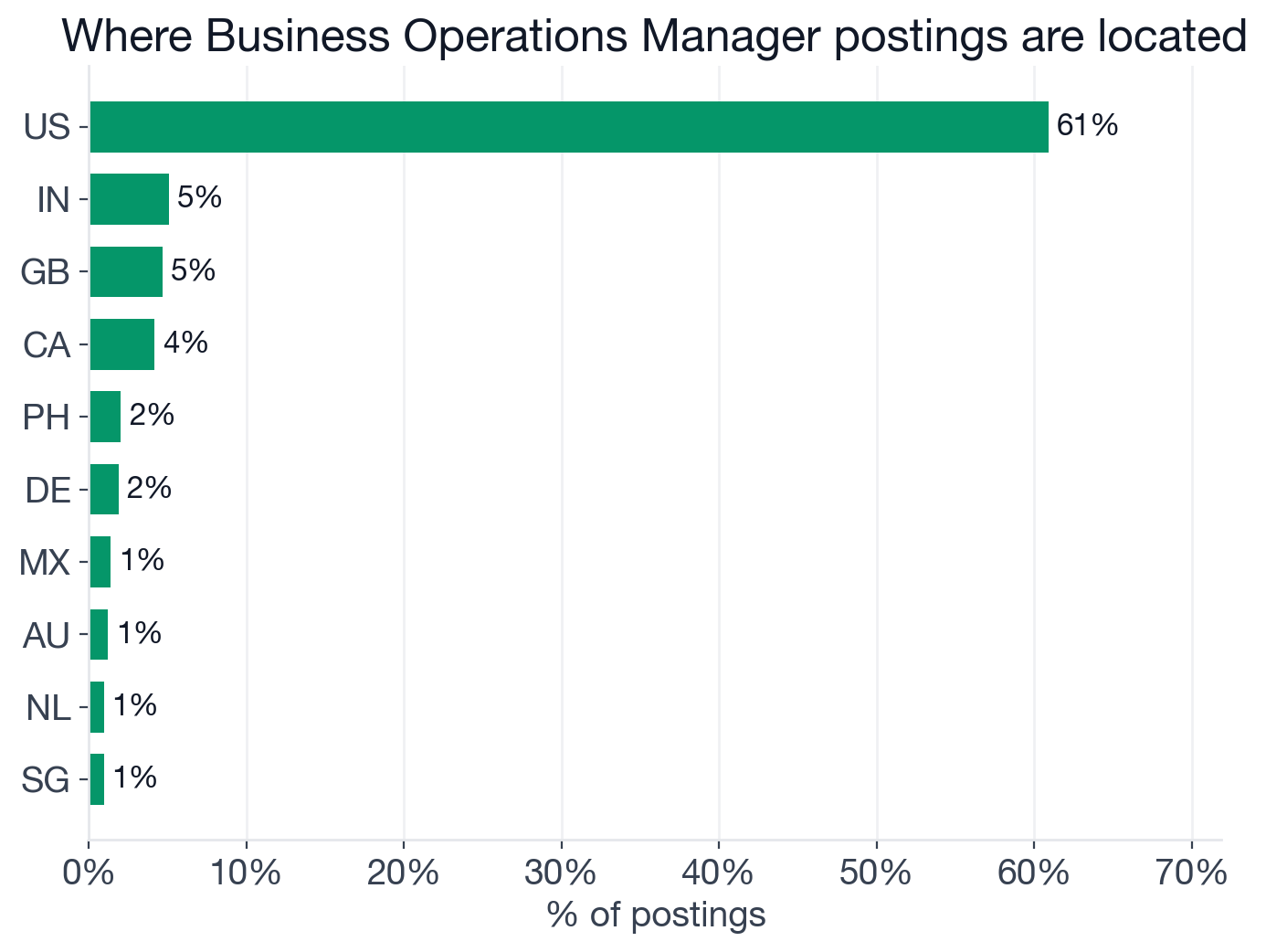
Top countries by share of Business Operations Manager postings.
- United States: 60.9% (2,652 postings) (US-only Business Operations Manager openings)
- India: 5.1% (222)
- United Kingdom: 4.7% (205)
- Canada: 4.2% (182)
- Philippines: 2.0% (89)
- Germany: 1.9% (82)
- Mexico: 1.4% (61)
- Australia: 1.2% (54)
The US share is the highest we have seen for any role on the board. Where Data Engineer postings split roughly 29% US and 23% India, Business Operations Manager is 61% US and only 5% India, because the work is overwhelmingly physical, in-person, and tied to a specific facility, store, restaurant, clinic, or office. Global capability centers in India do not exist for this role the way they do for software engineering or pipeline work.
The work-mode picture reinforces that geography.
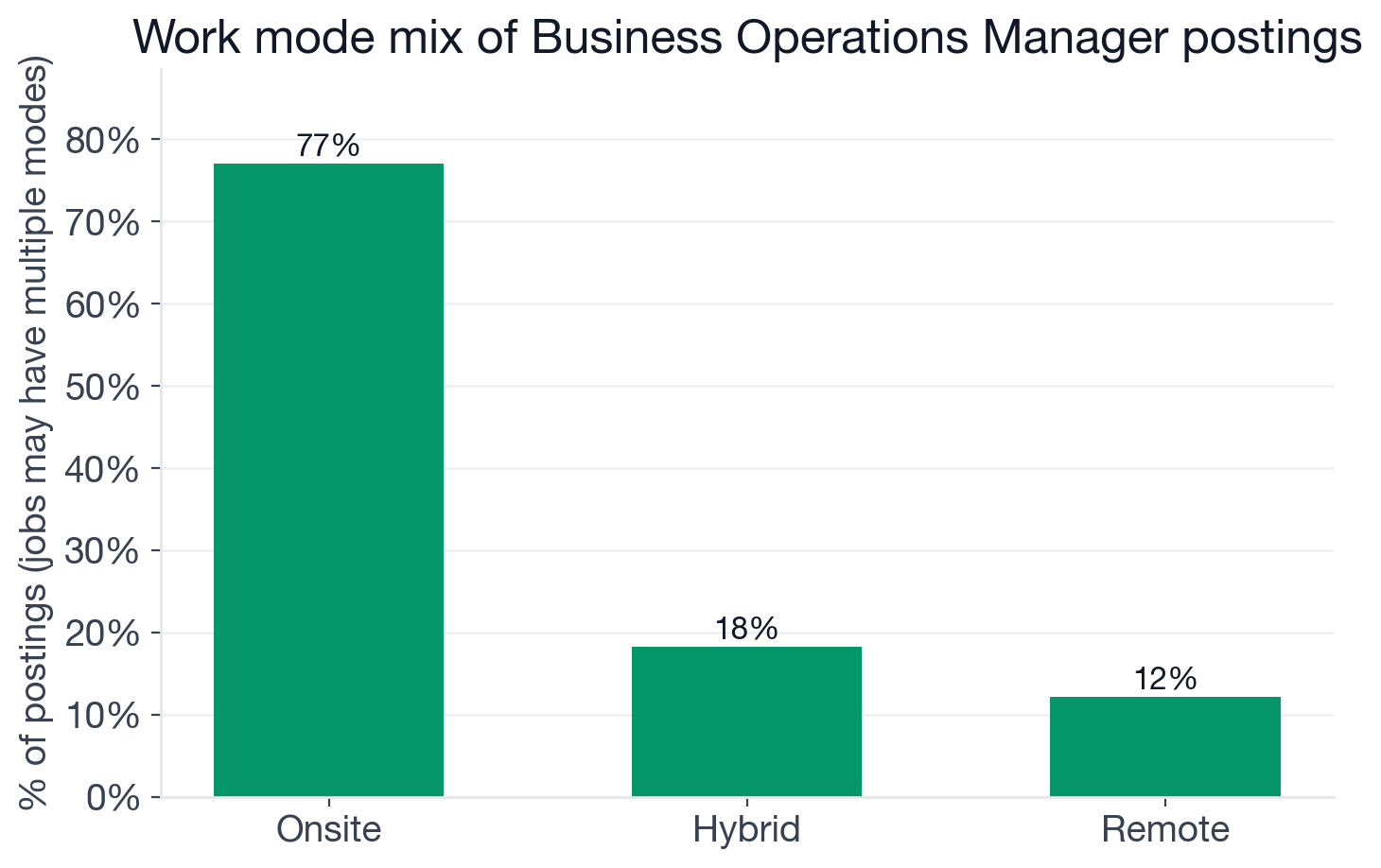
Share of Business Operations Manager postings tagged with each work mode. Some postings carry multiple tags (e.g., "Hybrid or Remote"), so percentages can sum to more than 100%.
- Onsite: 77.0% (3,355 postings)
- Hybrid: 18.2% (792)
- Remote: 12.1% (529) (fully-remote Business Operations Manager openings)
The 77% onsite share is the highest we have seen for any role. For comparison, Data Engineer postings sit at 50% onsite and Data Analyst postings at about 64%. The reason is in the company list (below): a meaningful share of these postings are at fitness chains, healthcare networks, food-service companies, and logistics carriers, all of which need someone physically near the operation. The fully-remote slice is real but small, and it concentrates at SaaS and digital-media employers running revenue-ops or growth-ops teams.
Who's Hiring Business Operations Managers in 2026?
The top hiring companies confirm what the geography and work-mode numbers already suggested. The role is dominated by physical-operations, healthcare, food-service, and consulting employers rather than the tech-first companies that dominate Data Engineer and ML Engineer hiring.
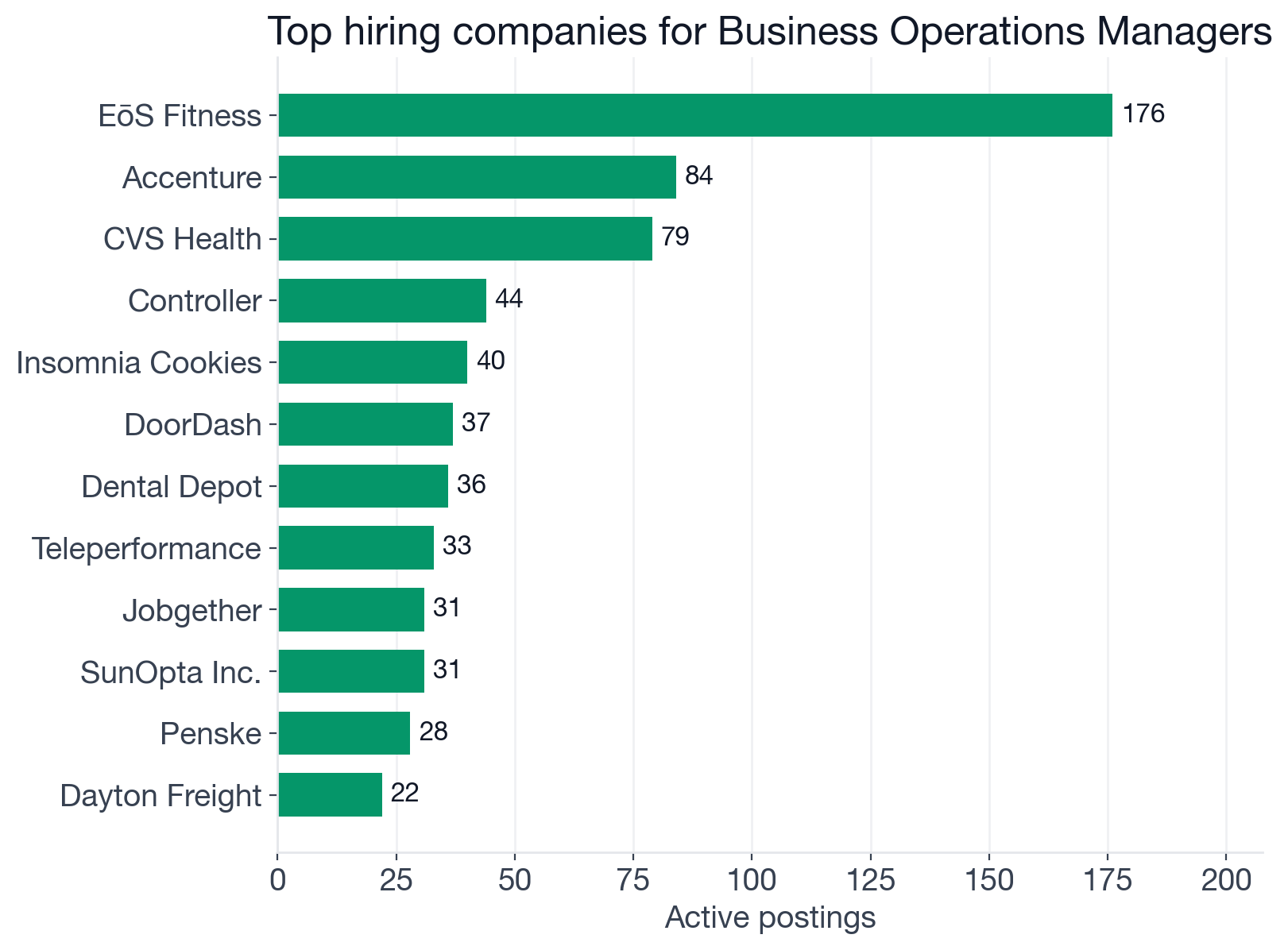
Top companies by active Business Operations Manager postings. Counts include all locations of the same job.
- EōS Fitness: 176 postings (fitness operator)
- Accenture: 84 (global consulting)
- CVS Health: 79 (retail healthcare)
- Insomnia Cookies: 40 (food service)
- DoorDash: 37 (food delivery, the most tech-native employer near the top)
- Dental Depot: 36 (healthcare)
- Teleperformance: 33 (business process outsourcing)
- Jobgether: 31 (job-aggregator/staffing)
- SunOpta: 31 (food manufacturing)
- Penske: 28 (logistics)
- Dayton Freight: 22 (freight logistics)
- Marriott International: 20 (hospitality)
The composition is the inverse of a typical software-engineering top-companies list. Two themes:
- Physical operations dominate. Fitness, healthcare, food service, logistics, and hospitality account for the majority of the top 12. These postings are nearly all onsite and concentrated near specific facilities; the role description usually centers on staffing, scheduling, inventory, cost control, and process improvement at a specific site or region.
- The analytical sub-archetype hides in the long tail. Companies like DoorDash and the consulting firms run a different version of the role focused on revenue operations, growth operations, or strategy-and-operations. Those listings are individually larger by salary and skill expectations than the median in the dataset, but they are a small share of the volume.
A job hunter using a board filter should expect the default Business Operations Manager query to return a mix of both worlds. Layering a skill filter (+ SQL, + Salesforce, + Tableau) narrows aggressively toward the analytical sub-archetype.
How to Use This in Your Job Search
If you're preparing for a Business Operations Manager job hunt, the data points to a clear sequence.
1. Decide which sub-archetype you are targeting. The role splits cleanly into two profiles: an Excel-first generalist coordinator at fitness, food, healthcare, retail, and logistics employers, and an analytical revenue-or-growth ops profile at SaaS, consulting, and digital-media employers. The first is much easier to enter, the second pays $30K to $40K more, and the skills overlap less than the shared title suggests. Pick one and tune your resume to it before applying.
2. Build Excel deeply, then add a specialist tool. Excel is the one near-universal expectation, but on its own it moves the median by about $1,000. Pairing it with one analytical tool (SQL, Tableau, or Power BI) or one revenue-ops tool (Salesforce, paired with CRM concepts) is the single highest-leverage move a candidate can make. The salary data is unambiguous: those tools each carry roughly a $30K to $38K premium over Excel alone.
3. Drill the topics that actually come up. Reading about Business Operations Manager skills is easy; performing under interview conditions is the hard part. Our interactive courses cover the foundations across SQL, statistics, and business analysis. The question bank lets you drill business analytics, case-style operations questions, and SQL one topic at a time. AI mock interviews put you under realistic interview conditions with on-demand feedback on the case-study and behavioral rounds that dominate this role's loops.
4. Use company-specific prep where it matters. For named consulting and operations-heavy employers, the rounds and expectations vary widely between, say, a fitness operator and a SaaS revenue ops team. Our interview preparation guides break down the rounds, topic priorities, and behavioral expectations company by company so you are not walking into a generic loop.
5. Filter the job board for your stack. Browse current Business Operations Manager openings on the InterviewStack.io job board and combine role and skill filters to narrow to your exact sub-archetype, for example Business Operations Manager + Salesforce for revenue-ops listings, or Business Operations Manager + SQL + Tableau for analytical-ops listings. The board updates daily, so the listings stay current.
FAQ
Q. What skills do companies want for Business Operations Manager roles in 2026?
No single skill is required across the majority of postings, which makes Business Operations Manager one of the most fragmented roles we track. Excel is the most common requirement at 26.7% (1,163 of 4,355 postings). The differentiator tier (5-20% of postings) covers Monitoring (16.6%), Automation (11.7%), Forecasting (11.4%), Data Visualization (10.8%), SQL (8.0%), and Salesforce (5.8%). Tableau, Power BI, CRM, A/B Testing, Google Sheets, Looker, and Agile each appear in 2-5% of postings.
Q. What is the median Business Operations Manager salary in 2026?
The median US base salary across 1,132 Business Operations Manager postings with disclosed pay is $90,000. That figure excludes equity, bonuses, and sign-on, so total compensation at top employers runs higher than what postings list. The baseline is lower than analytical roles (Data Analyst $87,200, Data Engineer $128,300) because the dataset blends true analytical operations work with general operations management at fitness, retail, healthcare, and food-service employers.
Q. Which Business Operations Manager skills pay the highest premium over the role baseline?
Among US postings, the largest premiums attach to revenue-operations and analytical tooling. Salesforce ($128,300, n=92), Automation ($127,800, n=130), Forecasting ($125,000, n=162), Tableau ($125,000, n=70), and CRM ($125,000, n=78) all sit roughly $35K to $38K above the $90,000 baseline. Data Visualization ($120,000), SQL ($120,000), and A/B Testing ($120,000) follow at about $30K above. Looker ($130,300, n=30) leads the table but on a small sample.
Q. Is Business Operations Manager a good entry-level role to break into?
It is more accessible than most tech roles. Roughly 9.8% of postings are tagged entry-level (427 of 4,355), about three times the entry-level share of Data Engineer (3%) and similar to Data Analyst (8%). Mid-level dominates the role at 76.4% (3,328 postings). Senior and staff combined are only 13.8%, which is one of the flattest seniority distributions we have seen and reflects that many Business Operations Manager titles are individual-contributor jobs rather than people-manager tracks.
Q. Where are Business Operations Manager jobs located, and how remote-friendly are they?
The role is heavily concentrated in the United States, with 60.9% of postings (2,652 of 4,355) compared with the high-20s for Data Engineer. India (5.1%), the United Kingdom (4.7%), Canada (4.2%), the Philippines (2.0%), and Germany (1.9%) round out the next markets. Work mode is sharply onsite: 77.0% of postings are onsite, 18.2% hybrid, and only 12.1% remote, by far the lowest remote share of any role we have analyzed.
Q. Which companies hire the most Business Operations Managers in 2026?
The top hiring companies are dominated by physical-operations, healthcare, food-service, and logistics employers rather than tech: EōS Fitness (176 active postings), Accenture (84), CVS Health (79), Insomnia Cookies (40), DoorDash (37), Dental Depot (36), Teleperformance (33), Jobgether (31), SunOpta (31), Penske (28), Dayton Freight (22), and Marriott International (20). Tech-native employers are a smaller share of the top of the list than they are for analytical roles.
Q. What is the dominant Business Operations Manager skill stack in 2026?
There is no single dominant stack. The data points to two coherent sub-archetypes. The Excel-first generalist stack pairs Excel with Data Visualization (207 postings, lift 1.64), SQL (181, lift 1.95), Automation (167, lift 1.23), and Forecasting (163, lift 1.23). The revenue-and-BI stack pairs Salesforce with CRM (98 postings, lift 7.95), Tableau with Power BI (89, lift 10.8), SQL with Tableau (102, lift 6.61), and Looker with SQL (72, lift 9.1). The high lifts on the BI and CRM pairs signal a real, specialized analytical-ops profile inside the broader role.
Final Thoughts
Business Operations Manager is two jobs in one title, and the gap between them is wider than the data on a typical job board suggests. Picking a sub-archetype and building the skills that anchor it (Excel plus SQL plus a BI tool for analytical ops, or Excel plus Salesforce plus CRM for revenue ops) is the most defensible move a candidate can make. The role rewards the candidates who refuse to be generalists about it.
We'll refresh this analysis quarterly so the trend lines stay current.
Topics
Ready to practice?
Put what you've learned into practice with AI mock interviews and structured preparation guides.