
CCNA's Pay Comparison Gets Worse the Higher You Climb
CCNA is Cisco's associate-level networking credential, the first rung on a ladder that continues through CCNP and CCIE. That positioning shows up directly in the numbers: postings that mention CCNA advertise less than postings that don't, in the same role scope, and the gap gets wider, not narrower, the more senior the job title gets. At mid-level the shortfall is 6.6%. At staff level it's 16.2%, more than double.
We looked at active postings across four roles, Network Engineer, Systems Administrator, Systems Engineer, and Cloud Engineer, on the InterviewStack.io job board, 11,365 postings from the last 90 days, and flagged every one that mentions CCNA by name: 864 of them do. What follows is where CCNA actually shows up, whether employers treat it as a requirement or a preference, and why the pay comparison gets worse instead of better as seniority rises.
Key Findings
- CCNA appears in 7.6% of postings across the four-role scope, 864 of 11,365 analyzed over 90 days.
- Within Network Engineer postings specifically, CCNA shows up in 22.9% of listings (592 of 2,583), far ahead of any other role in scope.
- Of the 521 postings that state a clear stance, 78.3% treat CCNA as preferred and 21.7% require it outright.
- Postings mentioning CCNA advertise a median US base salary of $121,354, 8.8% below the $132,998 median for otherwise-comparable postings that don't mention it.
- That gap isn't flat: -6.6% at mid-level, -13.5% at senior, -16.2% at staff, more than doubling in size from mid to staff.
- Nearly half of CCNA-mentioning postings (46.3%) also ask for CCNP; 41.0% also ask for CompTIA Security+.
- CACI International, Leidos, and Booz Allen Hamilton, all federal or defense contractors, lead the employer roster for CCNA-mentioning postings.
Which Role Actually Asks for CCNA?
CCNA is a Network Engineer credential first and a systems credential a distant second. It shows up in 22.9% of Network Engineer postings, 592 of 2,583 analyzed, more than five times the rate of any other role in scope. Systems Administrator postings mention it 4.3% of the time (117 of 2,737), Systems Engineer postings 2.8% (102 of 3,588), and Cloud Engineer postings least often at 2.2% (53 of 2,457).
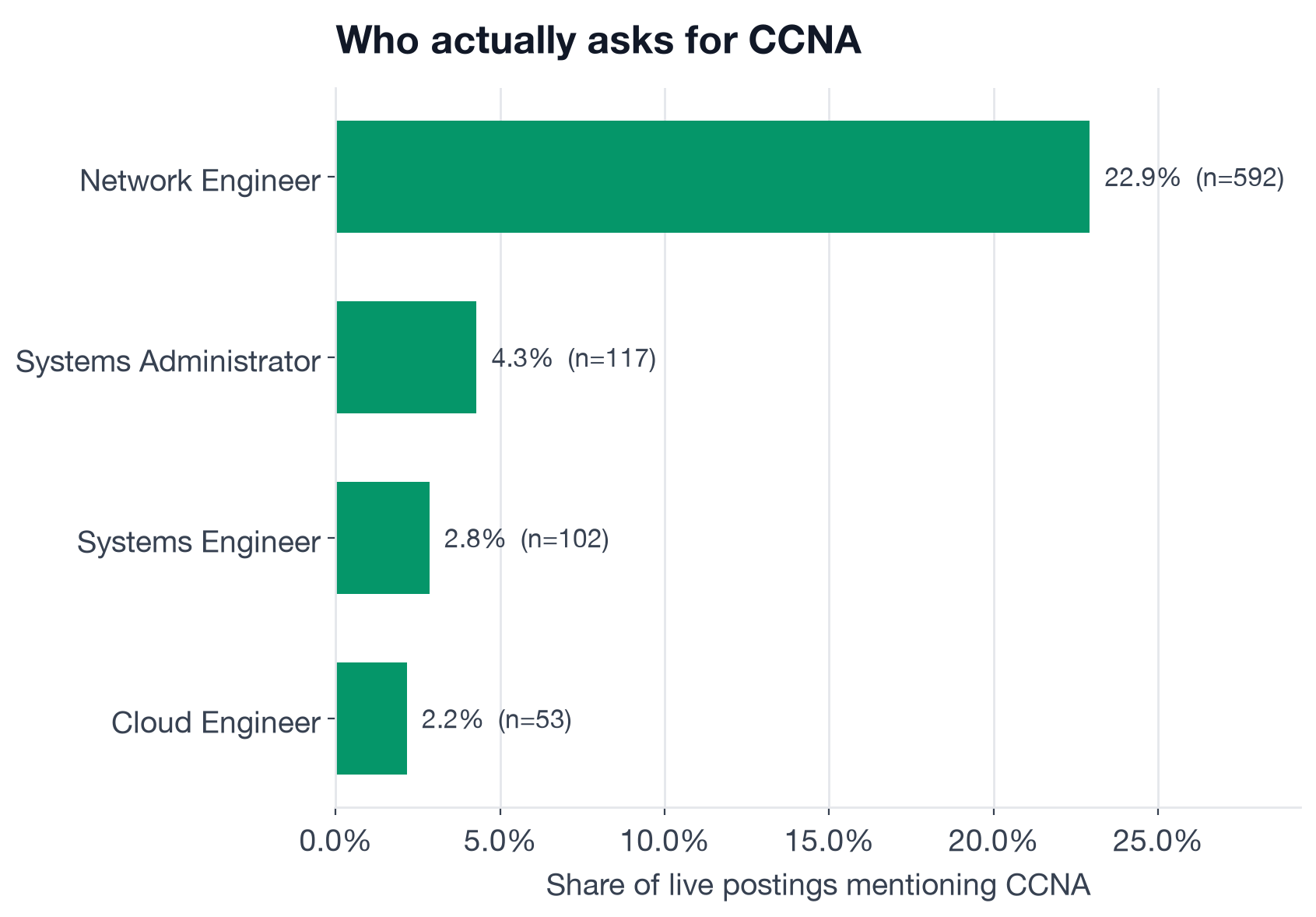 Network Engineer accounts for more than two-thirds of every CCNA mention in this scope; the other three roles barely register.
| Role | Active postings | Mention CCNA | Share |
|---|---|---|---|
| Network Engineer | 2,583 | 592 | 22.9% |
| Systems Administrator | 2,737 | 117 | 4.3% |
| Systems Engineer | 3,588 | 102 | 2.8% |
| Cloud Engineer | 2,457 | 53 | 2.2% |
If you're not applying to Network Engineer roles specifically, CCNA is a minor signal at best: fewer than 1 in 20 postings in the other three roles mention it at all. The credential's practical relevance narrows fast once you leave core network engineering.
Is CCNA a Requirement, or Just a Nice-to-Have?
CCNA rarely gates a candidate out on its own. Of the 521 postings clear enough to classify as required or preferred, 78.3% (408 postings) list it as preferred and 21.7% (113 postings) require it outright. Another 343 mentions, about 40% of all CCNA references, use phrasing too ambiguous to classify either way (open-ended cert lists, "or equivalent" language) and aren't counted in that ratio.
The practical read: holding CCNA clears the preferred bar in the large majority of postings that state a clear position. Not holding it rarely disqualifies you outright. Only about 1 in 5 classified postings, roughly 13% of all CCNA mentions, name it as a hard requirement.
The CCNA Pay Gap Never Closes, It Compounds
All salary figures here are advertised US base pay only, on the subset of postings that disclose it; equity, bonus, and any clearance premiums aren't part of job-posting data. The comparison baseline throughout is other postings in the same four-role scope that don't mention CCNA, not the broader job market.
Postings mentioning CCNA advertise a median $121,354 against $132,998 for non-CCNA postings in the same roles, 8.8% lower. Split by seniority, and the picture doesn't level out, it gets worse the higher you look.
| Level | With CCNA (median) | Without CCNA (median) | Gap |
|---|---|---|---|
| Entry | Not reportable (n=9) | $86,700 | n/a |
| Mid-level | $116,650 | $124,900 | -6.6% |
| Senior | $129,575 | $149,750 | -13.5% |
| Staff | $142,450 | $169,900 | -16.2% |
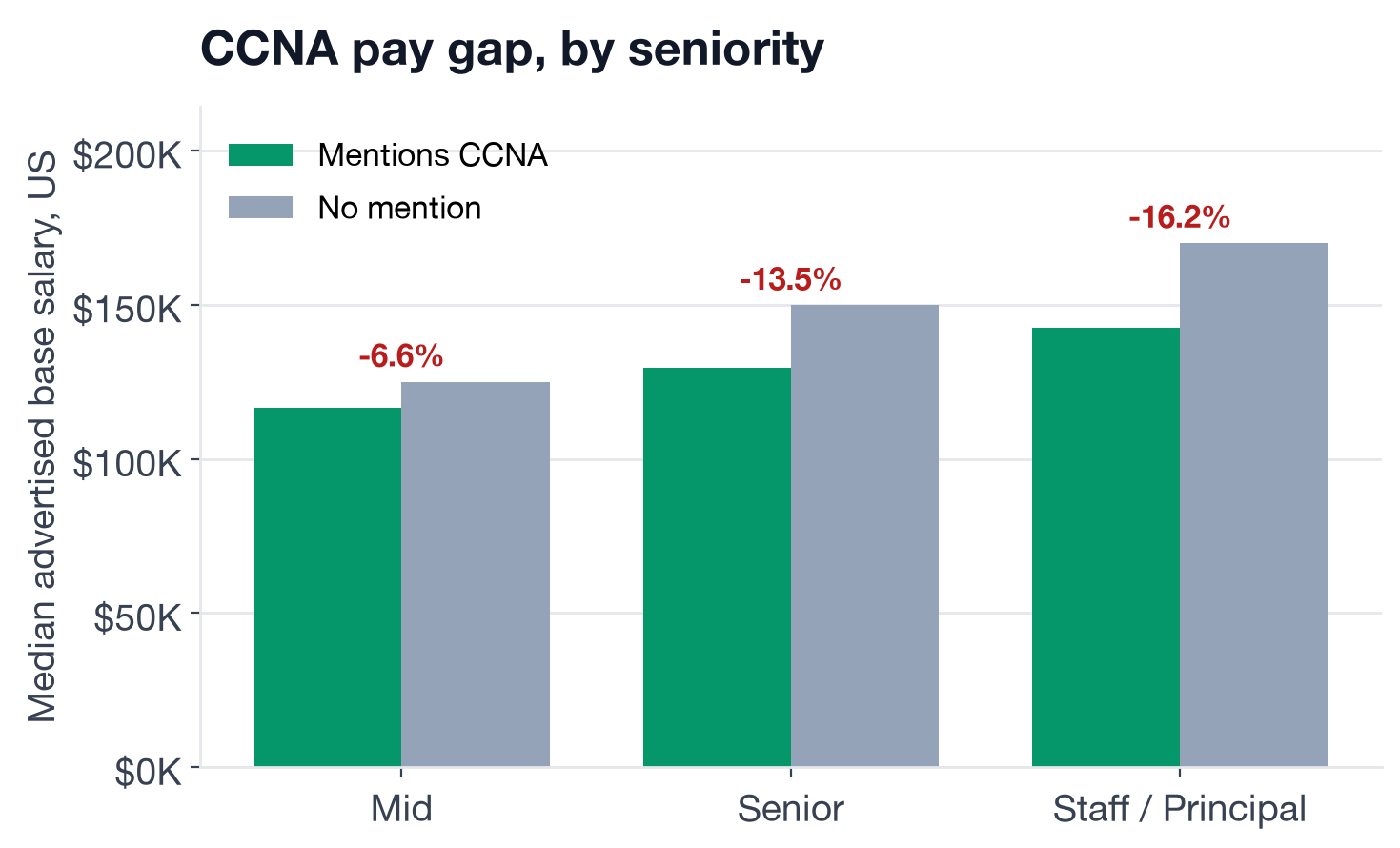 Unlike certifications where the pay comparison flips sign somewhere in the middle, CCNA's gap stays negative at every reportable level and more than doubles from mid to staff.
Part of that is seniority mix. CCNA-mentioning postings cluster at mid-level, 71.6% of them, versus 63.9% for non-CCNA postings, and are underrepresented at staff level, 6.3% versus 10.3%. But mix alone doesn't explain it: the gap holds, and grows, even comparing mid-to-mid and staff-to-staff. Whatever is driving the shortfall persists within each level. It isn't just that CCNA postings skew toward the cheaper end of the ladder.
The employer roster behind these numbers points at why.
Government and Defense Contractors Dominate CCNA Hiring
The employers asking for CCNA most often aren't a cross-section of the networking-hiring market. They're concentrated in one segment of it.
| Employer | Postings mentioning CCNA |
|---|---|
| CACI International | 92 |
| Leidos | 57 |
| Booz Allen Hamilton | 43 |
| General Dynamics Information Technology | 42 |
| Peraton | 39 |
| Northrop Grumman Corporation | 17 |
| Ntt Limited | 10 |
| AT&T Inc. | 8 |
| Entarian | 7 |
| Supermicro | 7 |
| Scientific Research Corporation | 7 |
CACI International, Leidos, Booz Allen Hamilton, General Dynamics Information Technology, and Peraton, all federal or defense contractors, account for more CCNA-mentioning postings than the rest of the top employer list combined. That concentration is consistent with why the pay gap widens instead of closing: network-engineering and operations work at large government-services contractors tends to sit on standardized, sustainment-focused pay bands, while the senior and staff postings in the broader comparison group increasingly reward cloud and platform specialization, work a base CCNA doesn't signal. The higher the level, the more that gap between government network-ops pay and private-sector platform pay shows up in the comparison.
What Do CCNA Postings Ask for Beyond the Cert?
CCNA rarely stands alone, either as a credential or as a skill list. Nearly half of CCNA-mentioning postings, 46.3%, also ask for CCNP, the next tier up Cisco's own certification ladder. CompTIA Security+ appears in 41.0% of them, and CompTIA Network+ in 20.5%, suggesting employers pair the associate-level Cisco credential with either the next Cisco tier or a foundational security one, not treat it as sufficient on its own.
| Certification | Co-occurs with CCNA |
|---|---|
| CCNP | 46.3% |
| CompTIA Security+ | 41.0% |
| CompTIA Network+ | 20.5% |
| Juniper JNCIA | 12.5% |
| SSCP | 11.9% |
| CISSP | 10.3% |
| GIAC GSEC | 10.2% |
| CompTIA CySA+ | 9.1% |
The skill list tells a complementary story. Monitoring (53.9%) and Firewalls (45.1%) lead, standard network-operations fundamentals, but Automation shows up in 30.6% of CCNA-mentioning postings, and Python (23.4%) and Ansible (19.3%, an open-source tool for automating server and network-device configuration) aren't far behind. AWS (20.9%) and Azure (20.3%) round that out. A CCNA-track network role in 2026 increasingly expects scripting and cloud fluency layered on top of routing and switching, not routing and switching alone. If you're building toward one of these roles, pairing Network Engineer with Automation skills is a reasonable way to see what that combination looks like in practice.
Putting This Data to Work in Your Search
If you're deciding whether CCNA is worth the study time, the data points at role and level more than raw value: it's most relevant if you're targeting Network Engineer roles specifically, holds up reasonably at mid-level, and matters less at senior and staff level, where automation and cloud skills carry more of the signal. If you already hold it, lead with the operational and automation skills employers pair it with, not the credential alone. Our breakdown of Network Engineer skills companies want in 2026 covers that full skill stack.
Drill the fundamentals CCNA covers, routing, switching, and network troubleshooting, with InterviewStack's Question Bank, organized by topic. If you're earlier in the path and want to build the underlying concepts before the exam or the interview, InterviewStack's interactive courses cover networking and cloud fundamentals. Once you have a target role in mind, run a mock interview against it to see where the gaps actually are.
To see current openings, browse active postings across all four roles in this scope or filter down to a specific one.
FAQ
Q. How many active postings mention CCNA in 2026?
864 of 11,365 active postings analyzed across four roles, Network Engineer, Systems Administrator, Systems Engineer, and Cloud Engineer, on the InterviewStack.io job board mention CCNA, about 7.6% of the scope, over a 90-day window.
Q. Which role actually asks for CCNA?
Network Engineer, by a wide margin. CCNA appears in 22.9% of Network Engineer postings (592 of 2,583), more than five times the rate of the next-closest role, Systems Administrator, at 4.3%.
Q. Is CCNA usually required or just preferred?
Preferred, in most cases where postings specify one. Of the 521 postings clear enough to classify, 78.3% list CCNA as preferred and 21.7% require it outright. Another 343 mentions, about 40% of all references, use phrasing too ambiguous to classify.
Q. Do postings that ask for CCNA pay more than postings that don't?
No, and the gap widens with seniority rather than closing. Postings mentioning CCNA advertise a median $121,354 versus $132,998 for non-CCNA postings in the same roles, 8.8% lower overall. By level, the gap is -6.6% at mid, -13.5% at senior, and -16.2% at staff, more than doubling in size from mid-level to staff.
Q. Why would postings mentioning CCNA pay less than postings that don't?
The employer roster explains most of it. CCNA-mentioning postings cluster at federal and defense contractors, CACI International, Leidos, and Booz Allen Hamilton among the largest, where network-operations pay bands tend to be more standardized than the private-sector cloud and platform roles that make up a larger share of senior and staff postings in the comparison group. It reflects who's hiring for CCNA and for what kind of role, not what the exam is worth.
Q. Is CCNA still worth pursuing for a networking career?
It depends on where you are in the path. CCNA is Cisco's associate-level credential and the data reflects that directly: it's the standard entry signal in almost a quarter of Network Engineer postings and holds up reasonably at mid-level, but postings that still lean on it at staff level trail the broader market by a growing margin. Most CCNA holders pair it with CCNP (46.3% of CCNA-mentioning postings also ask for it) rather than stopping there.
Where CCNA Fits in a Network Engineering Path
CCNA is what its name says: an associate-level credential, not a senior-level lever. It's the standard entry point into close to a quarter of Network Engineer postings and shows up at a real, if shrinking, rate the further up the ladder you look. Treat it as the foundation Cisco built it to be, typically the step before CCNP, rather than a credential that keeps paying dividends the more senior you get.
Topics
Ready to practice?
Put what you've learned into practice with AI mock interviews and structured preparation guides.