
The Cloud Architect Architectural Patterns and Anti-Patterns Interview Rewards Fixing Coupling, Not Naming Patterns
You're eight minutes into a mid-level Cloud Architect interview, and the interviewer has just described an internal platform service, ProjectHub, that grew from a single project-setup app into six components: project creation, IAM group provisioning, billing tag assignment, environment template selection, deployment tracking, and audit reporting. On paper, that split looks like progress. In practice, every one of those "services" still shares one relational database and still calls each other synchronously to finish a single user action, so page loads got slower and releases got harder to coordinate, not easier.
This walkthrough runs on the real interview package InterviewStack.io's AI interviewer uses for a mid-level Cloud Architect interview on architectural patterns and anti-patterns, the same blueprint scored by the Cloud Architect question bank if you want to drill the underlying concepts first.
Six services and one shared database is the textbook distributed monolith: all the operational cost of microservices (more deploys, more network hops, more places to debug) with none of the decoupling benefit. Worse, ProjectHub's habit of absorbing every new platform capability is also how a god-service forms if nobody draws a boundary now. A candidate who reaches straight for CQRS or event sourcing without diagnosing that first, or who proposes a full rewrite instead of an incremental fix, is behind before the second follow-up lands.
Key Findings
- 100 rubric points split 30/30/20/20 across Interviewer Objectives Alignment, Level-Specific Expectations, Technical Proficiency, and Communication, so 60 of 100 points ride on framing and judgment, not pattern trivia.
- The interview runs 30 minutes across 3 phases: 0-8 min on smell detection, 8-20 min (12 minutes) on target architecture and pattern selection, 20-30 min on migration and operational realism.
- Six named components, plus one shared database still read by multiple services, sit inside a single scenario.
- One follow-up asks what changes if project creation depends on five synchronous downstream calls before anything completes, a concrete fan-out number the interviewer expects you to name and reduce.
- Phase 2 alone packs 5 checklist items into its 12 minutes: boundaries, synchronous dependencies, pattern selection, overuse avoidance, and consistency choices.
- Phase 3 (20-30 min) carries 4 checklist items, and one explicitly expects a concrete step to remove shared database dependencies safely.
- 4 skill areas sit outside this interview's scope entirely: low-level coding implementation details, vendor-specific certification trivia, machine learning system design, and deep database query optimization.
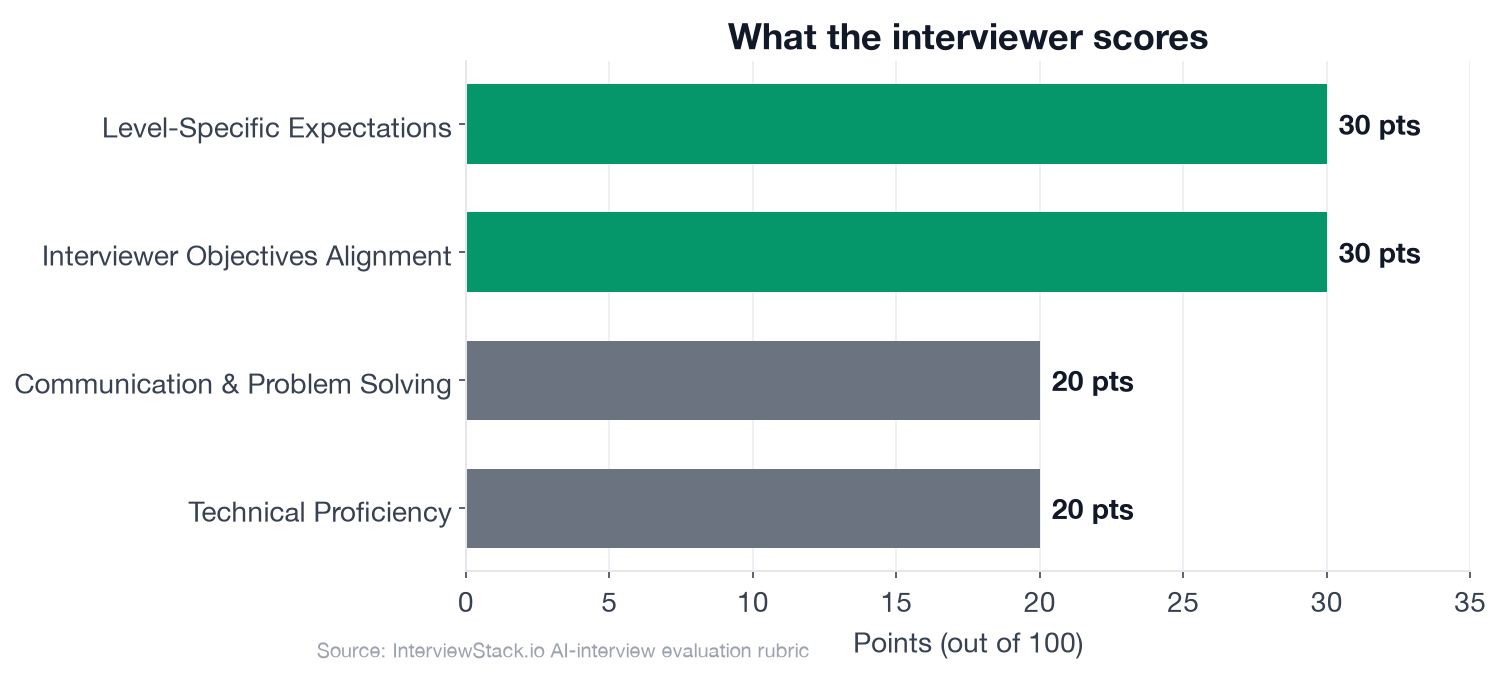
Framing and mid-level judgment, the top two dimensions, are worth more than Technical Proficiency and Communication combined (60 vs. 40 points).
What Is the Interviewer Actually Testing in the ProjectHub Scenario?
Here's the question as it appears in the live blueprint:
The interview question
Your team owns an internal cloud platform capability used by multiple product teams at a large tech company. A service called ProjectHub started as a single deployable app for project setup and now supports project creation, IAM group provisioning, billing tag assignment, environment template selection, deployment tracking, and audit reporting. Over the last year, several pieces were split into separate services, but every user action still triggers many synchronous calls across services before anything completes. Teams report slow page loads, hard-to-debug failures, and tightly coordinated releases. Leadership wants the architecture cleaned up before wider adoption.
Current participating components:
- ProjectHub API
- IAM Service
- Billing Tag Service
- Environment Template Service
- Deployment Tracker
- Audit Service
- shared relational database still read by multiple services for some workflows
How would you evaluate and redesign this architecture so it uses appropriate patterns and avoids the anti-patterns that are emerging, while remaining practical for a platform used by many internal teams?
The interviewer is checking whether you can tell symptoms from root causes, choose defensible service boundaries with real ownership rationale, apply patterns like hexagonal, layered, CQRS, or event-driven integration only where the workload actually justifies them, and land on a migration plan that a platform team of realistic size can actually execute over two quarters, not a full rewrite.
Four Follow-Ups, Four Places the Coupling Leaks Through
The candidate below, Jonah, is dramatized to show where mid-level answers commonly lose points on this scenario, not a transcript of a real session. These four follow-ups, in the order a strong candidate would actually hit them, move from diagnosis to interaction redesign to pattern selection to migration sequencing.
Turn 1: Naming the Real Smells
Interviewer: "What architectural smells would make you call this a distributed monolith rather than a healthy set of services?"
Turn 2: The Five-Call Chain
Interviewer: "If project creation currently depends on five synchronous downstream calls, how would you change that interaction model and what trade-offs would you accept?"
Turn 3: The Pattern Isn't the Point
Interviewer: "Would you use CQRS, event sourcing, layered architecture, or hexagonal architecture anywhere in this design, and where would you avoid overusing them?"
Turn 4: Two Quarters, Not One Weekend
Interviewer: "If leadership asked for an incremental migration plan over two quarters with minimal disruption to product teams, what would you sequence first?"
Why Doesn't Naming the Anti-Pattern Fix It Live?
Every mistake above is easy to catch on the page, the rubric line is basically printed next to it. Under real interview conditions there is no rubric line. You get 30 minutes, an interviewer who asks what you'd actually change the moment your diagnosis starts sounding like a vocabulary list, and a checklist you cannot see. Recognizing "that's the pattern-for-the-sake-of-a-pattern mistake" while reading an article is a different skill from catching yourself reaching for event sourcing mid-sentence, live, with the clock running. The only way to build that instinct is reps in the AI mock interview itself.
Where Do the 100 Rubric Points Actually Land?
The chart below maps how the interview's 13 checklist items are distributed across problem framing, target architecture, and migration planning.
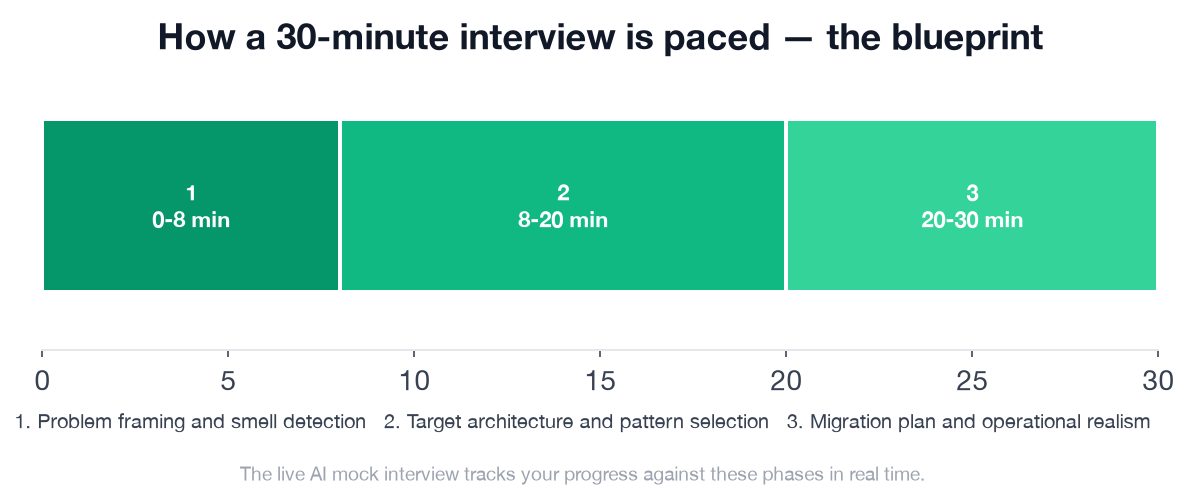
Phase 2, target architecture and pattern selection, is both the longest phase and the densest: 12 minutes carrying 5 of the interview's 13 checklist items.
This is the blueprint a strong candidate hits, phase by phase, and the exact structure the AI mock interview tracks you against while you're answering, not after:
- ✓States 2-4 concrete smells from the prompt, not just vague concerns
- ✓Calls out shared database access as a coupling problem
- ✓Notes synchronous fan-out and failure amplification in user-facing flows
- ✓Frames the issue as architecture and ownership misalignment, not just performance tuning
- ✓Proposes clearer service boundaries or module boundaries with ownership rationale
- ✓Recommends reducing synchronous dependencies in critical workflows
- ✓Uses at least one relevant pattern appropriately, such as hexagonal internals for testability or CQRS for read-heavy reporting
- ✓Avoids forcing event sourcing or CQRS everywhere without need
- ✓Discusses consistency choices for provisioning, audit, and reporting flows
- ✓Suggests an incremental sequence instead of big-bang replacement
- ✓Includes compatibility or facade strategy for existing consumers
- ✓Mentions observability signals such as call chains, failure rates, or queue lag to validate improvements
- ✓Identifies one or more steps to remove shared database dependencies safely
Take This Diagnosis Into a Real Interview
Reading the four mistakes above is the easy part. The AI mock interview for Cloud Architect architectural patterns and anti-patterns asks the ProjectHub scenario, follows up based on what you actually propose, and scores you across all four rubric dimensions the moment the 30 minutes end. That's the only way to find out whether you'd actually name the shared database as the problem live, not on a re-read of this post. For focused drilling first, the question bank for architectural patterns and anti-patterns covers smell detection, pattern selection, and migration sequencing with worked answers, and the InterviewStack.io preparation guide maps how this topic fits into the broader Cloud Architect prep path.
FAQ
Q. What does a mid-level Cloud Architect architectural anti-patterns interview test?
The interview runs 30 minutes across 3 phases: problem framing and smell detection (0-8 min), target architecture and pattern selection (8-20 min), and migration plan and operational realism (20-30 min). The rubric weights Interviewer Objectives Alignment and Level-Specific Expectations at 30 points each, so framing and judgment account for 60 of 100 points, with Technical Proficiency and Communication and Problem Solving worth 20 each.
Q. What makes a set of microservices a distributed monolith?
A shared database still read by multiple services, synchronous fan-out where one user action triggers many downstream calls before anything completes, and coordinated releases that force teams to deploy together. This interview's Phase 1 checklist explicitly rewards naming shared database access as a coupling problem and framing the issue as architecture and ownership misalignment, not just performance tuning.
Q. Should every architecture interview answer include CQRS or event sourcing?
No. The blueprint's Phase 2 checklist explicitly rewards using at least one relevant pattern appropriately (hexagonal internals for testability, CQRS for read-heavy reporting, for example), while also avoiding forcing event sourcing or CQRS everywhere without need. Applying every pattern to every part of the system concedes Level-Specific Expectations points for not communicating pattern fit.
Q. What is the most common mistake in architectural anti-pattern interviews?
Naming a pattern (CQRS, hexagonal, layered) without first diagnosing the actual coupling problem, or proposing a full rewrite instead of an incremental migration. Candidates who skip smell detection in Phase 1 or who never address the shared database directly tend to lose points across both Interviewer Objectives Alignment and Level-Specific Expectations.
Q. How should I prepare for a Cloud Architect architectural anti-patterns interview?
Practice naming concrete architectural smells before proposing solutions, distinguishing where synchronous versus asynchronous interaction actually matters, matching patterns like CQRS or hexagonal architecture to specific workloads instead of applying them everywhere, and sequencing an incremental migration with a compatibility strategy for existing consumers. The InterviewStack.io AI mock interview for Cloud Architect architectural anti-patterns tracks you against the live blueprint in real time.
Q. What is the scoring rubric for this Cloud Architect interview?
Four dimensions totaling 100 points: Interviewer Objectives Alignment (30 points), Level-Specific Expectations (30 points), Technical Proficiency (20 points), and Communication and Problem Solving (20 points). The two highest-weighted dimensions reward diagnosing coupling and making sound trade-offs, not naming the most patterns.
Q. Does this interview require deep Kubernetes or database query tuning knowledge?
No. This interview's blueprint explicitly excludes low-level coding implementation details, vendor-specific certification trivia, machine learning system design, and deep database query optimization. The focus is architectural diagnosis, pattern fit, and migration sequencing.
Coupling Doesn't Care What You Call It
Call it CQRS, hexagonal, or event-driven, none of it fixes a distributed monolith if the database is still shared and every request still waits on five synchronous calls. The candidates who score well here name that plainly before they reach for a pattern, then sequence the fix in steps a product team can actually survive. That diagnosis-first instinct is exactly what reps in a live interview build.
Topics
Ready to practice?
Put what you've learned into practice with AI mock interviews and structured preparation guides.