
The Migration Plan Is Five Problems, Not One
You are ninety seconds into a mid-level Cloud Architect interview on cloud migration strategy and planning, and the interviewer has just described a retail company running an e-commerce stack across two on-prem data centers, a second data center lease that ends in 9 months, and a change freeze that swallows November and December. Say "we'll rehost everything and figure out the database later," and you have already given away points nobody told you were on the table.
This walkthrough runs on the real interview_package InterviewStack.io's AI interviewer uses for a mid-level Cloud Architect interview on cloud migration strategy and planning, the same blueprint scored by the Cloud Architect question bank if you want to drill individual concepts first.
The environment in this scenario is not one system, it is five: a Java web app, a catalog and search layer, an order service, a SQL Server database, and a nightly batch file export to finance and fulfillment partners. Candidates who propose one migration approach for all five, or who promise a clean, symmetric rollback for the whole cutover once the database is live in the cloud, are behind before the first follow-up even lands.
Key Findings
- 100 rubric points split 30/30/20/20 across Interviewer Objectives Alignment, Level-Specific Expectations, Technical Proficiency, and Communication, so 60 of 100 points ride on framing and judgment, not tool trivia.
- The interview runs 30 minutes across 3 phases: 0-8 min on strategy framing, 8-20 min (12 minutes) on component approach and migration waves, 20-30 min on cutover and operations.
- Phase 2 alone packs 6 checklist items into 12 minutes, covering component differentiation, SQL Server migration, file-share continuity, and DNS coexistence.
- The scenario sets a 9-month data center lease deadline, a 2-month change freeze (November through December), and a 4x seasonal traffic spike as fixed constraints, not negotiable ones.
- Phase 3 carries 6 checklist items in its own 10 minutes, and one explicitly expects candidates to name where database rollback is genuinely difficult.
- 4 skill areas sit outside this interview's scope entirely: deep Kubernetes internals, writing infrastructure-as-code syntax from memory, low-level application code, and ML system design.
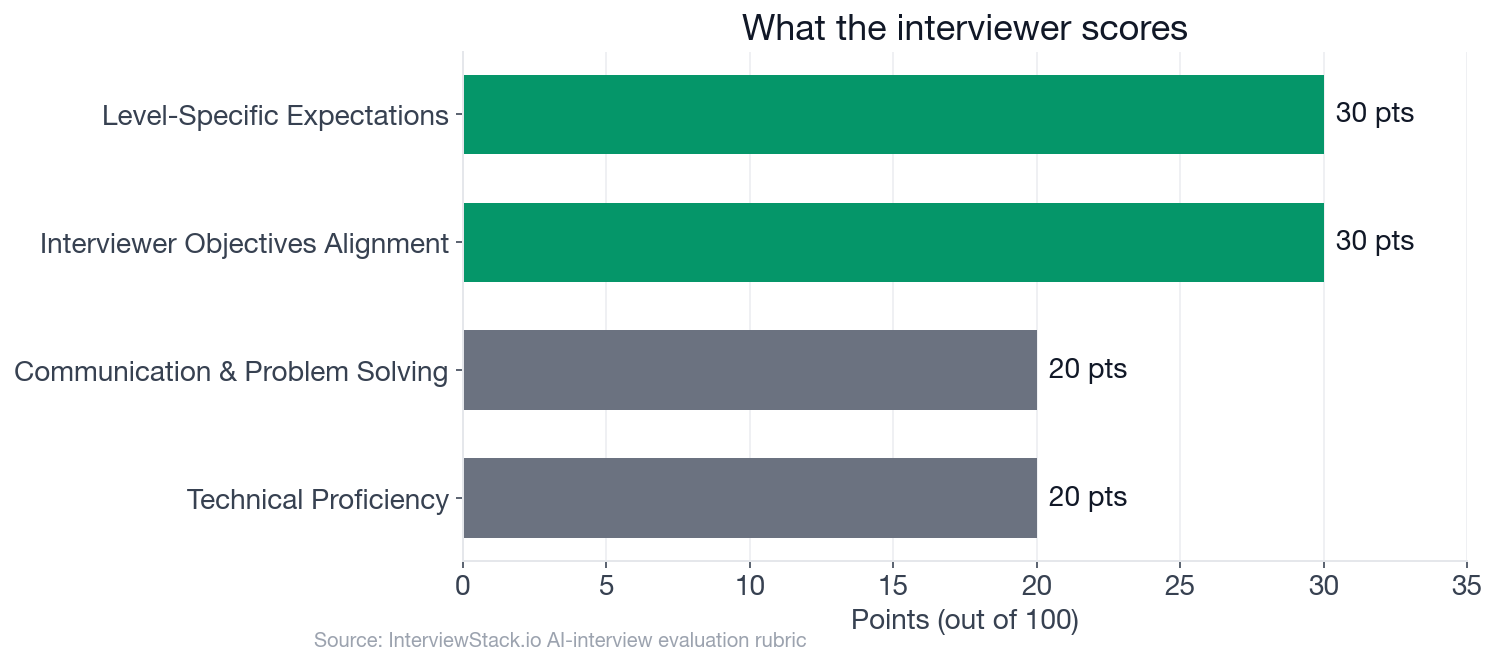
Framing and mid-level judgment, the top two dimensions, are worth as much combined as Technical Proficiency and Communication put together.
What Does a Cloud Architect Cloud Migration Strategy Interview Actually Test?
Here is the question as it appears in the live blueprint:
The interview question
You are supporting a business-critical migration for a regional retail and e-commerce company. The customer-facing e-commerce application runs in an on-prem VMware environment across two data centers. Core components include a Java-based web application serving browse and checkout traffic, a product catalog and search service, an order management service, a Microsoft SQL Server database for orders and customer data, a file share used for nightly batch exports to finance and fulfillment partners, and identity integrated with on-prem Active Directory. Traffic is seasonal and can spike to 4x during promotions.
The company's second data center lease ends in 9 months. There is a strict change freeze from November through December. Payment processing is handled by a third-party provider, and customer data is subject to PCI-related controls (payment-card industry compliance requirements). Engineering capacity is limited to one platform team, one DBA, and application teams that can make only moderate code changes this year. The business wants to reduce data center dependency before the lease ends, improve resilience and scalability before next year's peak season, minimize disruption to checkout and order processing, and avoid a large one-time rewrite.
How would you plan and sequence the migration of this environment to the cloud?
The interviewer is evaluating whether you can frame the migration in business and technical terms, choose a defensible approach per component instead of one blanket answer, sequence realistic waves, and fold security, compliance, and post-migration operations into the plan from the start, all while working with exactly one platform team and one DBA.
Watch the Plan Fall Apart in Real Time
Four follow-ups from the blueprint, in the order a strong candidate would actually hit them: discovery, component strategy, data continuity, and rollback. The candidate below, Diego, is dramatized to show where mid-level answers commonly lose points, not a transcript of a real session.
Turn 1: Discovery Before Commitment
Interviewer: "What discovery work would you do up front to uncover dependencies and migration risk before committing to migration waves?"
Turn 2: One Motion or Five?
Interviewer: "How would you decide which components to rehost, replatform, refactor, retain, or retire in the first year, and why?"
Turn 3: What Keeps Running During the Transition
Interviewer: "How would you handle the SQL Server and file-based integrations so the business can keep operating during the transition?"
Turn 4: The Rollback You Can't Promise
Interviewer: "Suppose leadership asks for a rollback option during cutover for checkout and order processing. What would a realistic rollback strategy look like?"
Spotting the Mistake Isn't the Same as Not Making It
Every mistake above reads obviously wrong on the page, with the rubric line already highlighted next to it. Under real interview conditions you do not get the highlight. You get 30 minutes, an interviewer who asks an unscripted follow-up the moment your plan sounds too clean, and a checklist you cannot see. Recognizing "that's the DNS-only rollback mistake" in an article is a different skill from catching yourself about to make it live, mid-sentence, with the clock running.
The Blueprint the AI Interviewer Tracks You Against
The chart below maps how the 16 checklist items are distributed across the interview's three phases.
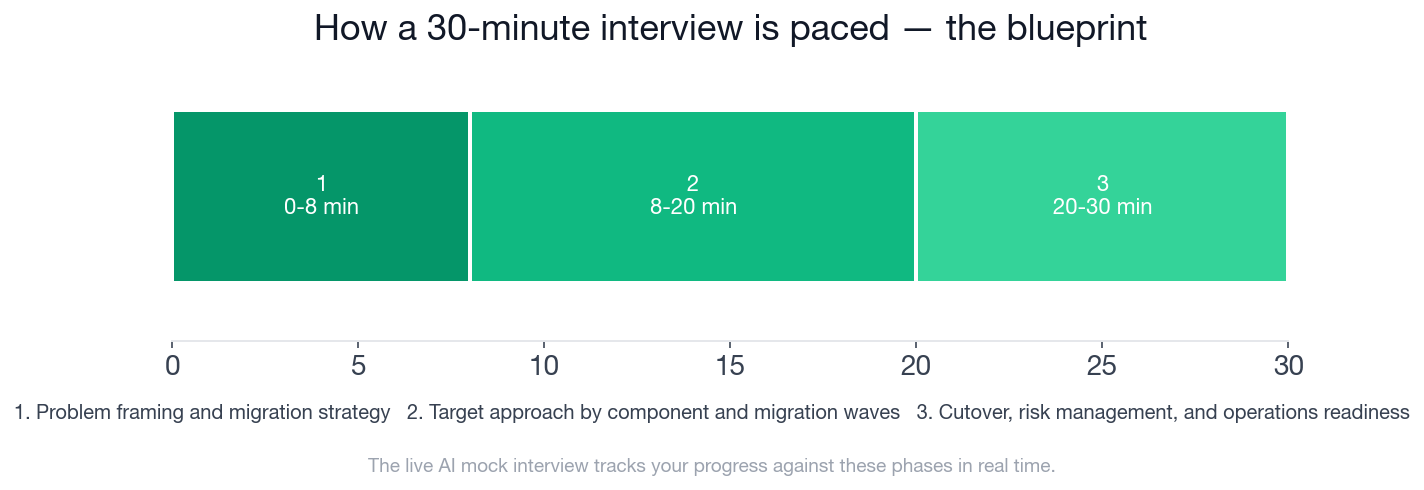
Phase 2 is both the longest phase and the densest, which is exactly where the component-by-component decision has to land.
This is the blueprint a strong candidate hits, phase by phase, and the exact structure the AI mock interview tracks you against while you are answering, not after:
- ✓Asks or states assumptions about business-critical flows such as checkout, order processing, and seasonal peaks
- ✓Surfaces key constraints including the 9-month deadline, holiday change freeze, limited engineering capacity, and PCI-related controls
- ✓Defines a success-oriented strategy such as prioritizing risk reduction and data center exit over broad modernization
- ✓Proposes an initial migration shape with hybrid transition rather than assuming a single cutover for all components
- ✓Differentiates components instead of treating the stack as one unit, for example web tier, services, database, identity, and batch/file integrations
- ✓Selects plausible first-year approaches such as rehost or replatform for lower-change components and limited refactoring only where it materially reduces risk or improves scalability
- ✓Identifies likely migration waves, for example foundation and landing zone, non-critical dependencies, application tier, then database and critical cutover
- ✓Explains how SQL Server migration would be handled, including backup/restore, replication, managed database options, or phased cutover considerations
- ✓Addresses file share and partner batch integration continuity, such as temporary hybrid transfer patterns or cloud-hosted replacements
- ✓Considers DNS, traffic shifting, synchronization, and coexistence between on-prem and cloud during transition
- ✓Describes a credible cutover path for customer-facing traffic, such as staged validation, limited traffic shift, maintenance window, or blue-green style approach where feasible
- ✓Provides a realistic rollback approach, especially noting where database rollback is difficult and what safeguards reduce that risk
- ✓Includes pre-cutover and post-cutover validation for checkout, order creation, payment flow, and downstream exports
- ✓Mentions foundational operational needs such as observability, alerting, runbooks, access model, patching ownership, backup, and disaster recovery
- ✓Recognizes PCI-related concerns such as network segmentation, secrets handling, auditability, and least-privilege access
- ✓Shows pragmatic decision-making if capacity becomes constrained, such as reducing scope of refactoring while preserving the deadline and critical business outcomes
Ready to Run This Migration Sequence Yourself?
The AI mock interview for Cloud Architect cloud migration strategy and planning asks the opening scenario, follows up based on what you actually say, and scores you across all four rubric dimensions the moment the 30 minutes end. That is the only way to find out whether you would catch the rollback asymmetry live, not on a re-read of this post. For focused drilling first, the question bank for cloud migration strategy and planning covers discovery, migration waves, cutover, and rollback planning with worked answers, and the InterviewStack.io preparation guide maps how this topic fits into the broader Cloud Architect prep path.
FAQ
Q. What does a mid-level Cloud Architect cloud migration strategy interview test?
The interview runs 30 minutes across 3 phases: problem framing and migration strategy (0-8 min), target approach by component and migration waves (8-20 min), and cutover, risk management, and operations readiness (20-30 min). The rubric weights Interviewer Objectives Alignment and Level-Specific Expectations at 30 points each, so framing and judgment account for 60 of 100 points, with Technical Proficiency and Communication and Problem Solving worth 20 each.
Q. How many phases are in a 30-minute cloud migration strategy and planning interview?
Three phases: problem framing and migration strategy (0-8 min, 4 checklist items), target approach by component and migration waves (8-20 min, 6 checklist items), and cutover, risk management, and operations readiness (20-30 min, 6 checklist items).
Q. Is a full rollback possible during a cloud migration cutover?
Not cleanly, and a strong candidate says so. Traffic and DNS rollback are close to free, but once a cloud database has accepted new writes, reversing it means reconciling orders that never happened on the on-prem side. The interview's checklist explicitly rewards candidates who name that asymmetry and propose safeguards, such as a bounded read-only fallback window, rather than promising a symmetric rollback.
Q. What is the most common mistake in cloud migration strategy interviews?
Treating a multi-component environment, web tier, services, database, identity, and file integrations, as one migration motion instead of five. Candidates who propose a single rehost-everything or refactor-everything plan miss the Phase 2 checklist item that expects component-by-component approach selection and concede Level-Specific Expectations points for skipping the trade-off analysis.
Q. How should I prepare for a Cloud Architect cloud migration strategy interview?
Practice differentiating migration approaches per component before reaching for a single answer, naming concrete discovery work (dependencies, RTO/RPO, integration owners), addressing database and file-integration continuity explicitly, and stating where rollback is genuinely difficult rather than assuming it is symmetric. The InterviewStack.io AI mock interview for Cloud Architect cloud migration strategy tracks you against the live blueprint in real time.
Q. What is the scoring rubric for a Cloud Architect cloud migration interview?
Four dimensions totaling 100 points: Interviewer Objectives Alignment (30 points), Level-Specific Expectations (30 points), Technical Proficiency (20 points), and Communication and Problem Solving (20 points). The two highest-weighted dimensions reward structured sequencing and mid-level judgment, not deep tool knowledge.
Q. Do Cloud Architect migration interviews require deep Kubernetes or infrastructure-as-code syntax knowledge?
No. This interview's blueprint explicitly excludes deep Kubernetes internals, writing infrastructure-as-code syntax from memory, low-level application code, and machine learning system design. The focus is migration strategy, sequencing, and trade-off reasoning, not tool syntax.
The Asymmetry Is the Point
Naming rehost, replatform, and refactor is table stakes. This interview actually rewards candidates who sequence five different components against a 9-month deadline and a two-month freeze, and who are honest that a database rollback is not the same promise as a DNS rollback. Get that framing right in the first 20 minutes, and the cutover conversation takes care of itself.
Topics
Ready to practice?
Put what you've learned into practice with AI mock interviews and structured preparation guides.