
Anika Named Five AWS Services and Still Lost the Room
Ten minutes into a mid-level Cloud Engineer interview, Anika has a clean diagram on the whiteboard: S3, Lambda, API Gateway, RDS, IAM. Every box is correct. The interviewer asks "why that one?" and the silence is where the points go. Technical Proficiency is only 20 of 100 rubric points; the other 80 reward reasoning, trade-offs, and how you handle new constraints.
This walkthrough uses the interview package behind InterviewStack.io's AI mock interview for a mid-level Cloud Engineer on AWS core services and architecture. The answers below are illustrative, not a transcript of a real person.
Key Findings
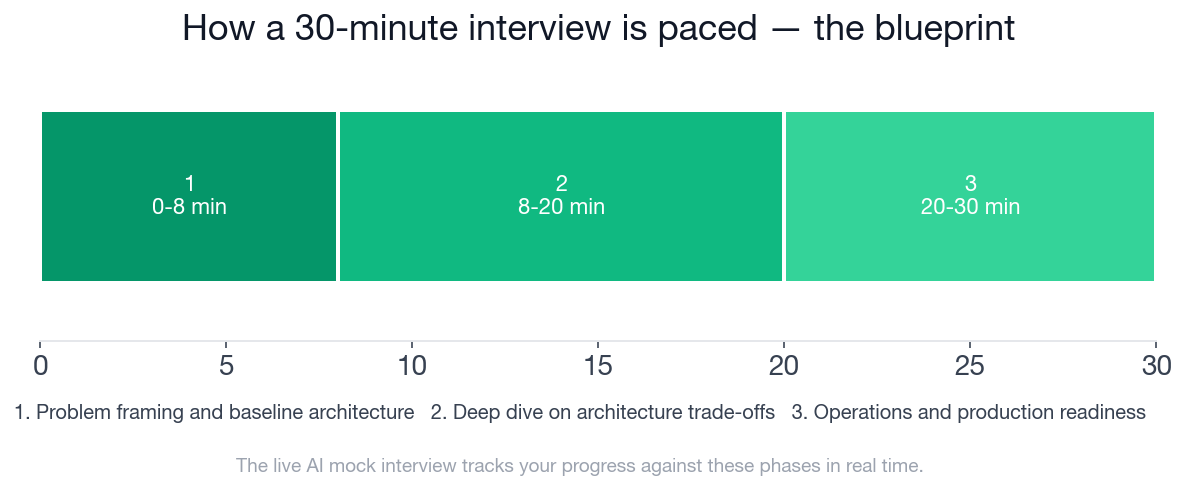
- The interview runs 30 minutes in 3 phases: 0-8, 8-20, and 20-30 minutes.
- Technical Proficiency is worth 20 of 100 points; Interviewer Objectives Alignment and Level-Specific Expectations are worth 30 each.
- The 12-minute deep-dive phase carries 6 checklist items, the most of any phase.
- The opening phase expects 2-4 clarifying questions before you commit to a design.
- A 20x upload surge is the stress test: the design must say what breaks first and how blast radius is capped.
- The final 10 minutes score 5 production-readiness checks, from monitoring signals to a safe rollout.
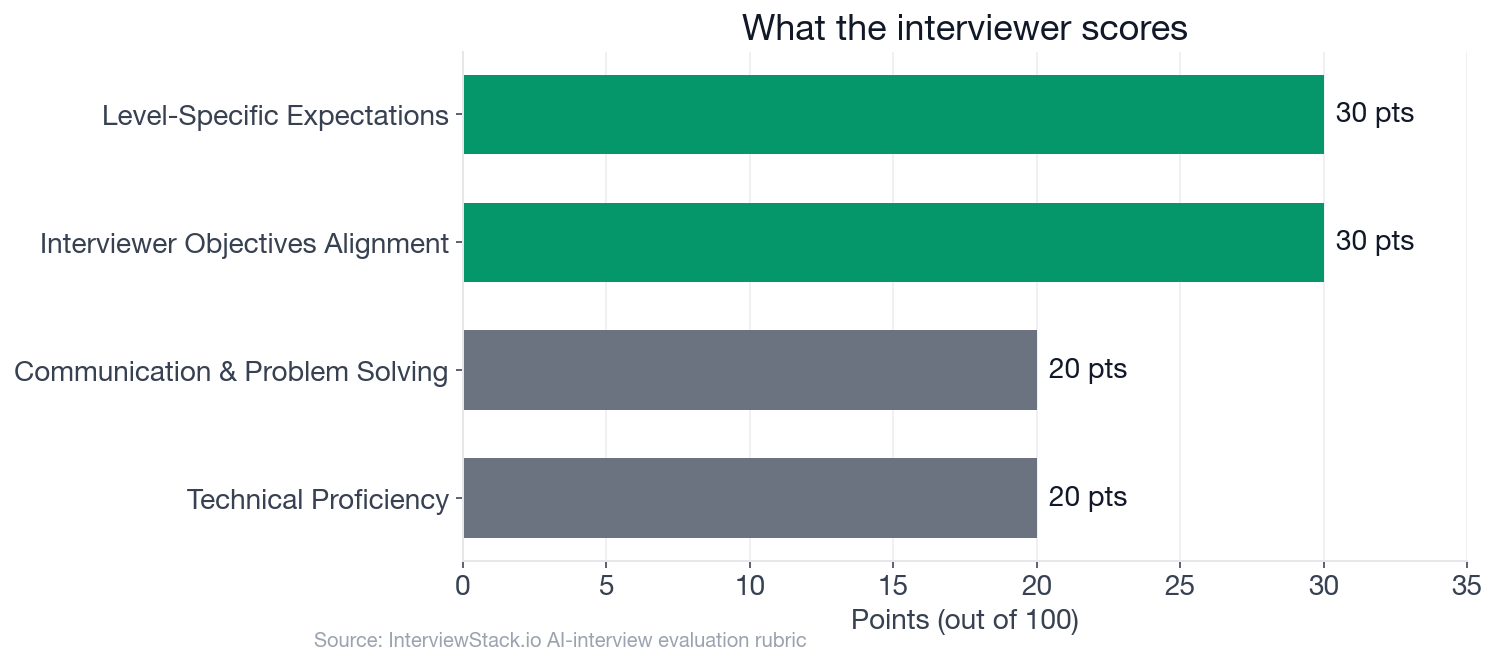
The rubric weights: 60 of 100 points sit in objectives and level expectations, where service choices must be justified.
What Is the Interviewer Asking You to Design?
Your question is a compliance-document service for a large company, and the first answer sets the tone.
The interview question
Your team is building an internal service for a large tech company that lets employees upload, process, and retrieve large compliance-related documents used by other internal systems. The service must support sudden usage spikes around audit periods, store documents durably, expose an API for metadata lookup and retrieval, and keep access tightly controlled because documents may contain sensitive internal data.
The team wants to build this on AWS and expects the first production version to be maintainable by a small engineering team. How would you design the AWS architecture for this service?
The interviewer is probing whether you can make sound decisions under incomplete requirements, explain EC2 versus Lambda versus managed services, and describe how the system is deployed, monitored, and evolved. "Maintainable by a small team" is the hidden constraint: bespoke infrastructure loses to managed services.
Four Follow-Ups, Four Slips Where Points Leak
Turn 1: The 20x audit spike
Interviewer: "If document uploads suddenly increase by 20x during an audit week, what would you change or validate in your design to handle the spike safely?"
Turn 2: EC2 versus Lambda
Interviewer: "How would you decide between EC2, Lambda, and other managed AWS options for the API and document-processing parts of this system?"
Turn 3: Least-privilege access
Interviewer: "How would you enforce least-privilege access for both employees using the service and AWS services talking to each other?"
Turn 4: Production readiness
Interviewer: "What monitoring, alerting, and operational checks would you want before calling this production-ready?"
Why Isn't Reading This Enough?
Spotting these mistakes on the page is easy because you have the rubric in front of you. Live, you have 30 minutes, an interviewer who changes the constraint mid-answer, and no list. Anika's mistakes were not knowledge gaps; they were habits of answering short under pressure. Those habits only change with reps against unscripted follow-ups.
What Does a Strong Cloud Engineer AWS Architecture Interview Look Like?
This is the blueprint a strong candidate hits, phase by phase, and the exact thing the AI mock interview tracks you against in real time. Use it as a self-check for what you skipped.
- ✓Asks 2-4 relevant clarifying questions such as document size, access pattern, internal auth model, latency expectations, retention, or processing type
- ✓Identifies at least the major building blocks: storage for documents, API layer, metadata store, auth/access control, and processing flow
- ✓Chooses AWS services that fit the problem rather than listing many alternatives
- ✓Keeps the initial design appropriately scoped for a small team operating the first production version
- ✓Describes a plausible request/data flow, for example upload path to S3, metadata persistence, processing trigger, and retrieval path
- ✓Correctly reasons about EC2 vs Lambda or another managed compute option using workload shape, runtime limits, operational burden, and scaling characteristics
- ✓Places sensitive components thoughtfully within VPC boundaries and explains public versus private exposure
- ✓Uses IAM roles/policies and possibly bucket policies/KMS in a way consistent with least privilege
- ✓Addresses database availability and scaling with concrete mechanisms such as Multi-AZ, read patterns, connection management, caching, or backpressure
- ✓Mentions durability and recovery considerations such as S3 durability, backups, versioning, or restore strategy
- ✓Names concrete monitoring signals such as API errors/latency, Lambda failures, queue depth if introduced, DB CPU/connections, S3 access failures, or auth errors
- ✓Suggests actionable alerting and logging approaches using AWS-native tooling such as CloudWatch, CloudTrail, and centralized logs
- ✓Explains at least one safe deployment approach such as blue/green, rolling, or staged rollout depending on compute choice
- ✓Can articulate how the design degrades under spikes or component failures and what safeguards limit blast radius
- ✓Shows balanced judgment on what to build now versus what to defer for a first production release
Run This Interview Live
Take the same scenario in the AI mock interview. It asks follow-ups based on what you actually say, then scores you on the same four dimensions. For more reps on the topic, work through the AWS core services question bank, and see the Cloud Engineer preparation guide and open Cloud Engineer roles to see the skills employers list.
FAQ
What does a Cloud Engineer AWS core services and architecture interview test?
It tests whether you can justify an AWS design with concrete trade-offs, not whether you can list services. The 100-point rubric gives 30 points to the interviewer's objectives, 30 to level-specific expectations such as trade-offs and system thinking, 20 to technical proficiency, and 20 to communication and problem solving.
How long is this interview and how is it paced?
It runs 30 minutes in three phases: problem framing and baseline architecture (0-8 minutes), a deep dive on architecture trade-offs (8-20 minutes), and operations and production readiness (20-30 minutes). The middle phase is the longest at 12 minutes and carries six checklist items.
Should I choose EC2 or Lambda for the API and document processing?
Choose based on workload shape, runtime limits, operational burden, and scaling behavior, and say so out loud. For a small team facing audit-week spikes, a managed, scale-to-demand option is usually easier to defend, but the interviewer scores the reasoning, not a fixed answer.
How do you show least-privilege IAM in an AWS design interview?
Give each component its own role scoped to the exact actions and resources it needs, then back it with bucket policies and KMS key policies for the sensitive documents. Name how employees authenticate separately from how services call each other.
What should I clarify before designing the architecture?
Ask 2-4 questions: document size, access pattern, internal auth model, latency expectations, retention, or processing type. The first phase checklist rewards clarifying questions before any service is named.
What monitoring signals make an AWS service production-ready?
Name concrete signals such as API errors and latency, Lambda failures, queue depth if you introduce a queue, database CPU and connections, S3 access failures, and auth errors. Pair them with CloudWatch alarms, CloudTrail, and centralized logs, plus one safe rollout approach.
Can I practice this exact scenario live?
Yes. InterviewStack.io's AI mock interview runs this AWS architecture scenario, asks unscripted follow-ups based on your answers, and tracks you against the same blueprint in real time.
Where Your Next Rep Goes
Draw the diagram once, then defend every box. If you cannot say why a service beats its neighbor for a small team, that is the next thing to practice.
Topics
Ready to practice?
Put what you've learned into practice with AI mock interviews and structured preparation guides.