
The Cloud Engineer Compute Options and Trade-offs Interview Rewards Reading the Spike's Duration Correctly
Ninety seconds into a mid-level Cloud Engineer interview on compute trade-offs, most candidates have already heard the two numbers that matter: traffic spikes 15x normal during major live events, and that spike lasts 1-2 hours. What they usually skip is doing anything with the second number. A rapid two-minute ramp and a two-hour elevated plateau call for close to opposite architectures, and this interview is built to notice which one you defaulted to.
This is a simulated walkthrough of that interview, turn by turn, anchored on the real scenario InterviewStack.io's AI interviewer runs for a mid-level Cloud Engineer. Below are four moments where a well-prepared candidate still gives up real rubric points, plus the complete blueprint the interviewer scores against underneath.
Key Findings
- Interviewer Objectives Alignment and Level-Specific Expectations each carry 30 of the interview's 100 points, 60 combined, both scored on how well you scope the workload before naming a service.
- Problem framing and requirement discovery (minutes 0-8) packs 5 checklist items into 8 minutes, including one that explicitly rewards probing spike behavior beyond the headline 15x figure.
- The scenario's upload traffic spikes 15x normal for 1-2 hours during major live events, a sustained elevated window, not a seconds-long ramp.
- Heavy transcoding jobs span 30 seconds to 20 minutes, a 40x range hiding inside one "heavy processing" label.
- Architecture proposal and compute selection (minutes 8-20) is the longest phase at 12 minutes and expects at least 3 compute models compared directly across 6 checklist items.
- If pushed, the premium tier's validation path has to hold p95 latency under 2 seconds even during the 15x spike window.
- Technical Proficiency and Communication and Problem Solving each add 20 of the remaining 40 points, scored through the interview's final phase (minutes 20-30, 5 checklist items).
What Is the Interview Actually Listening For?
Here's the prompt a real mid-level candidate walks into, mirrored from the production interview generator:
The interview question
Your team owns a customer-facing media processing service for a large streaming platform. A new internal product needs a compute design for a service that accepts video upload events, runs validation and metadata extraction within seconds, and then performs heavier transcoding jobs that can range from 30 seconds to 20 minutes. Traffic is uneven: most of the day is light, but during major live events upload volume can spike to 15x normal for 1-2 hours. Some customers pay for premium processing with stricter latency expectations. The team is small, already operates standard observability tooling, and wants to avoid unnecessary operational burden while still keeping costs reasonable.
How would you choose the compute approach for this service, and what architecture would you recommend?
What's really being scored is not whether you can list virtual machines, containers, managed containers, serverless functions, and bare metal in order. It's whether you can turn the scenario's numbers, a 15x spike sustained for 1-2 hours, transcoding jobs from 30 seconds to 20 minutes, into concrete architecture constraints, then probe for what's still missing (concurrency, hardware needs, exact latency targets) before landing on a pragmatic recommendation with explicit assumptions and a post-launch validation plan.
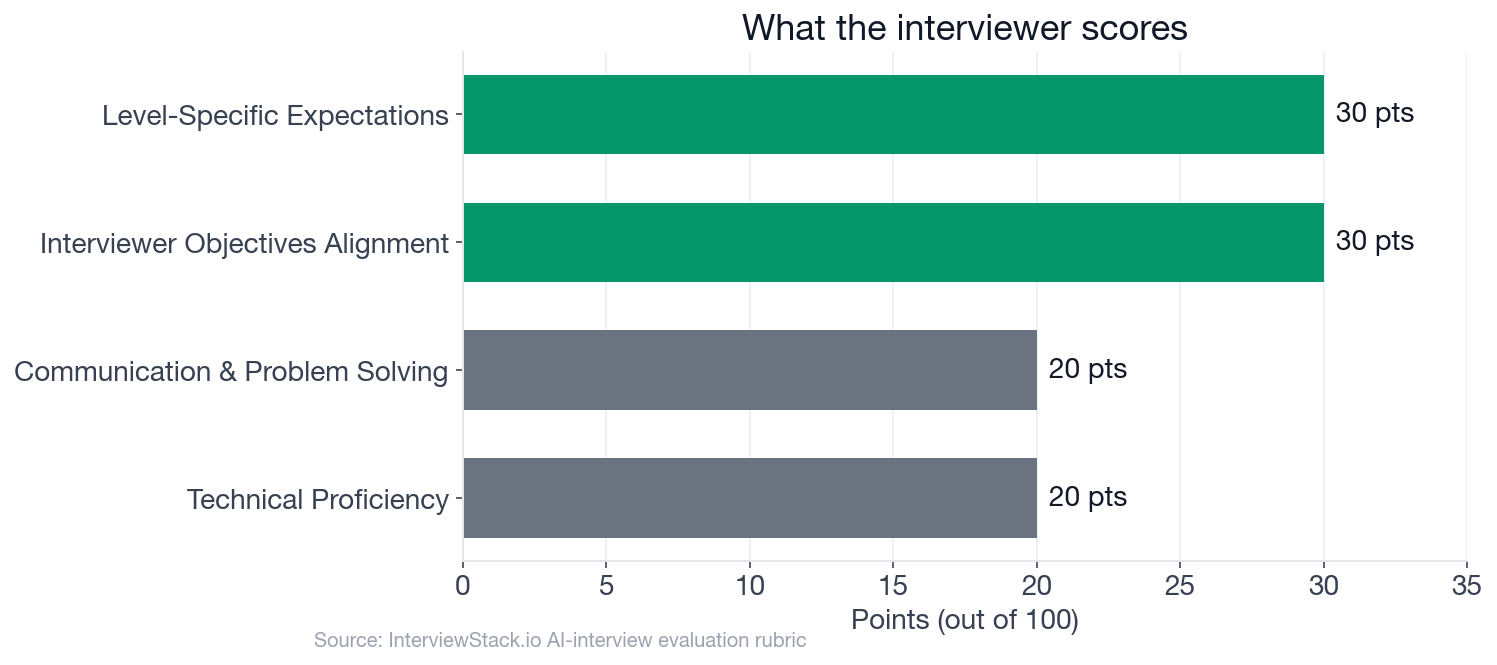 Sixty of the interview's 100 points reward how you scope and segment the workload; the other forty reward execution and communication.
Four Moments Where a Reasonable Answer Still Costs Points
Below are four moments from this interview where a well-prepared mid-level candidate, call him Miguel, gives an answer that sounds reasonable and still costs rubric points.
Turn 1: The Duration Trap
Interviewer: "What additional workload characteristics or business constraints would you want to clarify before committing to a compute model?"
Turn 2: The Premium Latency Floor
Interviewer: "If the premium tier requires p95 validation latency under 2 seconds even during spikes, how does that change your recommendation?"
Turn 3: The Hardware Pivot
Interviewer: "How would your design change if the transcoding workers require specialized hardware acceleration or very predictable performance?"
Turn 4: The Third-Party Code Problem
Interviewer: "If the team later needs stronger isolation for customer-specific processing logic written by third parties, how would that affect your compute choices?"
Reading This Is Not the Same as Answering It Live
Every mistake above is easy to spot once it's laid out with the wrong sentence in red and the fix in green. Under real interview conditions you don't get that framing, just a plain question, a clock that keeps moving, and follow-ups that never announce which checklist item they're testing. The gap between reading this and passing it is reps: running the scenario live, out loud, under pressure, until translating the scenario's given numbers into architecture decisions and asking about hardware needs is the first thing you do, not the thing you remember only after the interviewer pushes.
What a Strong Answer Hits, Minute by Minute
Here's how the three phases break down against the clock:
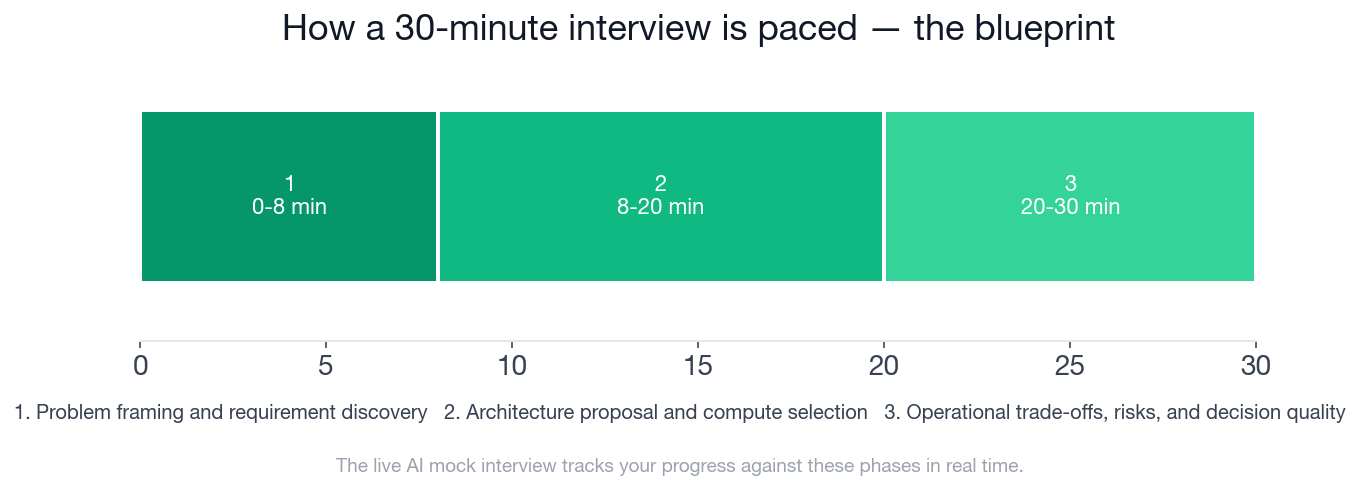 Requirement discovery gets 8 minutes, architecture proposal and compute selection gets the most time at 12 minutes, and operational trade-offs, risks, and decision quality close out the final 10.
- ✓Asks about latency expectations for validation versus transcoding
- ✓Asks about request volume, concurrency, and spike behavior beyond the provided 15x summary
- ✓Asks about job duration limits, CPU/GPU needs, memory profile, and whether tasks are stateless or stateful
- ✓Separates the lightweight synchronous path from the asynchronous heavy processing path
- ✓Surfaces team-size or operational-capacity considerations as a design input
- ✓Proposes a plausible end-to-end design, often with event ingestion, queueing, fast-path processing, and worker-based heavy processing
- ✓Matches low-latency short tasks to an option like serverless or managed containers when appropriate, while recognizing cold-start concerns
- ✓Matches long-running or resource-intensive transcoding to containers, managed batch/container workers, VMs, or specialized hosts with clear rationale
- ✓Compares at least three compute models directly rather than only describing the chosen one
- ✓Discusses autoscaling behavior and how the system behaves under burst traffic
- ✓Avoids unrealistic assumptions such as putting long-running transcoding entirely in a function platform with strict execution/runtime constraints unless carefully qualified
- ✓Explains monitoring, retry behavior, dead-letter handling, and backpressure for overloaded periods
- ✓Discusses cost shape such as paying for idle capacity versus per-invocation/per-use models
- ✓Identifies cold starts, noisy neighbor effects, image pull time, queue latency, and capacity exhaustion as practical risks
- ✓Adjusts the recommendation when premium latency or hardware acceleration requirements are introduced
- ✓Provides a final recommendation with explicit assumptions and notes what data they would validate post-launch
This is the blueprint a strong candidate hits, phase by phase, checklist item by checklist item, and it is the exact structure the AI mock interview tracks you against in real time, not just at the end.
Ready to Answer This Live, Not Just Read About It?
Reading the mistakes above is the easy part; catching yourself doing the same thing live, on a clock, before the interviewer even asks the follow-up, is the real test. Start the Cloud Engineer compute options and trade-offs mock interview and get scored against this exact rubric, with feedback on where you actually lost points. To drill the underlying concepts first, work through the Cloud Engineer compute options and trade-offs question bank, build foundational judgment with the interactive courses, or browse open Cloud Engineer roles to see what teams are asking for.
FAQ
Q. What does a Cloud Engineer interview on compute options and trade-offs actually test?
It tests whether you can turn a workload description into concrete constraints (latency, duration, concurrency, hardware needs) and choose the compute model, or mix of models, that fits each piece, rather than defending one option everywhere. Interviewer Objectives Alignment and Level-Specific Expectations each carry 30 of the interview's 100 points, rewarding that scoping work over naming the right service.
Q. Why does the scenario's 1-2 hour spike duration matter more than the 15x number itself?
The scenario states upfront that the spike lasts 1-2 hours, not seconds or minutes, which behaves closer to sustained steady-state load than a brief burst. A short ramp is mostly a cold-start and scale-out problem; a one to two hour elevated plateau is a per-invocation-pricing-versus-provisioned-capacity cost question. The interview's opening phase rewards candidates who register that distinction and then probe for what the scenario doesn't specify, like concurrency and spike shape, rather than candidates who treat the headline 15x figure as the whole picture.
Q. How should a strict premium latency requirement change the compute recommendation?
Once the premium tier needs p95 validation latency under 2 seconds even during spikes, a shared pool riding on best-effort cold starts isn't enough. A stronger answer separates premium traffic onto a warmed or provisioned execution path so its latency doesn't depend on cold-start variance during the exact window when concurrency is highest.
Q. When is specialized hardware or bare metal actually justified in this interview?
Only when the workload states an explicit need for it, such as hardware acceleration, predictable performance, or isolation from code the team doesn't control, never as a default upgrade. Both the hardware-acceleration and third-party isolation follow-ups test whether a candidate recognizes that trigger the moment it appears.
Q. How long is this interview and how is it scored?
Thirty minutes across three phases: problem framing and requirement discovery (minutes 0-8, 5 checklist items), architecture proposal and compute selection (minutes 8-20, 6 checklist items), and operational trade-offs, risks, and decision quality (minutes 20-30, 5 checklist items). The rubric totals 100 points across four dimensions, with Interviewer Objectives Alignment and Level-Specific Expectations worth 30 points each.
Q. What's the most common mistake mid-level candidates make in this interview?
Reaching for a scale-to-zero serverless design off the 15x figure alone, without registering that the scenario already says the spike runs 1-2 hours, closer to sustained load than a brief burst. That distinction decides whether cold starts or steady-state capacity cost is the real design constraint, and missing it costs points before the first follow-up arrives.
Q. Can I practice this exact interview?
Yes. The AI mock interview runs this same Cloud Engineer compute options and trade-offs scenario live, asks unscripted follow-up questions, and scores your answers against the same rubric described here.
How Long Comes Before How Much
The scenario hands you two numbers up front, a 15x spike and a 1-2 hour duration, and the interview is built to see whether you do anything with the second one: whether latency guarantees hold during that window, and which pieces of the workload need hardware or isolation the rest does not. None of that requires memorizing every compute option's spec sheet. It requires the habit of translating what you're given into architecture consequences, then asking about what you're not, which is exactly what running this interview live, under a clock, with unscripted follow-ups, builds.
Topics
Ready to practice?
Put what you've learned into practice with AI mock interviews and structured preparation guides.