
Spanning Two Clouds Doesn't Mean Writing to Both
Tariq is eight minutes into a mid-level Cloud Engineer interview at a leading tech company, and the interviewer has just heard a full target architecture for a platform Tariq has never seen the internals of. On paper it sounds resilient: everything critical runs in two clouds at once, with on-premises kept as a third safety net. It's also exactly the trap this scenario was built to expose.
This walkthrough runs on a real interview package, the same one InterviewStack.io's AI interviewer uses to score a live session on multi-cloud and hybrid cloud architecture, generated for a mid-level Cloud Engineer designing a hybrid order-processing platform. The Cloud Engineer question bank covers the same ground if you want to drill the concepts before the live scenario.
The interview's hardest phase does not ask whether Tariq knows two cloud providers. It asks whether Tariq can resist the instinct to duplicate everything symmetrically, especially the one system where duplication is genuinely dangerous: the transactional database that owns the order data.
Key Findings
- This is a 30-minute interview across 4 phases: problem framing (0-8 min), workload placement, networking, and identity (8-18 min), resilience, data strategy, and trade-offs (18-27 min), and wrap-up (27-30 min).
- The 100-point rubric splits evenly into two pairs: Interviewer Objectives Alignment and Level-Specific Expectations each carry 30 points, Technical Proficiency and Communication and Problem Solving each carry 20.
- Workload placement/networking/identity and resilience/data-strategy each carry 5 of the interview's 18 total expected-checklist items, more than problem framing and wrap-up (4 each).
- The scenario runs at roughly 2,000 requests per second at peak, with a hard requirement to keep serving through a full regional outage at any single cloud provider.
- Some systems must stay on-premises for at least 18 months due to compliance review and existing integrations, a fixed constraint built into the scoring.
- One of the interview's 5 level-specific expectations explicitly flags active-active cross-cloud transactional databases as usually high risk, exactly the trap this walkthrough dramatizes.
- The interviewer has 6 follow-up prompts available; this walkthrough dramatizes 4 of them.
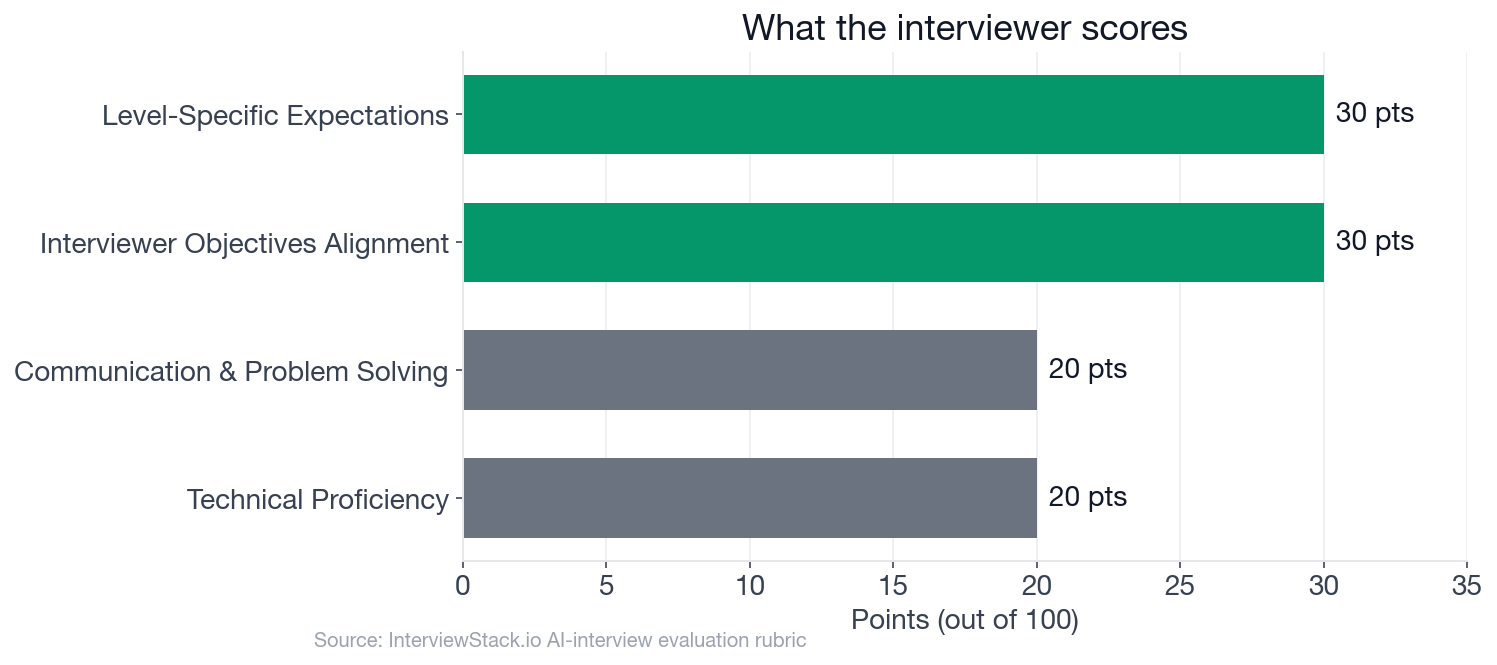
Interviewer Objectives Alignment and Level-Specific Expectations, 60 of the 100 points combined, score whether the architecture reflects real trade-off judgment, not whether the diagram names the right cloud services.
Where Do the Points Go in a Cloud Engineer Multi-Cloud and Hybrid Cloud Architecture Interview?
Here's the scenario as it appears in the live blueprint:
The interview question
A consumer-facing company is modernizing a core order-processing platform that still runs in an on-premises data center. It includes a public API for web and mobile clients, internal services for order validation, payment orchestration, inventory checks, and fulfillment events, a PostgreSQL database holding transactional order data, and downstream analytics consumers that need near-real-time event feeds.
Two constraints shape the design: the platform must keep operating through a major regional outage at any single cloud provider, and some systems will stay on-premises for at least the next 18 months because of existing integrations and compliance reviews still in progress. Traffic is moderate but business-critical, around 2,000 requests per second at peak, with strong reliability expectations during major sales events.
You are joining the team as a Cloud Engineer. How would you design a multi-cloud and hybrid cloud architecture for this platform over the next 18 months?
The interviewer isn't grading whether you pick AWS, Azure, or GCP. They're testing whether you can decompose workload placement across on-prem and cloud, design secure networking and identity boundaries between environments, make a defensible call on the transactional database, and describe realistic failure behavior, all without over-engineering for a platform running at roughly 2,000 requests per second.
Symmetry Feels Safe. It Isn't.
The candidate below, Tariq, is dramatized to show where mid-level answers commonly lose points on this scenario, not a transcript of a real session. Each turn tests a different layer of the same instinct: treat "multi-cloud" as symmetric duplication instead of a deliberate, asymmetric set of choices. Watch where that habit costs Tariq.
Turn 1: Duplicate First, Justify Later
Interviewer: "How would you decide which components should stay on-premises versus move to one cloud or be duplicated across two clouds?"
Turn 2: One Database, Two Writers
Interviewer: "What approach would you take for the PostgreSQL transactional data, given the need for resilience but also the risk and complexity of cross-cloud writes?"
Turn 3: Failover Isn't Just Rerouting
Interviewer: "If one cloud provider has a regional outage during a sales event, what traffic failover behavior would you want, and what state-management challenges would that create?"
Turn 4: Lock-In Isn't a Yes or No Question
Interviewer: "Where would you intentionally accept some vendor lock-in, and where would you push for cloud-agnostic patterns?"
What Happens When the Interviewer Pivots to Identity and Secrets?
Every mistake above is easy to spot once it's sitting on the page with the fix written right underneath it. Live, Tariq doesn't get that. After the database and failover answers land, the natural next follow-up is just as unscripted: how do you handle identity, secrets, and service-to-service authentication across on-prem and multiple clouds? Spotting "the symmetry trap" on a re-read is a different skill from not reaching for it mid-sentence, under a clock, with more follow-ups stacked up behind this one, and the only way to build that instinct is reps in the AI mock interview itself.
This Is the Blueprint a Strong Answer Hits
The chart below maps how the interview's 18 checklist items are distributed across the four phases.
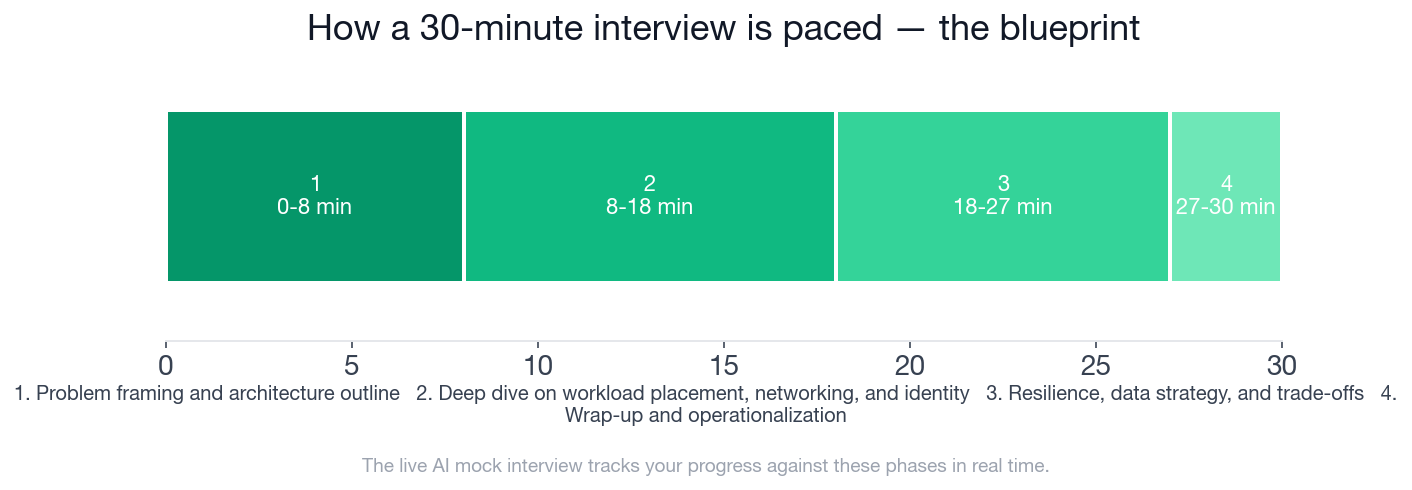
Workload placement/networking/identity and resilience/data-strategy, the middle 19 minutes from 8 to 27, carry 10 of the interview's 18 checklist items between them, more than problem framing and wrap-up combined, and that's exactly where a symmetric-duplication instinct costs the most points.
This is the blueprint a strong candidate hits, phase by phase, and the exact structure the AI mock interview tracks you against while you're answering, not after:
- ✓Asks 2-4 useful clarifying questions such as RTO/RPO expectations, compliance boundaries, tolerance for degraded modes, or whether payments/inventory integrations are provider-specific.
- ✓States a clear initial stance on hybrid plus multi-cloud strategy for the 18-month window.
- ✓Identifies major components: ingress, app services, transactional data, eventing, connectivity, identity, observability, and failover.
- ✓Avoids immediately proposing full active-active for every layer without discussing complexity.
- ✓Explains why some systems may remain on-prem temporarily, such as tightly coupled integrations or compliance-gated workloads.
- ✓Proposes a realistic connectivity model such as primary dedicated links with VPN backup, or equivalent resilient private connectivity.
- ✓Discusses network segmentation, private service connectivity, and minimizing east-west cross-cloud chatty calls.
- ✓Describes identity federation or centralized SSO/workload identity approach across cloud and on-prem environments.
- ✓Mentions secrets management and certificate or token-based service authentication instead of static shared credentials.
- ✓Treats the PostgreSQL order database as a critical design decision and discusses primary/replica, warm standby, or failover patterns with explicit trade-offs.
- ✓Acknowledges latency, consistency, failback, and split-brain risks of cross-cloud write-write database setups.
- ✓Provides a plausible eventing strategy for downstream analytics, such as CDC or event replication patterns that reduce provider coupling.
- ✓Describes failure behavior for cloud or region loss, including what continues, what degrades, and how traffic shifts.
- ✓Explicitly discusses when to use managed cloud-native services versus portable abstractions like containers, Terraform, Kubernetes, or open event formats.
- ✓Summarizes a phased 18-month approach rather than a big-bang migration.
- ✓Mentions baseline observability across environments, such as unified logs, metrics, tracing, and health checks used for failover decisions.
- ✓Calls out operational ownership or runbook needs for testing failover and recovery.
- ✓Ends with a clear recommendation that balances resilience goals against complexity and cost.
Could You Hold This Design Under a Live Follow-Up?
Reading Tariq's four mistakes is the easy part. The AI mock interview for Cloud Engineer Multi-Cloud and Hybrid Cloud Architecture asks this same order-processing scenario, follows up based on what you actually propose, and scores you across all four rubric dimensions the moment the 30 minutes end. That's the only way to find out whether you would actually hold a single-write-path answer live, not on a re-read of this post. For focused drilling first, the question bank for multi-cloud and hybrid cloud architecture covers workload placement, networking, identity, and failover with worked answers, our preparation guides cover how this bar shifts company to company, and current Cloud Engineer openings on the InterviewStack.io job board show what teams are actually hiring this skill set for. If provisioning and automation is the shakier part of your own prep, the infrastructure automation and provisioning walkthrough covers that adjacent scenario in the same format.
FAQ
Q. What does a Cloud Engineer multi-cloud and hybrid cloud architecture interview actually test?
It tests whether you can design a practical target architecture across on-premises and multiple cloud providers under real constraints, not whether you can name every cloud service. The rubric evaluates requirements clarification, workload placement, networking and identity boundaries, data replication and failover, and whether you avoid over-engineering for a company at this scale.
Q. Why is proposing an active-active database across two clouds treated as a mistake?
Because a writable PostgreSQL cluster taking writes in two clouds at once creates split-brain risk: both sides can accept conflicting writes during a network partition, and reconciling them afterward is far harder than the interviewer wants you to sign up for. One of this level's expectations explicitly calls active-active cross-cloud transactional databases as usually high risk, and a stronger answer keeps a single write path with a warm, fast-promotable replica instead.
Q. How should you handle identity and secrets across on-prem and multiple clouds?
Centralize identity behind a single federation or workload-identity layer instead of maintaining separate logins per environment, and use certificate- or token-based service authentication rather than long-lived shared secrets. The checklist is listening specifically for identity federation and secrets management, not a list of cloud-native identity products.
Q. How do you give analytics consumers near-real-time data without locking into one cloud's messaging stack?
Use change-data-capture or event-replication patterns that publish in an open, portable event format, so downstream analytics consumers subscribe to a stream instead of querying one provider's proprietary messaging service directly. That keeps the eventing layer swappable if the cloud mix changes later, which is exactly what the checklist's eventing-strategy item is testing.
Q. How long is this interview and how is it scored?
It runs 30 minutes across four phases: problem framing (0-8 minutes), workload placement, networking, and identity (8-18 minutes), resilience and data strategy (18-27 minutes), and wrap-up (27-30 minutes). The 100-point rubric weighs Interviewer Objectives Alignment and Level-Specific Expectations at 30 points each, with Technical Proficiency and Communication and Problem Solving at 20 points each.
Q. Is it wrong to accept any vendor lock-in in a multi-cloud design?
No. The expectation at this level is selective judgment, not an absolute rule: accept lock-in where a managed service buys real operational advantage for something that stays single-cloud, and push for portable patterns like containers, infrastructure-as-code, or open event formats where duplication or migration is a real near-term possibility. Treating portability as all-or-nothing is itself a mark against you.
Q. Can I practice this exact scenario before a real interview?
Yes. InterviewStack.io's AI mock interview runs this same multi-cloud and hybrid architecture scenario live, asks unscripted follow-ups based on your answers, and scores you against the same rubric used in this walkthrough.
Choose Deliberately, Not Symmetrically
Nothing in this scenario asks Tariq to pick a fancier cloud or a cleverer failover diagram. It asks Tariq, four separate times, to resist treating resilience as symmetry, because the rubric is built to reward the single write path and the selective trade-off instead. That's a discipline, not a service catalog, and it only gets reliable under the same time pressure and unscripted follow-ups a live interview actually applies.
Topics
Ready to practice?
Put what you've learned into practice with AI mock interviews and structured preparation guides.