
Five Flaws in One Manifest, and Only Part of the Score for Spotting Them
The payments platform team has a Deployment that an internal review flagged as high risk: a privileged container, the Docker socket mounted from the node, a database password sitting in plain text, the default service account, and an image tagged latest. Every mid-level candidate can spot those. The candidates who lose points are the ones who spot them, then recite a twelve-item control list when asked what to change over the next few weeks.
This walkthrough follows a dramatized candidate, Ingrid, through one Cybersecurity Engineer Container and Kubernetes Security AI mock interview blueprint. The answers are illustrative, not a real transcript, and the scenario is not any specific company's question.
Key Findings
- The interview scores 100 points across 4 dimensions; Interviewer Objectives Alignment and Level-Specific Expectations carry 30 points each, 60 combined.
- Technical Proficiency is worth 20 of 100 points, the same weight as Communication and Problem Solving.
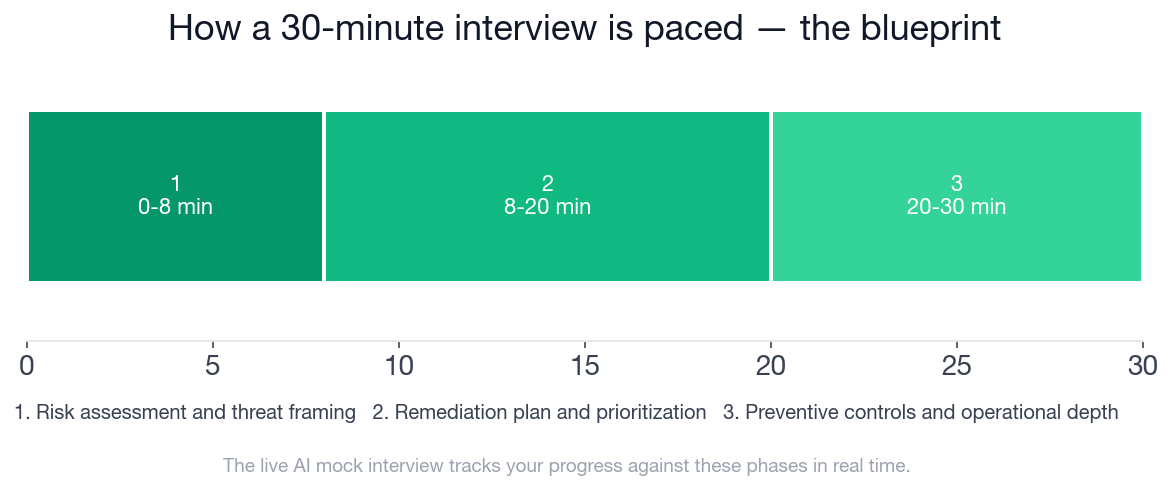
- The session runs 30 minutes in 3 phases: 0-8, 8-20, and 20-30 minutes, so the remediation phase gets 12 minutes, the most of any phase.
- The interviewer tracks 17 checklist items in total: 6 in risk assessment, 6 in remediation, and 5 in preventive controls.
- The manifest hides 5 headline flaws: privileged mode, a docker.sock mount, a plaintext secret, the default service account, and a latest tag.
- We dramatize 4 of the 6 follow-ups below, each one tempting a different shortcut.
- 4 skill areas, including malware analysis and cloud cost optimization, are explicitly out of scope.
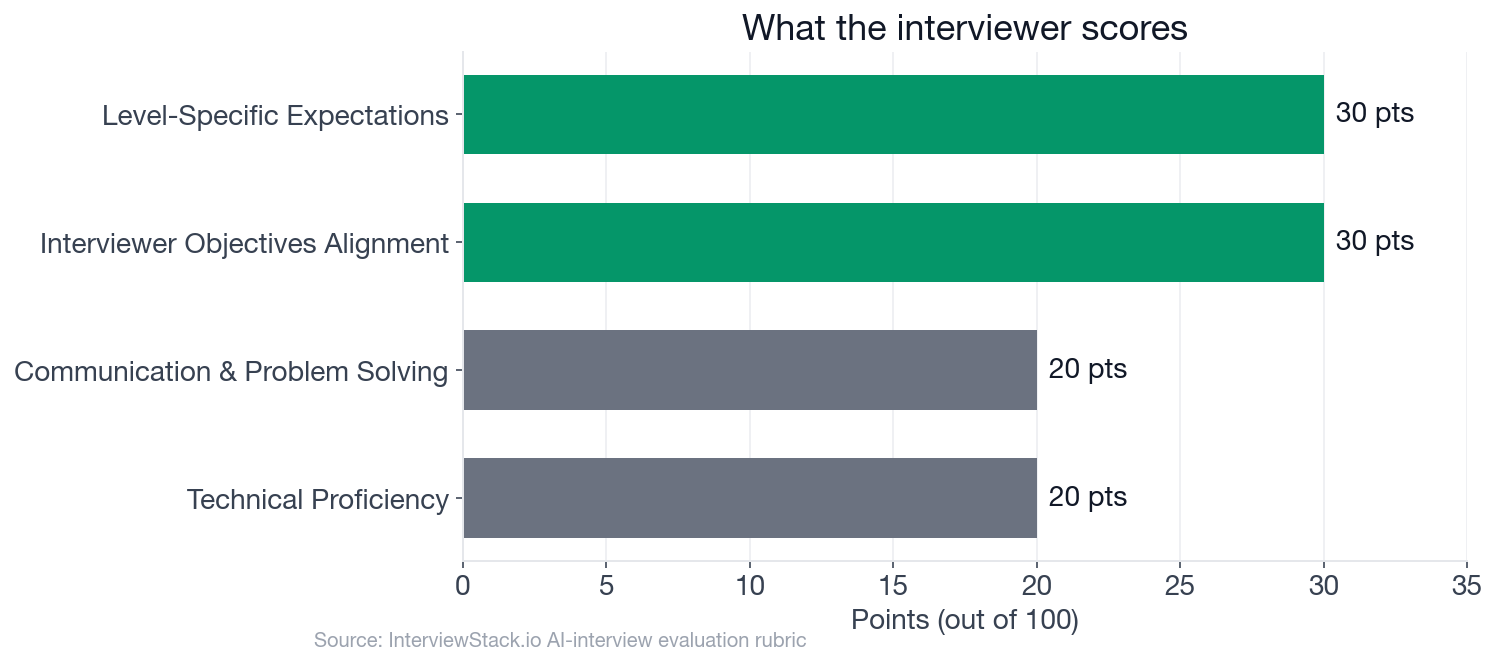
The chart is the strategy: technical accuracy is one-fifth of the score, and the other 80 points reward answering the question that was asked, at the depth expected of a mid-level engineer, in a structure the interviewer can follow.
What Is the Cybersecurity Engineer Kubernetes Security Interview Really Asking?
The opening question is "assess the current risks and what changes you would make over the next few weeks," and the phrase that matters is the last one: bring the service to an acceptable baseline without blocking product delivery. Nobody wants a catalog of controls. They want to hear what you would fix first, what can wait, and how you would keep the team shipping.
The interview question
Current state of a production-facing service called checkout-api running in a shared Kubernetes cluster:
# Current state of a production-facing service called checkout-api # running in a shared Kubernetes cluster.apiVersion: apps/v1 kind: Deployment metadata: name: checkout-api namespace: payments spec: replicas: 3 selector: matchLabels: app: checkout-api template: metadata: labels: app: checkout-api spec: serviceAccountName: default containers: - name: app image: registry.example.com/payments/checkout-api:latest ports: - containerPort: 8080 env: - name: DB_PASSWORD value: "prod-db-password" securityContext: privileged: true allowPrivilegeEscalation: true volumeMounts: - name: docker-sock mountPath: /var/run/docker.sock volumes: - name: docker-sock hostPath: path: /var/run/docker.sock
apiVersion: v1 kind: Service metadata: name: checkout-api namespace: payments spec: selector: app: checkout-api ports:
- port: 80 targetPort: 8080
You are joining an onsite discussion with the payments platform team after a recent internal review flagged the deployment above as high risk. Walk me through how you would assess the current risks and what changes you would make over the next few weeks to bring this service to an acceptable security baseline without blocking product delivery.
The interviewer is probing for threat modeling of the container attack surface, practical controls across build, deploy, and runtime, accurate use of Kubernetes-native mechanisms (RBAC, network policies, pod security, secrets), and pragmatic trade-offs for a fast-moving organization. Read the YAML as a list of attack paths, not a list of lint errors, and the follow-ups below become much easier to predict.
Four Follow-Ups, Each Tempting You to Take a Shortcut
Every follow-up below invites a plausible reflex. Ingrid takes the bait each time.
Turn 1: Two Changes, Not Ten
Interviewer: "How would you prioritize fixes if the team says they can only make two application or manifest changes this sprint?"
Turn 2: Break-Glass, Not Privileged
Interviewer: "Suppose the team argues they need elevated privileges for debugging in production. How would you handle that requirement safely?"
Turn 3: Stop It at Admission
Interviewer: "What Kubernetes controls would you put in place so similar insecure deployments are prevented before they reach the cluster?"
Turn 4: Trace the Attack Path
Interviewer: "If an attacker gained code execution inside this container today, what paths to cluster or node compromise concern you most, and how would your proposed changes reduce them?"
Would Your Fixes Survive a Live Clock?
Each of Ingrid's four answers sounds reasonable in isolation, and with the mistake already highlighted in red, the fix looks obvious. In a live 30-minute room nothing is labeled. You are tracking five flaws, remembering which two you promised to fix first, and fielding follow-ups you did not script, while the last 10 minutes quietly check whether you can enforce, detect, and explain an attack path.
Recognizing a mistake on the page is easy. Avoiding it live, with a clock running, is a different skill, and it only improves with reps. That gap is exactly what the AI mock interview is built to expose.
Which 17 Checklist Items Does the Interviewer Track?
Here is the pacing a strong candidate hits: 8 minutes to read the manifest and frame the threats, 12 to turn findings into a staged plan, and 10 to show you can stop this from recurring. For a mid-level engineer the bar is to recognize the obvious misconfigurations unprompted, sequence the fixes sensibly, and know where advanced tooling fits without needing to design a company-wide security platform.
- ✓Calls out privileged container as high risk.
- ✓Calls out docker.sock hostPath mount as a likely path to node or cluster compromise.
- ✓Notes hardcoded database secret in manifest/environment as insecure secret handling.
- ✓Notes use of default service account and discusses overbroad or unknown permissions risk.
- ✓Notes use of mutable image tag latest and supply-chain/rollback concerns.
- ✓Mentions missing baseline restrictions such as non-root, dropped capabilities, read-only root filesystem, and resource/operational guardrails if relevant.
- ✓Proposes removing privileged mode, docker.sock mount, and unnecessary privilege escalation as top priorities.
- ✓Suggests replacing default service account with a dedicated minimally scoped service account or disabling token mount if not needed.
- ✓Recommends migrating secrets out of manifests into Kubernetes Secret integrated with external secret manager or equivalent, with attention to rotation.
- ✓Recommends pinning images by immutable tag or digest and introducing image scanning/admission checks.
- ✓Explains how to sequence quick wins versus changes needing app-team validation.
- ✓Discusses blast-radius reduction with namespace, RBAC, and workload-level hardening.
- ✓Suggests enforcing baseline policies through admission controllers or policy engines to block privileged pods, hostPath mounts, and mutable tags.
- ✓Describes a workable NetworkPolicy approach with default deny and explicit ingress/egress allowances for dependencies.
- ✓Mentions runtime logging, alerting, or behavioral detection for suspicious container activity.
- ✓Explains at least one attacker path from pod compromise to node/cluster impact and ties mitigations back to that path.
- ✓Keeps recommendations realistic for a mid-level engineer in a shared production environment.
This is the same blueprint the AI mock interview tracks you against in real time. Notice that the first phase is only 6 items about reading the manifest, while the last phase asks for admission control, NetworkPolicy, runtime detection, and an attacker path in 10 minutes. Those are the items candidates who spent 20 minutes on manifest fixes never reach.
Rehearse the Payments Review Out Loud
Run this exact scenario with an interviewer that adapts to your answers: start the Cybersecurity Engineer Container and Kubernetes Security AI mock interview. You get the same blueprint, unscripted follow-ups, and feedback scored against the four rubric dimensions above.
If a specific area felt shaky, such as admission policy or secrets, drill it first in the Container and Kubernetes Security question bank. For the baseline controls themselves, the Kubernetes project's Pod Security Standards are the vocabulary interviewers expect. For wider structure, browse our preparation guides, or see current Cybersecurity Engineer openings to calibrate what teams ask for. You can also practice with AI mock interviews on other topics.
FAQ
Q. What does a mid-level Cybersecurity Engineer Kubernetes security interview cover?
It runs 30 minutes in 3 phases: risk assessment and threat framing (0 to 8 minutes), remediation plan and prioritization (8 to 20 minutes), and preventive controls and operational depth (20 to 30 minutes). The scenario is a checkout-api Deployment in a payments namespace that an internal review flagged as high risk, with a privileged container, a docker.sock mount, a plaintext database password, the default service account, and a latest image tag.
Q. How is the interview scored?
Out of 100 points: 30 for Interviewer Objectives Alignment, 30 for Level-Specific Expectations, 20 for Technical Proficiency, and 20 for Communication and Problem Solving. Technical accuracy is only one-fifth of the score, so a correct list of fixes with no prioritization and no trade-off reasoning still leaves most points unclaimed.
Q. Which two fixes should I ship first on a privileged Kubernetes deployment?
Remove privileged mode (and privilege escalation) and remove the docker.sock hostPath mount. Each one is a short path from a compromised container to node-level control, and both live in a single manifest edit that the app almost never depends on. Move the plaintext secret, the default service account, and the latest tag to the next change, and say out loud why they come second.
Q. How do you handle a team that needs elevated privileges to debug in production?
Separate the need from the mechanism. Keep the workload unprivileged and give engineers a time-boxed, approved, logged break-glass path, such as an ephemeral debug container with only the capabilities the task needs, that expires automatically and raises an alert when used.
Q. What stops insecure deployments from reaching the cluster in the first place?
Admission control. Use Pod Security admission or a policy engine to reject privileged pods, hostPath mounts, and mutable image tags. Start in audit or warn mode to see which teams would break, then enforce namespace by namespace with expiring exceptions.
Q. Does this interview expect eBPF runtime tooling or supply-chain attestations?
Not in depth. At the mid level you may need light prompting on supply-chain attestations or eBPF-based runtime tooling, but you should understand where they fit. The blueprint lists deep reverse engineering or malware analysis, low-level cryptographic protocol design, production application code unrelated to security controls, and detailed cloud cost optimization as out of scope.
Q. How can I practice this exact interview?
Start the Cybersecurity Engineer Container and Kubernetes Security AI mock interview. It runs the same blueprint with an interviewer that adapts follow-ups to what you actually say, and it tracks you against the checklist in real time. For concept drilling first, use the question bank for this topic.
Ship the Smallest Fix That Closes the Path
A strong answer removes the two changes that hand an attacker the node, schedules everything else with a reason, and installs a gate so the next team cannot repeat the mistake. That sequencing judgment is the part you only build by saying it out loud.
Topics
Ready to practice?
Put what you've learned into practice with AI mock interviews and structured preparation guides.