
The Cybersecurity Engineer Security Fundamentals Interview Punishes "It's Internal" Thinking
A mid-level Cybersecurity Engineer sits down for a 30-minute interview about a platform that lets employees upload and share build artifacts and debug bundles across teams. It's an internal tool, no customers touch it directly, and that single fact is exactly what the rubric is built to test. This walkthrough is built from a real InterviewStack.io AI-interview blueprint for that scenario, and the candidates who quietly lose points are the ones who let "internal" do the reasoning that the CIA triad, threat modeling, and least privilege are supposed to do instead.
The trap sits in plain sight from the first sentence of the prompt. The service is used by engineers, support staff, and automated systems, and it stores source code details, customer identifiers in logs, and operational secrets. None of that changes because the audience is internal. What changes is that a candidate who treats "internal" as shorthand for "lower risk" skips straight past prioritization, threat reasoning, and layered controls, exactly the three things the rubric is scoring.
Key Findings
- The interview runs 30 minutes across four phases lasting 7, 11, 9, and 3 minutes.
- The 100-point rubric splits 30/30/20/20 across Interviewer Objectives Alignment, Level-Specific Expectations, Technical Proficiency, and Communication.
- Phase 1 (minutes 0-7) holds 4 checklist items, all about identifying assets and trust boundaries before naming a single tool.
- Phase 2 (minutes 7-18) is the longest phase at 11 minutes and packs 4 checklist items on CIA-triad prioritization and threat-vulnerability-risk reasoning.
- Phase 3 (minutes 18-27) is the densest phase at 5 checklist items, covering access separation, layered controls, and availability trade-offs.
- Phase 4 (minutes 27-30) closes in just 3 minutes with a 3-item checklist on prioritized summary and residual risk.
- The interviewer's script carries 6 follow-up prompts; this walkthrough dramatizes 4 of them.
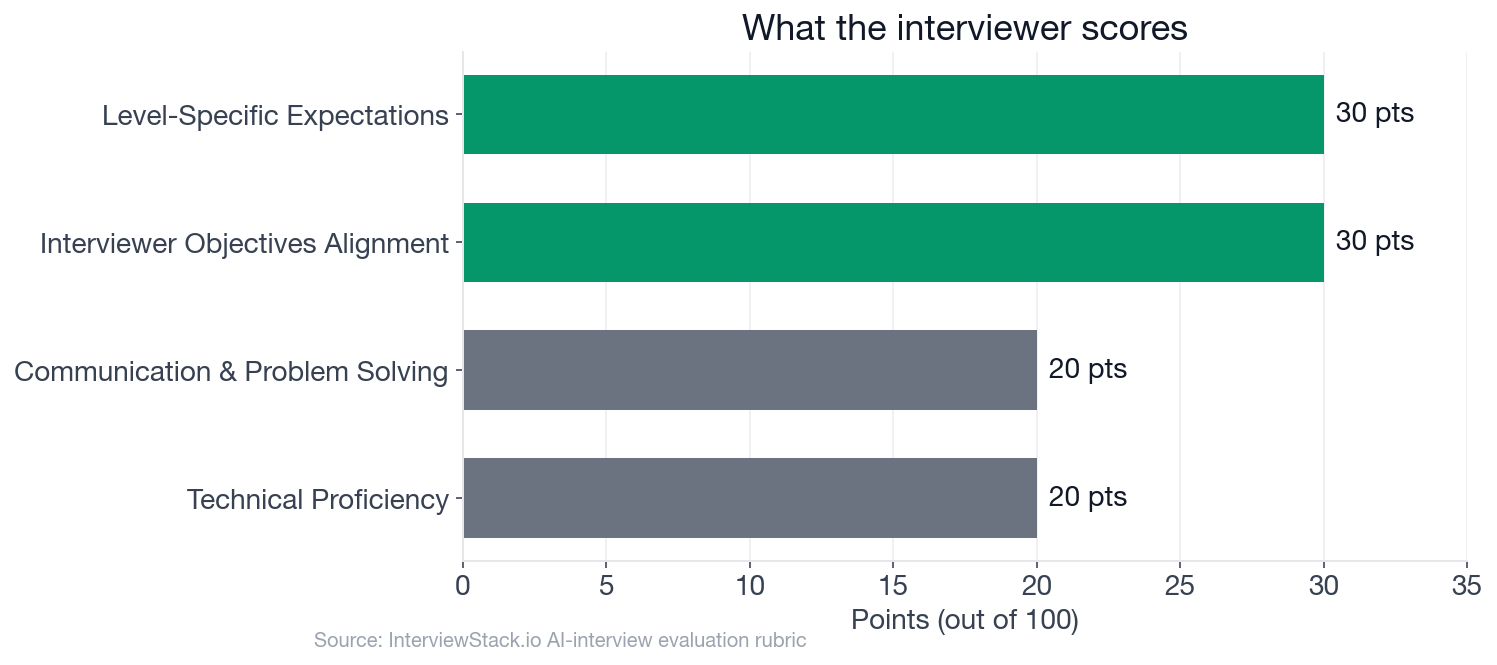 Interviewer Objectives Alignment and Level-Specific Expectations together hold 60 of the 100 points, 1.5 times the combined weight of Technical Proficiency and Communication, and three times the weight of either dimension alone.
The Setup: A Tool Everyone Already Trusts
The interview question
You're joining a service review for an internal platform at a large tech company. The platform lets employees upload and share build artifacts and debug bundles across teams, and it's used by engineers, support staff, and a small number of automated systems. The service is business-critical during incidents, so downtime has real operational impact, but it also stores sensitive internal data, source code details, customer identifiers in logs, and operational secrets, that could leak if mishandled.
The team wants a security fundamentals review before broadening access to more employees next quarter. How would you assess the security posture of this service, and what changes would you recommend first?
The interviewer isn't testing whether you can recite the CIA triad from memory. They're watching whether you can look at a service everyone already trusts because it's internal, still find the assets worth protecting, still separate threats from vulnerabilities from risk, and still recommend layered controls rather than one policy change and a shrug.
How Does "Just Internal" Cost Points, Turn by Turn?
Four follow-ups from the real interview package carry most of the signal. Here's how a candidate named Tara handles them, and where the mid-level bar actually sits.
Turn 1: Picking what actually matters
Interviewer: "What assets and security properties would you prioritize for this service, and how would you explain those priorities to the engineering team?"
Turn 2: Assuming employees are the safe part
Interviewer: "Can you walk me through a few concrete threats, the underlying vulnerabilities they might exploit, and how you would reason about the resulting risk?"
Turn 3: Reaching for a lock instead of a design
Interviewer: "If the team says broad employee access is required for usability, how would you apply least privilege without making the system unusable?"
Turn 4: Betting on one control
Interviewer: "What would defense in depth look like here if one control fails, such as a misconfigured access policy or an exposed credential?"
Spotting the Mistake and Not Making It Are Different Skills
Every mistake above is easy to catch on a page, with no clock running and no interviewer waiting on your next sentence. Live, in a 30-minute window, with follow-ups you haven't rehearsed, "it's internal, so it's lower risk" is exactly the kind of shortcut a prepared candidate still reaches for under pressure. Reading someone else's transcript and catching their gap is one skill. Catching your own gap while you're mid-sentence is a different one, and it only sharpens with reps.
What Does a Strong Answer Actually Cover, Phase by Phase?
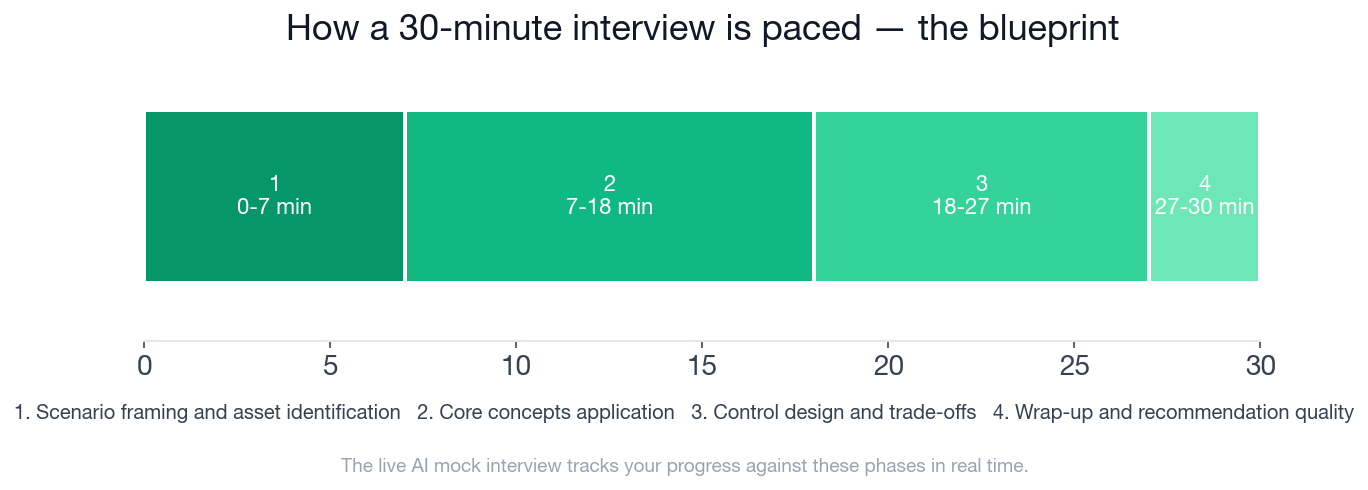 The 30-minute interview compresses into a 7-minute framing phase, an 11-minute concepts phase, a 9-minute control-design phase, and a 3-minute close.
This is the blueprint a strong candidate hits, phase by phase, and it's the exact structure the AI mock interview tracks you against in real time as you answer.
- ✓Asks or states reasonable assumptions about who uses the service, what data it stores, and why it is business-critical.
- ✓Identifies key assets such as uploaded artifacts, debug bundles, credentials/tokens, metadata, audit records, and service availability.
- ✓Maps at least basic actors and access paths: engineers, support staff, automated systems, and potential insider or compromised-account misuse.
- ✓Frames the problem in terms of security properties instead of jumping straight to tools.
- ✓Prioritizes confidentiality for sensitive internal data while also recognizing integrity and availability needs during incidents.
- ✓Gives at least two concrete examples separating a threat from the vulnerability it exploits and the resulting risk.
- ✓Mentions authenticity for validating who uploaded or accessed artifacts and non-repudiation/auditing for traceability of sensitive actions.
- ✓Shows awareness that internal systems still face meaningful risk from compromised accounts, misconfigurations, and excessive trust.
- ✓Recommends role-appropriate access separation for engineers, support staff, and automated systems rather than broad shared access.
- ✓Describes layered controls such as authentication, authorization, scoped credentials, network/service segmentation, encryption, validation, monitoring, and auditing.
- ✓Explains how controls reduce blast radius if one layer fails, rather than assuming prevention is perfect.
- ✓Addresses availability concerns with sensible measures like resilient auth patterns, rate protection, backups/recovery, or emergency access procedures with guardrails.
- ✓Prioritizes first actions, for example narrowing access, removing shared credentials, improving auditability, and protecting sensitive uploads.
- ✓Summarizes top risks and top recommended changes in a concise, ordered way.
- ✓Distinguishes high-priority fixes from longer-term improvements.
- ✓Acknowledges residual risk and what would need validation or follow-up.
Run This Interview Yourself
You've now watched four ways "it's internal" quietly costs points on this exact question. The only way to know if you'd catch that shortcut in yourself, live, with the clock running and no page to scroll back through, is to run the interview yourself. Start the AI mock interview on security fundamentals and core concepts and get turn-by-turn, rubric-based feedback the moment you finish.
If you want to drill the underlying concepts first, the CIA triad, threat versus vulnerability versus risk, least privilege, defense in depth, before taking the full interview, the security fundamentals question bank breaks the topic into individual questions. For broader Cybersecurity Engineer interview prep, browse the preparation guides.
FAQ
Q. What does a mid-level Cybersecurity Engineer security fundamentals interview actually score?
The rubric is worth 100 points across four dimensions: 30 for Interviewer Objectives Alignment (did you correctly prioritize security properties for this specific service), 30 for Level-Specific Expectations (the depth and independence expected at 2-5 years), 20 for Technical Proficiency, and 20 for Communication and Problem Solving.
Q. Why does calling a service "internal" tend to cost points in this interview?
Because the rubric explicitly checks whether a candidate still recognizes risk from compromised accounts, misconfigurations, and excessive trust inside a service that only employees and automated systems can reach. Treating "internal" as a proxy for "low risk" skips that checklist item entirely, even though the same service stores source code details, customer identifiers, and operational secrets.
Q. How do you apply least privilege when the business is asking for broader access, not less?
Least privilege does not mean minimizing everyone's access equally; it means separating roles (engineers, support staff, automated systems) into scoped tiers so each gets only what its function needs, then layering in auditing so broader usage stays traceable. Simply declining to expand access, or granting the same access to every employee, both fail the interview's expectation of role-appropriate separation.
Q. What is the difference between a threat, a vulnerability, and risk in this interview?
A vulnerability is a weakness, such as a shared service account or an overbroad access policy. A threat is a way that weakness gets exploited, such as a compromised employee credential. Risk is the resulting exposure, weighed against the sensitivity of what is exposed. The interview rewards candidates who name at least two concrete threat-to-vulnerability-to-risk chains rather than treating the three terms as synonyms.
Q. What does defense in depth mean if a single access policy or credential is compromised?
It means no one control is assumed to hold on its own. Authentication, scoped credentials, network or service segmentation, encryption, validation, and monitoring should each reduce the blast radius if any single layer fails, rather than the design leaning on one preventive control, like an access policy, to catch everything.
Q. How long does the mock interview run and how many follow-up prompts does it include?
The scenario runs 30 minutes across four phases: 7 minutes on scenario framing and asset identification, 11 minutes on applying core security concepts, 9 minutes on control design and trade-offs, and 3 minutes on wrap-up, with the interviewer working through six scripted follow-up prompts across those phases.
Trust Is a Design Decision, Not a Default
Nothing about this scenario changes because the platform is internal. The assets are the same, the threats are the same, the need for layered controls is the same. What "internal" actually changes is how easily a candidate stops paying attention, and the interview is built specifically to catch that moment. The candidates who score well never let the label do the thinking the rubric is checking for.
Topics
Ready to practice?
Put what you've learned into practice with AI mock interviews and structured preparation guides.