
A Possible Decline Isn't a Verdict Yet
Harper is 30 minutes away from finding out how a mid-level Data Analyst interview actually gets scored. The setup: a subscription app's Growth team redesigned its mobile signup and trial-start flow, trial-to-paid conversion looks like it declined afterward, and the PM wants a recommendation by end of day on whether there is a real funnel problem and what to do next. The natural instinct is to confirm the drop and blame the redesign. That is exactly the instinct this interview is built to catch: two of the four rubric dimensions, worth 60 of 100 points combined, reward Harper for treating "a possible decline" as a claim still waiting on evidence, not a fact already explained.
Key Findings
- This Data Analyst conversion funnel interview runs 30 minutes across three scored phases: problem framing (0-8 minutes), SQL and analytical logic (8-20 minutes), and diagnosis and recommendation (20-30 minutes).
- The 100-point rubric weighs Interviewer Objectives Alignment and Level-Specific Expectations at 30 points each, 60 of 100 combined, three times the weight of Technical Proficiency's 20 points.
- Phase 1 alone carries 5 checklist items on scoping the funnel and its conversion window, before any SQL gets written.
- Phase 2 carries 5 checklist items on stage-by-stage SQL logic, including deduplication and reconciling against the subscriptions table.
- Phase 3 carries 5 checklist items spanning causal evidence, statistical validation, UX hypotheses, a next-action plan, and guardrails, none of them additional SQL.
- The interviewer has 6 distinct follow-up probes available, spanning funnel definition, SQL isolation, data quality, platform reconciliation, attribution, and rollout bias.
- The scenario spans 3 core data sources, app_events, marketing_touches, and subscriptions, that must be reconciled against each other, not trusted individually.
What Is a Data Analyst Conversion Funnel Interview Actually Testing?
The interview question
You are supporting the Growth team for a consumer subscription product at a leading tech company. The team recently launched a redesigned mobile signup and trial-start flow and saw a possible decline in trial-to-paid conversion. You have been asked to investigate the end-to-end acquisition funnel from landing on the signup experience through becoming a paid subscriber. Assume the core event data available is:
-- one row per event
app_events(
  user_id STRING,
  event_time TIMESTAMP,
  event_name STRING,        -- e.g. landing_view, signup_start, signup_complete,
                            -- trial_start, paywall_view, payment_submit, subscribe_paid
  session_id STRING,
  platform STRING,          -- ios, android, web
  country STRING,
  experiment_id STRING,
  variant STRING,
  acquisition_channel STRING,
  device_type STRING
)

-- optional marketing touch data, one row per attributed touch
marketing_touches(
  user_id STRING,
  touch_time TIMESTAMP,
  channel STRING,
  campaign_id STRING,
  touch_type STRING         -- impression, click, email_open
)
-- subscription records
subscriptions(
  user_id STRING,
  trial_start_time TIMESTAMP,
  paid_start_time TIMESTAMP,
  subscription_status STRING,
  plan_type STRING,
  price_usd NUMERIC
)
The PM wants a recommendation by the end of the day on whether there is a real funnel issue, where it is happening, and what the team should do next. How would you approach this analysis, and what would you deliver to the PM?
This question is deliberately open-ended. The interviewer is watching whether Harper can independently structure a first-pass funnel analysis, write scalable SQL logic against raw event data, reason about instrumentation quality and attribution choices, diagnose the likely cause of a drop, and land on a practical recommendation, exactly what a mid-level analyst supporting a Growth team is expected to do without hand-holding.
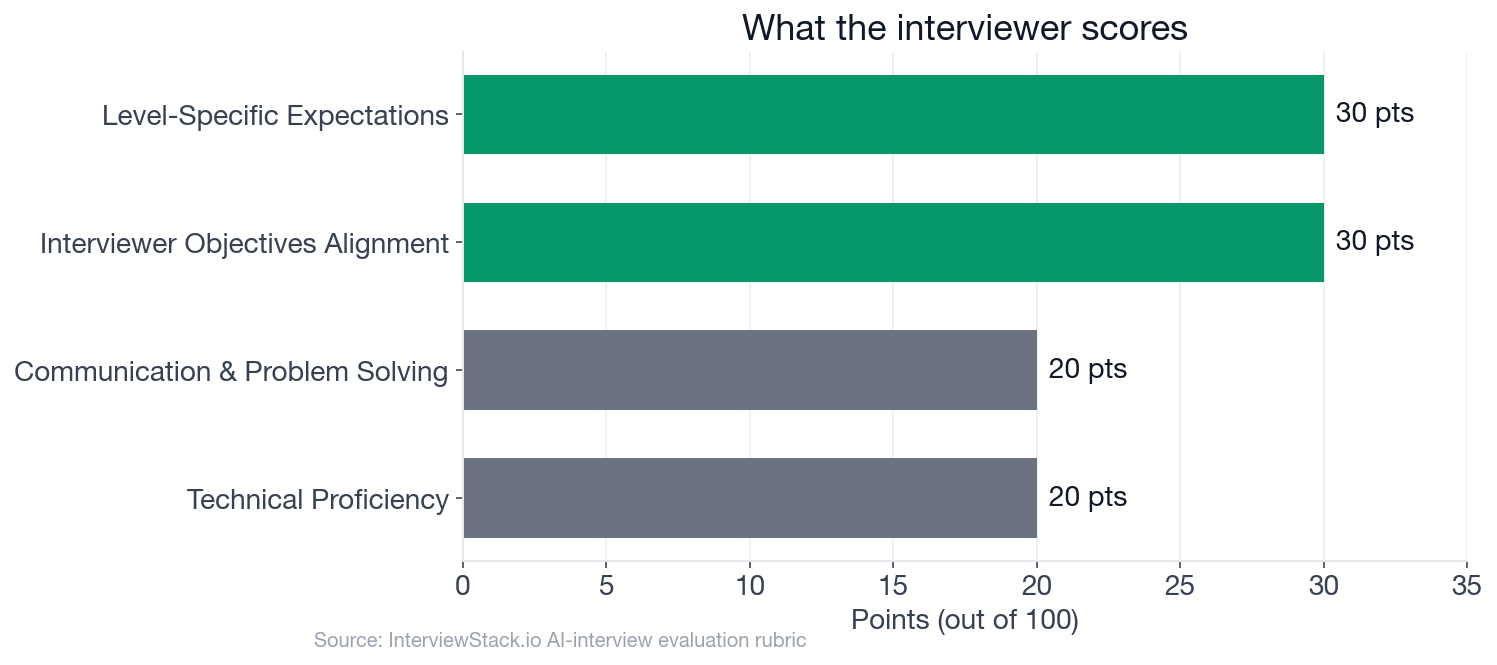
Interviewer Objectives Alignment and Level-Specific Expectations carry 30 points each, 60 of 100 combined, three times the weight of getting the SQL exactly right.
Where Do Candidates Actually Lose Points in This Funnel Interview?
The interviewer has six follow-ups available. Harper draws four of them here, spanning all three scored phases, from scoping the funnel through ruling out rollout bias.
Turn 1: Defining the Window
Interviewer: "How would you define the funnel stages and conversion windows so the analysis reflects a user's first bounded path rather than ongoing retention behavior?"
Turn 2: Isolating the Stage
Interviewer: "If the PM says trial-to-paid dropped after the redesign, what SQL logic would you use to compute stage-to-stage conversion and isolate whether the issue is at signup completion, trial start, payment submission, or paid activation?"
Turn 3: Trusting the Events
Interviewer: "How would you handle users with repeated events, out-of-order events, or missing instrumentation so your funnel metrics are trustworthy?"
Turn 4: Ruling Out Noise
Interviewer: "Suppose randomization was imperfect or the redesign was launched only in a few countries first. How would you assess whether the observed drop is a real effect rather than noise or rollout bias?"
Spotting the Gap on the Page Is the Easy Part
Every mistake above looks obvious once it is laid out in a red box with the fix right underneath. Live, under a 30-minute clock, with a PM waiting on an actual recommendation and follow-up questions Harper has not seen in advance, that obviousness disappears. The gap between reading a correction and producing it yourself, unprompted, in real time, is exactly what the rubric's Level-Specific Expectations dimension measures, and it only closes with reps against a live interviewer.
What Does a Strong 30-Minute Answer Actually Look Like?
The three phases below are not a loose outline. They are the exact blueprint InterviewStack.io's AI interviewer tracks a candidate against in real time, phase by phase, checklist item by checklist item.
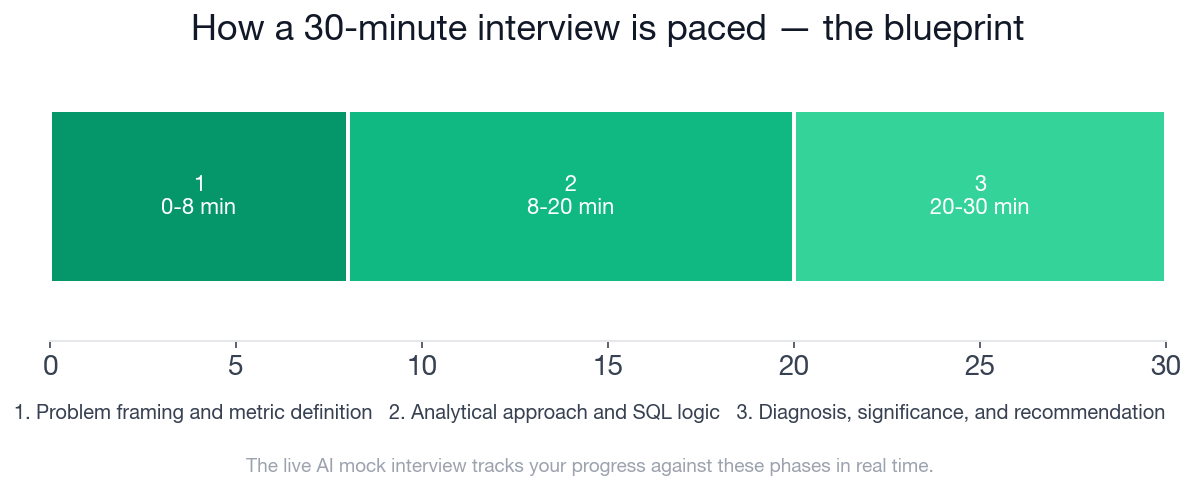
Problem framing gets 8 minutes, SQL and analytical logic gets 12, and diagnosis and recommendation gets the final 10, the same pacing the live interview enforces.
- ✓Clarifies what counts as funnel entry and final conversion
- ✓Defines whether analysis is by user, session, or first exposure cohort
- ✓Introduces a reasonable conversion window such as signup-to-paid within a bounded time period
- ✓Separates stage conversion, overall conversion, and volume effects
- ✓Mentions key segment cuts likely to matter: platform, country, acquisition channel, experiment variant
- ✓Describes selecting first relevant event timestamps per user per stage
- ✓Explains ordering constraints so later stages only count after earlier stages
- ✓Addresses duplicate or repeated events and possible joins to subscriptions as a source of truth for paid status
- ✓Explains how to compute counts, step conversion rates, and drop-off table outputs
- ✓Proposes at least one decomposition to isolate whether a top-line drop comes from traffic mix, stage friction, or instrumentation changes
- ✓States what evidence would be needed before concluding the redesign caused the drop
- ✓Mentions confidence intervals, significance testing, or quasi-experimental fallback if rollout was not randomized
- ✓Offers plausible UX or operational hypotheses for the biggest drop-off stage
- ✓Recommends a concrete next action plan: validate instrumentation, quantify affected segment, propose follow-up test or rollback decision
- ✓Includes guardrails such as payment errors, acquisition mix, refund/cancellation signals, or downstream quality of converted users
Every checkmark above is a point on the rubric. Miss one in a live interview and there is no red box waiting to catch it.
Take the Same Funnel Into a Live Mock Interview
Reading Harper's four corrections is not the same as producing them cold, with an interviewer asking real-time follow-ups and a clock that does not pause. The fastest way to close that gap is to run this same mid-level Data Analyst conversion funnel scenario as a live AI mock interview, scored against the identical blueprint and rubric above. Want to drill the underlying concepts first? The conversion funnel optimization question bank breaks the topic into individual practice questions, and the preparation guides cover how specific companies structure their analytics interviews.
FAQ
Q. What counts as a bounded conversion funnel in a Data Analyst interview?
A bounded funnel has an explicit entry event, one terminal conversion event, and a conversion window anchored to each user's own first exposure rather than a shared calendar cutoff. That last part matters: measuring trial-to-paid conversion against a fixed reporting date instead of each user's own signup timestamp makes recently acquired users, who have not had time to convert yet, look like drop-offs. This is also what separates funnel analysis from retention analysis, which tracks behavior after the terminal event, not before it.
Q. How would a Data Analyst isolate which funnel stage caused a trial-to-paid drop?
By building a stage-by-stage table rather than one aggregate rate: select the first qualifying event timestamp per user per stage, enforce that each stage's timestamp falls after the prior stage's, and compute step conversion as the count at stage N divided by the count at stage N-1. That produces a drop-off table across signup completion, trial start, payment submission, and paid activation, so the PM can see exactly which step lost the most users instead of one blended number.
Q. How should duplicate, out-of-order, or missing events be handled in funnel metrics?
Deduplicate to the earliest qualifying event per user per stage before counting, since a user reopening the app can fire the same event twice and inflate a stage's count. Paid status should be reconciled against the subscriptions table, treated as the source of truth, rather than trusted purely from a subscribe_paid event in the log, because a gap between the two systems usually signals an instrumentation problem, not a real drop in conversion.
Q. How long does a Data Analyst conversion funnel interview run, and how is the time split?
This interview runs 30 minutes across three phases: problem framing and metric definition (0-8 minutes), analytical approach and SQL logic (8-20 minutes), and diagnosis, significance, and recommendation (20-30 minutes). Each phase carries its own checklist of five expectations the interviewer is listening for.
Q. How is a Data Analyst conversion funnel interview scored?
The 100-point rubric weighs Interviewer Objectives Alignment and Level-Specific Expectations at 30 points each, 60 combined, with Technical Proficiency and Communication and Problem Solving each worth 20 points. Framing the funnel correctly and reasoning about whether a drop is real carries three times the weight of getting the SQL exactly right.
Q. What should a mid-level Data Analyst candidate handle without prompting?
A mid-level candidate is expected to independently structure the funnel problem and propose a practical analysis plan, write realistic SQL patterns for stage-by-stage conversion without deriving advanced attribution math from first principles, judge the trade-off between speed and rigor for an end-of-day recommendation, and identify the most likely confounders, such as a staggered country rollout, even without exhausting every edge case.
Q. Is this walkthrough based on a real company's actual interview questions?
No. This is an illustrative simulation of how a strong Data Analyst conversion funnel optimization interview runs at a mid-level bar, built from InterviewStack.io's interview blueprint for this role and topic. It does not represent any specific employer's real interview questions.
The Verdict Was Never the First Move
Harper's four turns above are not really about SQL or funnel definitions individually. They are about whether evidence comes before conclusions. A subscription app with "a possible decline" deserves a diagnosis, not a verdict handed over before the data has been checked, and that discipline is what a mid-level Data Analyst conversion funnel interview is actually built to score.
Topics
Ready to practice?
Put what you've learned into practice with AI mock interviews and structured preparation guides.