
Two Careers That Share a Label but Almost Nothing Else
Data Analyst and AI Engineer both sit under the "data careers" banner at most companies, which makes the comparison a natural career planning question. The data suggests these careers diverge far earlier and more sharply than the shared vocabulary implies.
Across 7,421 active Data Analyst and 4,530 active AI Engineer postings on the InterviewStack.io job board as of June 2026, the two roles share only 20% of their top-30 skill sets (Jaccard similarity) and sit $59,000 apart at the US salary median. That combination of near-zero skill transfer and a large pay gap makes this a genuine fork, not a natural career progression.
| Metric | Data Analyst | AI Engineer |
|---|---|---|
| Median US base salary | $111,000 | $170,000 |
| Active postings | 7,421 | 4,530 |
| Top skill | SQL (59%) | Python (67%) |
| Remote + hybrid share | 47% | 59% |
| Entry-level share | 7.5% | 5.4% |
| Skill overlap (Jaccard) | 20% | - |
Key Findings
- Median US base salary: $111,000 for Data Analysts (n=1,575) versus $170,000 for AI Engineers (n=812), a $59,000 gap.
- Skill overlap is 20% (Jaccard similarity on top-30 skill sets), one of the lowest of any role pair in data hiring.
- Data Analyst postings outnumber AI Engineer postings 7,421 to 4,530, a 1.64 to 1 ratio.
- Data Analyst entry-level share is 7.5% versus 5.4% for AI Engineer; both roles are mostly mid-level and senior.
- Data Visualization (52%), Power BI (35%), Excel (33%), and Tableau (32%) top the Data Analyst exclusive skills; none breaks 5% in AI Engineer postings.
- LLMs (42%), RAG (40%), Generative AI (37%), and Prompt Engineering (27%) top the AI Engineer exclusive skills; none breaks 5% in Data Analyst postings.
- AI Engineers have 59% hybrid or remote postings versus 47% for Data Analysts.
What Does Each Role Actually Do?
A Data Analyst's job is to answer questions with data that already exists. That means SQL queries against production databases, dashboards in Tableau or Power BI so stakeholders can track metrics without requesting new queries each week, and translating results into decisions a non-technical audience can act on. The output is insight; the audience is the business. See the full Data Analyst skill picture for per-skill depth.
AI tools are embedded in this workflow regardless of what the job description says. Power BI Copilot automates visualization building and anomaly flagging. ChatGPT-assisted SQL debugging is now standard practice. Tableau Pulse adds AI-generated summaries. Stack Overflow's 2025 developer survey found 84% of developers use or plan to use AI tools and 51% use them daily. The roughly 12% of Data Analyst postings that explicitly mention Machine Learning measure analysts hired to build ML-adjacent work, not the ambient AI layer every analyst already uses.
An AI Engineer's job is different at the root: the AI system itself is the deliverable. That means building RAG (Retrieval-Augmented Generation) pipelines so an application can query a knowledge base using language models, wiring LLM APIs into product features, deploying models with CI/CD pipelines, and ensuring the system behaves reliably under production load. The output is a running system, not a report. See the AI Engineer skills breakdown for the full picture.
How Do Data Analyst and AI Engineer Skills Diverge?
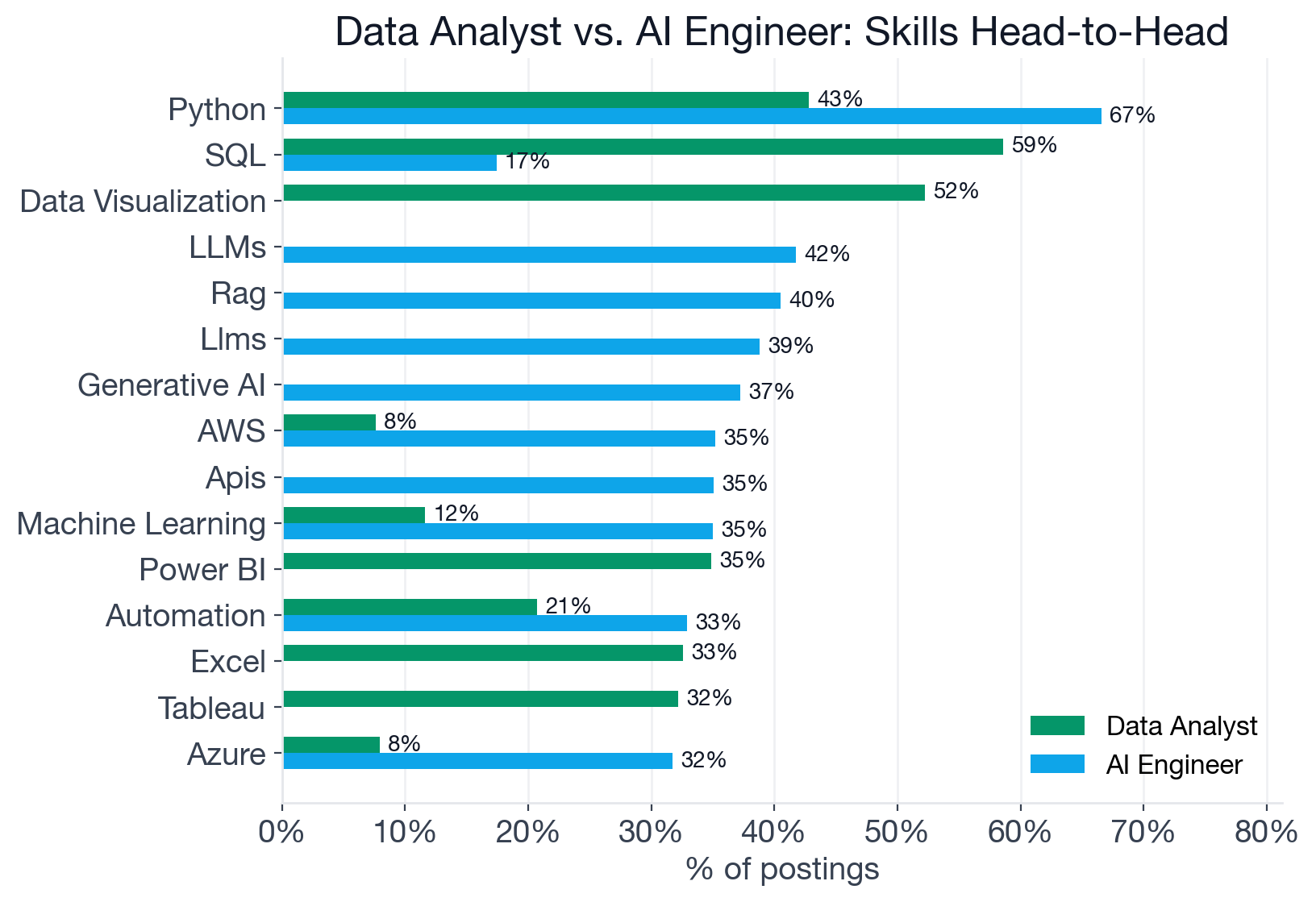
Percentage of active postings that mention each skill. Many top-ranked skills for one role appear in fewer than 5% of the other's postings.
The exclusive skill clusters make the split concrete. Data Visualization (52%), Power BI (35%), Excel (33%), and Tableau (32%) are the Data Analyst's domain: presentation-layer tools that connect analysis to business stakeholders. Statistics (27%) and Data Quality (24%) round out a role built on rigor and reporting.
LLMs (42%), RAG (40%), Generative AI (37%), APIs (35%), Prompt Engineering (27%), and LangChain (a Python framework for building LLM-powered applications, 25%) are the AI Engineer's domain. CI/CD at 24% signals that this is a software-engineering discipline: AI Engineers ship code to production environments, they do not send decks to stakeholders.
Python is the one genuine bridge. It appears in 43% of Data Analyst postings and 67% of AI Engineer postings. SQL, however, is the analyst's core skill at 59% and the AI Engineer's peripheral skill at 17%. The 20% Jaccard overlap is real: these roles share a programming language, not a discipline.
Which Pays More?
All salary figures are US base salary only, from postings with salary disclosed. Equity, bonuses, and sign-on are not captured in posting data; total compensation at top employers is meaningfully higher on both sides.
AI Engineers earn a $59,000 premium over Data Analysts at the US median: $170,000 versus $111,000 (n=812 versus n=1,575). The premium is structural, not just a skill mix artifact. For the same skills, AI Engineers earn substantially more: Python postings pay Data Analysts a median of $119,000 and AI Engineers $170,000. A/B Testing postings pay Data Analysts $146,900 versus $185,000 for AI Engineers. The premium persists because AI Engineers are being priced on production AI systems experience, which the market still treats as scarce.
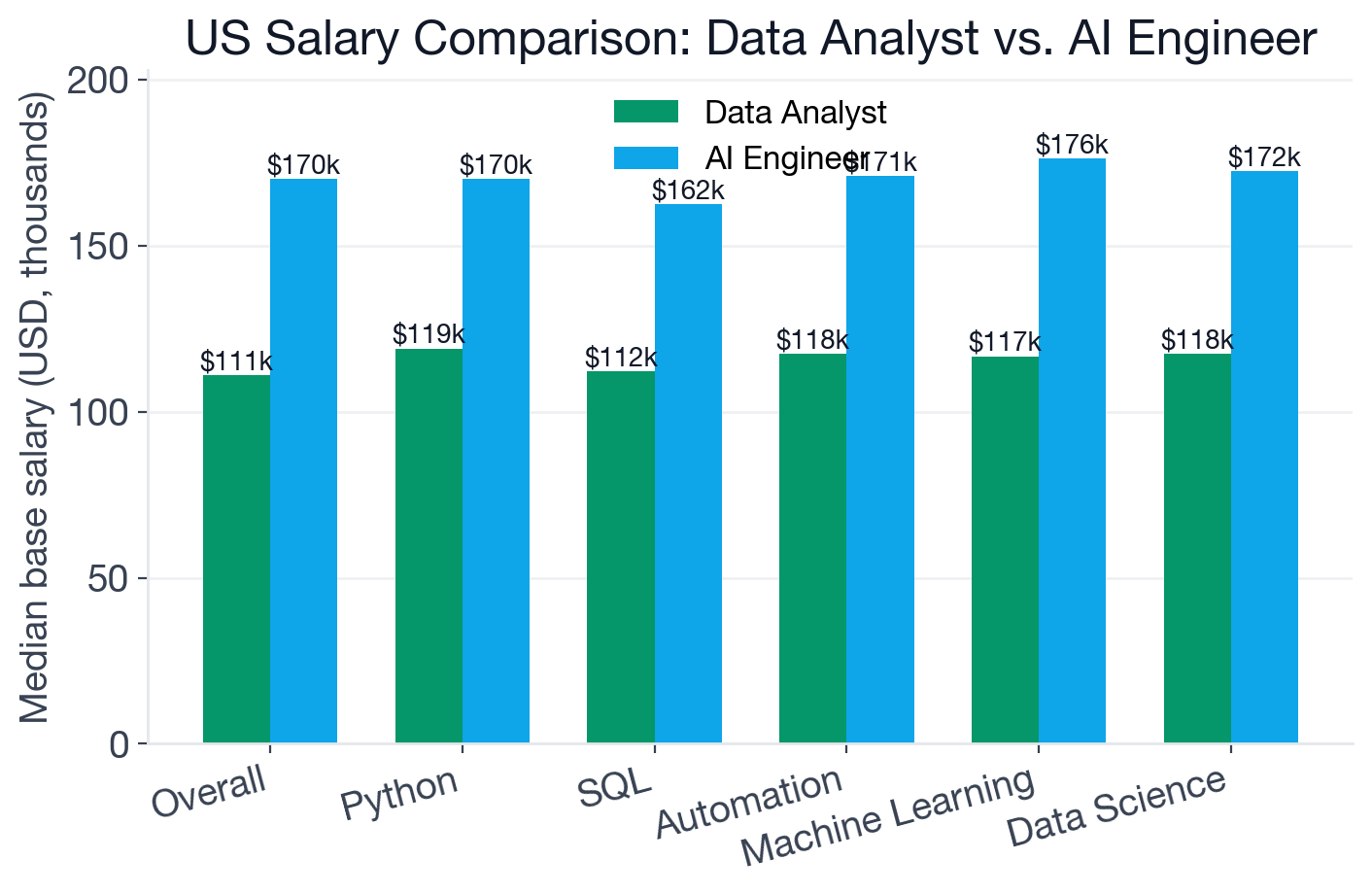
US base salary medians. Equity and bonus excluded. Data Analyst n=1,575; AI Engineer n=812.
The highest-paying AI Engineer skills are infrastructure and model-depth specialties: Distributed Systems ($200,000), TensorFlow ($184,300), Model Evaluation ($183,900), and LangGraph (an orchestration library for multi-step LLM agents, $177,900). The highest-paying Data Analyst skills tilt more strategic: A/B Testing ($146,900), dbt (a SQL transformation framework, $140,000), and Generative AI ($139,500).
Which Role Has More Openings?
Data Analyst is the larger market at 7,421 active postings versus 4,530 for AI Engineer, a 1.64 to 1 ratio. It is also slightly more accessible at entry level: 7.5% of Data Analyst postings are explicitly entry-level versus 5.4% for AI Engineer. Neither role is beginner-heavy, but the analyst path has more room at the base.
AI Engineer is growing faster despite the smaller current volume. External market analyses tracked AI Engineer postings rising roughly 143% year-over-year in 2025, a figure from third-party reporting, not the current dataset. The AI Engineer staff-tier share is also notably larger (15.5%) than the Data Analyst staff tier (7.6%), which suggests a steeper seniority ceiling as the discipline matures.
AI Engineers also get more flexibility in where they work: 59% of AI Engineer postings are hybrid or fully remote versus 47% for Data Analysts (23.5% vs 17.2% fully remote). Both roles are globally distributed, with the US representing 38% of Data Analyst postings and 32% of AI Engineer postings.
Which Should You Choose?
Choose Data Analyst if you:
- Want a faster path to your first job: larger market, slightly higher entry-level share, and skills many candidates already have (SQL, Excel, Tableau).
- Prefer business-facing work: translating data into decisions for stakeholders, not building the systems that process it.
- Are in healthcare, finance, or enterprise environments: IQVIA, PwC, Royal Bank of Canada, and PNC are among the leading Data Analyst hirers in this dataset.
- Want to layer AI in gradually: ambient AI tools are already embedded in the analyst workflow, and the explicit AI requirement bar is lower.
Choose AI Engineer if you:
- Have (or are building) a software engineering foundation: Python, APIs, CI/CD, and cloud infrastructure are baseline requirements, not differentiators.
- Want to build production AI systems: the pipelines, retrieval layers, and APIs that deploy models into products.
- Can absorb the steeper entry bar: 5.4% entry-level share and a skill set that assumes engineering fluency.
- Are targeting the higher salary ceiling: $59,000 above the analyst median today, with the gap widening at staff level (AI Engineer staff tier is 15.5% versus 7.6% for analysts).
How to Use This in Your Job Search
Both paths reward deliberate preparation. AI mock interviews let you practice the questions specific to each role: SQL case studies and business framing for Data Analysts, ML system design and LLM integration scenarios for AI Engineers. Use the question bank to drill individual topics by role, and interactive courses to build the foundational skills each path assumes going in.
Browse live openings filtered to your target: Data Analyst postings or AI Engineer postings.
FAQ
Q. What is the salary difference between Data Analyst and AI Engineer in 2026?
The median US base salary is $111,000 for Data Analysts (n=1,575 postings with salary disclosed) and $170,000 for AI Engineers (n=812). That $59,000 gap (about 53%) reflects the scarcity premium for AI engineering skills and the fundamentally different scope of the two roles. Both figures are base salary only; equity and bonus are not reflected in posting data, so total compensation at top employers runs higher on both sides.
Q. How much skill overlap do Data Analyst and AI Engineer share?
The Jaccard similarity between the top-30 skill sets for each role is 20%, based on 7,421 Data Analyst and 4,530 AI Engineer active postings. Only a handful of skills cross both: Python, SQL, Automation, Machine Learning, and Data Pipelines. Everything else diverges sharply, with visualization tools dominating the analyst side and LLM and RAG tooling dominating the AI Engineer side.
Q. What skills are unique to AI Engineers that Data Analysts don't need?
The top skills exclusive to AI Engineers are LLMs (42% of postings), RAG (40%), Generative AI (37%), APIs (35%), Prompt Engineering (27%), LangChain (25%), and CI/CD (24%). These reflect a role built around engineering and deploying AI systems, not analyzing data from them.
Q. Which role has more job openings, Data Analyst or AI Engineer?
Data Analyst postings outnumber AI Engineer postings by about 1.6 to 1: 7,421 active versus 4,530 active. Data Analyst also has a slightly higher entry-level share (7.5% vs 5.4%), making it the more accessible starting point. AI Engineer demand is growing faster; external market analyses tracked postings rising roughly 143% year-over-year in 2025, though that figure is from third-party reporting, not the current dataset.
Q. Are AI Engineer jobs more remote-friendly than Data Analyst jobs?
Yes. AI Engineers have 23.5% fully remote postings versus 17.2% for Data Analysts. Combined hybrid and remote availability is 59% for AI Engineers versus 47% for Data Analysts, an 11-point difference that reflects AI Engineers' more tech-native employer base.
Q. How hard is it to transition from Data Analyst to AI Engineer?
The 20% skill overlap makes this a more significant career shift than most expect. Python is the main bridge, appearing in 43% of Data Analyst postings and 67% of AI Engineer ones. SQL is the analysts' core strength but appears in only 17% of AI Engineer postings, so the transition means building new fluency in LLM frameworks and API engineering while deprioritizing a skill that defines the analyst role.
Q. Do Data Analysts need AI skills in 2026?
Yes, but in a different sense from AI Engineers. Job postings only state AI skills explicitly when you are hired to build AI systems, which is roughly 12% of Data Analyst postings that mention Machine Learning. But ambient AI use, including Copilot in Excel and Power BI, ChatGPT-assisted SQL work, and Tableau Pulse, is now an assumed baseline. Stack Overflow's 2025 developer survey found 84% of developers use or plan to use AI tools and 51% use them daily.
Know Which Track You're On
The $59,000 salary gap is the market's measure of two distinct disciplines: business intelligence versus AI systems engineering. The skill overlap data makes the choice unusually clear: only 20% of top-30 skills transfer, which means each path requires mostly new learning regardless of where you start. If you are already in data analysis and curious about AI Engineer roles, Python is the investment that pays on both sides. If you are evaluating both from scratch, the analyst path is larger and more accessible today, and the AI Engineer path offers a higher ceiling for those willing to build toward it. Browse Data Analyst postings and AI Engineer postings side by side and let the actual requirements calibrate your decision.
Topics
Ready to practice?
Put what you've learned into practice with AI mock interviews and structured preparation guides.