
The $82K Gap in Plain Numbers
Machine Learning Engineers earn a median $193,000 base salary in the US. Data Analysts earn $111,100. That $81,900 difference is one of the widest gaps in the data-role tier, and it sits on a foundation of only 22% shared skills. These two roles are far less connected than their shared "data" roots suggest, and the divergence is structural rather than cosmetic.
These figures come from 7,552 active Data Analyst postings and 4,714 active Machine Learning Engineer postings on the InterviewStack.io job board, with salary disclosed in 1,586 US Data Analyst postings and 1,206 US Machine Learning Engineer postings. Both salary figures are base salary only; equity and bonus are not captured in job-posting disclosures, so total compensation at top employers runs meaningfully higher. As with any role-level dataset, both figures represent the broader role family: the Data Analyst dataset includes business analyst, research analyst, and analytics manager variants alongside core data analyst roles; the Machine Learning Engineer dataset includes a small share of AI-adjacent postings (annotation specialists, forward-deployed AI strategists) alongside core ML engineering roles. Both are best read as market-level signals for each role category rather than narrow role definitions.
| Data Analyst | Machine Learning Engineer | |
|---|---|---|
| Median US base salary | $111,100 | $193,000 |
| Active postings | 7,552 | 4,714 |
| Top skill | SQL (59%) | Machine Learning (71%) |
| Remote share | 17% | 23% |
| Entry-level share | 7.4% | 4.5% |
| Skill overlap (Jaccard) | 22% shared | (same metric) |
Key Findings
- Machine Learning Engineers earn a median $193,000 US base salary vs $111,100 for Data Analysts: an $81,900 gap.
- The two roles share only 22% of their top-30 skill sets (Jaccard coefficient = 0.22).
- SQL is the sharpest divider: 59% of DA postings vs only 16% of MLE postings.
- Machine Learning as an explicit skill: 71% of MLE postings vs 12% of DA postings.
- Python is the single true bridge: 43% of DA postings, 65% of MLE postings.
- Data Analyst has 1.6x the job volume (7,552 vs 4,714) and a larger entry-level share (7.4% vs 4.5%).
- Machine Learning Engineers are more remote-friendly: 23% fully remote vs 17% for Data Analysts.
What Does Each Role Actually Do?
Data Analysts spend most of their time translating business questions into queries, then translating query results into decisions. A typical week involves pulling data from a warehouse or reporting tool (SQL, Power BI, Tableau), building a dashboard or analysis deck, and presenting findings to stakeholders who need to act on them. The output is interpretation: insight, visualization, recommendation. The exclusive skills confirm the nature of the work. Data Visualization (52%), Power BI (35%), and Excel (32%) are all presentation-layer tools that signal proximity to business decision-makers.
Machine Learning Engineers build and maintain the systems that generate predictions at scale. A typical week involves training or fine-tuning a model (PyTorch, TensorFlow), wiring it into a production pipeline (MLOps, CI/CD, Kubernetes), monitoring it for drift, and iterating when performance degrades. The output is infrastructure: a model running in production and serving real users. The exclusive skills confirm it. PyTorch (41%), deep learning (29%), and MLOps (27%) are all model-lifecycle tools, not reporting tools.
One role answers questions from data. The other builds the machinery that produces them. For a deeper dive into each role's skill stack, see our Data Analyst skills analysis and Machine Learning Engineer skills analysis.
What Skills Connect the Two Roles?
Python, shared data-science vocabulary, and a handful of cloud and pipeline concepts form the genuine common ground.
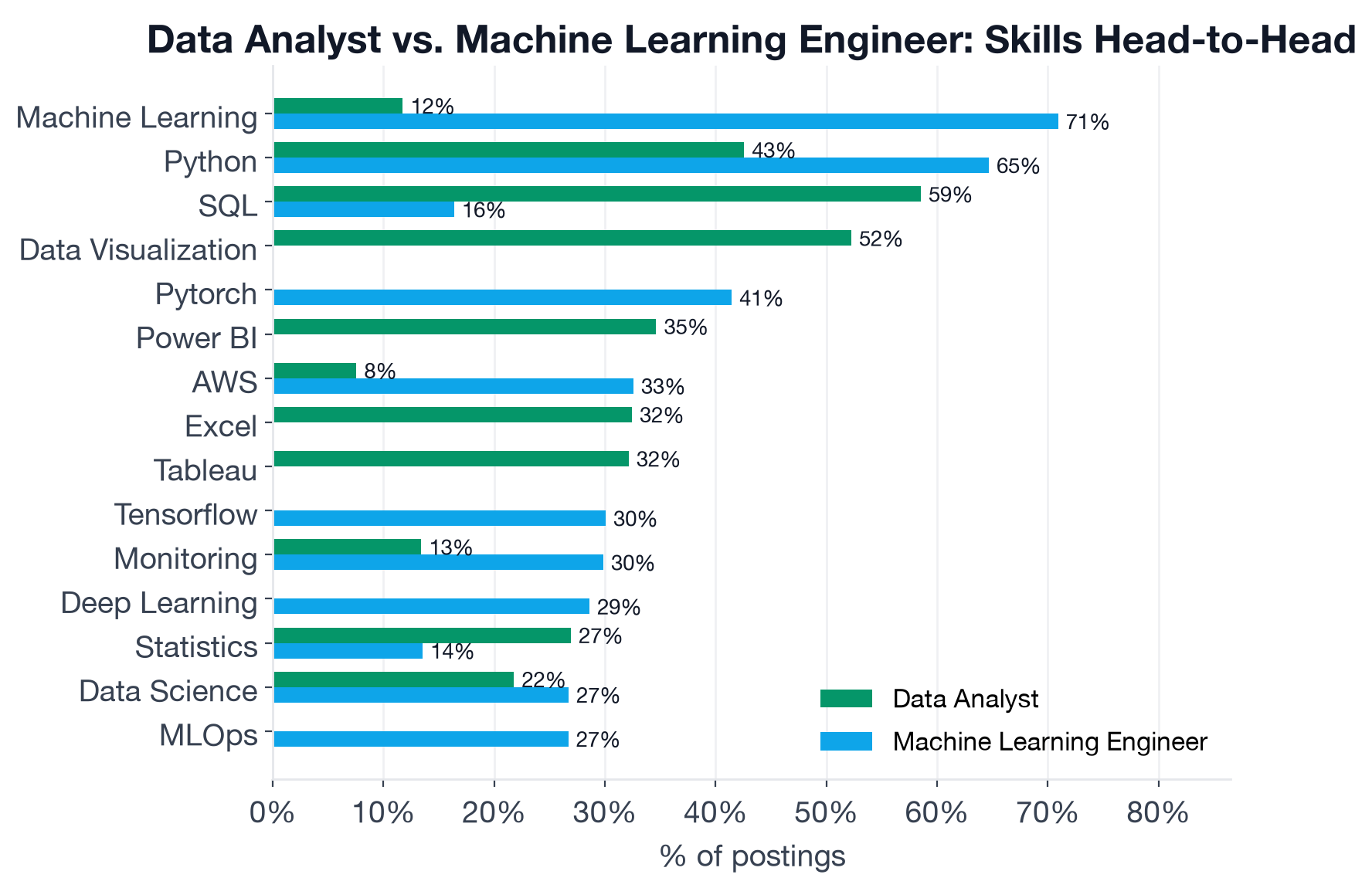
Skill presence in each role's active postings. Emerald = Data Analyst; blue = Machine Learning Engineer. Skills shown for the combined top-skill union.
Eleven skills appear in both roles' top-30 lists: Python, Machine Learning, SQL, Data Science, Monitoring, Data Pipelines, Statistics, AWS, Automation, Azure, and A/B Testing. Frequency tells a more nuanced story than simple overlap:
| Skill | Data Analyst | Machine Learning Engineer |
|---|---|---|
| Python | 43% | 65% |
| SQL | 59% | 16% |
| Machine Learning | 12% | 71% |
| Data Pipelines | 21% | 22% |
| Statistics | 27% | 14% |
Python is genuinely shared. If you can write Python, you are relevant in both markets. SQL and Machine Learning each belong firmly to one role: SQL is foundational for Data Analysts and a background competency for ML Engineers; Machine Learning is the job definition for MLE and a specialized niche for DA. If you are a Data Analyst with strong SQL, you have the most-demanded DA skill at 59% but only 16% coverage in MLE postings.
Where the Skill Stacks Split
The divergence is structural, not a question of tool preference.
Data Analyst exclusives reflect a presentation and governance function: Data Visualization (52%), Power BI (35%), Excel (32%), Tableau (32%), Data Quality (24%), and Data Governance (14%). Every skill on this list is oriented toward communicating findings to decision-makers or ensuring the data is trustworthy enough to share. None appear in more than 5% of MLE postings.
Machine Learning Engineer exclusives reflect a production systems function: PyTorch (41%), TensorFlow (30%), deep learning (29%), MLOps (a discipline for managing the full model lifecycle from training to serving: 27%), Generative AI (24%), CI/CD (24%), and Algorithms (24%). These are the tools for building, training, and deploying models at scale. None appear in more than 5% of DA postings.
The AI-specific skills on the MLE side deserve careful framing. Generative AI (24%) and LLMs (24%) measure postings explicitly hiring engineers to build AI systems: training large models, fine-tuning them, deploying them in production. That is not the full picture of AI's role here. JetBrains research puts AI coding tool adoption at 85-90% among developers (85% in late 2025, rising to 90% actively at work by April 2026); the Stack Overflow Developer Survey 2025 found 84% use or plan to use AI coding tools. Either way, ML Engineers almost certainly use tools like Copilot or Cursor to write the code that builds those systems. The explicit percentage measures "build AI"; ambient tool use is a floor that applies to both roles regardless of what postings say.
Data Analysts sit at a different point on that spectrum. The 12% explicit Machine Learning signal in DA postings represents a specialized segment (analysts hired for modeling work in healthcare, finance, or product). At the ambient layer, most analysts in modern organizations are already inside an AI-assisted workflow: Microsoft 365 Copilot reached 28 million enterprise seats in Q1 2026, meaning anyone using Excel or PowerPoint at a large employer has AI available in their toolchain. For more on how AI is reshaping the analyst role specifically, see how AI is changing Data Analyst work in 2026.
Which Pays More: Data Analyst or Machine Learning Engineer?
The $81,900 median gap holds across the skill distribution. These are US base salaries from postings with salary disclosed; equity and bonus are excluded.
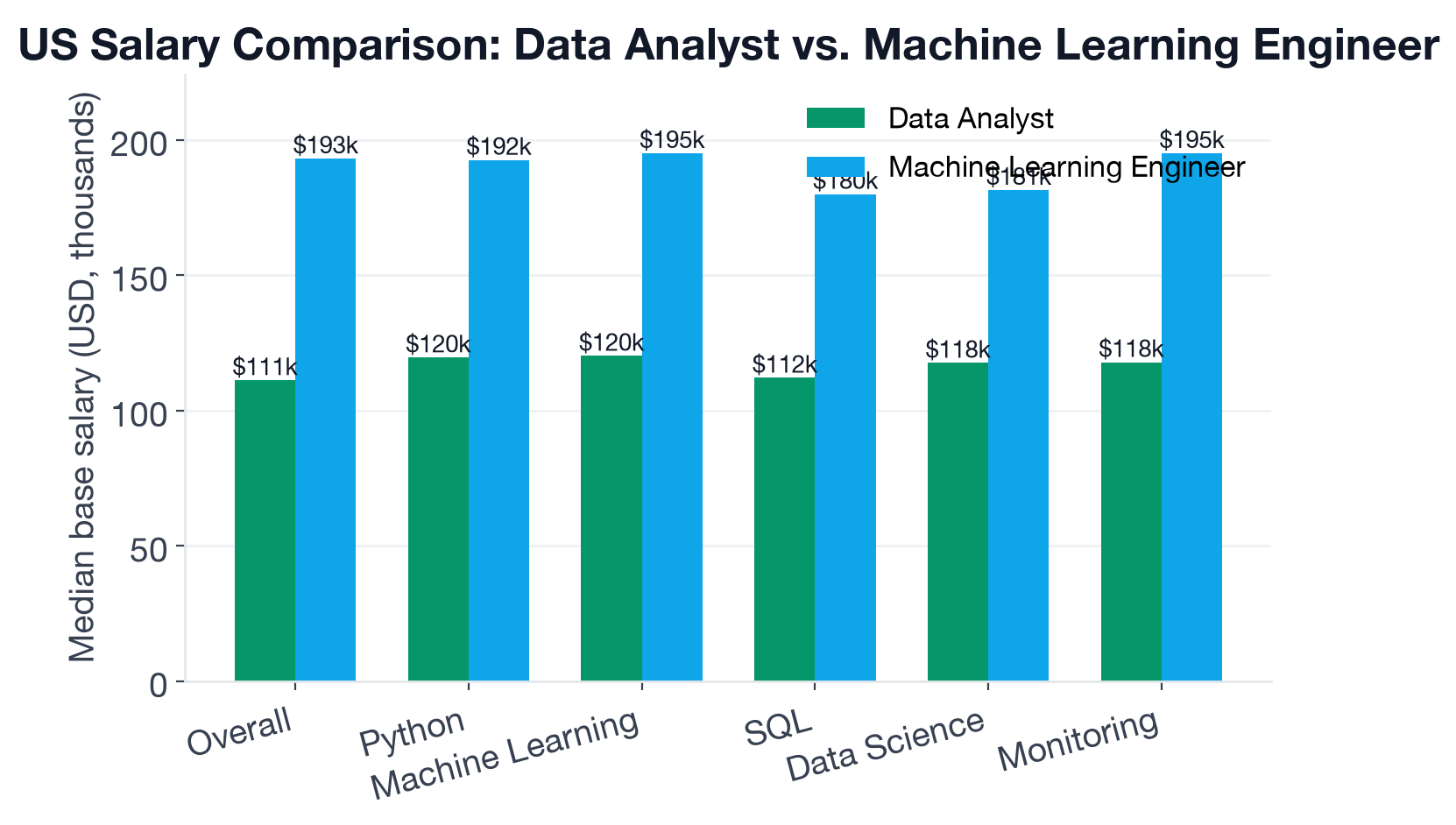
Median US base salary by role and selected skills. US base salary only; equity and bonus excluded.
For Machine Learning Engineers, the largest premiums above the $193,000 baseline attach to deep training specializations: RLHF ($235,600, +$42,600), JAX ($222,900, +$29,900), Distributed Training ($210,000, +$17,000), and Model Training ($208,600, +$15,600). These are research-engineering specializations that frontier AI labs and large model teams compete for.
For Data Analysts, the premium skills above the $111,100 baseline push toward engineering-adjacent work: A/B Testing ($146,900, +$35,800), dbt ($140,000, +$28,900), Generative AI ($139,000, +$27,900), and Scalability ($135,000, +$23,900). A dbt (a SQL-based data transformation framework) or A/B Testing requirement signals a product-analytics or growth-analytics context requiring engineering fluency beyond standard SQL and BI tooling. These skills are also worth watching as stepping stones: they build engineering-adjacent intuition without requiring a full career pivot.
Which Is Easier to Break Into?
Data Analyst is the wider entry point. Seven percent of DA postings (roughly 560 of 7,552) are explicitly entry-level, compared to 4.5% for Machine Learning Engineer (roughly 212 of 4,714). Mid-level dominates both at 61% for DA and 54% for MLE, but the staff-level concentration is more than twice as high in MLE (18% vs 8% for DA), signaling that ML Engineering career ladders extend further into senior specialization.
The US is the dominant market for both: 38% of DA postings and 44% of MLE postings. Canada plays a larger role in MLE hiring (5.4% vs 4.4% for DA), reflecting the concentration of AI research labs and product teams in North America.
On work mode, MLE is modestly more flexible: 23% fully remote and 30% hybrid (53% total) vs 17% remote and 30% hybrid (47% total) for DA. The gap is measurable but not dramatic.
Which Should You Choose?
Choose Data Analyst if you:
- Are earlier in your career or switching fields. The 7.4% entry-level share and larger job pool give you significantly more routes in.
- Want to work closer to business stakeholders, turning data into decisions rather than building systems.
- Already have SQL and BI tool familiarity. These skills still drive the bulk of DA hiring and are table-stakes at 59%.
- Want to preserve the option to move toward engineering without a full pivot. DA premium skills like A/B Testing and dbt build engineering fluency incrementally.
Choose Machine Learning Engineer if you:
- Have Python fluency and are prepared to build PyTorch, TensorFlow, MLOps, and algorithmic depth from there.
- Want the salary ceiling the MLE track provides ($193K median vs $111K) and can commit to the full skill rebuild.
- Are drawn to systems work: training models, deploying them, and monitoring them in production.
- Can work within a narrower hiring pool (4,714 vs 7,552) and accept the tighter entry-level window (4.5% vs 7.4%).
How to Use This in Your Job Search
For Data Analysts, browse current DA openings on InterviewStack.io. Filtering by Python or SQL surfaces the two largest skill segments in the market. Use the question bank to sharpen the technical and stakeholder communication skills that appear most in DA interviews.
For those targeting Machine Learning Engineer, browse current MLE openings. The Python-requiring postings cover 65% of the market. Use AI mock interviews to practice the technical depth MLE interviews require, and our interactive courses to build ML and system design foundations.
FAQ
Q. What is the median salary for Data Analyst vs Machine Learning Engineer in 2026?
The median US base salary is $111,100 for Data Analysts (n=1,586 postings with salary disclosed) and $193,000 for Machine Learning Engineers (n=1,206), an $81,900 gap. Both figures are base salary only; equity and bonus are not reflected in job posting data.
Q. How much skill overlap is there between Data Analyst and Machine Learning Engineer roles?
The Jaccard overlap coefficient is 0.22, meaning the two roles share about 22% of their combined top-30 skill set. Python is the strongest bridge (43% of DA postings, 65% of MLE postings); SQL and PyTorch are the clearest dividers. SQL is 59% in DA but only 16% in MLE, while PyTorch is 41% in MLE and near-absent in DA.
Q. Which role has more job openings: Data Analyst or Machine Learning Engineer?
Data Analyst has more openings: 7,552 active postings vs 4,714 for Machine Learning Engineer, a 1.6x volume advantage. Data Analyst also has a higher entry-level share (7.4% vs 4.5%), making it the more accessible starting point for career changers.
Q. What skills are unique to Machine Learning Engineers that Data Analysts rarely need?
PyTorch (41%), TensorFlow (30%), deep learning (29%), MLOps (27%), generative AI (24%), CI/CD (24%), and algorithms (24%) are the top MLE-exclusive skills. None appear in more than 5% of Data Analyst postings.
Q. What skills are unique to Data Analysts that Machine Learning Engineers rarely need?
Data Visualization (52%), Power BI (35%), Excel (32%), Tableau (32%), Data Quality (24%), and Data Governance (14%) are the top Data Analyst exclusive skills. These tools signal proximity to business stakeholders and a presentation and governance function.
Q. Can a Data Analyst transition to a Machine Learning Engineer role?
Yes, but the transition requires building most of the skill stack from scratch: only 22% of the skill set transfers directly. Python fluency is the strongest foundation. Beyond that, the path requires building PyTorch or TensorFlow proficiency, MLOps and CI/CD discipline, and deeper algorithmic knowledge.
Which Way to Invest?
Both roles are hiring at scale. Data Analyst offers the lower entry bar, larger pool, and a faster path to employment. Machine Learning Engineer offers the $81,900 salary premium, but the 22% skill overlap means the move is a career rebuild, not a lateral step. Browse live Data Analyst openings or Machine Learning Engineer openings to see exactly what each open position requires.
Topics
Ready to practice?
Put what you've learned into practice with AI mock interviews and structured preparation guides.