
The File-Size Line Is Where This Interview Is Actually Won
The prompt buries its hardest requirement inside a code comment: files can be large enough that loading everything into memory is undesirable. Most candidates read past it, sketch a function that opens the file and pulls every record into a list, and jump straight to the interesting part: deduplication, validation, aggregation. In a mid-level Data Engineer Python interview built on this scenario, that one skimmed line costs points twice, once during the first six minutes of framing and again during the fifteen minutes of hands-on coding that follow. This walkthrough uses one real interview package, the same one the AI mock interview runs for mid-level Data Engineer candidates, to show exactly where those points go missing.
Key Findings
- The rubric allocates 100 points across 4 dimensions: Interviewer Objectives Alignment (30), Level-Specific Expectations (30), Technical Proficiency (20), Communication and Problem Solving (20).
- Objectives Alignment and Level-Specific Expectations combine for 60 of the 100 points, before a single line of code is judged for correctness.
- Phase 2, core implementation, spans minutes 6 to 21 (15 of the 30 minutes) and covers 7 of the interview's 16 total checklist items, the most of any single phase.
- Avoiding an all-in-memory plan is a checklist item in Phase 1 (0-6 min) and a separate checklist item in Phase 2 (6-21 min): the same gap can cost points twice.
- Phase 3 (21-30 min) expects a test plan spanning at least 4 categories: happy path, malformed input, duplicates, and large-stream behavior.
- This walkthrough dramatizes 4 of the interview's 6 possible follow-up questions across all 3 scored phases.
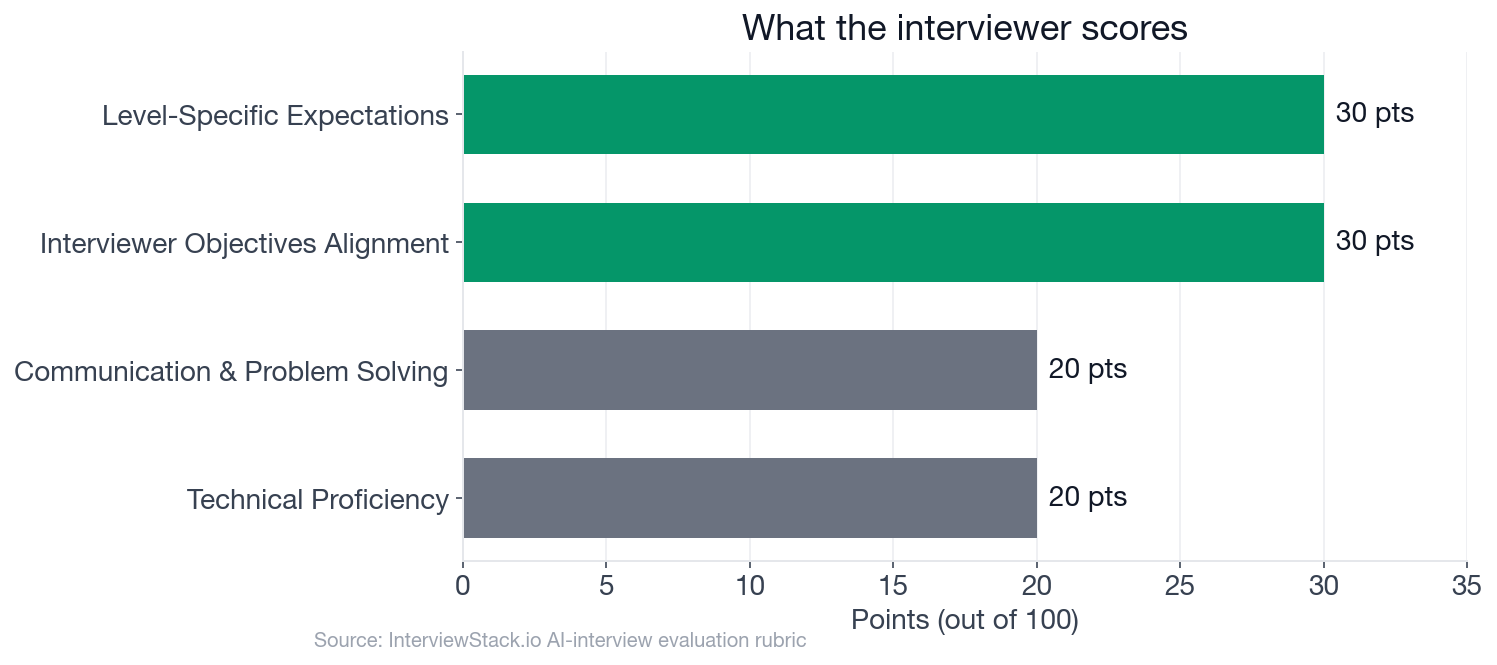
The four scoring dimensions and their weights. Objectives Alignment and Level-Specific Expectations together outweigh Technical Proficiency and Communication and Problem Solving combined.
How Narrow Is the Data Engineer Python Programming Interview's Scope?
The interviewer's stated objective is narrow and concrete: evaluate whether you can write correct, production-minded Python for a realistic data engineering utility, using core data structures and the standard library idiomatically, handling malformed input without crashing, reasoning about memory at a practical level, and explaining your testing instincts, all inside a single Python process. Distributed systems design, SQL, ML modeling, and Spark or Flink specifics are explicitly off the table for this round.
The interview question
You ingest newline-delimited JSON (NDJSON) event logs from multiple producers. Each line is expected to look like the record below, but production data rarely cooperates: duplicate event_id values show up, some lines are malformed JSON, required fields go missing, timestamps arrive invalid or out of order, and files can run large enough that loading everything into memory at once is not an option.
{"event_id": "e1", "user_id": "u1", "event_type": "click", "ts": "2025-01-10T10:00:00Z", "metadata": {"source": "web"}}
Write a Python function that processes the log stream above and returns a per-user summary of valid events, handling bad records in whatever way you think is appropriate for a production data pipeline.
Notice what the prompt withholds: a function signature, a definition of "valid," and a decision on how rejected records get surfaced. A strong first six minutes proposes all three before a single line of implementation code gets written, and the memory constraint shapes that proposal from the start rather than arriving as a surprise once the code does not run on a large file.
The Follow-Ups That Actually Move the Score
Turn 1: Streaming vs. Loading It All
Interviewer: "If the input file is tens of gigabytes, what would you change in your implementation to keep memory usage predictable?"
Turn 2: Deduplicating on Shaky Ground
Interviewer: "What rules would you apply for deduplicating event_id values, and how would you justify them if duplicates contain conflicting payloads?"
Turn 3: Timestamps You Cannot Trust
Interviewer: "How would you validate and parse timestamps using the standard library, and what would you do with records that have invalid or missing ts values?"
Turn 4: The Tests That Prove It Works
Interviewer: "What tests would you write first to give you confidence this utility is safe to deploy in a shared ingestion codebase?"
What Happens When You Only Have Fifteen Minutes to Actually Write the Code?
Every mistake above reads as obvious once it is laid out with the fix sitting right next to it. Live, you do not get the fix next to it. Phase 2 alone runs fifteen straight minutes with the clock visible, the interviewer asking follow-ups in an order you do not control, and each answer narrowing what you can still credibly say in the next one. Catching a memory-planning gap on the page costs nothing; catching it out loud, six minutes in, while you are also trying to name a function signature and keep your code running, is a different skill entirely.
The only way to close that gap is a live rep against unscripted follow-ups. That is what the AI mock interview for Data Engineer Python Programming is built to give you. If you want to drill the underlying language mechanics first, the Python Programming question bank for Data Engineer breaks streaming iteration, standard library parsing, and collections-based aggregation into individual practice questions.
What Does the AI Interviewer Track From the First Line to the Last Test?
This is the blueprint a strong candidate hits across all three phases, checklist item by checklist item. It is also exactly what the AI mock interview tracks you against in real time, with feedback on all four rubric dimensions once the session ends.
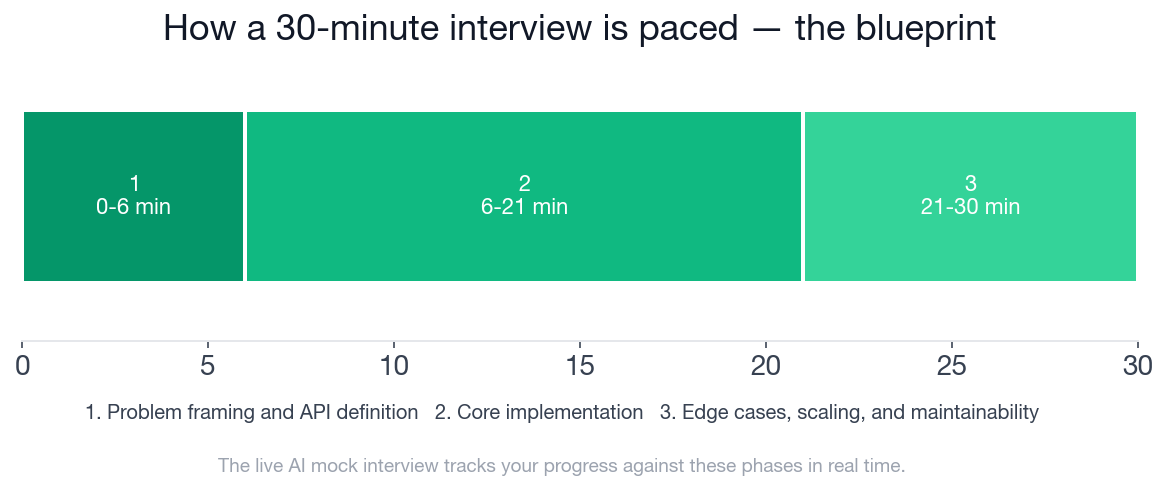
Three-phase structure of the 30-minute interview. Core implementation alone runs 15 straight minutes, as long as framing and wrap-up combined.
- ✓Asks or states assumptions about what qualifies as a valid event
- ✓Proposes a concrete function signature or return structure
- ✓Identifies at least 3 failure modes from the prompt and states how they will be handled
- ✓Acknowledges large-file constraint and avoids an all-in-memory plan
- ✓Writes runnable or near-runnable Python with coherent structure
- ✓Uses streaming iteration over lines rather than reading the entire file at once
- ✓Parses JSON safely and handles decode failures explicitly
- ✓Validates presence of required fields before aggregation
- ✓Implements deduplication logic for event_id with clear behavior
- ✓Aggregates per-user summaries using appropriate structures such as dict/defaultdict/Counter
- ✓Keeps the solution reasonably modular through helper functions or clear blocks
- ✓Explains time complexity and identifies major memory drivers such as dedup state and per-user aggregation
- ✓Discusses at least one strategy for rejected-record observability, such as counters, sampled errors, or side output
- ✓Identifies edge cases like conflicting duplicates, invalid timestamps, blank lines, and missing metadata
- ✓Suggests a reasonable extension path for new summary fields without major rewrites
- ✓Outlines a focused test set with happy path, malformed input, duplicates, and large-stream behavior
Practice This Exact Interview
Run the AI mock interview for Data Engineer Python Programming to get this exact question with scored, unscripted follow-ups and a feedback report broken out by all four rubric dimensions, not just a pass or fail. For the fuller picture of what companies expect from Data Engineers beyond this one topic, see the Data Engineer skills analysis, browse current Data Engineer openings, check the preparation guide library for company-specific prep, or work through the companion Data Pipeline Architecture interview walkthrough if system design is next on your list.
FAQ
Q. How is the Data Engineer Python Programming interview scored?
The rubric allocates 100 points across four dimensions: Interviewer Objectives Alignment (30 points), Level-Specific Expectations (30 points), Technical Proficiency (20 points), and Communication and Problem Solving (20 points). Objectives Alignment and Level-Specific Expectations together account for 60% of the score, so how you frame and reason about the problem matters as much as whether the code runs.
Q. What should the function signature and return value look like?
There is no single required signature, but the rubric rewards a concrete contract proposed early: a function that accepts a file path or iterable of lines and returns both a per-user summary structure and a separate collection of rejected records with reasons attached. Proposing that shape in the first six minutes, before writing implementation code, is one of Phase 1's four checklist items.
Q. Why does memory matter so much in a Python coding interview?
The prompt states files can be large enough that loading everything into memory is undesirable, and the rubric checks for that awareness twice: once in Phase 1's problem-framing checklist and again in Phase 2's core-implementation checklist, which specifically rewards streaming iteration over lines instead of reading the whole file at once. Missing it costs points under Level-Specific Expectations, which asks whether you recognize when generator-based processing is preferable.
Q. How do you extend the code to add event_type counts and earliest and latest timestamps per user without a rewrite?
Phase 3's checklist explicitly rewards a reasonable extension path for new summary fields without a major rewrite. The strongest answers keep per-user aggregation behind a small, well-named data structure, such as a dataclass or a nested dict with clear keys, so adding a new field means adding a line inside the existing aggregation step, not restructuring the whole function.
Q. What level is this Python interview calibrated for?
This blueprint is calibrated for mid-level Data Engineers (2-5 years of experience). At this level, the interviewer expects an independently workable solution with clean control flow, pragmatic validation choices instead of a perfect framework, and readable, testable code, but not a fully distributed system or deep dedup-state optimization without light prompting.
Q. What does the AI mock interview track during this Python round?
The AI mock interview tracks you against the three-phase blueprint in real time: problem framing and API definition (0 to 6 minutes), core implementation (6 to 21 minutes), and edge cases, scaling, and maintainability (21 to 30 minutes). After the session, feedback is broken out across all four rubric dimensions, not just a single score.
The File-Size Line Was the Real Test
The dedup rule, the timestamp parsing, the test plan: all of it sits downstream of one decision made in the first six minutes. The pattern holds across every turn above: the candidates who lose points are not missing Python knowledge, they are making a decision by default instead of stating it out loud and defending it. Practice stating it out loud, under a real clock, before it happens live.
Topics
Ready to practice?
Put what you've learned into practice with AI mock interviews and structured preparation guides.