
Both Roles Run on SQL. The Pay Gap Lives in the Infrastructure.
SQL is not a Data Engineer skill or a Business Intelligence Analyst skill. It belongs to both, at the same frequency: SQL appears in 67.5% of Data Engineer postings and 67.5% of Business Intelligence Analyst postings across the InterviewStack.io job board as of June 2026, covering 8,774 active Data Engineer listings and 2,440 Business Intelligence Analyst listings. The rates are tied to the decimal.
The $25,700 salary gap between these roles has nothing to do with SQL fluency. It comes from the layer that surrounds SQL in each job. Data Engineers use SQL inside pipelines: they write transformations that run on Spark, orchestrated by Airflow, deployed via CI/CD, monitored with observability tooling, and stored in cloud warehouses. Business Intelligence Analysts use SQL to pull data into dashboards, where Power BI (60% of postings), Tableau (37%), and Excel (31%) are the destinations. Both populations need SQL. Only one needs the infrastructure that feeds it.
Dataset note: the Data Engineer sample is tightly scoped to software and data-platform engineering roles. The Business Intelligence Analyst sample draws from a broader analytics analyst population; a random title review found roughly 15% of entries were adjacent roles (government intelligence analysts, compensation analysts, and market intelligence specialists whose descriptions include "business intelligence"). The core BI tool signals (Power BI at 60%, Tableau at 37%) and the salary median reflect genuine demand from BI-oriented roles and are directionally reliable at this contamination level.
Key Findings
- SQL is demanded at 67.5% for both Data Engineer and Business Intelligence Analyst roles; the two roles share this foundation at identical depth across 11,214 active postings.
- Data Engineers earn a median US base salary of $155,500 (n=1,598) vs. $129,800 for Business Intelligence Analysts (n=445), a $25,700 (19.8%) gap.
- Data Engineer postings outnumber Business Intelligence Analyst postings 3.6 to 1: 8,774 vs. 2,440 active listings.
- The Jaccard overlap between the two skill sets is 46%, meaning less than half the skills transfer directly.
- Business Intelligence Analyst has a higher entry-level share: 5.9% of postings vs. 2.6% for Data Engineer.
- Data Engineers have more remote flexibility: 21% of DE postings are tagged remote vs. 15% for Business Intelligence Analysts.
- The highest-paying BI Analyst skills (BigQuery at $152,500, dbt at $149,500, Looker at $149,500) are all infrastructure-adjacent. Leaning toward the DE side of the stack is how BI Analysts close the pay gap.
The Short Answer
Data Engineers earn more, have roughly 3.6 times as many open positions, and require a deeper infrastructure skill set. Business Intelligence Analysts have a lower barrier to entry and a skill profile built for stakeholder-facing reporting rather than pipeline construction. Both roles need SQL at the same intensity; neither is more SQL-heavy than the other.
| Data Engineer | Business Intelligence Analyst | |
|---|---|---|
| Median US base salary | $155,500 | $129,800 |
| Active postings | 8,774 | 2,440 |
| Top skill | Data Pipelines (72%) | Data Visualization (68%) |
| Remote share | 21% | 15% |
| Entry-level share | 2.6% | 5.9% |
| Skill overlap (Jaccard) | 46% shared | N/A |
What Does Each Role Actually Do?
A Data Engineer's job is to make data reliable, scalable, and accessible. Their week looks like building and maintaining ETL/ELT pipelines, writing Python and SQL transformations, debugging pipeline failures, and incrementally improving infrastructure: adding monitoring to an Airflow DAG (Apache Airflow is the open-source scheduler most data teams use to orchestrate pipelines), optimizing a Spark job, migrating a warehouse to Snowflake. The output is infrastructure that analysts and data scientists depend on to do their work. The exclusive skills (Spark, CI/CD, Kafka, Airflow) signal that production reliability and scale are core concerns, not optional. Machine learning appears in 19% of Data Engineer postings, specifically in roles hired to build the pipelines that feed AI systems.
A Business Intelligence Analyst's job is to turn that infrastructure's output into decisions. Their week looks like building and maintaining dashboards in Power BI or Tableau, writing SQL queries to answer business questions, and presenting findings to stakeholders who are not technical. The exclusive skills (Tableau, Excel, Storytelling, Forecasting) signal that translating data into insight for non-technical audiences is the primary output. "Storytelling" appears in 9% of BI Analyst postings and has no counterpart in Data Engineer hiring. Machine learning shows up in 10% of BI Analyst postings, typically in roles expected to incorporate predictive outputs into dashboards rather than build the models themselves.
Both roles now work alongside ambient AI tools regardless of what the job posting says. Microsoft Copilot is embedded directly in Power BI (present in 60% of BI Analyst postings), bringing AI-native anomaly detection and natural-language querying into the tool most BI Analysts use every day. For Data Engineers, AI-assisted coding tools have become standard across data and analytics engineering work. GitHub Copilot and ChatGPT are now routinely used for authoring SQL transformations and Python pipeline functions. The job posting numbers measure who is hired to build AI systems; the survey numbers measure who uses AI tools every week as a baseline expectation, which is nearly everyone in either role.
What Skills Do Both Roles Require?
Both roles demand SQL, Python, and data quality practices in the majority of postings. The shared foundation is more extensive than most people assume.
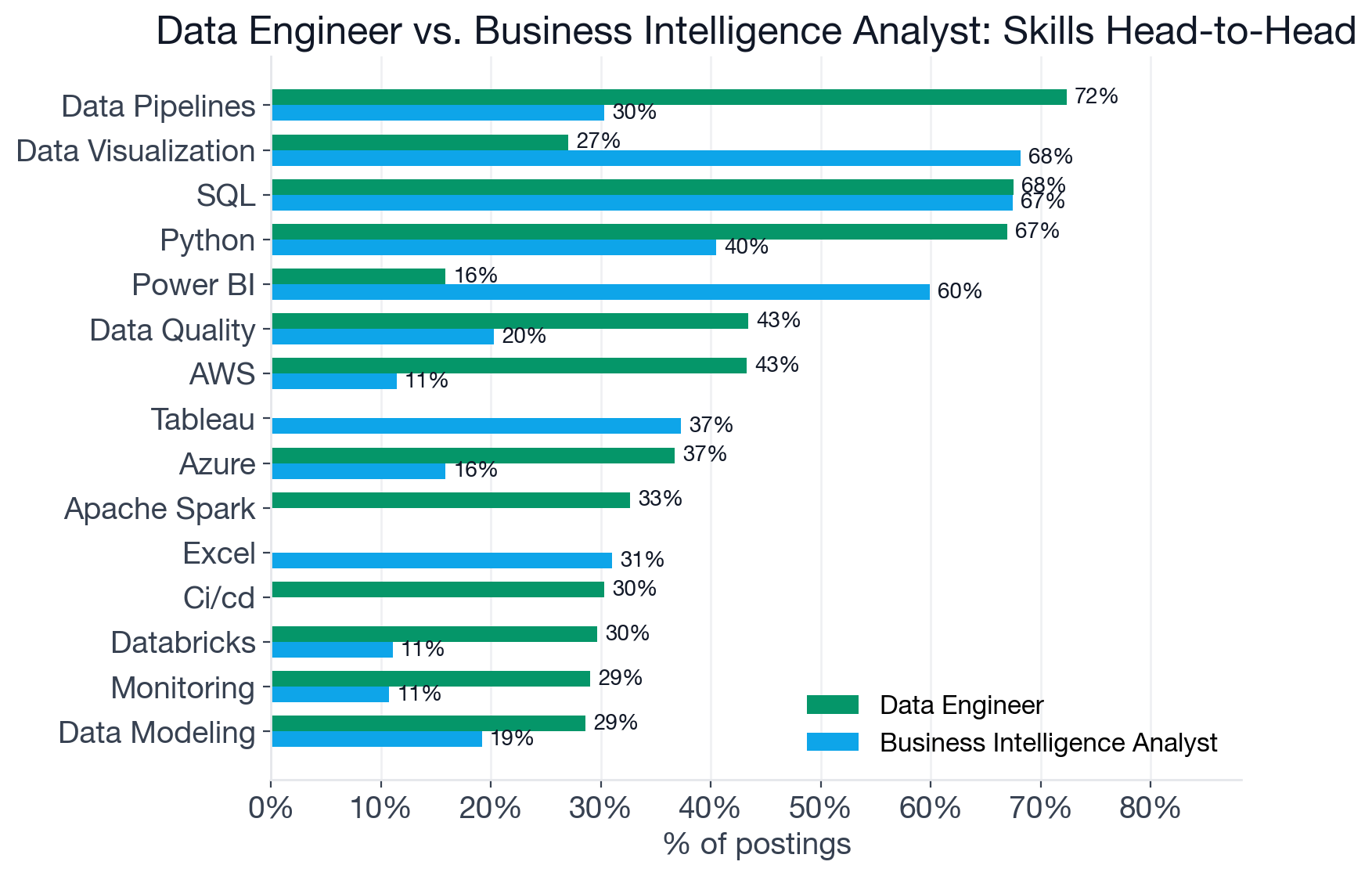
Share of postings that mention each skill for Data Engineer and Business Intelligence Analyst, drawn from the union of both roles' top 30 skill lists.
The SQL parity is the headline: despite feeling like very different roles, both are built on structured query work at comparable intensity. Beyond SQL, the shared profile includes:
- Python: 67% of Data Engineer postings vs. 40% for Business Intelligence Analyst. Shared, but with a 27-point gap. Python in DE postings signals pipeline code; in BI Analyst postings it signals analytical scripting and automation.
- Data Pipelines: 72% DE vs. 30% BI. The BI Analyst fraction represents roles that interact with the pipeline layer, not build it.
- Data Visualization: 27% DE vs. 68% BI. Conceptually shared, but at opposite intensities.
- Data Quality: 43% DE vs. 20% BI. Both roles care about data accuracy; Data Engineers are also responsible for enforcing it structurally.
- Snowflake, Databricks, Azure, AWS: present in both roles, but at much higher rates in Data Engineer postings.
The 46% Jaccard overlap means roughly half the skill set transfers across the two roles. A BI Analyst who knows SQL, Python, Snowflake, and data quality practices already holds a meaningful chunk of what Data Engineer postings require. The gap is in what they have never had to build: pipelines, orchestration, and cloud infrastructure.
Where Do the Roles Diverge?
Exclusive to Data Engineer (skills present in DE postings at meaningful rates but not in BI Analyst postings at comparable levels):
- Apache Spark: 33% of Data Engineer postings. Spark signals distributed compute: the ability to process datasets too large for a single machine or a standard warehouse query.
- CI/CD: 30%. Data Engineers are expected to ship pipeline code through versioned, tested release pipelines. This is software engineering practice applied to data work.
- Data Architecture: 26%. Designing the overall structure of the data platform, not just querying against it.
- Airflow: 25%. The dominant orchestration tool for scheduling and monitoring data workflows.
- Google Cloud: 24%. Triple-cloud exposure (AWS 43%, Azure 37%, Google Cloud 24%) is common in DE postings.
- Kafka: 19%. Real-time event streaming, the signal for roles that process data as it arrives rather than in batches.
Exclusive to Business Intelligence Analyst (skills present in BI Analyst postings but not in Data Engineer postings at comparable rates):
- Tableau: 37%. The dominant visualization tool in non-Microsoft environments.
- Excel: 31%. Ubiquitous in BI Analyst postings for reporting, modeling, and stakeholder delivery.
- Statistics: 18%. BI Analysts are expected to apply statistical reasoning to business problems; Data Engineers are not.
- Looker: 11%. The modern data-app layer for embedded analytics.
- Forecasting: 9%. Projecting future business metrics from historical data.
- Storytelling and Stakeholder Management: each around 9%. Both signal that the job includes presenting to non-technical decision-makers. Data Engineer postings carry neither.
The dividing line is clear: infrastructure vs. presentation. Data Engineers build reliable data systems; Business Intelligence Analysts translate those systems' output into business decisions.
Which Pays More?
Data Engineers earn more. Among US postings with consistent salary disclosure (where wage-transparency laws produce comparable figures), the median base salary is $155,500 for Data Engineers (n=1,598) vs. $129,800 for Business Intelligence Analysts (n=445). These are base salary figures only; equity, RSUs, bonuses, and sign-on are not disclosed in postings and are not captured here. Total compensation at top tech and finance employers runs meaningfully higher on both sides.
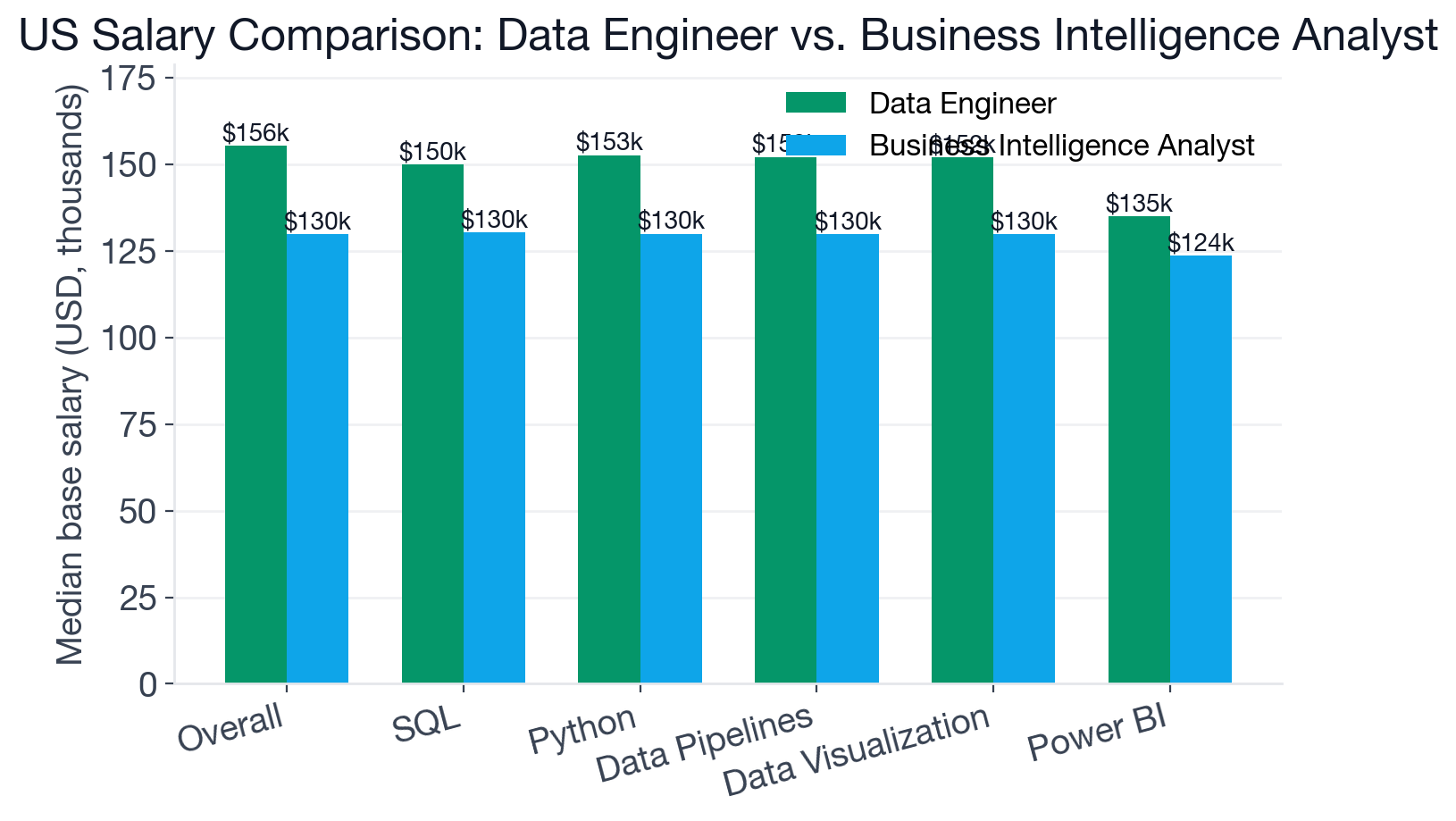
Median US base salary for Data Engineer and Business Intelligence Analyst postings, overall and for selected shared skills. Base salary only, US postings only.
The highest-paying skills in BI Analyst postings reveal where the pay ceiling lives: BigQuery ($152,500, n=25), dbt (a SQL transformation framework that runs inside the data warehouse, $149,500, n=61), Looker ($149,500, n=55), and Snowflake ($147,800, n=79) each carry premiums of $18,000 to $23,000 above the $129,800 BI Analyst baseline. Every one of them is an infrastructure-adjacent tool, closer to the Data Engineer side of the stack than the Excel-and-dashboard side. A BI Analyst who adds genuine cloud warehouse or data transformation skills can close a substantial portion of the pay gap without switching roles.
On the Data Engineer side, premium skills push well above the $155,500 median: Distributed Systems ($180,000, n=147), Observability ($172,800, n=319), dbt ($164,500, n=340), Kafka ($163,000, n=337), Apache Spark ($160,000, n=526), and Airflow ($160,000, n=417). Infrastructure depth pays more than presentation breadth across both sides of this comparison. See the full Data Engineer skills breakdown for the complete salary-by-skill picture on the DE side.
Which Has More Openings?
Data Engineer postings outnumber Business Intelligence Analyst postings 3.6 to 1: 8,774 vs. 2,440 active listings. That volume gap matters for job search strategy. There are roughly 3.6 times as many positions to apply for in the DE market.
The seniority picture differs in two important ways. Business Intelligence Analyst has a higher entry-level share: 5.9% of BI Analyst postings are explicitly entry-level vs. 2.6% for Data Engineer. Both roles are dominated by mid-level work (64% for BI Analyst, 54% for Data Engineer), but the BI path is roughly twice as accessible at the starting level. At the upper end, Data Engineering skews harder toward staff and above (14% staff/lead/principal vs. 9% for BI Analyst), which means the long-term IC ceiling is higher on the DE track.
For remote work, Data Engineers have a modest advantage: 21% of DE postings are tagged remote vs. 15% for Business Intelligence Analysts. Both roles are predominantly onsite (50% for Data Engineer, 58% for Business Intelligence Analyst). Neither stands out for flexibility compared to software engineering or ML roles.
Geography: the US leads for both, at 32% of Data Engineer postings and 34% of Business Intelligence Analyst postings. India is a significant Data Engineer market (17%), reflecting global capability centers that build data infrastructure for US and UK clients. Business Intelligence Analyst postings have a notable Brazil presence (7.4%), reflecting strong regional demand for analytics reporting roles. Browse Data Engineer openings or Business Intelligence Analyst openings filtered to your location to see the regional picture directly.
Which Should You Choose?
Choose Data Engineer if you:
- Want to build the systems that produce data, not analyze what those systems produce
- Have or want to develop programming depth: Python for pipeline code, not just analysis scripts
- Are drawn to infrastructure concerns: reliability, scale, orchestration, observability
- Can accept a steeper entry bar (2.6% of postings are entry-level) in exchange for a 3.6x larger job market and a $25,700 salary premium
- Want the higher career ceiling: 14% of DE postings are staff/lead/principal level vs. 9% for BI Analyst
Choose Business Intelligence Analyst if you:
- Are stronger in business communication and data presentation than in software engineering
- Want more entry-level access (5.9% of postings) while building toward mid and senior roles
- Are comfortable in a dashboard-building workflow centered on Power BI, Tableau, or Looker
- Have or are building statistical reasoning skills (forecasting, trend analysis) that DE roles rarely require
- Prefer stakeholder-facing work: the "storytelling" and "stakeholder management" signals in BI Analyst postings have no counterpart in Data Engineer hiring
A BI Analyst crossing into Data Engineering has a meaningful head start: the shared SQL foundation plus Python and data quality skills covers a large portion of what DE postings require. The remaining gap is in infrastructure tools (Spark, Airflow, Kafka, CI/CD) and cloud depth. Practice data pipeline design and system design scenarios before your first DE interview to close that gap.
How to Use This in Your Job Search
For both roles, start with the shared foundation. SQL at production depth (window functions, CTEs, query tuning) is required for either path, and drilling it in realistic interview conditions matters more than reading documentation. The InterviewStack.io question bank covers SQL, data modeling, and Python topics that appear in both types of interviews.
From there the paths diverge. Data Engineer candidates should add one cloud platform and one orchestration tool to their story before applying: browse Data Engineer postings filtered to AWS to see which cloud dominates the segment you are targeting. Business Intelligence Analyst candidates should ensure their dashboard portfolio includes at least one of the dominant tools: Power BI, Tableau, or Looker. Browse Business Intelligence Analyst openings to see what the current market expects in your region.
For interview preparation, AI mock interviews let you practice role-specific scenarios: pipeline design and troubleshooting for DE candidates, dashboard requirements and business framing for BI Analyst candidates. Interactive courses cover SQL, Python, and statistics foundations applicable to both paths.
FAQ
Q. What is the salary difference between Data Engineer and Business Intelligence Analyst in 2026?
Data Engineers earn a median US base salary of $155,500 vs. $129,800 for Business Intelligence Analysts, a $25,700 (19.8%) gap. Both figures are base salary only from postings with US wage disclosure; equity and bonuses are not reflected.
Q. Do both Data Engineer and Business Intelligence Analyst roles require SQL?
Yes, and at almost exactly the same rate. SQL appears in 67.5% of Data Engineer postings and 67.5% of Business Intelligence Analyst postings across 11,214 active listings. The two roles share a SQL foundation; the divergence is in everything built on top of it.
Q. Which role is easier to break into as a beginner?
Business Intelligence Analyst has a higher entry-level share: 5.9% of BI Analyst postings are explicitly entry-level vs. 2.6% for Data Engineer. Both are predominantly mid-level roles, but BI Analyst is roughly twice as accessible at the entry tier.
Q. What skills separate Data Engineers from Business Intelligence Analysts?
Data Engineers own the infrastructure layer: Apache Spark (33%), CI/CD (30%), Airflow (25%), Kafka (19%), and cloud architecture. Business Intelligence Analysts own the presentation layer: Tableau (37%), Excel (31%), Storytelling (9%), and Forecasting (9%). The overlap is 46% by Jaccard similarity.
Q. Which role has more job openings in 2026?
Data Engineer postings outnumber Business Intelligence Analyst postings 3.6 to 1: 8,774 active Data Engineer listings vs. 2,440 Business Intelligence Analyst listings. The US is the top market for both, at 32% of Data Engineer postings and 34% of Business Intelligence Analyst postings.
Make the Call
The data frames a concrete choice: more entry points and presentation-layer work on the BI Analyst side; higher pay, more volume, and infrastructure work on the Data Engineer side. SQL ties the two roles together at the foundation. What you build on top of it is the actual decision. Browse live Data Engineer postings or Business Intelligence Analyst postings on InterviewStack.io to see what the current market is asking for.
Topics
Ready to practice?
Put what you've learned into practice with AI mock interviews and structured preparation guides.