
Equal Seats, $30K Apart
The conventional story says analyst roles vastly outnumber engineer roles, that data engineering is the rarer, harder-to-land specialty while data analysis is the accessible entry point at scale. The hiring data does not support that picture. There are 8,686 active Data Engineer postings on the InterviewStack.io job board right now versus 8,298 active Data Analyst postings, a 1.05x ratio across 16,984 listings analyzed in June 2026. The headcount is nearly identical.
What separates these two roles is not availability. It is pay and entry bar. Data Engineers earn a median $126,300 US base salary; Data Analysts earn $96,400 at the median. The $29,900 gap exists on top of a market that is, by open-seat count, essentially tied. If you are deciding between these paths, the question becomes: what is $30,000 worth in terms of skill investment and the longer runway to a first role?
| Data Engineer | Data Analyst | |
|---|---|---|
| Active postings | 8,686 | 8,298 |
| Median US base salary | $126,300 | $96,400 |
| Top skill | Data Pipelines (70%) | SQL (58%) |
| Remote share | 21% | 17% |
| Entry-level share | 3% | 8% |
| Skill overlap (Jaccard) | 50% shared |
Key Findings
- Active postings are nearly equal: 8,686 Data Engineer vs 8,298 Data Analyst (a 1.05x ratio).
- Data Engineers earn a median $126,300 US base salary versus $96,400 for Data Analysts, a $29,900 (31%) gap. Base salary only; n=1,271 DE and n=1,508 DA postings with US salary disclosed.
- Skill overlap is substantial: a Jaccard coefficient of 0.50 means half the combined top-30 skill universe is common ground; roughly two-thirds of each role's own top skills appear in the other role's list.
- SQL appears in 68.9% of Data Engineer postings and 58.4% of Data Analyst postings; Python appears in 65.4% and 41.9% respectively.
- Data Analyst entry-level share is 7.8%, nearly three times the Data Engineer figure of 2.7%.
- Data Engineers have a slightly higher remote share: 21% versus 17% for Data Analysts.
- Specialization compounds the salary gap: Dagster ($160,000), Sagemaker ($155,000), and Distributed Systems ($150,000) lead the Data Engineer premium tier.
What Each Role Actually Does
Data Analysts answer questions that business stakeholders are asking. They build dashboards, run queries against the warehouse, and translate numbers into findings: which campaign converted, why churn spiked, how revenue trended last quarter. The output is a chart, a slide, or a recommendation. The audience is someone who does not write SQL themselves.
Data Engineers build the infrastructure those analysts depend on. They design and run the pipelines that move raw event data from production systems into the warehouse, model how it is stored, and keep the whole system running reliably on a schedule. When an analyst's dashboard breaks, a Data Engineer's pipeline is usually the root cause. The output is not a presentation; it is infrastructure.
Generative AI is explicitly required in 3.4% of Data Analyst postings and sits below the top-30 threshold for Data Engineers (fewer than ~12% of postings, based on where the top-30 cutoff falls). Both numbers measure roles hired specifically to build or productionize AI systems. The ambient picture is broader: the Stack Overflow Developer Survey and similar reports consistently show that a large majority of data practitioners now use AI-assisted coding and query tools as part of their daily workflow. Employers write job descriptions for owned responsibilities, not for tooling like Copilot or AI-assisted SQL generation that practitioners in both roles already use as a productivity baseline.
What Skills Do Both Roles Share?
SQL and Python anchor both roles, though at different depths. SQL appears in 68.9% of Data Engineer postings and 58.4% of Data Analyst postings. Python appears in 65.4% and 41.9% respectively. Both are non-negotiable table stakes on either side.
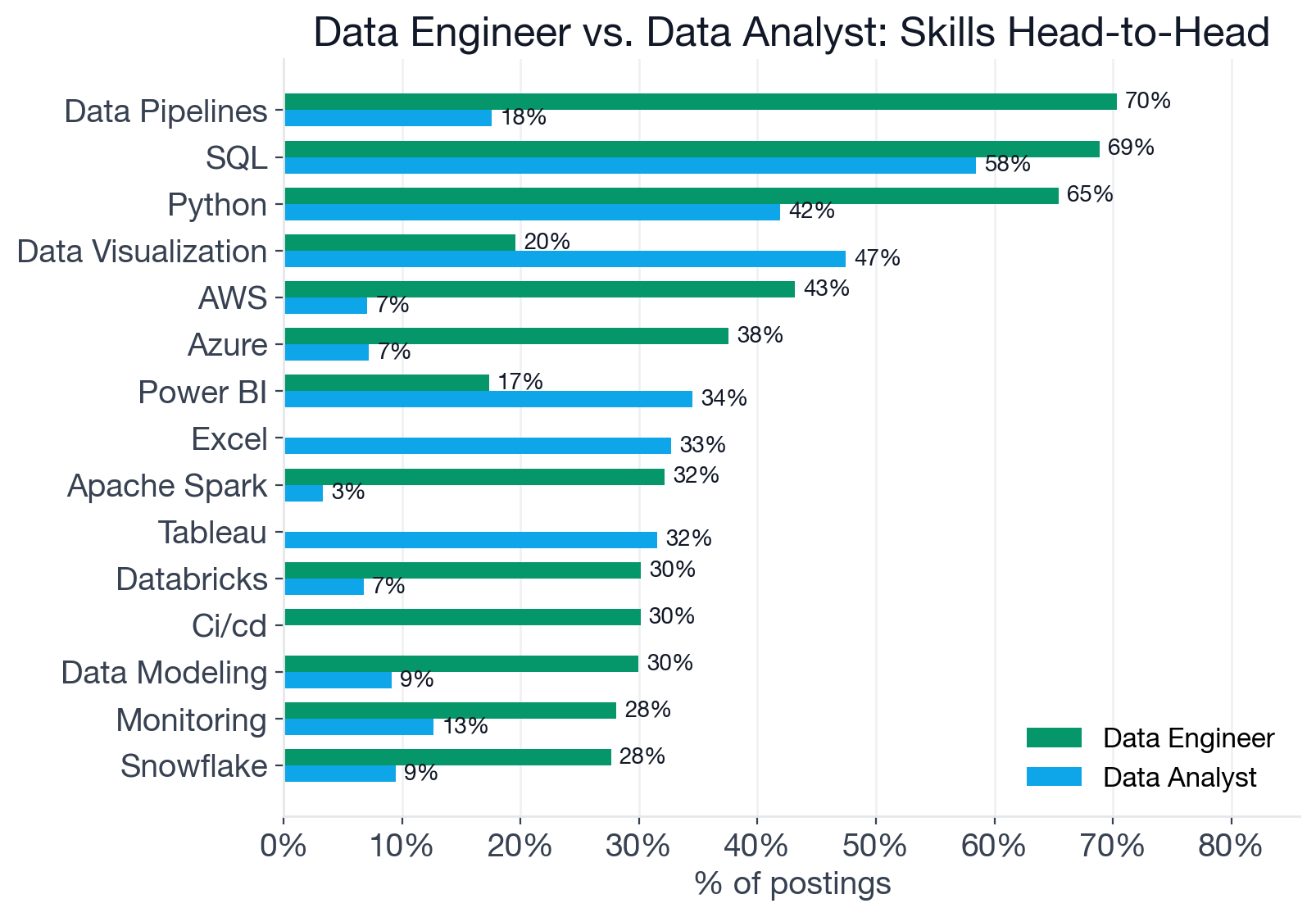
Top skills ranked by combined posting frequency. Emerald bars show Data Engineer; blue bars show Data Analyst. SQL and Python heights are close; the splits below them tell the real story.
The shared zone extends further than SQL and Python alone. Automation appears in 23.6% of DE and 19.6% of DA postings. Monitoring shows up in 28.1% and 12.7%. Snowflake appears in 27.6% and 9.4%. Databricks in 30.2% and 6.7%. The Jaccard overlap coefficient of 0.50 is meaningful for career switchers: a Data Analyst with Python, Snowflake, and dbt experience is not rebuilding a skill set from zero when moving toward engineering. Roughly two-thirds of each role's top skills appear in the other role's list, so the foundation is broader than the 50% headline number suggests.
Where the Roles Fork
The divergence is clean and structural. Engineers own the production layer; analysts own the presentation layer.
Exclusive to Data Engineer (present in DE postings but not in the top-30 for DA): Apache Spark (32%), CI/CD pipelines (30%), Airflow (the open-source pipeline scheduler) (25%), Google Cloud (24%), Kafka (18%), scalability (17%), data warehouse (17%), PySpark (15%), and APIs (14%). Every item on this list is either a distributed computing framework, a pipeline orchestrator, or a cloud service. These are tools for building systems that serve data, not for interpreting what those systems produce.
Exclusive to Data Analyst (present in DA postings but not in the top-30 for DE): Excel (33%), Tableau (32%), Statistics (23%), and Looker (11%). Tableau and Excel are presentation-layer tools that place the analyst close to stakeholders and reporting. Statistics shows up here because analysts routinely own experiment design, A/B testing interpretation, and significance testing. Engineers are rarely expected to run a hypothesis test.
For someone planning a transition: if you know SQL and Python well, the path from analyst to engineer runs through cloud infrastructure and orchestration (AWS, Airflow, Spark). The path from engineer to analyst runs through BI tooling and applied statistics (Tableau, Power BI, statistical reasoning). Both are learnable; both are specific enough to target.
Which Pays More, and Why?
Among US postings where wage transparency laws produce consistent salary disclosure, the median Data Engineer base is $126,300 (n=1,271). The comparable Data Analyst figure is $96,400 (n=1,508). These are base salaries only; equity and bonus are not disclosed in job postings and are not reflected here.
Data note: A title-level review of the Data Analyst dataset found a minority of adjacent-role postings (actuarial analysts, business analysts, and analytics leads) captured alongside standard Data Analyst titles. These likely represent under 10–15% of the 8,298 postings and are not expected to substantially alter the skill frequencies or salary median reported here, but the $96,400 figure is best read as the market rate for analytical-role professionals broadly rather than exclusively for the narrow "Data Analyst" title.
The gap grows as Data Engineers specialize into infrastructure and orchestration tools. Dagster (a modern pipeline orchestration framework increasingly adopted in cloud-native data platforms) leads the premium tier, followed by Sagemaker (Amazon's managed ML service, n=27) and Distributed Systems:
| Skill | DE Median (US) | Premium vs $126,300 Baseline |
|---|---|---|
| Dagster | $160,000 | +$33,700 |
| Sagemaker | $155,000 | +$28,700 |
| Distributed Systems | $150,000 | +$23,700 |
| Observability | $146,400 | +$20,100 |
| dbt | $140,000 | +$13,700 |
| Airflow | $135,000 | +$8,700 |
| Apache Spark | $130,000 | +$3,700 |
On the analyst side, the highest-paying specializations are engineering-adjacent. LLMs push the DA median to $124,000 (n=35); Airflow reaches $123,100 (n=35); and dbt (a SQL transformation framework that runs inside the data warehouse) lifts it to $117,000 (n=114). The pattern is consistent across both roles: pay follows infrastructure proximity and complexity.
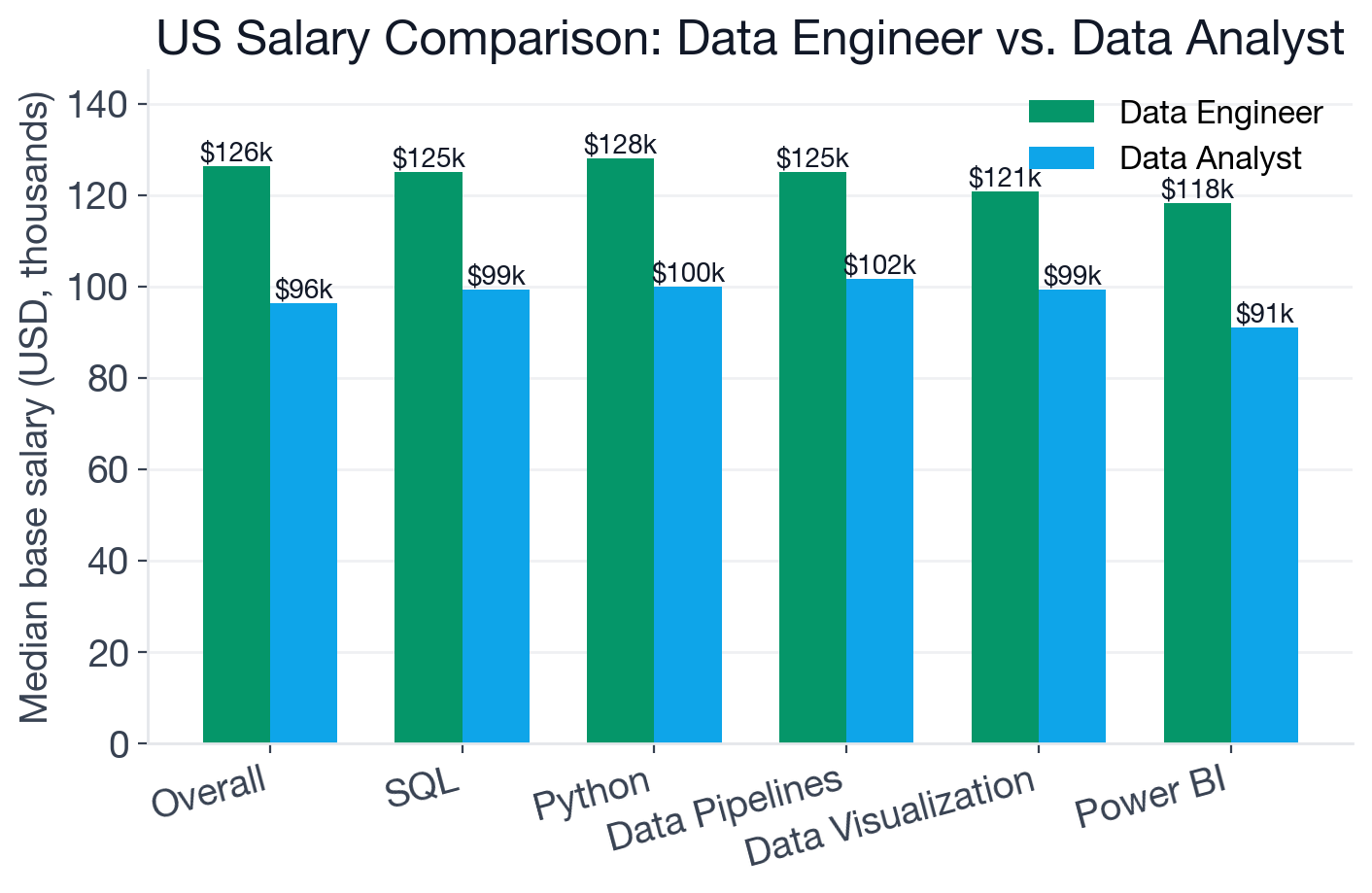
Median US base salaries. Requires n≥25 US postings with disclosed salary. Equity and bonus excluded.
Which Is Easier to Break Into?
Data Analyst is meaningfully more accessible at the entry level. About 7.8% of Data Analyst postings are explicitly entry-level, roughly 1 in 13 openings. The comparable Data Engineer figure is 2.7%, roughly 1 in 37. For a career changer or bootcamp graduate, that difference is concrete: the analyst path offers a surface area nearly three times larger for landing a first role.
Mid-level roles dominate both: 60.5% of DA postings and 53.7% of DE postings sit at mid-level. Senior and staff combined account for about 32% of DA and 44% of DE, which means both roles skew toward experienced candidates. Neither is especially welcoming to fresh graduates by raw volume.
Geography notes: the US accounts for 36.6% of Data Analyst postings and 29.4% of Data Engineer postings. India is a much larger share of the DE market (17.5%) than the DA market (9.4%), reflecting the globally distributed nature of engineering hiring. Remote share is modest for both: 21% DE and 17% DA. In practice, both roles skew onsite or hybrid.
Which Should You Choose?
Choose Data Engineer if:
- You want to own infrastructure. Designing and maintaining the pipelines that power data products is the core job, not a side task.
- You are building toward cloud and systems fluency. AWS, Spark, Airflow, and CI/CD pipelines appear in 25-43% of postings and are assumed at mid-level and above.
- You are optimizing for the salary ceiling. The $29,900 median premium compounds as you specialize into orchestration, observability, and distributed systems.
- You can afford a longer runway to a first role. At 2.7% entry-level share, most openings expect prior production pipeline experience.
Choose Data Analyst if:
- You want to influence decisions directly. Analysts hand recommendations to stakeholders, not infrastructure to engineers.
- You are transitioning from a non-technical or semi-technical background. SQL, Excel, Tableau, and foundational statistics is a faster skill set to build than cloud infrastructure.
- You need a faster path to a first job. At 7.8% entry-level share, the market is about three times more accessible than Data Engineering.
- You are comfortable with a lower starting salary in exchange for a larger initial opportunity pool and a path that can converge on engineering later.
How to Use This in Your Job Search
Once your path is clear, the work is targeted practice. AI mock interviews let you rehearse the domain-specific questions each role demands: pipeline architecture, SQL query design, and cloud infrastructure for Data Engineers; exploratory analysis, A/B testing, and stakeholder communication for Data Analysts. The question bank lets you drill specific weak spots such as data modeling, Spark internals, or Tableau best practices without repeating ground you already know. If either path reveals a foundations gap, interactive courses covering SQL, statistics, and Python can close it efficiently. See current openings for both roles on the Data Engineer board and the Data Analyst board, with filters for seniority and remote share to narrow the field.
FAQ
Q. How much more do Data Engineers earn than Data Analysts in 2026?
The median US base salary for Data Engineer postings is $126,300, versus $96,400 for Data Analyst, a $29,900 (31%) premium. These figures cover base salary only; equity and bonus are not disclosed in job postings and are not included.
Q. Which role is easier to break into without experience?
Data Analyst is significantly more accessible. About 7.8% of Data Analyst postings are explicitly entry-level (roughly 1 in 13 openings), versus just 2.7% for Data Engineer (about 1 in 37). Career changers who want the fastest path into data work typically start on the analyst side.
Q. Do Data Engineers and Data Analysts share the same core skills?
Yes. The two roles share a Jaccard overlap coefficient of 0.50, meaning half the combined skill surface of both roles' top-30 lists is common ground, with roughly two-thirds of each role's own top skills appearing in the other's list. SQL and Python appear in the majority of postings for both roles. The split happens at the tooling layer: engineers lean on pipelines, orchestration, and cloud infrastructure; analysts lean on visualization tools like Tableau, Power BI, and Excel.
Q. Which role has more job openings in 2026?
The market is nearly equal: 8,686 active Data Engineer postings versus 8,298 Data Analyst postings (a 1.05x ratio). The conventional wisdom that analyst jobs vastly outnumber engineer jobs is not supported by current active posting volumes.
Q. Is Data Engineer or Data Analyst more remote-friendly?
Data Engineer edges ahead on remote share: 21% of postings are tagged remote versus 17% for Data Analyst. Both roles are predominantly onsite or hybrid in practice (40% onsite for Data Engineer, 46% for Data Analyst).
Q. What skills are exclusive to Data Engineers versus Data Analysts?
Data Engineers rely heavily on infrastructure and orchestration tools not found in analyst postings: Apache Spark (32%), CI/CD (30%), Airflow (25%), Google Cloud (24%), and Kafka (18%). Data Analysts use visualization and analysis tools that rarely appear in engineer postings: Excel (33%), Tableau (32%), Statistics (23%), and Looker (11%).
Where to Start
These two roles are more complementary than they are competing career tracks. A Data Engineer who understands what analysts actually need builds better pipelines; a Data Analyst who learns engineering fundamentals opens the door to a higher-paying tier with roughly the same number of available seats. The $29,900 premium is real, and so is the 3x entry-level access advantage on the analyst side. Both are knowable inputs to a career decision, not just impressions. Browse live Data Engineer openings and Data Analyst openings to see where the active hiring sits right now.
Topics
Ready to practice?
Put what you've learned into practice with AI mock interviews and structured preparation guides.