
The Data Engineer Workflow Orchestration and Scheduling Interview Rewards Cadence Judgment
You're 90 seconds into a mid-level Data Engineer interview on workflow orchestration and scheduling, and the interviewer has just described three upstream systems with three completely different rhythms: one lands hourly, one every 15 minutes, one once a night from a vendor you don't control. Most candidates hear "DAG" and reach for one schedule to cover all three. That single move, treating every input as if it arrives on the same clock, is where a chunk of the score quietly disappears before the first follow-up question even lands.
This walkthrough uses the real blueprint InterviewStack.io's AI interviewer runs for this exact role, topic, and level (see our Data Engineer question bank for more like it), so every mistake and every fix below traces to an actual rubric line, not a guess about what "good" looks like.
Key Findings
- The rubric is 100 points: 30 for Interviewer Objectives Alignment, 30 for Level-Specific Expectations, 20 for Technical Proficiency, 20 for Communication and Problem Solving.
- The interview runs 30 minutes across 3 phases: framing and DAG design (0-10 min), reliability and failure handling (10-20 min), backfills and observability (20-30 min).
- The scenario has 3 upstreams on 3 different cadences: hourly, every 15 minutes, and once nightly from an external vendor.
- The business SLA is a hard 8:00 AM deadline; the follow-up stress-tests it with a vendor delay that pushes delivery to 9:30 AM, 90 minutes past deadline.
- Phase 1 alone carries 4 checklist items, and one of them specifically penalizes treating all upstream inputs identically.
- Phase 2 carries 5 checklist items spanning retries, idempotency, late-data handling, validation, and alerting.
- Phase 3 carries 4 checklist items on backfills, concurrency, run metadata, and articulating at least one real trade-off.
The interview question
You are supporting the data platform for a large consumer product. Every day, multiple upstream systems produce data needed for business-critical analytics by 8:00 AM local time.
Upstreams: 1. app_events landed hourly in object storage 2. orders replicated from OLTP into the warehouse every 15 minutes 3. user_profile snapshots delivered once nightly by an external vendorBusiness requirement:
- A daily "marketplace_health" dataset must be ready by 8:00 AM for dashboards and downstream jobs.
- If upstream data is late or partially missing, the workflow should behave predictably and operators should know what happened.
- The platform uses an Airflow-style DAG scheduler.
Assume you are responsible for orchestrating this workflow end to end. How would you design the workflow and its operational behavior so this dataset is produced reliably each day?
The interviewer isn't grading whether you know Airflow's syntax. They're checking whether you can turn three upstreams with three different reliability profiles into one coherent design that hits an 8:00 AM SLA, stays safe to retry when something breaks, and leaves on-call with a fighting chance instead of a mystery.
Watching the Interview Unfold
We picked the four follow-up prompts from the real blueprint that expose the most instructive mistakes: the scheduling decision, the late-vendor stress test, the retry-safety probe, and the observability ask. A common answer at each turn below is Ben's, a stand-in for the mid-level candidates who show up prepared on paper and still lose points live.
Turn 1: Cron for everything
Interviewer: "How would you decide between time-based scheduling and waiting on upstream data availability for different parts of this workflow?"
Turn 2: Wait and hope
Interviewer: "Suppose the external user_profile delivery is delayed until 9:30 AM on some days. How would your DAG behave, and what alerts or fallbacks would you put in place?"
Turn 3: Retry and pray
Interviewer: "If a task fails after partially writing data, how would you make retries and reruns safe?"
Turn 4: The default dashboard
Interviewer: "What metadata, logging, or run-level status would you want so an on-call engineer can quickly debug a missed SLA?"
Reading This Isn't the Same as Doing It
Spotting Ben's mistakes on the page is easy: the mismatch is right there in black and white, with the fix printed two lines below it. Spotting the same mistake in your own answer, live, thirty seconds after you've already said it, under a ticking clock and an interviewer asking an unscripted follow-up, is a completely different skill. This scenario still has a backfill question and a duplicate-record question we didn't even dramatize here. That's the gap reps close and reading alone can't.
The Blueprint a Strong Mid-Level Candidate Hits
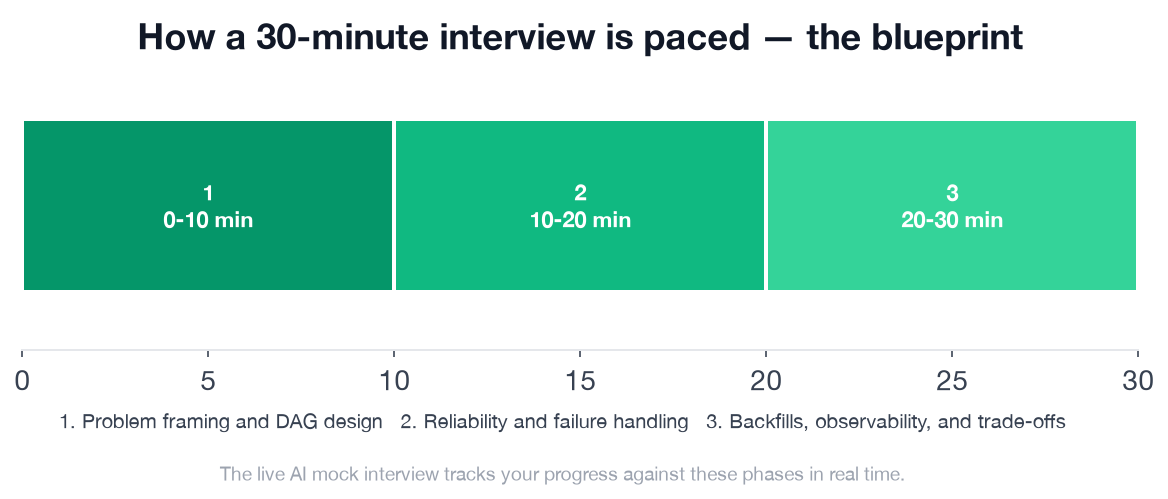 This is the pacing a strong candidate follows: roughly a third of the time on framing, a third on reliability, a third on backfills and trade-offs, not front-loaded technical detail with no time left for operations.
- ✓Clarifies at least one important assumption such as data freshness expectations, partitioning by date, or whether partial output is allowed
- ✓Outlines a DAG with explicit stages such as readiness checks, ingestion/validation, transformations, and publish/finalize
- ✓Connects upstream cadence differences to orchestration choices rather than treating all inputs identically
- ✓Acknowledges the 8:00 AM delivery target and designs around it
- ✓Describes retry behavior with sensible limits, timeouts, or escalation paths
- ✓Explains how task outputs are made idempotent, such as partition overwrite, staging plus atomic publish, or merge semantics
- ✓Defines what happens when an upstream is late or unavailable, including fail-fast, wait-until-cutoff, or produce-degraded-output behavior
- ✓Mentions validation or completeness checks before publishing final data
- ✓Includes operator-facing alerts or status signals tied to SLA or task failure
- ✓Describes a safe backfill approach that respects partitioning/date parameters and avoids clobbering current runs
- ✓Identifies concurrency or resource concerns when replaying many historical runs
- ✓Mentions run-level metadata, logs, lineage, or dashboarding useful for debugging missed SLAs
- ✓Articulates at least one trade-off, such as simpler schedule-driven DAGs versus more reliable event/data-aware triggering
This is the exact structure InterviewStack.io's AI interviewer tracks you against in real time. It doesn't wait until the end to tell you how you did; it knows which checklist item you just satisfied, or missed, the moment you say it.
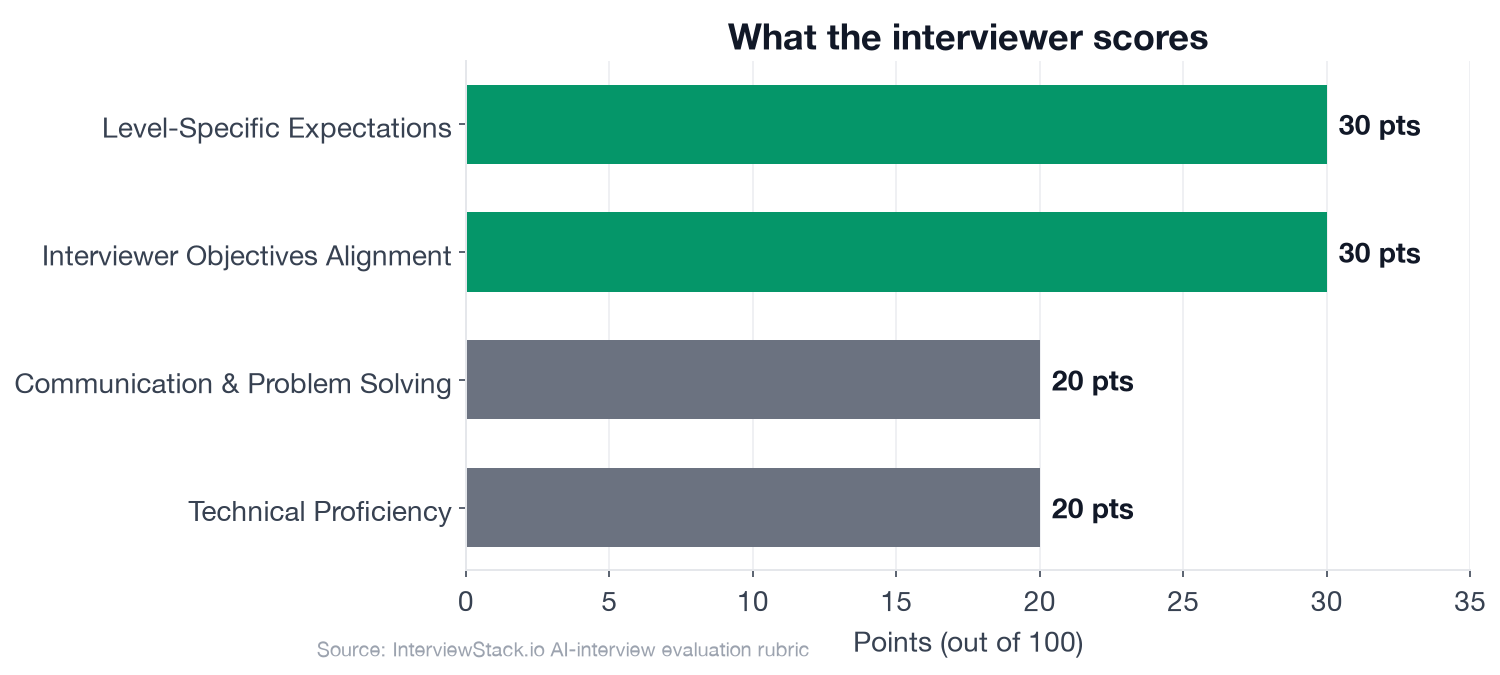 Level-Specific Expectations and Interviewer Objectives Alignment carry 60 of the 100 points between them, so a design-level miss like treating every upstream identically costs the most up front. But the rubric doesn't stop punishing shallow answers once framing is over: the idempotency gap above costs Technical Proficiency points, and skipping debug metadata costs Level-Specific Expectations points again, proof that depth is graded in every phase, not just the first ten minutes.
Practice This Live Before It Costs You Points
Every mistake above reads as obvious once it's labeled. It won't feel obvious when you're the one talking, the interviewer just asked an unscripted follow-up, and the clock is running. The only way to close that gap is to run this scenario live and get the correction in the moment, not after the fact.
Start the AI mock interview on this exact Data Engineer workflow orchestration and scheduling scenario and get scored against this rubric in real time. If you want to drill the underlying concepts first, work through the workflow orchestration and scheduling question bank, or browse open Data Engineer roles to see what these interviews are actually screening for.
FAQ
Q. What does a Data Engineer workflow orchestration interview actually test?
It tests whether you can turn upstream data with different reliability profiles into a coherent DAG that hits a stated SLA, stays safe to retry, and gives on-call engineers a way to debug a missed deadline. The rubric weighs interviewer objectives and level-appropriate depth (60 of 100 points) over technical accuracy and communication (40 points), and it keeps scoring across all three phases, not just the opening design.
Q. How is this mock interview scored?
On a 100-point rubric: 30 points for Interviewer Objectives Alignment, 30 for Level-Specific Expectations, 20 for Technical Proficiency, and 20 for Communication and Problem Solving. The interview runs 30 minutes across three phases: framing and DAG design (0-10 min), reliability and failure handling (10-20 min), and backfills and observability (20-30 min).
Q. What's the most common mistake candidates make in this scenario?
Applying one schedule to every upstream. When a workflow has to reconcile an hourly feed, a 15-minute feed, and a once-nightly vendor delivery, treating all three identically instead of distinguishing time-based triggers from data-availability checks is the single biggest point loss in the first ten minutes.
Q. How should a DAG handle a late or missing upstream?
Define an explicit cutoff and a defined behavior at that cutoff: fail fast, wait until a hard deadline, or publish a degraded output with a staleness flag. What loses points is having no defined behavior at all, where the pipeline just waits indefinitely with no alert and no decision point.
Q. What makes task retries safe in a data pipeline?
Idempotent writes. A task should write to a staging location and atomically publish or overwrite a full partition, so retrying after a partial failure repeats the same deterministic work instead of risking duplicate or torn data.
Q. How do I prepare for a mid-level Data Engineer orchestration interview?
Practice narrating trade-offs out loud, not just naming tools. Naming Airflow answers almost none of the checklist; the points come from explaining retries, idempotency, late-data handling, and observability in the context of a specific SLA. Live practice under time pressure surfaces gaps that reading a walkthrough won't.
The Schedule Was Never the Hard Part
Anyone can say "use Airflow." The interview is won or lost in the decisions underneath that name: which upstream gets a sensor instead of a cron, what happens at the cutoff when the vendor is late, and whether a retry is actually safe to fire. Go run the scenario yourself and see where your own answer lands against the rubric.
Topics
Ready to practice?
Put what you've learned into practice with AI mock interviews and structured preparation guides.