
Two Roles Share Half a Stack. One Earns $43K More.
Machine Learning Engineers earn $194,300 at the US median. Data Scientists earn $151,500. That is a $42,800 gap between two roles that share exactly half their skill set: a Jaccard overlap of 0.50 across each role's top-30 skills. When two careers share that much ground, similar pay is the expected outcome. These don't follow that pattern.
The explanation lives in the half that does not overlap. Among 7,317 active Data Scientist postings and 4,718 active Machine Learning Engineer postings on InterviewStack.io as of June 2026, the data draws a clean line: Data Scientists own the analysis and insight layer; ML Engineers own the deployment and production layer. Companies pay a premium to keep models running in production under real-world load, not just to build them.
| Data Scientist | Machine Learning Engineer | |
|---|---|---|
| Median US base salary | $151,500 | $194,300 |
| Active postings | 7,317 | 4,718 |
| Skill overlap (Jaccard) | 50% shared | (pairwise) |
| Top skill | Python (63%) | Machine Learning (71%) |
| Remote share | 17% | 24% |
| Entry-level share | 6.9% | 4.6% |
Key Findings
- $42,800 salary gap: Machine Learning Engineers earn a median $194,300 US base salary versus $151,500 for Data Scientists (n=1,651 DS, n=1,249 MLE; base salary only, equity and bonus excluded).
- 50% skill overlap (Jaccard 0.50): Python and Machine Learning are near-universal in both roles; the split happens below that surface.
- SQL divides the roles: 46% of Data Scientist postings require SQL versus 17% for Machine Learning Engineers, one of the sharpest divergences across the two skill profiles (PyTorch shows an equivalent gap in the opposite direction: 13% DS vs 42% MLE).
- Production engineering is the MLE premium: CI/CD (24%), Kubernetes (19%), Docker (18%), and MLOps (27%) are exclusive or heavily skewed to ML Engineers.
- Data Scientists have 55% more job openings: 7,317 active postings versus 4,718 for MLE, a meaningful volume advantage.
- Entry-level access differs modestly: 6.9% of DS postings are explicitly entry-level versus 4.6% for MLE; neither role is easy to break into.
- MLEs work more remotely: 24% remote share versus 17% for Data Scientists.
What Do Data Scientists and Machine Learning Engineers Actually Do?
Data Scientists work on the investigation layer. They build hypotheses, query data to test them, run statistical models, and translate findings into decisions or forecasts. A typical week might involve designing an A/B test, validating its significance, prototyping a forecasting model in Python, and presenting the results to a product or business team. The outputs are notebooks, reports, slide decks, or a model handed off to engineering for production. Statistics (40% of DS postings), data visualization (29%), and SQL (46%) are all signals of this stakeholder-facing, analysis-first orientation.
Machine Learning Engineers are closer to software engineering than to research. They take models that data scientists or research teams built and make them run reliably at scale. A typical week might involve building CI/CD pipelines for model retraining, containerizing inference services with Docker and Kubernetes, debugging model drift in production, or fine-tuning a large language model for a specific downstream task. The output is a system that operates without someone watching it. Notably, "Data Science" appears as an explicit requirement in 27% of MLE postings, meaning employers expect MLEs to understand the full modeling lifecycle, not just the infrastructure side.
Which Skills Do Both Roles Share?
Both roles are grounded in Python, Machine Learning, cloud platforms, and algorithmic thinking. These show up at high frequency on both sides of the comparison.
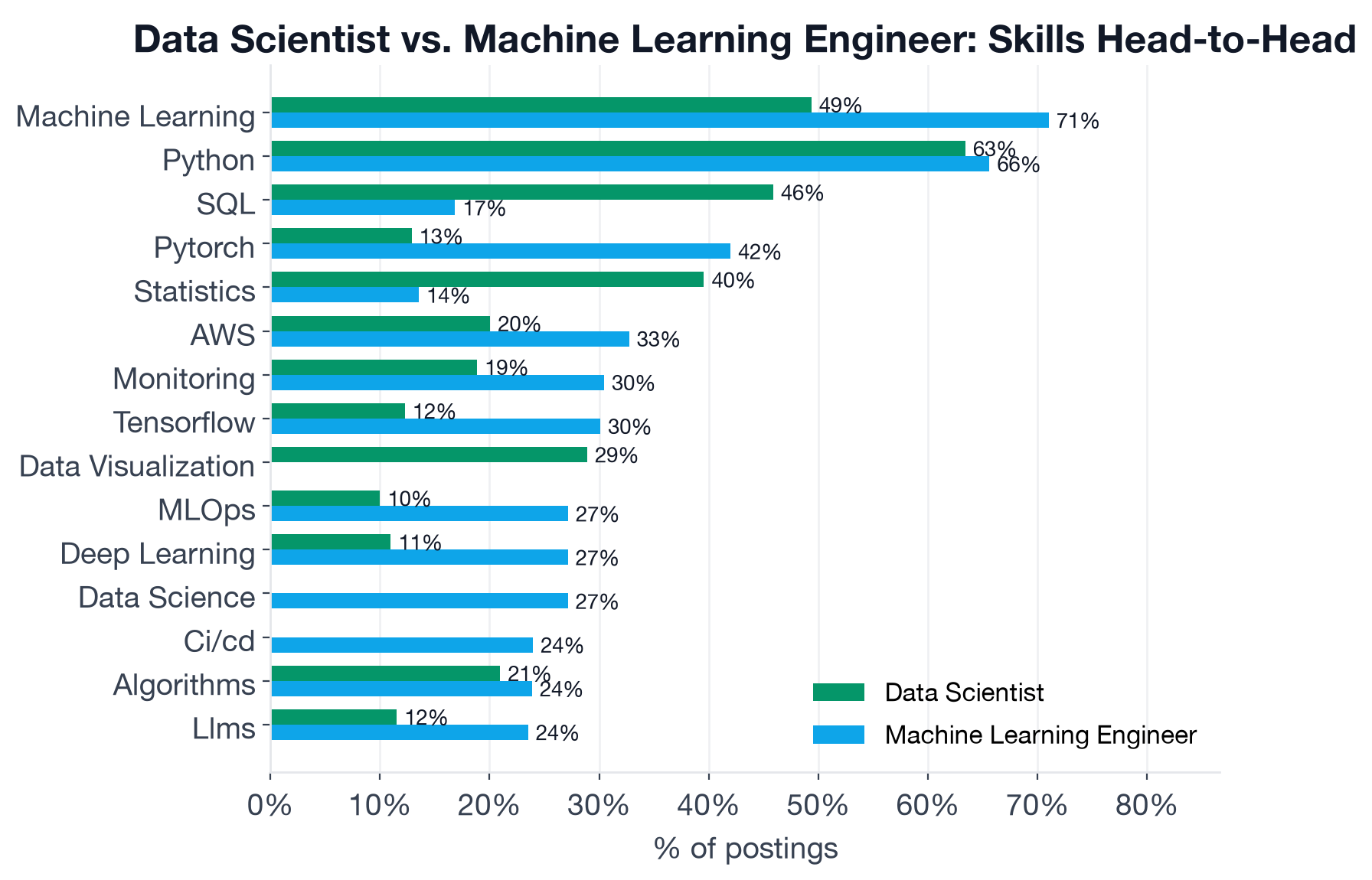
Skill frequency in Data Scientist (emerald) and Machine Learning Engineer (slate) postings. Python and Machine Learning anchor both; SQL and production-engineering tools are where the profiles diverge.
Python is essentially universal: 63% of DS postings and 66% of MLE postings list it. Machine Learning follows at 49% (DS) and 71% (MLE). AWS (20% DS, 33% MLE), monitoring (19% DS, 30% MLE), algorithms (21% DS, 24% MLE), TensorFlow (12% DS, 30% MLE), deep learning (11% DS, 27% MLE), data pipelines (20% DS, 22% MLE), and Generative AI (14% DS, 23% MLE) all clear 10% in both roles.
The 50% Jaccard is the highest overlap we have seen in the series for roles with a salary gap this large. The shared foundation is real. What you do with that Python and ML knowledge is what separates the compensation.
Where the Stack Splits
The divergence is clean at the exclusive skill level. Data Scientists lean toward analysis and communication tools; ML Engineers lean toward deployment and infrastructure.
Data Scientist exclusives (appear in DS postings; absent or below threshold in MLE):
| Skill | DS Frequency |
|---|---|
| Data Visualization | 29% |
| Data Quality | 16% |
| Power BI | 15% |
| Tableau | 14% |
| Forecasting | 11% |
| pandas | 11% |
| Excel | 10% |
Data Visualization (29%), Power BI (15%), and Tableau (14%) are presentation-layer tools that surface findings to non-technical stakeholders. Forecasting (11%) and pandas (11%) are data manipulation and prediction tools that stay inside the notebook. Statistics, shared but heavily weighted toward DS at 40% vs 14% for MLE, further signals the role's formal analytical orientation.
Machine Learning Engineer exclusives (appear in MLE postings; absent or below threshold in DS):
| Skill | MLE Frequency |
|---|---|
| CI/CD | 24% |
| Kubernetes | 19% |
| Docker | 18% |
| RAG | 16% |
| Model Training (explicit) | 16% |
| APIs | 16% |
| Scalability | 14% |
| Fine Tuning | 13% |
CI/CD, Kubernetes, and Docker are the software-engineering backbone of production ML. RAG (retrieval-augmented generation) and fine-tuning are applied GenAI engineering skills: building production AI pipelines, not experimenting in notebooks. If you want to work in roles that explicitly require MLOps and model deployment, the MLE track is the direct path.
One framing worth noting on the GenAI numbers: job postings cite AI skills when they are explicit requirements, meaning someone hired specifically to build AI systems. The figures here (23% Generative AI in MLE, 14% in DS) measure that builder layer. Both roles sit well inside the ambient layer: the Stack Overflow Developer Survey and similar developer reports consistently show the large majority of working engineers now use AI coding tools weekly, regardless of whether "AI" appears in their job title. GitHub Copilot, Claude for code, and ChatGPT are baseline tools for both roles now. The posting percentages tell you who is architecting the AI pipelines, not who is using Copilot to write code.
Which Pays More, and Why?
All salary figures below are US-only base salary from postings with disclosed compensation. Equity, bonuses, and sign-on are excluded; total compensation at top employers runs meaningfully higher than these numbers.
Machine Learning Engineers earn $194,300 at the US median versus $151,500 for Data Scientists, a $42,800 gap (28% premium). The premium reflects the engineering layer of the MLE role, visible in which skills carry the highest pay within each role.
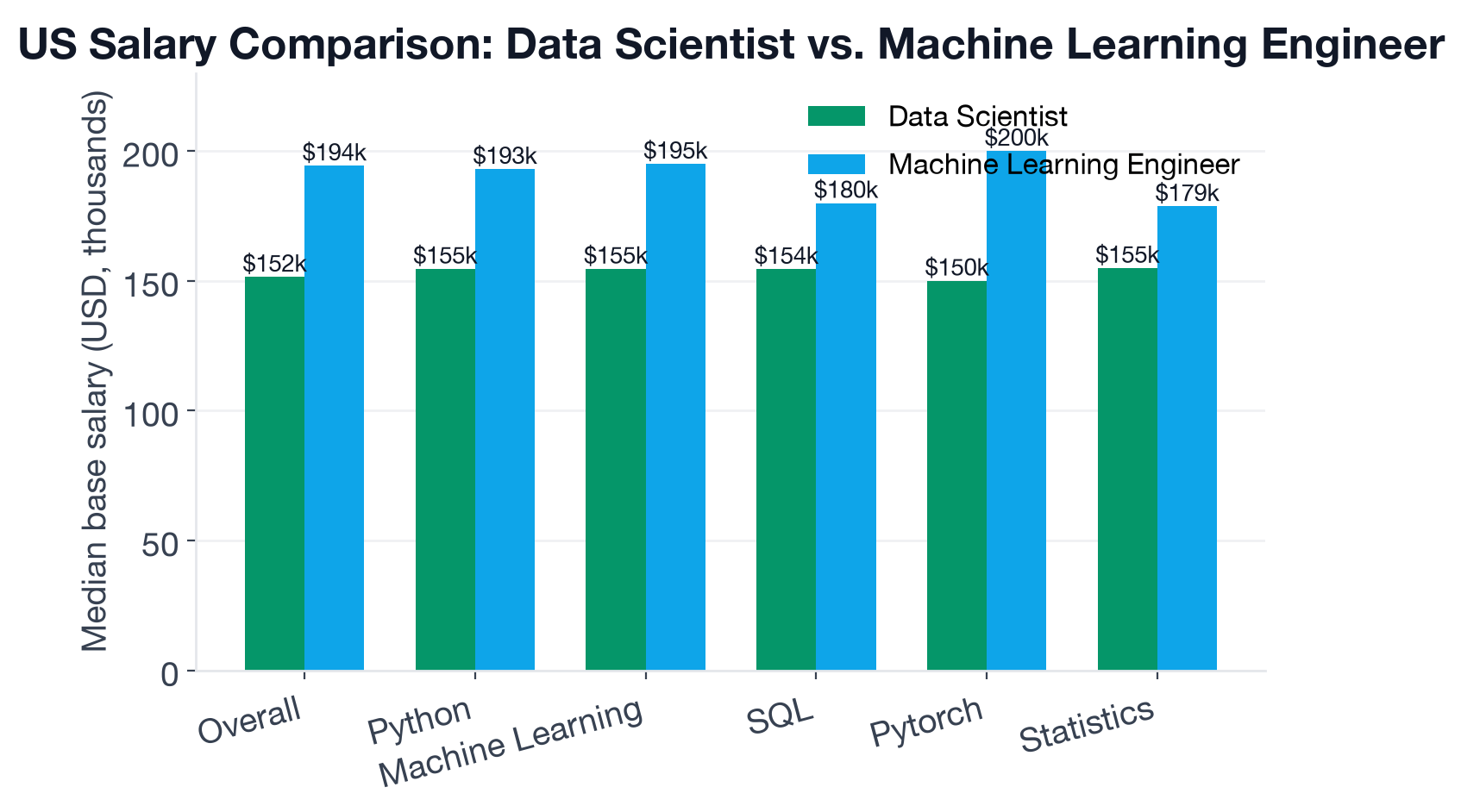
US base salary medians for both roles. MLE salaries start $42,800 higher at the baseline; the gap between roles for the same shared skill (Python: $155K DS vs $193K MLE) reflects the overall baseline difference, not a skill-specific premium.
Top-paying MLE skills (all above the $194,300 MLE baseline):
| Skill | Median US Salary | Sample Size |
|---|---|---|
| RLHF | $235,600 | 39 |
| JAX | $227,500 | 101 |
| Distributed Training | $221,300 | 94 |
| ONNX | $220,000 | 44 |
| Fine Tuning | $208,600 | 184 |
| CUDA | $208,600 | 86 |
| Reinforcement Learning | $207,500 | 149 |
| C++ | $204,500 | 224 |
RLHF (reinforcement learning from human feedback, the alignment technique behind modern LLMs) and JAX (Google's high-performance ML framework) sit well above the MLE baseline. Distributed Training, ONNX (a model portability and optimization format), and CUDA (GPU programming for neural networks) all cluster around $220K, signaling that training large models at infrastructure scale is among the highest-paid work in the field.
Top-paying DS skills (above the $151,500 DS baseline):
| Skill | Median US Salary | Sample Size |
|---|---|---|
| Causal Inference | $194,300 | 163 |
| A/B Testing | $183,000 | 349 |
| MLOps | $169,500 | 115 |
| Vector Databases | $169,100 | 38 |
| Feature Engineering | $165,300 | 140 |
| Deep Learning | $163,000 | 150 |
Causal inference is the signal skill here: a Data Scientist who masters experiment design and causal methodology reaches the MLE median ($194,300 for causal inference vs $194,300 MLE baseline). That skill set routes into product data science roles at tech companies, the highest-value DS context in the market. A/B testing at $183,000 (n=349) confirms the same pattern: experimentation fluency at scale is what the top of the DS salary distribution looks like.
Which Role Has More Open Positions?
Data Scientists: 7,317 active postings. Machine Learning Engineers: 4,718. The DS market is 55% larger by volume, a meaningful hiring pool advantage. (The Data Scientist dataset spans a broad set of data-adjacent postings, including data architects, research analysts, and academic research roles, which modestly inflates the raw DS count relative to a strictly bounded definition.)
Seniority mix is nearly parallel. DS is modestly more accessible to career switchers: 6.9% entry-level share versus 4.6% for MLE. In both cases, mid-level dominates at 55% (DS) and 52% (MLE), with senior and staff roles accounting for 38% (DS) and 43% (MLE) of the market. Neither role has a deep junior pipeline; most postings expect you to arrive with production Python and ML experience already in place.
The US anchors both markets: 38% of DS postings and 45% of MLE postings originate in the US. Data Scientist spreads more broadly internationally: India (11%), UK (5%), Germany (3%), and Singapore (3%) all have meaningful share, consistent with the role's broader industry footprint. ML Engineer is more concentrated in North America and strong in India (12%) and Canada (5%).
On remote access: ML Engineers are modestly more remote-friendly at 24% versus 17% for Data Scientists, with both roles predominantly onsite (55% DS, 54% MLE) or hybrid (32% DS, 30% MLE). Note that postings can carry multiple work-mode tags, so these figures sum above 100%.
Which Role Should You Choose?
Choose Data Scientist if you:
- Come from a statistics, economics, or quantitative research background
- Want to work directly with business stakeholders to shape decisions through data analysis and modeling
- Are more interested in developing, testing, and communicating models than in deploying infrastructure
- Need a larger job pool to get started: 7,317 active openings versus 4,718 for MLE
- Are comfortable with SQL as a core daily tool (46% of DS postings require it)
Choose Machine Learning Engineer if you:
- Have software engineering experience and are comfortable with CI/CD, containers, or distributed systems
- Want to build the production systems that serve ML predictions at scale
- Are ready to invest in MLOps, Kubernetes, and deployment tooling beyond the model itself
- Are targeting the AI/LLM infrastructure space (RAG, fine-tuning, and LLMs are MLE-skewed skills)
- Want the $42,800 salary premium that production-engineering skills command
The transition from DS to MLE is well-documented. MLOps appears in 10% of DS postings and 27% of MLE postings; building familiarity with CI/CD and containerization is the clearest signal that you are ready to cross. If you are already a DS who has deployed models to production, the gap is smaller than the salary figures imply.
Browse open Data Scientist roles or Machine Learning Engineer roles on InterviewStack.io to see exactly what today's postings are asking for, filtered to remote or hybrid if flexibility is a priority.
FAQ
Q. What is the median US salary for a Data Scientist vs Machine Learning Engineer in 2026?
Among US postings with disclosed salary, Data Scientists earn a median of $151,500 (n=1,651) and Machine Learning Engineers earn $194,300 (n=1,249), a $42,800 gap. These are base salaries only; equity and bonuses are not reflected in job-posting data.
Q. What skills do Data Scientists and Machine Learning Engineers share?
Both roles share Python (63% DS, 66% MLE), Machine Learning (49% DS, 71% MLE), AWS, monitoring, algorithms, and deep learning. The Jaccard similarity across their top-30 skill sets is 0.50; half the skills overlap, but frequency and emphasis diverge significantly.
Q. Which role is easier to break into as an entry-level candidate?
Data Scientist is modestly more accessible: 6.9% of its 7,317 postings are entry-level, versus 4.6% of Machine Learning Engineer's 4,718 postings. Neither role is easy to enter; most postings for both expect experience with ML workflows and Python.
Q. What skills does a Machine Learning Engineer need that a Data Scientist doesn't?
MLEs need production engineering skills that rarely appear in Data Scientist postings: CI/CD (24%), Kubernetes (19%), Docker (18%), RAG (16%), Model Training (16%), fine-tuning (13%), and scalability engineering. These infrastructure skills are what employers pay the $43K premium for.
Q. Is SQL important for Machine Learning Engineers?
Not by job-posting frequency. SQL appears in 46% of Data Scientist postings but only 17% of Machine Learning Engineer postings, one of the sharpest divergences across the two skill sets (PyTorch shows a near-identical gap in the opposite direction at 13% DS vs 42% MLE). MLEs work with model pipelines and production infrastructure more than relational databases.
Q. Which role has more job openings in 2026?
Data Scientist has significantly more: 7,317 active postings versus 4,718 for Machine Learning Engineer, a 1.55x volume advantage. The US accounts for 38% of Data Scientist postings and 45% of Machine Learning Engineer postings.
Q. Should I become a Data Scientist or Machine Learning Engineer?
Choose Data Scientist if you have a statistics or analytics background and want to influence business decisions through modeling and insight generation. Choose Machine Learning Engineer if you have software engineering experience and want to build the systems that deploy and maintain ML models in production. The $43K salary gap is real, but so is the engineering bar to clear it.
Before You Pick a Path
Both roles are healthy and growing. Data Science has more openings and broader global reach; ML Engineering commands a $42,800 salary premium with a tighter focus on production infrastructure. The shared Python and Machine Learning foundation means these careers are not as divergent as the salary gap implies, but the gap is real, and it sits entirely in the engineering half of the MLE stack, not the ML half that both roles already share.
To prepare for either path, the InterviewStack.io question bank covers ML fundamentals, algorithms, statistical modeling, and system design for both roles. AI mock interviews let you practice the scenario-based questions each role attracts under realistic interview pressure. And interactive courses can help you close the gap on whichever skills sit between where you are now and the role you are targeting, whether that is MLOps and distributed systems for the MLE track or causal inference and experimentation design for the DS ceiling.
Topics
Ready to practice?
Put what you've learned into practice with AI mock interviews and structured preparation guides.