
This Is Two Research Questions, Not One
You are 30 seconds into a mid-level Design Researcher interview. The interviewer hands you a scenario that sounds like a single ask: recommend whether to launch a redesigned mobile onboarding flow in six weeks. It is not a single ask. Buried in the prompt is a metric that already broke before either concept existed, and a candidate who treats this as one research question instead of two loses points before the first follow-up lands.
This walkthrough is built on the real blueprint the InterviewStack.io AI interviewer uses to grade this exact scenario at the mid-level (2-5 years) bar. We will show you the question, the traps a prepared candidate still falls into, and the corrected move at each step.
Key Findings
- The rubric splits 100 points across four dimensions: Interviewer Objectives Alignment (30), Level-Specific Expectations (30), Technical Proficiency (20), Communication and Problem Solving (20).
- Phase 1, problem framing, runs only 0 to 7 minutes but already carries 4 graded checklist items.
- Phase 2, methodology selection, spans 7 to 20 minutes (13 minutes) and packs 5 checklist items on sampling, instrumentation, and study design.
- Phase 3, tradeoffs and communication, runs 20 to 30 minutes and grades whether you can call evidence "decision-grade" or "directional" and mean it.
- The scenario's core number, new-user day-1 activation, dropped from 62% to 55% over two quarters, and every proposed method has to trace back to it.
- A follow-up question collapses the 6-week research timeline to 2 weeks mid-interview, testing whether your plan survives a real budget cut.
- Level-Specific Expectations alone is worth 30 of the 100 points, the same weight as satisfying the interviewer's explicit objectives.
The interview question
You are supporting a product team for a large consumer video platform. The team wants to redesign the mobile onboarding and recommendation setup for new users because early signals suggest too many people abandon before they start watching. The PM wants a recommendation on whether to launch a redesigned onboarding flow in 6 weeks, and the designer already has 2 competing concepts mocked up. New-user day-1 activation, defined as completing onboarding and watching at least 10 minutes of video in the first session, has dropped from 62% to 55% over the last 2 quarters. The team can recruit some new users, but access is limited and international recruiting will be difficult in this timeline. Existing event instrumentation covers the funnel steps, but the team is not fully confident in the quality of all onboarding events, and engineering can support light instrumentation changes but not a major logging overhaul before the launch decision.
How would you design a research plan to help this team decide whether and how to move forward with the onboarding redesign?
What Does a Design Researcher Research Methodology Selection and Tradeoffs Interview Actually Test?
The interviewer's objective, in plain terms, is to see whether you can pick and defend a methodology, or a mix of methods, that matches an actual business decision under real time, access, and stakeholder constraints. That means distinguishing generative goals from evaluative ones, scoping a minimal viable research design, reasoning about sampling and recruitment, naming threats to validity, and communicating what is and is not proven to a PM, designer, data scientist, and engineer at the same time.
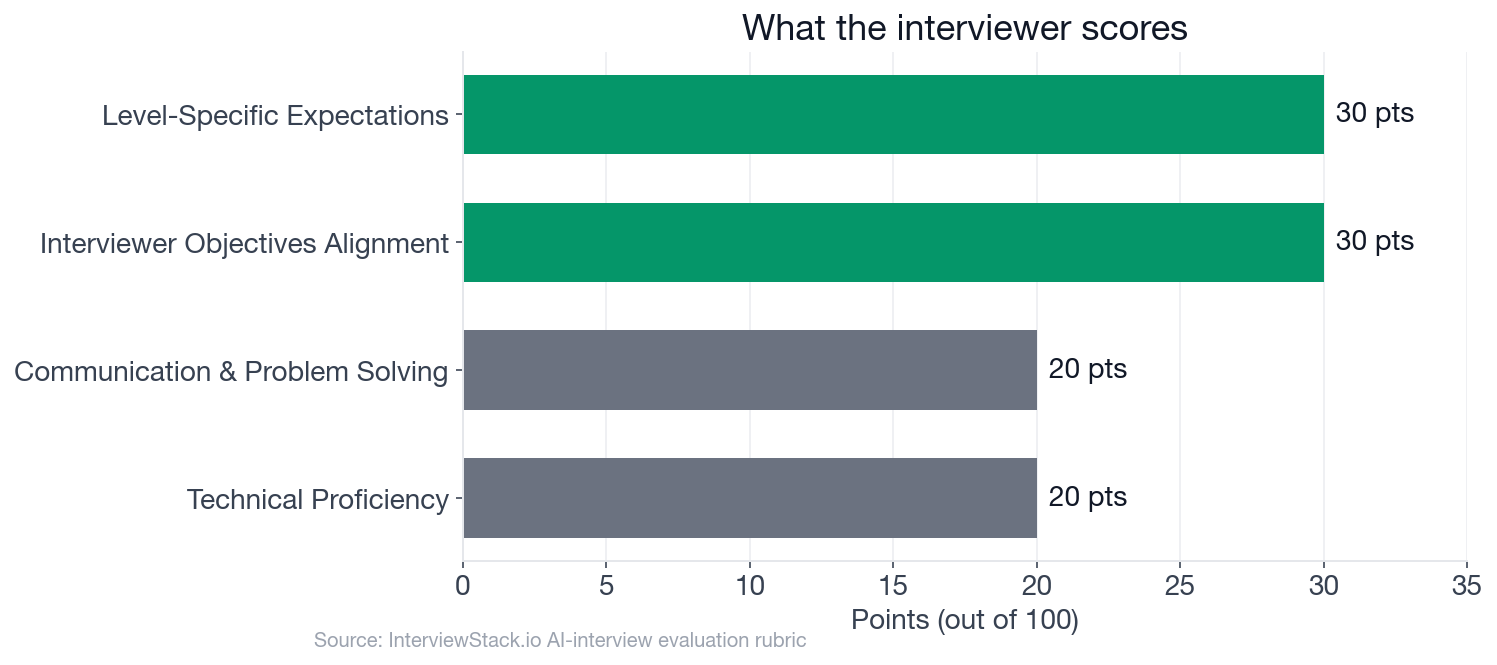 Interviewer Objectives Alignment and Level-Specific Expectations carry 60 of the 100 points between them, so a technically fluent answer that never lands on a launch-ready recommendation still scores poorly.
Four Moments That Decide the Score
Turn 1: One Question or Two
Interviewer: "How would you determine whether this is primarily a generative problem, an evaluative problem, or both, and how would that change your plan?"
Turn 2: The Numbers You Do Not Trust Yet
Interviewer: "Given that event quality is uncertain, how would you use or validate the existing analytics before relying on them?"
Turn 3: Recruiting Users Who Do Not Represent Everyone
Interviewer: "How would you think about sampling and recruitment if the users you can recruit are not perfectly representative of the platform's broader new-user population?"
Turn 4: The Prove-It Trap
Interviewer: "If the PM asks whether you can prove one concept will improve activation before launch, how would you respond and what evidence would you propose instead?"
Spotting This on the Page Is the Easy Part
Reading Elena's mistakes above and immediately seeing the fix is not the same skill as catching yourself doing it live. Under interview time pressure, with a follow-up question you did not prepare for, the generative-versus-evaluative split and the prove-it trap are much easier to miss than they look in writing. The interviewer will not pause to let you reconsider, and the checklist keeps advancing whether or not you caught the distinction. That gap between recognizing a mistake on the page and avoiding it live only closes with reps under real time pressure, which is exactly what a live AI mock interview is built to force.
What Does a Strong 30-Minute Design Researcher Interview Look Like?
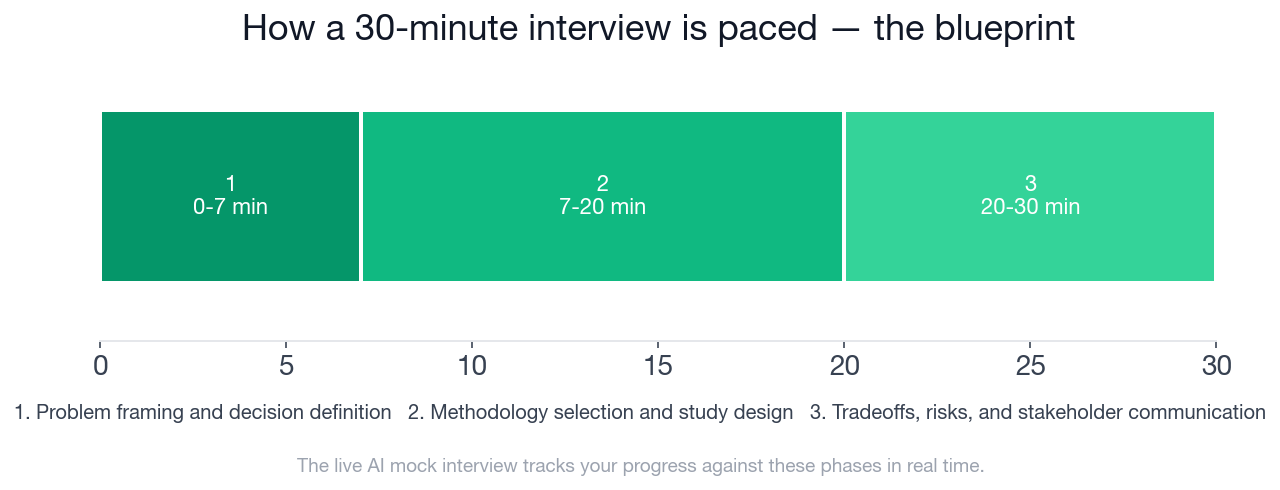 Seven minutes to frame the decision, thirteen to design the study, ten to defend it, the pacing itself is part of what gets graded.
Below is the exact blueprint the AI interviewer tracks against in real time, the same one behind every turn above.
- ✓Clarifies the decision question, such as launch readiness, concept selection, or root-cause diagnosis
- ✓Distinguishes between understanding why activation dropped and evaluating which design is better
- ✓References timeline, recruiting limits, instrumentation uncertainty, and stakeholder confidence needs as design constraints
- ✓Defines what evidence would be sufficient for a 6-week product decision
- ✓Proposes a realistic plan such as validating the funnel analytics, conducting focused usability tests on the two concepts, and possibly adding lightweight survey or behavioral measures
- ✓Explains why chosen methods fit the stage of the problem better than alternatives like ethnography or a full controlled experiment before launch
- ✓Defines target participants and a reasonable sampling approach, including likely proxies or segmentation choices for new users
- ✓Notes the need to pilot tasks, scripts, and event tracking assumptions before full execution
- ✓Specifies what outputs each method would produce and how those outputs inform the launch recommendation
- ✓Identifies key threats such as untrustworthy events, recruitment bias, concept fidelity effects, moderator bias, and mismatch between test behavior and real activation
- ✓Proposes concrete mitigations such as triangulation, event QA on critical funnel steps, clear limitation statements, or a staged recommendation
- ✓Communicates what can be concluded confidently versus what remains directional or uncertain
- ✓Handles follow-up constraint changes pragmatically, for example by simplifying the design for a 2-week timeline without losing the core decision utility
Practice This Before the Real Interview
The gap between reading Elena's mistakes and not making them yourself closes with practice, not more reading. Start a live AI mock interview on this exact topic and get scored against this same blueprint in real time, with follow-up questions that adapt to what you actually say. If you want to drill the underlying concepts first, generative-versus-evaluative framing, sampling proxies, validity threats, before taking the full simulation, the Research Methodology Selection and Tradeoffs question bank breaks the topic into individual practice questions.
FAQ
Q. What does a Design Researcher interview on research methodology selection actually test?
It tests whether you can pick and defend a research plan, qualitative, quantitative, or mixed, that fits an actual product decision under real constraints, rather than reciting method definitions. The rubric weights Interviewer Objectives Alignment and Level-Specific Expectations at 30 points each, so the plan has to tie directly to the launch recommendation, not just demonstrate that you know what a usability test is.
Q. How do you know if a research question is generative or evaluative?
Ask whether you are trying to discover why something is happening (generative: interviews, diary studies, exploratory analytics) or measure which known option performs better (evaluative: usability tests, surveys, experiments). Many real product questions are actually both, and naming that split early is one of four checklist items graded in the interview's first 7 minutes.
Q. Can qualitative research alone prove a redesign will improve activation?
No. Qualitative and lightweight quantitative research before launch can reduce risk and build directional confidence, but only a controlled post-launch comparison, such as a staged rollout or holdout test, produces causal, decision-grade proof. The interview's final phase specifically grades whether you can say this to a stakeholder instead of overpromising certainty.
Q. What happens if the research timeline gets cut mid-interview?
The interviewer is testing whether your plan degrades gracefully under a real constraint change. A strong answer keeps the decision question intact and cuts scope, fewer sessions, a narrower comparison, rather than abandoning rigor altogether.
Q. How should uncertain analytics event quality affect a research plan?
Treat funnel numbers as a hypothesis until validated, not as ground truth. A pragmatic first step is a small event-quality check, a handful of manually tracked sessions compared against the logged funnel, before building a multi-week plan on numbers that might be wrong.
Q. What does decision-grade versus directional evidence mean?
Decision-grade evidence is strong and specific enough to defend a launch call on its own, typically from a controlled comparison. Directional evidence points toward a likely answer but carries real uncertainty, such as findings from a handful of usability sessions. Naming which kind you are delivering, and when, is graded in the interview's stakeholder-communication phase.
Q. How is this AI mock interview scored?
Across four dimensions worth 100 points total: Interviewer Objectives Alignment (30), Level-Specific Expectations (30), Technical Proficiency (20), and Communication and Problem Solving (20), tracked in real time against a phased blueprint like the one in this post.
The Proof Comes After the Plan
Every mistake above comes from the same instinct: trying to make the research plan do more certainty than a six-week window allows. The candidates who score well are not the ones with the fanciest methods vocabulary, they are the ones who know exactly what a given method can and cannot promise, and say so plainly to a PM who wants an answer. That instinct is trainable, and the fastest way to build it is live, under a clock, against follow-ups you did not see coming.
Topics
Ready to practice?
Put what you've learned into practice with AI mock interviews and structured preparation guides.