
The Design Researcher Title Is Splitting in Two
Two postings on the InterviewStack.io job board, both titled "Design Researcher," can sit $60,000 apart in pay and share almost no skill requirements. One asks for Usability Testing, Product Strategy, and User Experience, and pays a median $147,300. The other asks for Instructional Design and eLearning, and pays a median $86,700. Same title, same board, two different jobs.
We looked at every active Design Researcher posting on the board as of July 2026, 448 listings, with skills extracted and normalized the same way the live filter works. The split shows up everywhere in the data: in the skill list, in the salary table, and in which companies post under the title. It isn't noise to explain away. Instructional design and eLearning work (course design, curriculum, workplace training) get filed under "Design Researcher" right alongside genuine UX and product research work, and companies use the label interchangeably. If you apply to "Design Researcher" postings without checking which track a given listing belongs to, you're applying blind.
Key Findings
- No individual skill clears 50% of postings. Instructional Design tops the list at 42.6% (191 of 448), meaning even the single most common "Design Researcher" skill misses the majority of postings carrying the title.
- The median US base salary across all postings is $122,000 (n=113), but Usability Testing postings pay $147,300 while Instructional Design postings pay $86,700, a $60,600 gap.
- Explicit AI/ML skill mentions sit at 13-15% (Generative AI 15.4%, Machine Learning 15.0%, LLMs 13.2%), differentiator-tier, not table stakes, and cluster with the UX/research skills, not the learning-design ones.
- Only 4.0% of postings (18 of 448) are explicitly entry-level; 62.3% are mid-level and 30.4% are senior.
- The US is the largest single market at 43.1% of postings, well ahead of India (6.0%) and Canada (4.5%).
- Onsite still leads work mode at 49.8%, with remote (30.8%) edging out hybrid (27.9%).
- One employer, INFUSE, posted 58 "Design Researcher" listings (13.0% of the dataset), but its business (B2B demand-generation marketing) and the near-identical count of postings mentioning "Demand Generation" as a skill (60) point to a labeling artifact, not real design-research hiring volume; we've excluded it from the employer ranking below.
Which Design Researcher Track Actually Pays More?
Salary figures below are restricted to US postings, where wage-transparency laws produce consistent disclosure, and reflect base salary only. Equity, bonus, and sign-on aren't captured in posting data, so total compensation at top employers runs higher than what's reported here.
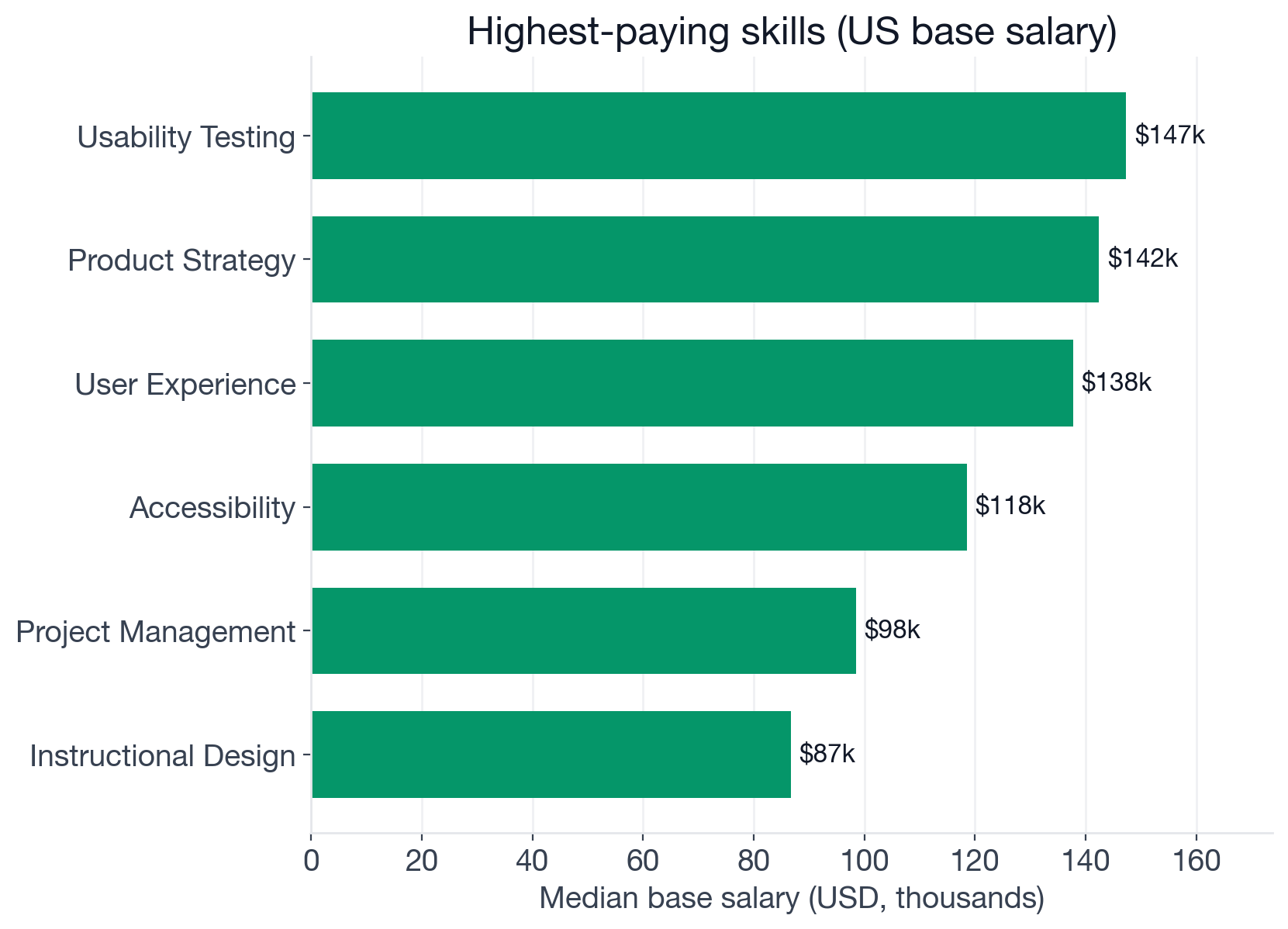
Median US base salary by skill among Design Researcher postings with structured salary data. The overall US median across all postings is $122,000 (n=113).
The single overall number hides the story. Broken out by skill:
| Skill | Median US base salary | Sample size | vs. $122,000 baseline |
|---|---|---|---|
| Usability Testing | $147,300 | 26 | +$25,300 |
| Product Strategy | $142,400 | 54 | +$20,400 |
| User Experience | $137,700 | 32 | +$15,700 |
| Accessibility | $118,500 | 27 | -$3,500 |
| Project Management | $98,500 | 26 | -$23,500 |
| Instructional Design | $86,700 | 42 | -$35,300 |
Instructional Design is the single most-mentioned skill on the entire board (42.6% of postings) and the lowest-paid one in this table, a $60,600 gap from Usability Testing at the top. Demand and pay are running in opposite directions: the skill that shows up in the most postings is the one attached to the smallest paycheck.
That's the clearest signal of the two-track split. Track one looks like a product-org job: evaluating user behavior, running usability studies, feeding findings into product strategy, sitting next to a PM and a UX designer. Track two looks like an L&D job: building training curricula, eLearning modules, and workplace learning programs, sitting next to a curriculum lead. Both get called "Design Researcher." Only one of them pays like a product researcher. We flagged this same blend in our Product Manager vs. Design Researcher comparison: the "Design Researcher" figure there was explicitly a blend across UX Researchers and Instructional Designers, and this analysis shows exactly where that blend splits.
What Skill Families Show Up in Design Researcher Postings?
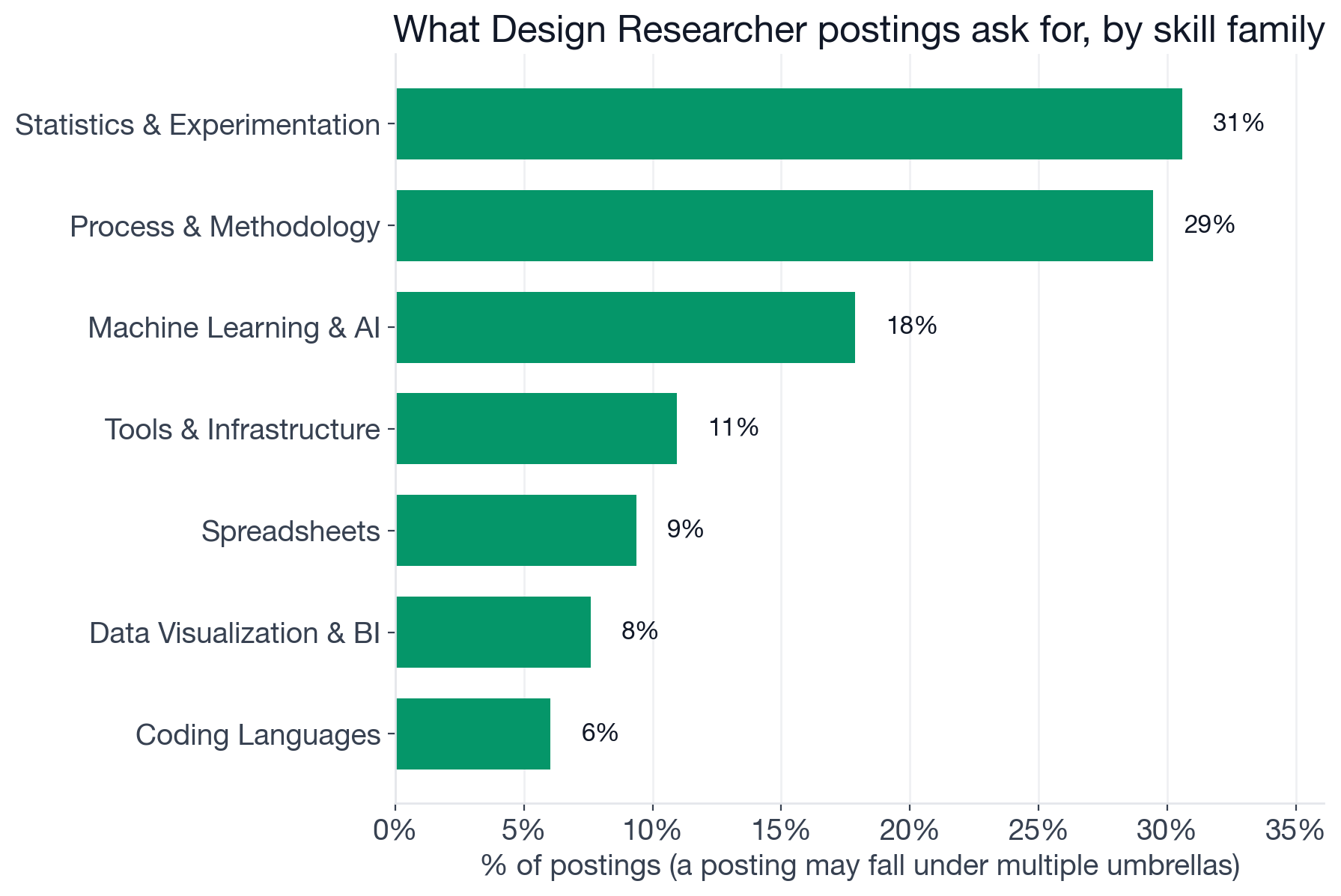
Share of Design Researcher postings that ask for at least one skill in each family, excluding the catch-all "Other" bucket where most of this role's actual skills land.
Notice what's near zero: Querying & SQL (1.3%), Cloud Platforms (1.1%), Modern Data Stack (0.4%), Data Engineering Foundations (0.2%). This is not a technical or infrastructure role, and the umbrella taxonomy built for data and engineering titles barely applies to it. Statistics & Experimentation (30.6%, driven almost entirely by A/B Testing at 24.8%) is the strongest quantitative signal and belongs squarely to the UX/product-research track. Process & Methodology (29.5%, Project Management 17.0% plus Agile 13.4%) shows up across both tracks; every research role, whichever flavor, has to manage a project. Machine Learning & AI (17.9%) is discussed in more detail below.
The Common Tier Is Where the Two Tracks Collide
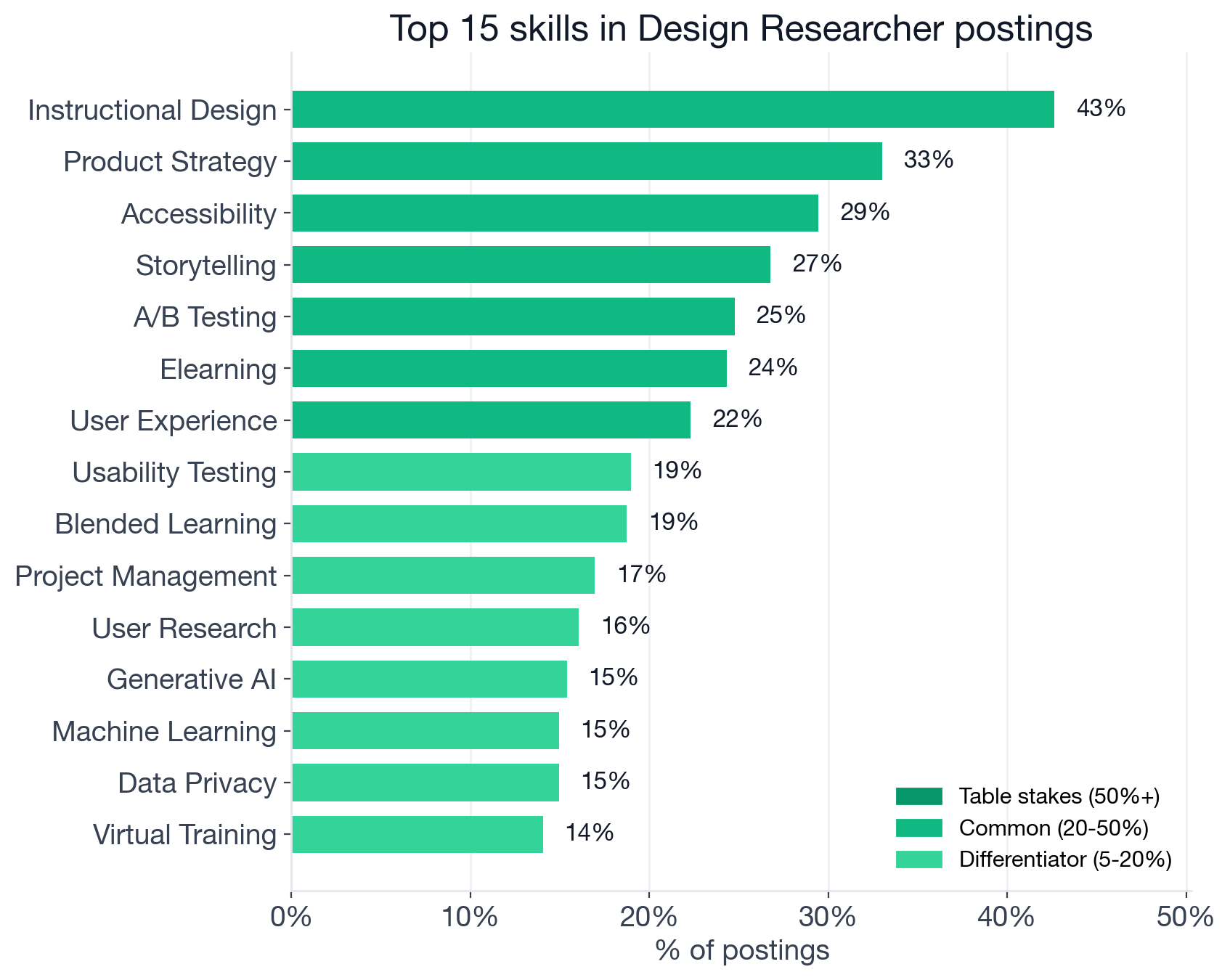
Top individual skills by share of postings that mention them. Skills above 50% would be table stakes; 20-50% are common; 5-20% are differentiators. No Design Researcher skill clears the table-stakes line.
Zero skills clear 50%. That absence of a table-stakes tier is itself the finding: a role with one coherent job usually has at least one skill nearly every posting requires. Design Researcher doesn't, because "nearly every posting" would have to span two different jobs.
The seven skills in the 20-50% common tier split cleanly by track:
Learning-design track: Instructional Design (42.6%), eLearning (24.3%)
UX/product-research track: Product Strategy (33.0%), Accessibility (29.5%), Storytelling (26.8%), A/B Testing (24.8%), User Experience (22.3%)
The differentiator tier (5-20%) is where the two tracks develop their own vocabulary:
| Learning-design track | % | UX/product-research track | % |
|---|---|---|---|
| Blended Learning | 18.8% | Usability Testing | 19.0% |
| Virtual Training | 14.1% | User Research | 16.1% |
| Andragogy (adult-learning theory) | 12.9% | Quantitative Research | 10.5% |
| Learning and Development | 5.1% | UX Design | 10.3% |
| Product Design | 9.8% | ||
| Interaction Design | 7.4% | ||
| Prototyping | 6.9% | ||
| Qualitative Research | 5.4% |
A handful of skills cut across both tracks rather than belonging to either: Project Management (17.0%), Generative AI (15.4%), Machine Learning (15.0%), Data Privacy (15.0%), Agile (13.4%), Figma (13.2%), LLMs (13.2%), Excel (9.2%), and Adobe Creative Suite (8.0%). Every research role, regardless of flavor, touches process, privacy, and increasingly, AI.
The Skill Pairings Confirm Two Separate Pipelines
We computed every two-skill co-occurrence among the top 25 skills to find combinations that show up together more than chance would predict (lift greater than 1 means the pair is over-represented; lift 1 is independent).
| Skill pair | % of postings | Lift |
|---|---|---|
| Blended Learning + Virtual Training | 13.6% | 5.16 |
| Data Privacy + Elearning | 13.4% | 3.68 |
| A/B Testing + Machine Learning | 13.6% | 3.67 |
| Blended Learning + Elearning | 16.1% | 3.52 |
| Elearning + Generative AI | 13.4% | 3.57 |
| A/B Testing + Generative AI | 13.4% | 3.51 |
| Generative AI + Storytelling | 13.6% | 3.30 |
| Accessibility + Data Privacy | 13.8% | 3.14 |
| Accessibility + Generative AI | 13.8% | 3.05 |
| Blended Learning + Instructional Design | 18.8% | 2.35 |
| Elearning + Instructional Design | 23.0% | 2.22 |
The learning-design track is the most tightly bound cluster in the whole dataset: Blended Learning and Virtual Training co-occur at a lift of 5.16, the highest pairing anywhere in this analysis, and Instructional Design plus eLearning (the foundational pair for that track) shows up together in 23% of all postings. These skills travel as a set; a posting that mentions one is far more likely to mention the others.
The UX/research track pairs differently, and this is where the AI story lives. A/B Testing correlates strongly with both Machine Learning (lift 3.67) and Generative AI (lift 3.51), and Generative AI correlates with Storytelling (3.30) and Accessibility (3.05). Explicit AI/ML mentions across the whole dataset sit at 13-15%, differentiator tier, not table stakes, but this pairing pattern tells you where they show up: on teams evaluating AI-powered products or AI-driven UX, quantitatively, not on teams building training content.
That explicit rate is a floor, not a ceiling. Job postings only name AI as a requirement when researchers are hired specifically to study or evaluate AI systems. They don't capture the ambient layer: AI-assisted transcription, clustering interview themes, drafting survey questions, the tooling most research teams already lean on day to day. A 2026 industry survey found 69% of user researchers already use AI in some part of their process, up roughly 19 points from the year before, concentrated almost entirely in analysis and synthesis rather than moderation or judgment calls. Worth a counterweight: design and research professionals report some of the weakest AI ROI of any knowledge-worker group surveyed (45% positive vs. 78% for founders), so read the adoption curve as real and fast-growing, but the practitioner sentiment as genuinely mixed, not a straight line to "AI replaces the researcher."
Who's Hiring, and at What Seniority Level?
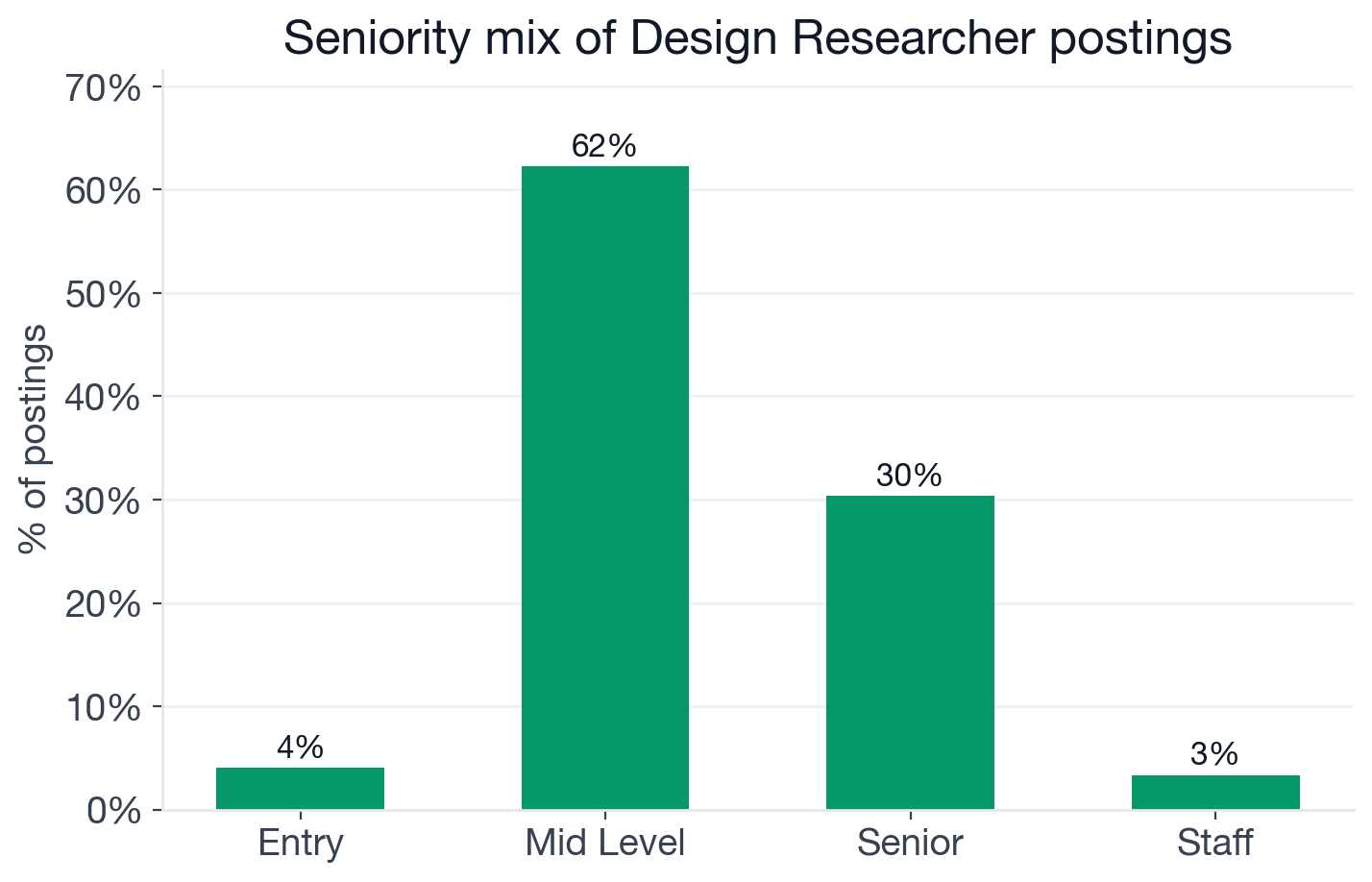
Seniority distribution across all Design Researcher postings, tagged from title keywords; postings with no explicit signal default to mid-level.
- Mid-level: 62.3% (279 postings)
- Senior: 30.4% (136) (senior Design Researcher openings)
- Entry: 4.0% (18)
- Staff: 3.3% (15)
Only 4.0% of postings are explicitly entry-level, on both tracks. Companies expect either a research portfolio (usability studies, interview transcripts, synthesized findings) or a training/curriculum portfolio already in hand. Most people land the title after a stint in an adjacent role, junior UX designer, research coordinator, or training and curriculum assistant, rather than walking directly into "Design Researcher" as a first job.
Where Are Design Researcher Jobs, and How Remote-Friendly Is the Work?
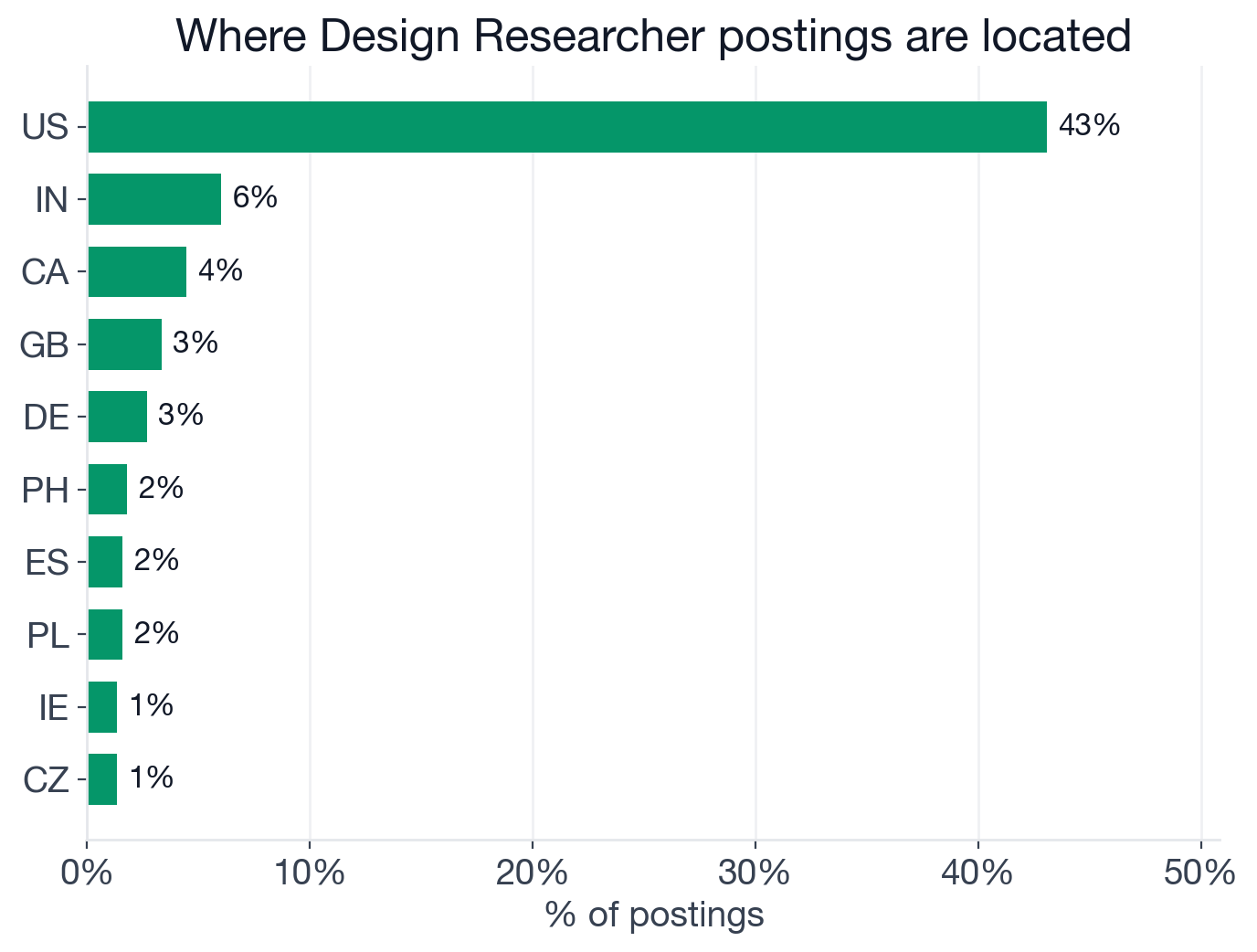
Top countries by share of Design Researcher postings.
- United States: 43.1% (US-only Design Researcher openings)
- India: 6.0%
- Canada: 4.5%
- United Kingdom: 3.3%
- Germany: 2.7%
The US concentration here (43.1%) is well above what we typically see for globally-distributed tech roles, a reflection of how much instructional-design and internal-training hiring in particular stays close to a company's US headquarters.
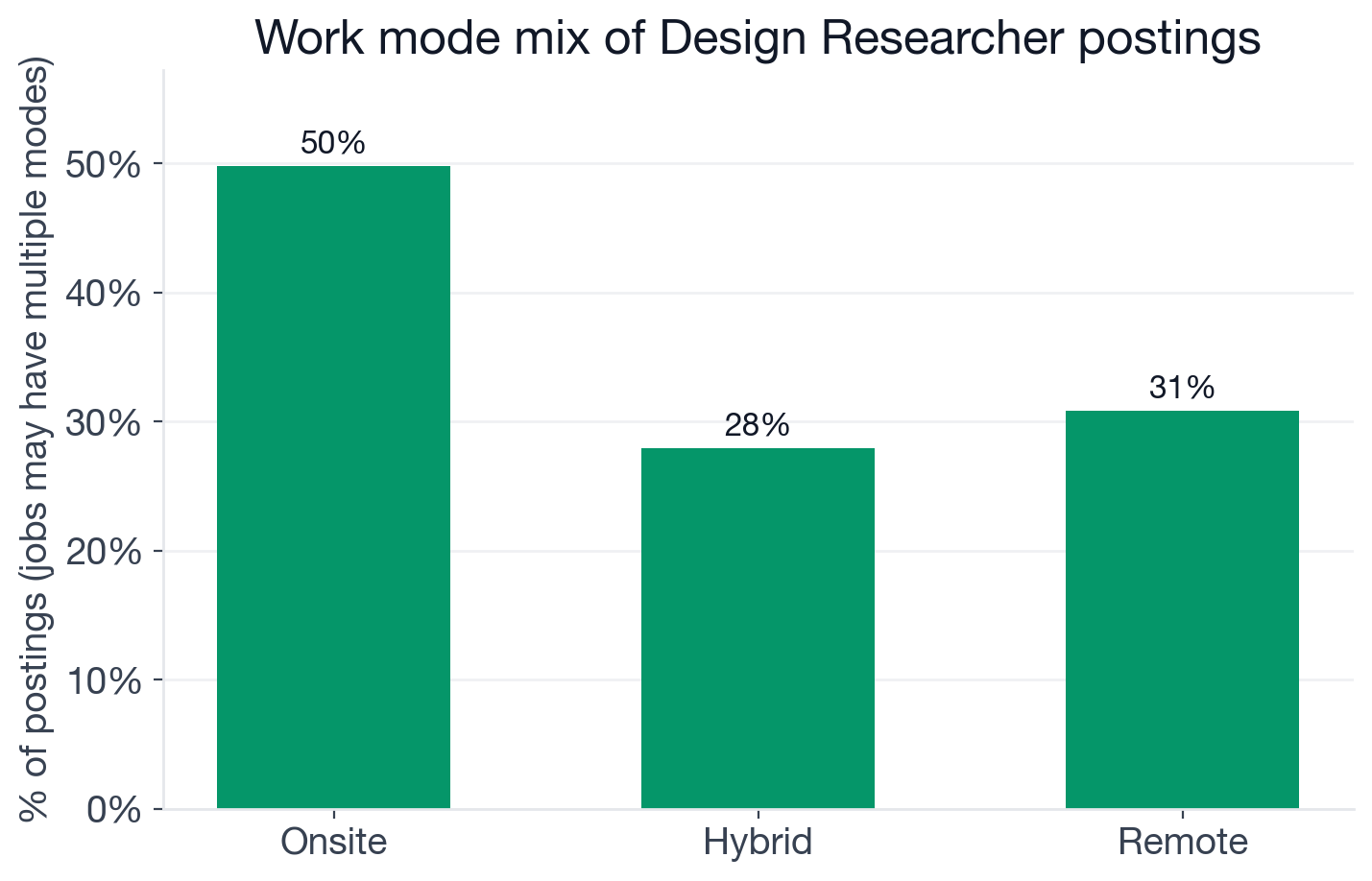
Share of Design Researcher postings tagged with each work mode. Postings can carry more than one tag (e.g., "Hybrid or Remote"), so percentages don't sum to 100%.
- Onsite: 49.8% (223 postings)
- Remote: 30.8% (138) (fully-remote Design Researcher openings)
- Hybrid: 27.9% (125)
Onsite still leads, but remote (30.8%) narrowly beats hybrid (27.9%), a mix that's friendlier to distributed work than most of the tech-adjacent roles we've analyzed on this board.
Who's Actually Hiring Design Researchers?
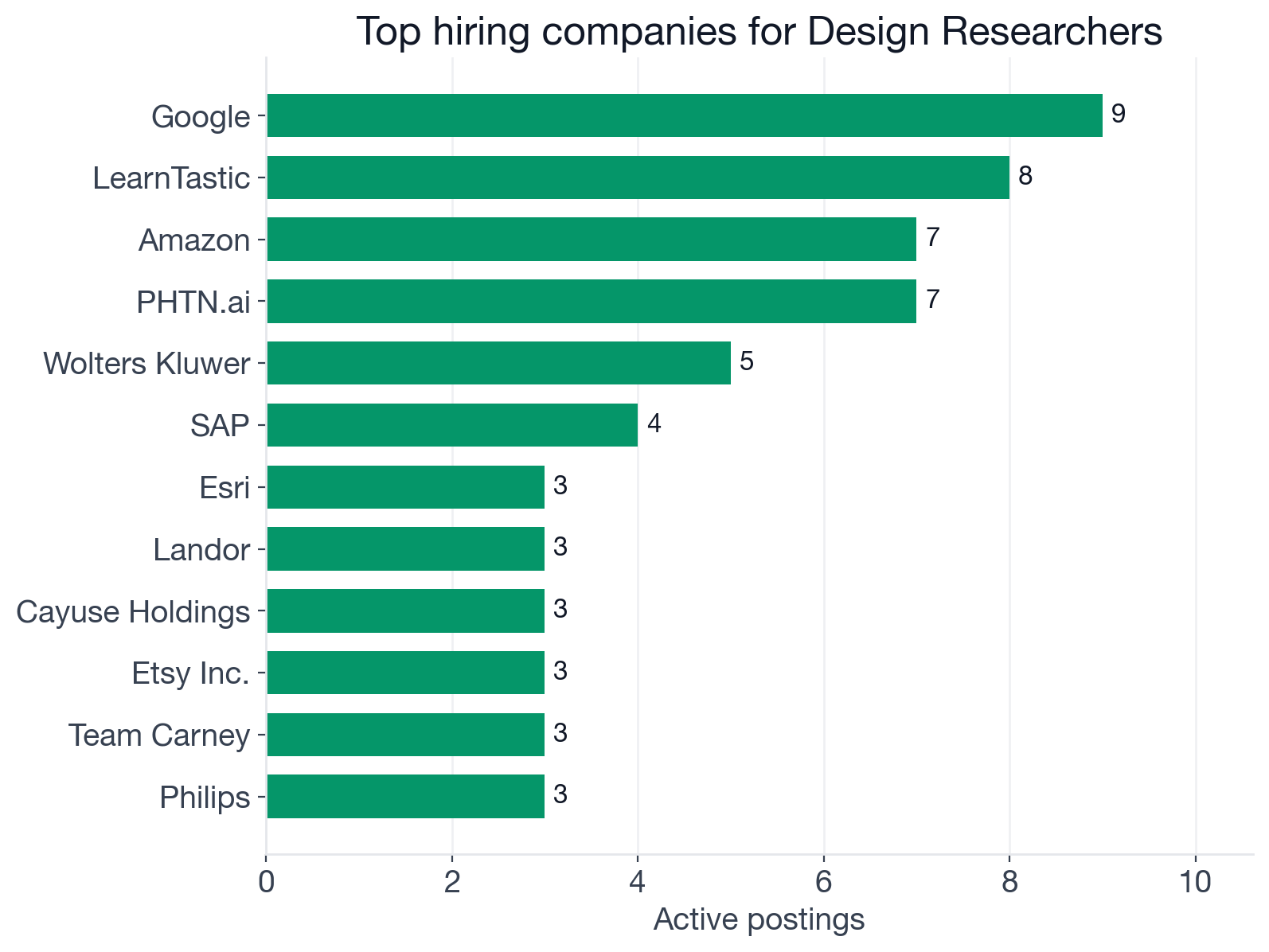
Top companies by active Design Researcher postings on the board, as of July 2026. We've excluded two entries from this ranking: The Hive Careers, a listings aggregator rather than a single in-house employer, and INFUSE, whose posting volume doesn't hold up as genuine design-research hiring (see below).
| Company | Design Researcher openings |
|---|---|
| 9 | |
| LearnTastic | 8 |
| Amazon | 7 |
| PHTN.ai | 7 |
| Wolters Kluwer | 5 |
| SAP | 4 |
| Esri | 3 |
| Landor | 3 |
| Cayuse Holdings | 3 |
| Etsy Inc. | 3 |
| Team Carney | 3 |
| Philips | 3 |
Past those exclusions, the roster splits along the same two-track line the rest of this post describes: Google, Amazon, and Etsy hire directly for product and UX research; LearnTastic, an eLearning platform, hires for the learning-design side; Wolters Kluwer (information services), SAP (enterprise software), Esri (geographic information systems), and Landor (brand strategy and design consultancy) round out a genuinely mixed employer base.
One employer is worth flagging rather than ranking: INFUSE, a B2B demand-generation marketing firm, posted 58 listings under the "Design Researcher" label, 13.0% of the entire dataset and more than six times Google's count. That volume doesn't square with what a demand-generation agency plausibly needs in design researchers, and it lines up almost exactly with a different number in this same dataset: "Demand Generation" is a top-20 skill here, appearing in 60 postings (13.4%), a skill that belongs to neither the UX/product-research track nor the learning-design track described above. That overlap points to a labeling issue, not a real hiring signal: INFUSE's postings look like marketing or growth roles that got tagged into the Design Researcher category rather than evidence that a demand-gen agency is quietly the largest employer of design researchers on the board. We've left INFUSE out of the ranked table and chart above for that reason.
How to Use This in Your Job Search
Figure out which track a posting actually belongs to before you apply. Read the skill list, not just the title. If a listing leads with Instructional Design, eLearning, Blended Learning, or Andragogy, you're looking at the learning-design track, and your portfolio should show curricula, courses, and training outcomes. If it leads with Usability Testing, User Research, Product Strategy, or Quantitative Research, you're looking at the UX/product-research track, and your portfolio needs studies, findings, and product impact.
Build toward the track that pays for what you already have. The data is unambiguous: Usability Testing, Product Strategy, and User Experience sit $15,700 to $25,300 above the $122,000 baseline, while Instructional Design sits $35,300 below it. If your background is genuinely UX/product research, don't let a "Design Researcher" posting's Instructional Design requirements pull you toward a lower-paying track by accident.
Drill the quantitative side if you're aiming for the UX/product-research track. A/B Testing shows up in a quarter of all postings and correlates strongly with both Machine Learning and Generative AI, a sign that the highest-paying corner of this role increasingly expects researchers who can evaluate AI-driven product features, not just qualitative interviews. Our interview-prep courses cover research methods and experimentation foundations, and the question bank lets you drill usability-testing and research-methodology questions specifically.
Practice explaining your track clearly. Interviewers hiring for either flavor of "Design Researcher" will probe whether you understand which job you're actually interviewing for. AI mock interviews let you rehearse that framing under realistic conditions before the real thing.
Filter the board for your track. Browse current Design Researcher openings and narrow by skill, e.g., Design Researcher + Usability Testing for the UX/product track or Design Researcher + Instructional Design for the learning-design track.
FAQ
Q. What skills do companies want for Design Researcher roles in 2026?
It depends which of the two tracks the posting belongs to. Instructional Design (42.6% of postings) and eLearning (24.3%) anchor the learning-design track; Product Strategy (33.0%), Accessibility (29.5%), Storytelling (26.8%), A/B Testing (24.8%), and User Experience (22.3%) anchor the UX/product-research track. No single skill clears the 50% table-stakes bar, which is itself a sign the title covers two distinct jobs rather than one broad one.
Q. What is the median salary for a Design Researcher in 2026?
The median US base salary across all Design Researcher postings is $122,000 (n=113). That figure hides a $60,600 gap between tracks: postings mentioning Usability Testing pay a median $147,300, while postings mentioning Instructional Design pay $86,700. Equity, bonus, and sign-on are not disclosed in postings, so total comp at top employers runs higher than these base-salary figures.
Q. Is "Design Researcher" the same job at every company?
No. Job boards, including ours, apply the label to two genuinely different specialties: UX/product design research (usability testing, user interviews, product strategy) and instructional/learning design (course design, eLearning, workplace training). Roughly 4 in 10 "Design Researcher" postings on the board are closer to an Instructional Designer role than a product researcher role, and the pay, skill requirements, and hiring companies differ sharply between the two.
Q. Do Design Researchers need AI or machine learning skills in 2026?
Explicitly, not often: Generative AI appears in 15.4% of postings, Machine Learning in 15.0%, and LLMs in 13.2%, all differentiator-tier rather than table stakes, and concentrated in the UX/product-research track rather than the learning-design one. That understates real usage. A 2026 industry survey of user researchers found 69% already use AI somewhere in their process (mostly transcription and synthesizing interview data), up sharply from the year before. Practitioner-reported ROI is more mixed than in software engineering, so treat AI adoption as real and fast-growing, not a differentiator most postings will explicitly reward.
Q. Is Design Researcher a good entry-level role to break into?
Not especially. Only 4.0% of postings (18 of 448) are explicitly entry-level, while 62.3% are mid-level and 30.4% are senior. Most Design Researchers, on either track, enter through an adjacent role (junior UX designer, research coordinator, or training and curriculum assistant) rather than directly into the title.
Q. Where are most Design Researcher jobs located, and how remote-friendly are they?
The United States accounts for 43.1% of postings, the largest single market by a wide margin, followed by India (6.0%), Canada (4.5%), the UK (3.3%), and Germany (2.7%). Onsite is the most common work mode at 49.8% of postings, with remote (30.8%) slightly ahead of hybrid (27.9%); postings can carry more than one tag.
Q. Which companies hire the most Design Researchers in 2026?
Once you set aside INFUSE, a B2B demand-generation marketing firm whose 58 postings (13.0% of the role) line up almost exactly with the dataset's unrelated "Demand Generation" skill count, a sign these are mislabeled marketing postings rather than genuine design-research hiring, the roster splits along the same two-track line as the rest of the data: Google (9), Amazon (7), and Etsy (3) hire for product and UX research, while LearnTastic (8), an eLearning platform, hires for the learning-design side. Wolters Kluwer (5), SAP (4), Esri (3), and Landor (3) round out the top employers.
Pick Your Track First
"Design Researcher" isn't one job with a wide skill spread; it's two jobs sharing a label, and the $60,600 salary gap between them is too large to ignore. Before you tailor a resume or walk into an interview, work out which track a specific posting actually wants, because the portfolio, the interview questions, and the offer will all follow from that answer, not from the title.
Topics
Ready to practice?
Put what you've learned into practice with AI mock interviews and structured preparation guides.