
The DevOps Engineer Containerization and Docker Fundamentals Interview Rewards What You Fix Unprompted
You're six minutes into a mid-level DevOps Engineer interview on containerization and Docker fundamentals, and the interviewer just handed you a Dockerfile that builds cleanly, runs locally, and looks like most teams' first attempt at containerizing a service. That's exactly the trap: nothing here throws an error. The image builds, the container starts, the API responds. A candidate who reads "it works" as "it's fine" is already behind, because the checklist for this phase is built entirely around issues that never show up in a build log.
This walkthrough runs the real blueprint InterviewStack.io's AI interviewer uses for this exact role, topic, and level (see the DevOps Engineer question bank for more on this topic), so every mistake and fix below traces to an actual rubric line, not a guess about what "good" looks like.
Key Findings
- The rubric is 100 points: 30 for Interviewer Objectives Alignment, 30 for Level-Specific Expectations, 20 for Technical Proficiency, 20 for Communication and Problem Solving.
- The interview runs 30 minutes across 4 phases: framing (0-6 min), image and runtime redesign (6-18 min), security and registry (18-27 min), wrap-up (27-30 min).
- Phase 1 expects at least 3 concrete Dockerfile issues called out unprompted in the first 6 minutes.
- Phase 2 packs 6 separate checklist items (caching, .dockerignore, base image choice, runtime config, log handling, signal handling) into 12 minutes.
- Phase 3 packs 5 checklist items (non-root execution, secrets handling, scanning, tagging, the operability tradeoff) into 9 minutes.
- The wrap-up phase is only 3 minutes, so prioritizing a small set of changes matters as much as naming them.
- Kubernetes-specific orchestration is explicitly out of scope; the entire 30 minutes stays on a single Docker host.
The interview question
An internal team runs a small Python HTTP API on a single VM, deployed with a manual script. Build times are slow, images are large, and security has flagged concerns. Before adopting any orchestrator, the team wants to standardize on Docker. This is the Dockerfile they run today.
FROM python:3.11
WORKDIR /app
COPY . /app
RUN pip install -r requirements.txt
EXPOSE 8080
CMD ["python", "app.py"]
You are joining an internal platform review for the service shown above, and the team wants a production-ready containerization approach they can run on a single-host Docker runtime over the next quarter. How would you redesign and operationalize this container setup?
The interviewer isn't checking whether you know docker build syntax. They're checking whether you can independently spot risk in someone else's Dockerfile, reason about the container runtime model (immutable image versus runtime configuration, process model, filesystem, signals), and make production-grade tradeoffs for a service other teams will depend on, all inside a strict single-host Docker scope with no orchestrator to lean on.
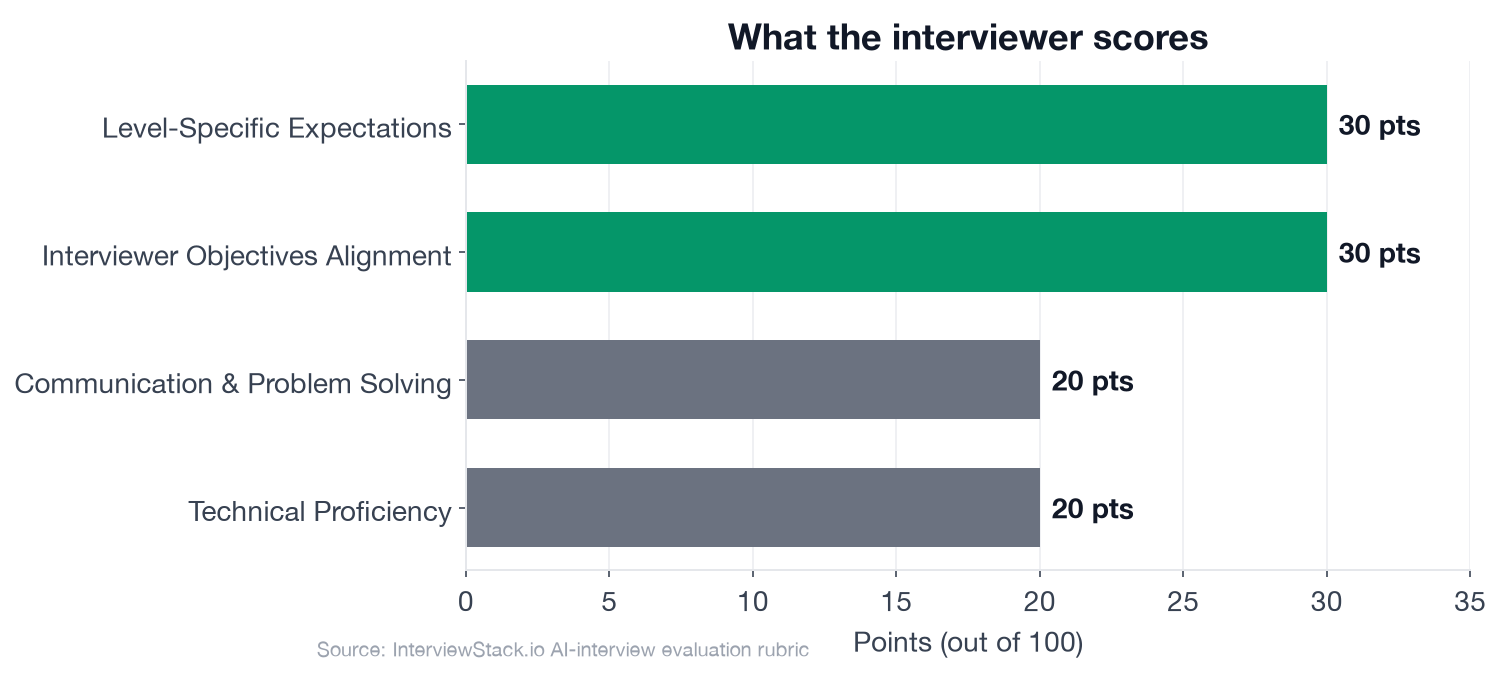 Interviewer Objectives Alignment and Level-Specific Expectations together account for 60 of the 100 points, twice what Technical Proficiency is worth on its own.
Watching the Interview Unfold
We picked four follow-up prompts from the real blueprint that expose the most instructive mistakes: the build fix, the runtime-config question, the isolation probe, and the registry ask. A common answer at each turn below belongs to Nora, a stand-in for the mid-level candidates who look prepared on paper and still lose points live.
Turn 1: Fixing the Dockerfile
Interviewer: "How would you change the Dockerfile and build process to improve rebuild speed and reduce image size, and what tradeoffs would you be making?"
Turn 2: Where config and secrets live
Interviewer: "The service needs configuration, secrets, logs, and persistent temporary uploads. How would you handle those at runtime on a single Docker host?"
Turn 3: Isolation and the supply chain
Interviewer: "If security requires stronger isolation and lower risk in the image, what concrete changes would you make to the image, runtime configuration, and dependency handling?"
Turn 4: The registry question
Interviewer: "If this image is going to be pushed to an internal registry and reused by multiple teams, what tagging, scanning, and promotion approach would you recommend?"
Spotting the Mistake on the Page Is the Easy Part
Every mistake above reads as obvious once it's labeled in a red box. Live, under a 30-minute clock, with a follow-up you didn't see coming, it's a different exercise: you have to notice the cache-busting COPY order yourself, decide where secrets go before you're asked, and keep the runtime and security answers connected instead of treating each follow-up as its own isolated question. Reading the fix is not the same skill as producing it under pressure, and that gap only closes with reps against an interviewer that actually pushes back.
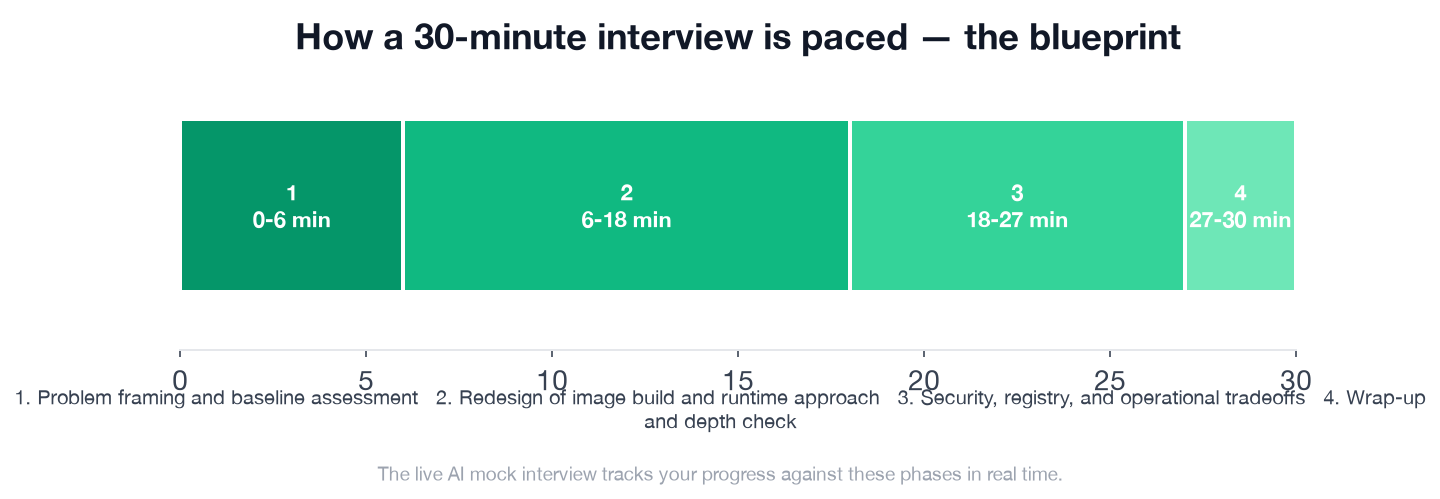 This is the pacing a strong candidate hits: roughly a fifth of the time on framing, close to half on the build and runtime redesign, a third on security and the registry, and a short, decisive wrap-up.
The Complete Blueprint
This is the exact blueprint InterviewStack.io's AI interviewer tracks a candidate against in real time, phase by phase, checklist item by checklist item.
- ✓Calls out at least 3 concrete issues in the current Dockerfile such as copying everything before dependency install, unpinned base image, running as root, no .dockerignore, large base image, or weak reproducibility
- ✓Frames the solution around image build concerns and runtime concerns rather than only one side
- ✓Clarifies or states assumptions about the app artifact, dependency management, and operational environment on a single host
- ✓Suggests a revised build flow that separates dependency installation from application copy to improve cache reuse
- ✓Mentions using .dockerignore to avoid copying unnecessary files into the build context
- ✓Makes a defensible base image recommendation such as slim image or multi-stage approach, with a reasoned tradeoff
- ✓Explains runtime config via environment variables or mounted files rather than baking secrets into the image
- ✓Explains log handling through stdout/stderr and does not rely on writing logs only inside the container filesystem
- ✓Addresses signal handling or PID 1 concerns at a practical level for graceful shutdown
- ✓Recommends running as a non-root user or otherwise reducing privileges
- ✓Avoids putting secrets in the image and names at least one safe alternative
- ✓Mentions scanning or validation of base images and dependencies before promotion
- ✓Proposes a tagging strategy beyond latest, such as immutable version or commit-based tags
- ✓Discusses the tension between minimal images and on-call/debug needs with a realistic mitigation
- ✓Summarizes the top implementation steps in a sensible order
- ✓Prioritizes a small number of high-value changes for the next quarter
- ✓Keeps recommendations within Docker fundamentals and single-host constraints
Run This Interview Yourself
Reading four turns is not the same as holding your own answer together across all four phases while an interviewer decides what to ask next. Start the AI mock interview scoped to this exact role, level, and topic, and it will score you against the same rubric and phase timing shown above. If you want to warm up on individual questions first, the Containerization and Docker Fundamentals question bank breaks the topic into focused drills, and the DevOps Engineer preparation guide covers what else tends to come up around this topic.
FAQ
Q. What does a DevOps Engineer containerization and Docker interview actually test at the mid-level?
It weighs Interviewer Objectives Alignment and Level-Specific Expectations at 30 points each, 60 of the 100-point rubric, so more than half the score rewards independently spotting what's wrong with a given Dockerfile and reasoning about production tradeoffs, not reciting Docker command syntax.
Q. How long is this interview and how is the time split?
30 minutes across four phases: problem framing and baseline assessment (0-6 minutes), image and runtime redesign (6-18 minutes), security and registry tradeoffs (18-27 minutes), and a 3-minute wrap-up (27-30 minutes).
Q. What Dockerfile issues are candidates expected to catch without being told?
At least three concrete issues in a Dockerfile like copying the full app before installing dependencies, an unpinned base image, running as root, a missing .dockerignore, an oversized base image, or weak reproducibility, called out unprompted in the first 6 minutes.
Q. Do candidates need to know Kubernetes for this interview?
No. The scope is explicitly a single-host Docker runtime. Kubernetes-specific orchestration design, infrastructure-as-code implementation details, and CI/CD pipeline syntax are all out of scope for this topic.
Q. What's the biggest scoring trap in a Docker fundamentals interview?
Fixing the Dockerfile (smaller base image, better layer order) while skipping the runtime side: secrets, logs, non-root execution, and tagging. Phase 2 alone packs 6 checklist items into 12 minutes, and Phase 3 carries 5 more on security and the registry. Missing either side costs Level-Specific Expectations points even when the image itself looks clean.
Q. How is this different from just memorizing Docker commands?
The rubric doesn't score command recall directly. Technical Proficiency is only 20 of 100 points; the other 80 reward tradeoff reasoning, operational judgment, and communicating a coherent recommendation under a 30-minute clock, which is exactly what an AI mock interview can stress-test.
Q. Where can I practice this exact scenario?
Start a live AI mock interview scoped to DevOps Engineer, mid-level, Containerization and Docker Fundamentals, or drill individual questions first in the question bank.
The Image Was Never the Hard Part
The Dockerfile in this scenario is a starting point, not the test. The test is whether the runtime decisions around it, config, secrets, logs, tagging, hold up once someone else has to run that container in production next quarter. Read the blueprint again, then go find out where your own answer actually breaks.
Topics
Ready to practice?
Put what you've learned into practice with AI mock interviews and structured preparation guides.