
Your platform is up, your dashboards are green, and the engineers using it still say deployments hang. In a mid-level DevOps Engineer SRE interview, the candidate who answers "we have 99.9% uptime" has described a host, not an engineer's experience of the platform. The blueprint is not checking whether you know the vocabulary. It looks for whether you can decide, out loud, when a team should keep shipping and when it should stop.
This is a simulated mock interview built on one AI interview blueprint for a mid-level DevOps Engineer, with illustrative mistakes and coaching. It is not a transcript of a real person or a real company's questions.
Key Findings
- The interview is scored out of 100 points across 4 dimensions; Technical Proficiency is only 20 of them.
- Interviewer Objectives Alignment and Level-Specific Expectations are worth 30 points each, 60 of 100 combined.
- The conversation runs 30 minutes in 4 phases, and SLI/SLO and error budget design gets the longest slot at 12 minutes (minutes 8 to 20).
- Toil reduction gets 7 minutes (20 to 27); reflection and iteration gets only the last 3 minutes.
- A strong answer proposes at least 2 to 3 meaningful SLIs rather than relying on host uptime alone.
- The interviewer has 6 prepared follow-ups; this walkthrough dramatizes 4 of them.
- The 4 blueprint phases carry 16 expected checklist items in total (4, 5, 4 and 3).
The Scenario Behind the Interview
The interview question
Your team owns an internal deployment platform used by hundreds of engineers to roll out services to production. Over the last quarter, adoption has grown quickly, but incident complaints have also increased. Product and platform leadership want the team to improve reliability without stalling feature delivery, because several roadmap items depend on the platform this half.
Current state:
- The platform has APIs for creating deployments, a control plane that
  schedules rollouts, and workers that execute changes in clusters.
- Engineers report two main pain points:
  1. "Deployments sometimes hang or fail unpredictably."
  2. "Even when the platform is technically up, it can be too slow
     during peak release windows."
- On-call engineers spend a noticeable amount of time manually retrying
  stuck rollouts, cleaning up bad state, and answering repeated support
  questions from service teams.
- Leadership asks the team to operate more like an SRE organization and
  come back with a reliability model that can guide engineering and
  release decisions.
How would you define and apply an SRE reliability model for this deployment platform so the team can make day-to-day engineering and release decisions?
The interviewer is probing four things: user-centered reliability targets, the link between SLIs, SLOs and error budgets, a concrete read on toil, and trade-off thinking between reliability and feature velocity. The scoring split below shows that the judgment-heavy dimensions carry more weight than technical accuracy alone.
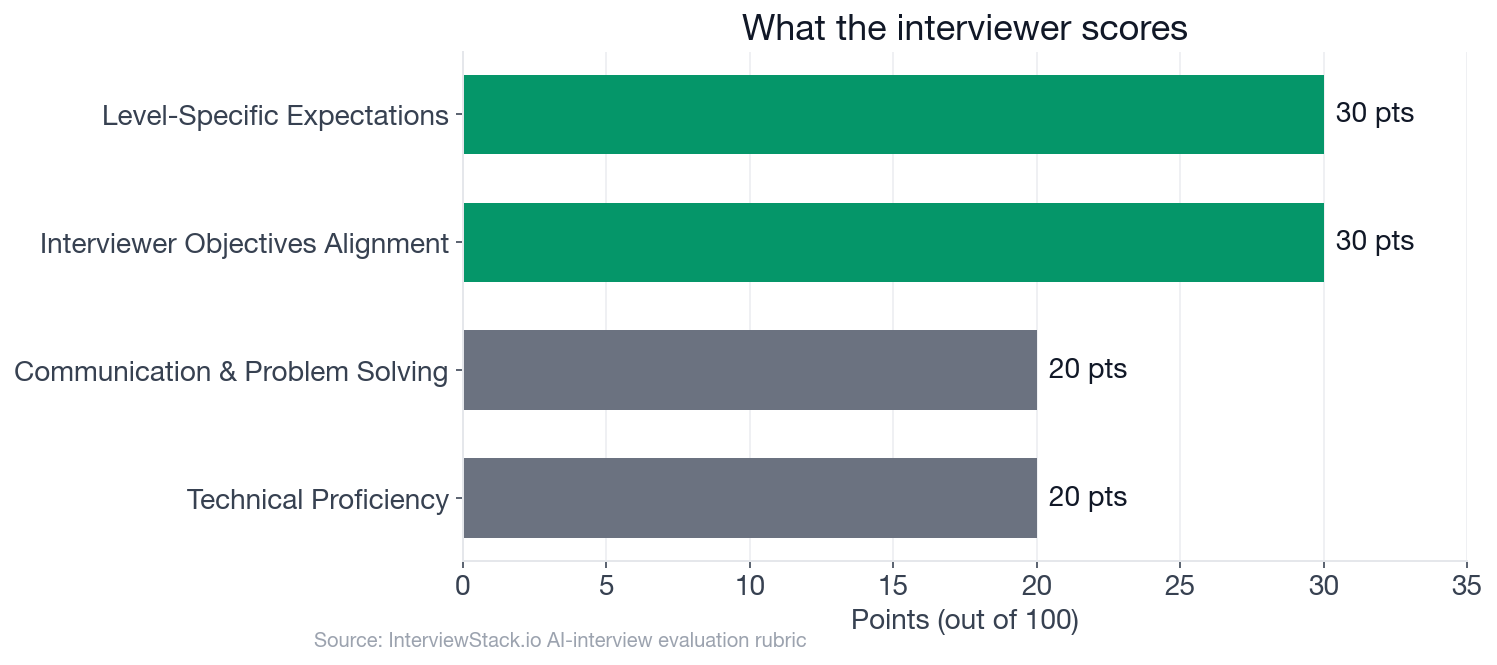
Level-Specific Expectations and Interviewer Objectives Alignment together outweigh Technical Proficiency three to one.
Four Follow-Ups, One Habit: Decide, Don't Describe
Each turn below shows an illustrative mistake and the move that scores. The candidate, Marcus, is fictional.
Turn 1: Pick the right SLIs
Interviewer: "What SLIs and SLOs would you choose for this platform, and how would you justify them to both platform leadership and the engineers using it?"
Turn 2: Uptime is green, rollouts crawl
Interviewer: "Suppose the platform meets a basic uptime target but deployment latency spikes badly during peak release windows. How would that affect your reliability model?"
Turn 3: Turn the budget into a decision
Interviewer: "How would you translate error budget policy into an actual decision about whether to keep shipping features or slow down releases for reliability work?"
Turn 4: Separate toil from work
Interviewer: "Which parts of the current operational load would you classify as toil versus acceptable operational work, and what would you automate first?"
Why Does Spotting These Mistakes Not Fix Them?
You read four mistakes and probably agreed with every correction. That is the easy part. Live, you answer in real time, and the follow-up is rarely the one you rehearsed. Marcus knew what an error budget was; the points were lost when the question asked what the team would actually do on Monday. The only way to close that gap is reps against an interviewer who does not let you coast.
What Does a Strong DevOps Engineer SRE Interview Look Like?
Here is the pacing a well-run session follows. Notice how little of it is spent on tools: nearly every checklist item is about judgment.
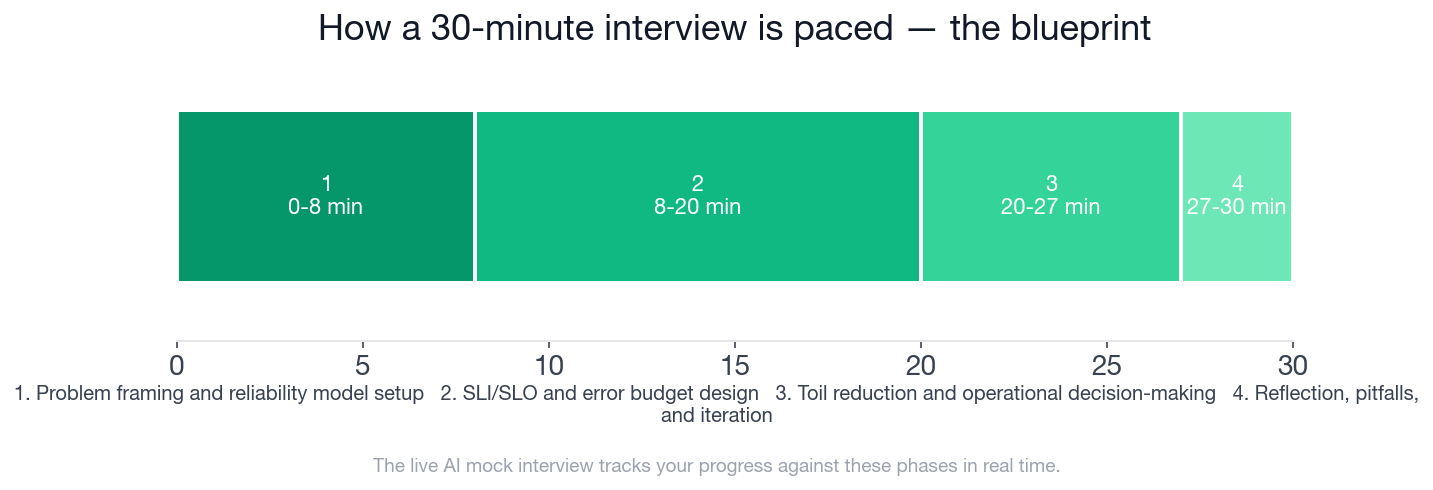
This is the blueprint a strong candidate hits, and the exact structure the AI mock interview tracks you against in real time.
- ✓Identifies primary users as internal engineering teams using the deployment platform
- ✓Names key user-visible outcomes such as deployment request acceptance, rollout completion success, and time to complete deployment
- ✓Separates control plane health from user experience instead of treating host uptime alone as sufficient
- ✓States that the reliability model should guide prioritization and release decisions, not just reporting
- ✓Proposes at least 2-3 meaningful SLIs, such as successful deployment completion rate, deployment latency percentile, API availability for deployment actions, or stuck rollout rate
- ✓Explains why latency and correctness both matter for this platform
- ✓Describes SLOs as target service behavior over a time window rather than aspirational statements
- ✓Explains error budget consumption in terms of allowed unreliability and links it to release or change policy
- ✓Discusses different user journeys or service tiers if one SLO cannot represent all important outcomes
- ✓Classifies manual retries, cleanup of bad state, and repetitive support handling as likely toil when repetitive, manual, and low-leverage
- ✓Suggests practical automation or product changes such as automatic stuck rollout detection, safer retries, better state reconciliation, improved user-facing status, or self-service diagnostics
- ✓Prioritizes fixes that reduce repeated operational load and improve user-visible reliability
- ✓Connects toil reduction back to freeing engineering time for reliability and feature work
- ✓Acknowledges that first-pass SLOs may need adjustment after collecting baseline data
- ✓Mentions at least one failure mode of bad SLO design, such as measuring what is easy rather than what users feel
- ✓Describes signals that would trigger revision, such as frequent user pain despite meeting targets or targets that are too loose/tight to drive decisions
Run This Interview Against a Live Interviewer
Take this exact scenario into the AI mock interview for DevOps Engineer SRE principles. You get the same four phases, follow-ups you have not seen, and feedback scored against the rubric above. If you want to warm up on individual concepts first, drill them in the SRE principles question bank, and browse the preparation guides for company-specific processes. When you are ready to apply, the DevOps Engineer job board lists current openings.
FAQ
Q. What does an SRE principles interview test for a DevOps Engineer?
It tests whether you can turn a vague reliability complaint into measurable user outcomes (SLIs and SLOs), connect error budgets to release decisions, spot toil, and revise your own model. In our 30-minute blueprint, Technical Proficiency is only 20 of 100 points; Interviewer Objectives Alignment and Level-Specific Expectations are 30 points each.
Q. How long is the mock SRE interview and how is it paced?
It runs 30 minutes in four phases: problem framing (minutes 0 to 8), SLI/SLO and error budget design (8 to 20), toil reduction (20 to 27), and reflection and iteration (27 to 30). The longest phase goes to SLI/SLO and error budget design.
Q. How many SLIs should a mid-level candidate propose?
The blueprint expects at least 2 to 3 meaningful SLIs, such as deployment completion rate, a deployment latency percentile, API availability for deployment actions, or stuck rollout rate. Quality matters more than count: each one should map to something the platform's users actually feel.
Q. Is host uptime a good SLI for a deployment platform?
On its own, no. The blueprint explicitly checks that you separate control plane health from user experience, because a platform can be technically up while rollouts hang or crawl during peak release windows.
Q. How do you explain an error budget in an interview?
Describe it as the amount of unreliability the SLO allows over a time window, then link it to a policy: what the team does when the budget is healthy, burning fast, or spent. The blueprint scores whether you tie budget consumption to release or change decisions, not just reporting.
Q. How do I practice this kind of interview?
Run it live. The AI mock interview for this role, level and topic asks the unscripted follow-ups and tracks you against the same four-phase blueprint in real time. The question bank is a good warm-up for individual SRE concepts first.
Your Next Rep Is the Real Test
Reliability interviews reward the candidate who commits to a decision and explains what would change their mind. Practice saying "we slow releases when the budget is spent, and here is who decides" out loud, under a clock, before someone else asks it.
Topics
Ready to practice?
Put what you've learned into practice with AI mock interviews and structured preparation guides.