
Different Jobs, Nearly Identical Paychecks
DevOps Engineers manage the infrastructure that keeps software running. Full-Stack Developers write the software itself. These two roles sit on opposite ends of the engineering stack, and yet the job market prices them within $1,500 of each other.
That number comes from analyzing 6,939 active DevOps Engineer and 6,552 Full-Stack Developer postings on the InterviewStack.io job board in June 2026, with salary data restricted to US postings where wage-transparency laws produce consistent base-pay disclosure. DevOps Engineers: $153,000 median US base (n=1,215). Full-Stack Developers: $151,500 (n=734). On a $150K-plus salary, a $1,500 spread is noise.
What is not noise is the skill divergence. These two roles share only a 33% Jaccard overlap on their top-30 skill sets, meaning 2 in 3 skills you build for one role do not transfer directly to the other. If salary is your primary reason for choosing between them, you are using the wrong signal.
| DevOps Engineer | Full-Stack Developer | |
|---|---|---|
| Median US base salary | $153,000 | $151,500 |
| Active postings | 6,939 | 6,552 |
| Top skill | CI/CD (65.8%) | React (53.2%) |
| Remote share | 22.3% | 28.1% |
| Entry-level share | 2.3% | 2.6% |
| Skill overlap (Jaccard) | 33% shared | (pairwise) |
Key Findings
- DevOps Engineers earn a median $153,000 US base salary (n=1,215); Full-Stack Developers earn $151,500 (n=734), a $1,500 gap that is statistically indistinguishable.
- Skill profiles share only 33% Jaccard overlap: 2 in 3 skills from one role's top-30 set do not appear in the other's.
- DevOps is defined by infrastructure: CI/CD (65.8%), Kubernetes (54.1%), Terraform (49.4%), and Linux (31.6%) rank in the top skills.
- Full-Stack is defined by product code: React (53.2%), TypeScript (43.4%), JavaScript (40.9%), and SQL (32.9%) dominate.
- Both roles share CI/CD, AWS, Python, and Docker as core connective tissue.
- Entry-level pipelines are narrow in both: 2.3% of DevOps postings and 2.6% of Full-Stack postings are explicitly entry-level.
- Full-Stack is more remote-friendly: 28.1% remote vs. 22.3% for DevOps.
- AI skills carry stronger premiums in Full-Stack (roughly $37K above baseline for LLM-related postings) than in DevOps (roughly $26K above baseline).
The Day-to-Day Divide
DevOps Engineers own the plumbing. A typical week involves provisioning cloud infrastructure with Terraform or Ansible, maintaining Kubernetes clusters, diagnosing a failed CI/CD pipeline, and improving the observability stack so the next incident has cleaner dashboards. The work is a continuous loop of build-automate-monitor. When something breaks in production, a DevOps engineer is in the blast radius.
Full-Stack Developers own the product. A typical week involves picking up a feature ticket, writing the React component on the frontend, the API endpoint in Node.js or Python on the backend, the database migration in PostgreSQL, and the tests that prove it all works. The output is visible software a user touches. When a feature ships, a Full-Stack developer can point to it directly.
The exclusive skills confirm the split. Terraform (49.4%), Infrastructure as Code (38.4%), Observability (32.1%), and Bash (27.2%) appear specifically in DevOps postings because infrastructure management is not incidental to the job: it is the job. React (53.2%), JavaScript (40.9%), SQL (32.9%), and Node.js (32.8%) appear specifically in Full-Stack postings because the user-facing product stack is what the role exists to build.
What Skills Do Both Roles Share?
CI/CD is the strongest common skill by a wide margin. It appears in 65.8% of DevOps postings and 38.6% of Full-Stack postings. DevOps engineers own the pipelines; Full-Stack developers trigger them. Both sides need to speak the same language about how code moves from a developer's laptop to production.
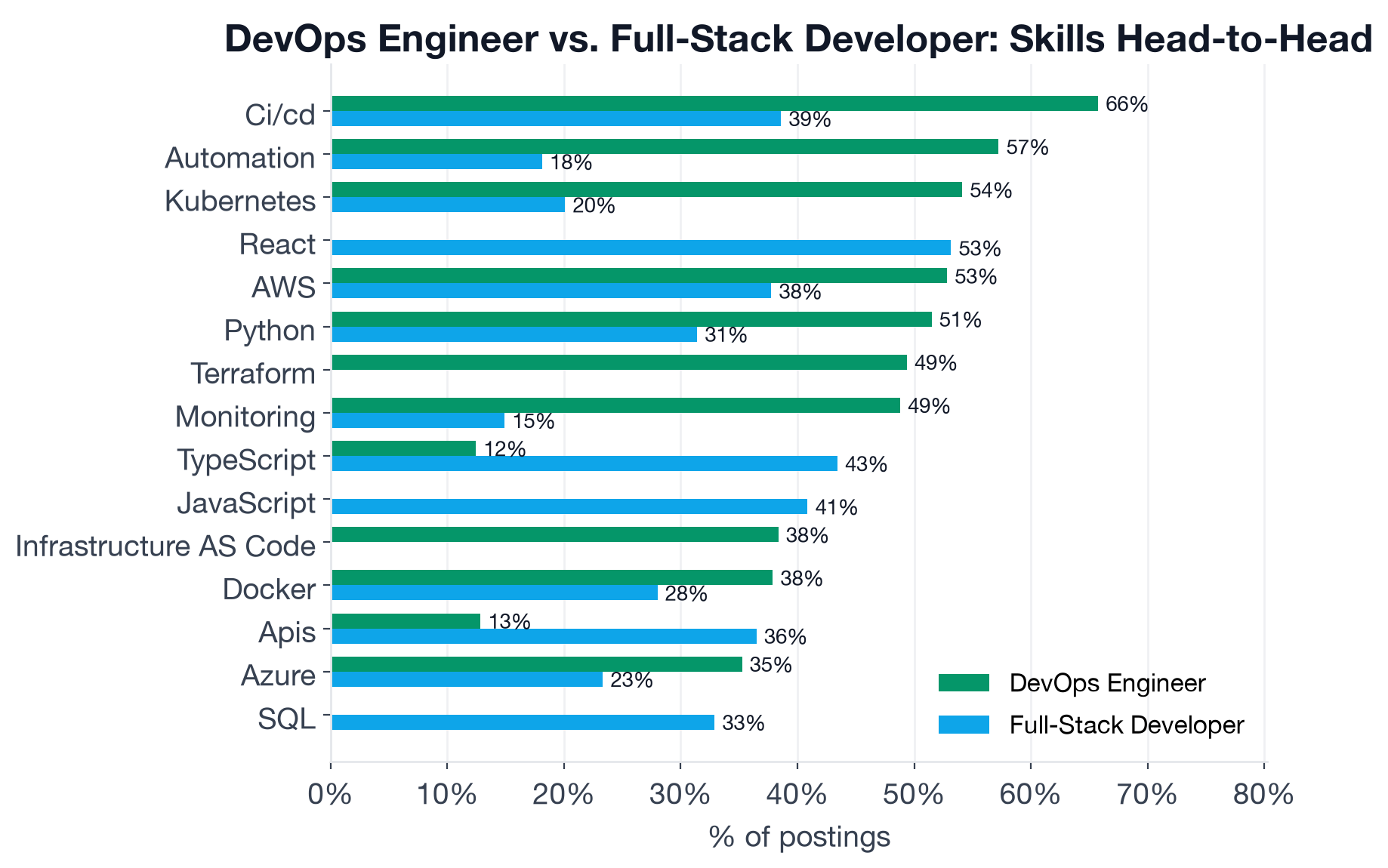
Top skills for each role by share of active postings. DevOps (emerald) leads on infrastructure skills; Full-Stack (blue) leads on product-code skills. Shared skills cluster in the middle range.
Beyond CI/CD, the shared cluster includes AWS (52.8% DevOps / 37.8% Full-Stack), Python (51.5% / 31.4%), Docker (37.9% / 28.0%), Azure (35.3% / 23.3%), and Agile (26.2% / 32.8%). Cloud and container fluency is table stakes for both roles. Python is the common scripting language across infrastructure automation and backend application code. Agile is the team rhythm on both sides.
TypeScript is worth noting: it appears in 43.4% of Full-Stack postings and 12.5% of DevOps postings. Full-Stack developers write TypeScript to build products; DevOps engineers increasingly reach for it in automation tooling and cloud-native infrastructure scripts. GitHub Octoverse 2025 data shows TypeScript has become the top language on the platform, a shift driven partly by LLM tooling that benefits from static types. Both roles are being pulled in the same direction here.
Where the Skill Sets Part Ways
DevOps exclusives (skills prominent in DevOps postings but rare in Full-Stack):
| Skill | DevOps frequency |
|---|---|
| Terraform | 49.4% |
| Infrastructure as Code | 38.4% |
| Observability | 32.1% |
| Linux | 31.6% |
| Bash | 27.2% |
| Jenkins | 24.4% |
| Ansible | 23.6% |
Infrastructure as Code tools (Terraform, Ansible, and related tooling) appear in close to 4 in 10 DevOps postings. Linux fluency is expected in nearly a third. Grafana and Prometheus round out the observability cluster at 20% and 19%. These skills signal a role that reasons about what infrastructure is doing at the system level, not just what a Kubernetes dashboard shows.
Full-Stack exclusives (skills prominent in Full-Stack postings but rare in DevOps):
| Skill | Full-Stack frequency |
|---|---|
| React | 53.2% |
| JavaScript | 40.9% |
| SQL | 32.9% |
| Node.js | 32.8% |
| Angular | 27.3% |
| PostgreSQL | 25.4% |
| Microservices | 20.2% |
| CSS | 19.2% |
React and JavaScript together define the frontend half of Full-Stack work. SQL and PostgreSQL define the data layer. The co-presence of CSS and microservices in the same exclusive list reflects the role's full span: Full-Stack developers are expected to care about pixel-level UI details and service-level architectural patterns at the same time.
AI use in both roles. Explicit AI requirements do not break into the top-30 skills list for either role, meaning AI integration is not yet a mainstream posting requirement in either discipline. That number misses most of what is actually happening. JetBrains' January 2026 survey of over 10,000 developers found 90% of engineers use AI tools regularly at work, a figure that explicitly includes DevOps engineers. For DevOps, AI shows up mostly as Copilot-style assistance for Terraform and Bash generation, and for AI-summarized incident postmortems. For Full-Stack developers, it increasingly means multi-file agents like Claude Code and Cursor for feature development across frontend and backend simultaneously. The roles differ in how they use AI, not whether they do.
Which Pays More?
These figures are US base salaries only. Equity, bonuses, and sign-on are not disclosed in posting data, so total compensation at top employers runs meaningfully higher than what we report. Figures come from postings with disclosed salary data under US wage-transparency laws.
DevOps Engineers: $153,000 median (n=1,215). Full-Stack Developers: $151,500 (n=734). The gap is not a real signal.
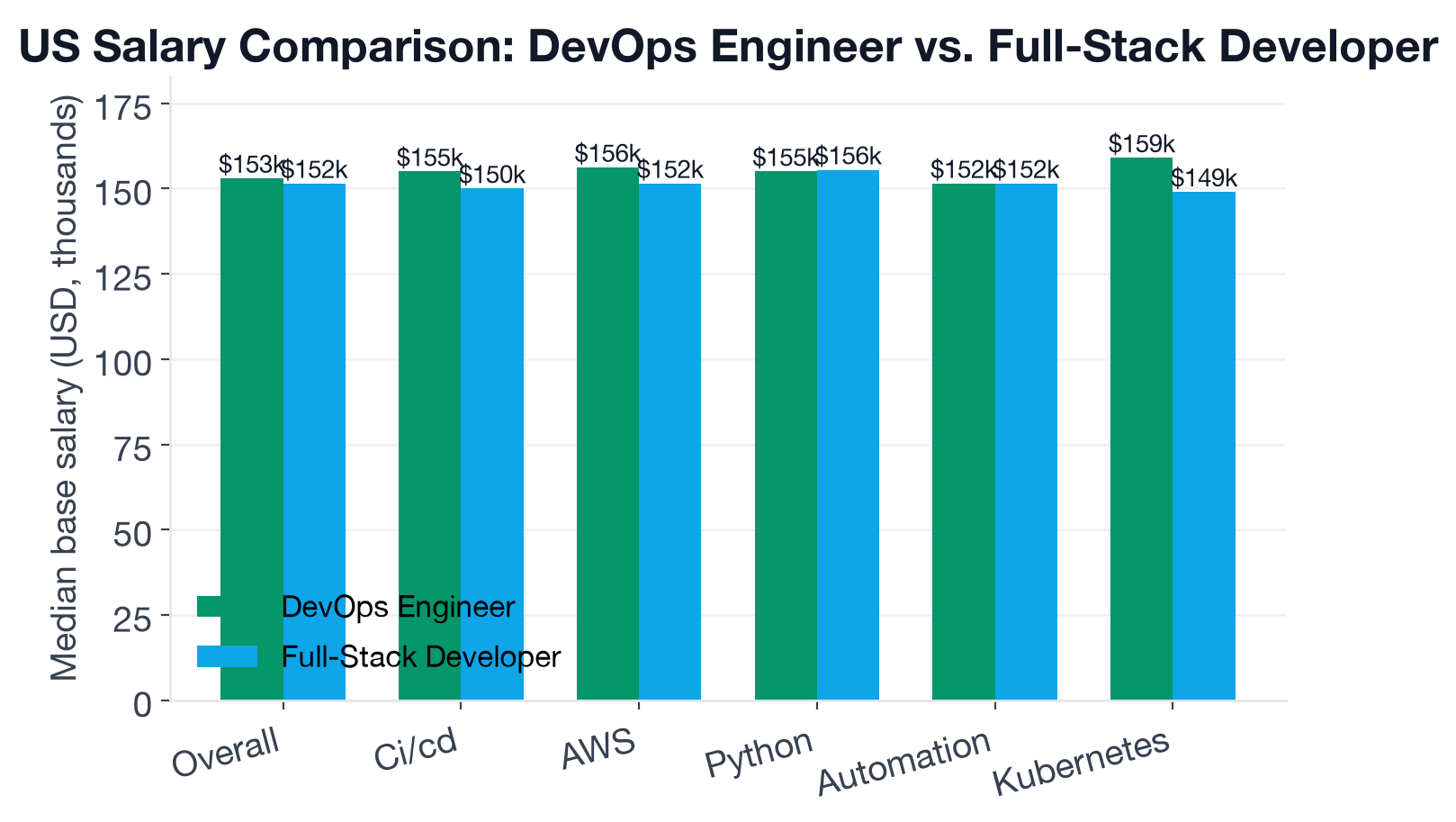
Median US base salary by role. DevOps and Full-Stack sit within $1,500 of each other at the overall median. Premium skills diverge more meaningfully.
The more interesting salary story is in premium-skill territory:
| Skill | DevOps median | Premium over $153K base |
|---|---|---|
| LLM/AI skills | ~$179,300 | +$26,300 |
| Distributed Systems | $185,000 | +$32,000 |
| Observability | $170,000 | +$17,000 |
| Kubernetes | $159,000 | +$6,000 |
| Skill | Full-Stack median | Premium over $151.5K base |
|---|---|---|
| LLM/AI skills | ~$188,800 | +$37,300 |
| Distributed Systems | $175,000 | +$23,500 |
| Observability | $175,000 | +$23,500 |
| Next.js | $168,400 | +$16,900 |
| TypeScript | $161,000 | +$9,500 |
AI-skill premiums are roughly 40% larger in Full-Stack than in DevOps. Roles that combine Full-Stack work with LLM integration sit at the upper end of the salary band because product-facing AI work is closer to where LLM APIs create visible, monetizable value. Kubernetes earns a $6K premium in DevOps but no meaningful premium in Full-Stack, confirming that it is a differentiated infrastructure specialty for DevOps and a background expectation for Full-Stack.
Which Has More Openings, and How Hard Is Entry?
DevOps postings (6,939) outnumber Full-Stack (6,552) by a 1.06 ratio. For practical purposes, these are the same-size market. Neither is constrained by demand.
Both are inhospitable to career changers. Only 2.3% of DevOps postings and 2.6% of Full-Stack postings are explicitly entry-level. Mid-level roles dominate in both at 55.2% (DevOps) and 57.5% (Full-Stack). Senior roles account for another 30.4% and 31.5% respectively. Staff-level positions are more prevalent in DevOps (12.1%) than in Full-Stack (8.3%), reflecting a deeper IC track in platform engineering.
Work mode and geography:
| DevOps Engineer | Full-Stack Developer | |
|---|---|---|
| Remote | 22.3% | 28.1% |
| Hybrid | 37.0% | 25.3% |
| Onsite | 48.3% | 50.9% |
| Top country (US) | 31.1% of postings | 24.8% of postings |
Remote, hybrid, and onsite shares sum to more than 100% because some postings carry multiple work-mode tags.
Full-Stack has a meaningfully larger remote share. If geographic flexibility matters to your job search, remote Full-Stack Developer openings outnumber remote DevOps Engineer openings by roughly 300 postings. DevOps postings concentrate more heavily in the US (31.1% vs 24.8%); Full-Stack has stronger representation in Germany (6.1%), Brazil, and Mexico, reflecting global appetite for product-oriented web developers. Both roles have active markets in India (DevOps 13.2%, Full-Stack 13.8%), where demand largely flows through consulting and services firms.
DevOps or Full-Stack: How to Decide
The salary data eliminates itself as a tiebreaker. Pick based on the work:
Choose DevOps Engineer if you:
- Prefer systems thinking over product thinking: you want to own how applications run, not what they do
- Are drawn to reliability, automation, and operational ownership over feature delivery
- Have or want to build depth in Linux, networking, cloud infrastructure, or IaC tools like Terraform (49.4% of postings require it)
- Are comfortable with on-call rotations and incident response as a regular part of the role
Choose Full-Stack Developer if you:
- Want to see your work in a user interface and own a feature end-to-end from database to browser
- Prefer breadth across frontend (React 53.2%, TypeScript 43.4%) and backend (Node.js 32.8%, SQL 32.9%) over infrastructure depth
- Value remote-work flexibility: Full-Stack is meaningfully more remote-friendly (28.1% vs 22.3%)
- Are interested in building AI-integrated products: Full-Stack AI premiums are roughly 40% larger than DevOps AI premiums
How to Use This in Your Job Search
Whichever path you choose, the same preparation logic applies.
Browse the live market first. Filter by work mode and seniority to understand how competitive your target segment actually is. Useful starting points: DevOps + Terraform or Full-Stack + React + TypeScript to see demand for the specific stacks that define each role.
Drill the exclusive skills. For DevOps, that means Kubernetes, Terraform, observability tooling, and Linux internals. For Full-Stack, it means React, TypeScript, SQL, and microservice design. The question bank has role-specific questions you can drill by topic; AI mock interviews let you practice realistic rounds with on-demand feedback on the scenarios that actually come up in these interviews.
Build the shared stack first. CI/CD, AWS, Python, and Docker appear at high frequency in both roles. Fluency there keeps both options open while you decide and closes the gap fast if you switch later. Interactive courses cover CI/CD fundamentals, cloud platforms, and system design if you need to close gaps at the foundation layer.
For the companies actively hiring in each space, preparation guides break down the interview formats and topic priorities by company so you know what to expect before the first call.
FAQ
Q. What is the salary difference between DevOps Engineer and Full-Stack Developer in 2026?
Based on US postings with disclosed salary data, DevOps Engineers earn a median $153,000 base (n=1,215) and Full-Stack Developers earn $151,500 (n=734), a $1,500 gap that rounds to statistical parity. These are base salaries only; equity, bonuses, and sign-on are not captured in posting data.
Q. Which role has more job openings, DevOps Engineer or Full-Stack Developer in 2026?
DevOps Engineer postings (6,939 active) slightly outnumber Full-Stack Developer postings (6,552) by a ratio of 1.06. Both are large, healthy markets. Entry-level share is similarly tight in both: 2.3% for DevOps and 2.6% for Full-Stack.
Q. What skills do DevOps Engineers and Full-Stack Developers share?
The two roles share a 33% Jaccard skill overlap. The strongest shared skills are CI/CD (65.8% of DevOps postings, 38.6% of Full-Stack), AWS (52.8% vs 37.8%), Python (51.5% vs 31.4%), Docker (37.9% vs 28.0%), and Agile (26.2% vs 32.8%). Cloud platforms and CI/CD tooling are the connective tissue.
Q. What skills are exclusive to DevOps Engineers vs Full-Stack Developers?
DevOps Engineers are defined by infrastructure tooling: Terraform (49.4% of postings), Infrastructure as Code (38.4%), Observability (32.1%), Linux (31.6%), and Bash (27.2%). Full-Stack Developers are defined by product code: React (53.2%), JavaScript (40.9%), SQL (32.9%), Node.js (32.8%), and Angular (27.3%).
Q. Which role is easier to break into as a career changer in 2026?
Both roles have narrow entry-level pipelines: only 2.3% of DevOps postings and 2.6% of Full-Stack postings are explicitly entry-level. Full-Stack is slightly more remote-friendly (28.1% vs 22.3% remote), which broadens the geographic reach of job hunting.
Q. How is AI changing DevOps Engineer and Full-Stack Developer roles in 2026?
Explicit AI requirements do not appear in the top-30 skills list for either role, meaning AI integration is not yet a mainstream posting requirement in either discipline. The practice layer tells a different story: JetBrains' January 2026 survey of over 10,000 developers found 90% of engineers use AI tools regularly. Full-Stack AI premiums are stronger for postings that do specify AI: LLM skills carry a $37,300 premium over the Full-Stack baseline vs. $26,300 for DevOps.
Q. Should I become a DevOps Engineer or Full-Stack Developer?
Choose DevOps if you prefer systems thinking, infrastructure ownership, and reliability engineering. Choose Full-Stack if you enjoy owning a product end-to-end from database to UI and want the broadest remote options. Salary should not be the deciding factor: both roles pay virtually the same at $153,000 vs $151,500 median US base.
Choose the Work, Not the Salary
The data makes one thing clear: these two roles have priced themselves into parity despite being almost opposite in skill profile. DevOps owns the infrastructure layer that keeps everything else running; Full-Stack owns the product that users actually see. The 33% skill overlap is real but narrow: a foundation of cloud, CI/CD, and Python connects them, but everything built on top of that foundation diverges sharply. Pick the layer of the stack that you would genuinely rather work in, build the exclusive skills that define that path, and let the shared foundation carry you. Start with live DevOps Engineer openings or Full-Stack Developer openings to see where the demand sits right now.
Topics
Ready to practice?
Put what you've learned into practice with AI mock interviews and structured preparation guides.