
A mid-level Digital Forensic Examiner interview on compliance investigations is rarely lost on tooling. It is easily lost in the opening scoping phase, when a capable candidate reaches for the forensic imager before asking who has authorized it. This mock walks through one insider data-export scenario, shows where prepared candidates drop points they never see coming, and ends with the blueprint a strong answer hits. It is illustrative of how a strong interview runs, not any company's real questions.
Key Findings
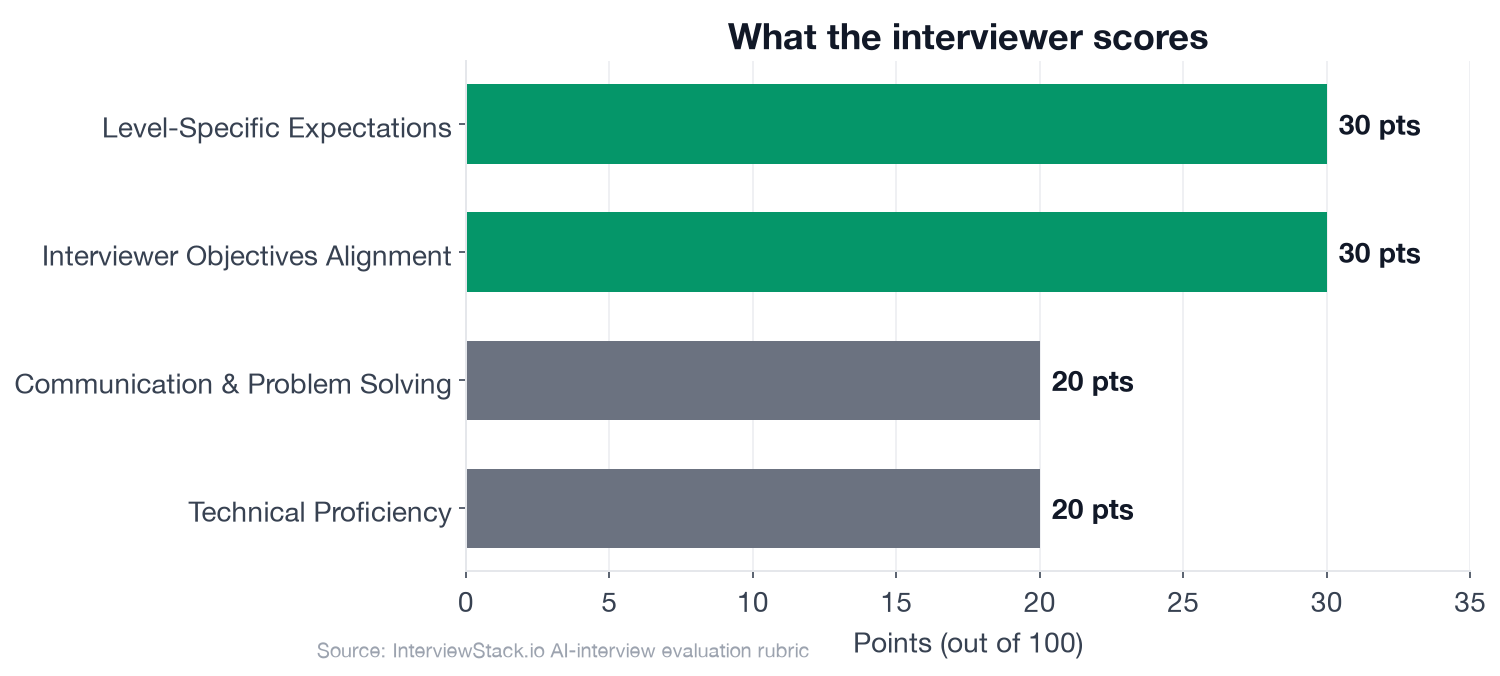
- The rubric is 100 points, and only 20 of them go to Technical Proficiency.
- Interviewer Objectives Alignment and Level-Specific Expectations carry 30 points each, so 60 of 100 points reward judgment and fit to the level.
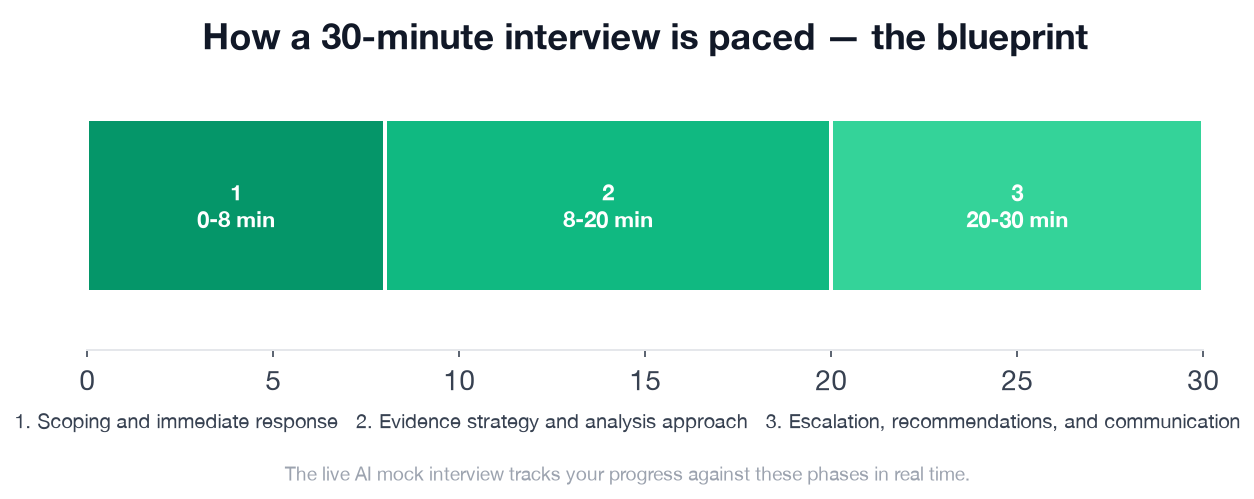
- The interview is 30 minutes across 3 phases: scoping (0-8), evidence strategy (8-20), and escalation and communication (20-30).
- The evidence phase is the longest at 12 minutes, yet scoping only gets 8, so a slow start squeezes everything after it.
- Across the 3 phases there are 13 expected checklist items (4, 5, and 4), and several reward restraint, not action.
- The interviewer has 6 follow-up probes. This post dramatizes 4 of them.
What Is the Interviewer Asking You to Do?
You are the on-call examiner. The clock is ticking, access is still live, and legal, HR, and security all want something from you.
The interview question
A regional compliance manager reports that a sales employee may have exported customer records from an internal CRM to a personal cloud account shortly before resigning. The employee worked with customers in the US and EU, used a company-managed laptop and phone, and may have communicated with an external competitor. Legal has asked for a fast fact-finding effort because the employee’s access is still active, HR is considering immediate action, and there is a chance outside counsel or law enforcement could become involved later.
You are the on-call Digital Forensic Examiner asked to lead the investigation response.
Walk me through how you would handle this investigation from the moment you receive the allegation through your recommendation to stakeholders.
The interviewer is probing for a structured plan (intake, scoping, preservation, collection, analysis, coordination, reporting), defensible evidence handling, and sound judgment on when to pause or narrow actions for privacy, employment, or jurisdictional reasons. Advanced malware reverse engineering and SIEM architecture are explicitly out of scope.
Digital Forensic Examiner Compliance Investigation Interview: The Four Turns
Each turn below shows a common answer and a stronger one. The answers are dramatized for illustration, not transcripts of a real person.
Turn 1: The First Hour
Interviewer: "What would you do in the first hour, and how would you balance evidence preservation with the risk of tipping off the employee?"
Turn 2: Cross-Border Complications
Interviewer: "Suppose legal tells you some customer data may be subject to EU restrictions and the employee is currently traveling internationally. How does that change your approach?"
Turn 3: Proof Versus Indicators
Interviewer: "If you find indicators that files were uploaded to a personal cloud account but you cannot prove the contents, how would you frame your findings and escalation recommendation?"
Turn 4: Defensible Documentation
Interviewer: "How would you document chain of custody and your investigative decisions so the case would hold up in an internal disciplinary review or later external scrutiny?"
Why Isn't Reading This Enough?
Spotting these four mistakes on a page took seconds. Avoiding them live is different: the interviewer interrupts, the scope shifts, and the instinct to look competent by naming tools is strong. The gap between knowing the material and performing it under a 30-minute clock only closes with repetition.
The Complete Blueprint a Strong Candidate Hits
This is the checklist the AI mock interview tracks you against in real time, phase by phase. Use it to see which items you would have missed before you practice.
- ✓Clarifies allegation, source of report, timeline, employee status, and business urgency
- ✓Identifies immediate steps such as preserving logs/data, validating whether access should be changed through approved channels, and confirming case ownership
- ✓Mentions involving legal/HR/security appropriately before invasive actions or employee contact
- ✓Recognizes risk of over-collection, employee notification, or spoliation
- ✓Names relevant sources such as CRM audit/export logs, SSO/IdP logs, endpoint telemetry, browser history/downloads, USB/cloud sync artifacts, email/chat, DLP/CASB, and mobile management records
- ✓Prioritizes high-value volatile or retention-limited sources before lower-value broad collection
- ✓Explains how to correlate user actions across systems using timestamps, identities, and device context
- ✓Describes preservation/integrity steps such as hashes, access logging, evidence inventory, and note-taking
- ✓Distinguishes confirmed facts from indicators or hypotheses when interpreting evidence
- ✓Provides a clear recommendation path tied to evidentiary confidence, business risk, and stakeholder roles
- ✓States triggers for outside counsel or law enforcement without overstepping the company decision process
- ✓Explains how findings would be summarized for HR/legal leadership in plain language
- ✓Acknowledges limitations, alternate explanations, and next best steps if evidence is incomplete
Start the Mock Interview
The fastest way to find your own blind spots is to answer this exact scenario out loud, with follow-ups you cannot predict, then read where the rubric marked you down.
Start the AI mock interview for this scenario and get scored on all four dimensions.
Want more reps first? Work through the compliance investigation question bank, skim the Digital Forensic Examiner prep guides, or see what employers ask for on the job board.
FAQ
What does a Digital Forensic Examiner compliance investigation interview test?
It tests whether you can run a defensible insider-data case from intake to recommendation while coordinating with legal, HR, and security. The rubric weights judgment heavily: 30 of 100 points for meeting the interviewer's objectives and 30 for level-specific expectations, against 20 for technical proficiency.
How long is this mock interview and how is it paced?
It runs 30 minutes in three phases: scoping and immediate response (minutes 0-8), evidence strategy and analysis (8-20), and escalation, recommendations, and communication (20-30). The evidence phase is the longest at 12 minutes.
Should I collect everything from the employee's devices right away?
No. The blueprint explicitly checks that you recognize the risk of over-collection, employee notification, and spoliation. Start with retention-limited, high-value sources such as CRM export logs and identity logs, and widen the scope only with legal's direction.
What should I say when I can see an upload but cannot prove what was in it?
Separate confirmed facts from indicators. State what the logs show, name the alternate explanations, list the next best evidence sources, and tie your escalation recommendation to your evidentiary confidence rather than overclaiming.
When should a forensic examiner involve outside counsel or law enforcement?
Name concrete triggers, such as cross-border data restrictions, confirmed exfiltration of regulated customer data, or evidence of a coordinated competitor. Frame the decision as the company's to make through legal, not yours to make alone.
What is a mid-level examiner expected to do differently from a senior one?
A mid-level candidate should independently propose a practical end-to-end plan and make reasonable escalation calls under moderate ambiguity. Designing company-wide policy or settling nuanced jurisdictional questions is left to legal and senior investigators.
The Takeaway for Your Next Case Interview
Speed impresses less than restraint here. The blueprint rewards the candidate who says "I would pause and confirm that with legal" at the right moment over the one who images everything in the first five minutes.
Topics
Ready to practice?
Put what you've learned into practice with AI mock interviews and structured preparation guides.