
The Powered-On Laptop Is the First Test, Not the Toolset
A managed laptop is powered on, logged in, and encrypted, and it might not stay that way. That single detail, buried in the middle of an otherwise ordinary insider-exfiltration scenario, is the whole test in a mid-level Digital Forensic Examiner interview on digital forensics tools and equipment. Candidates who reach straight for a write blocker and a forensic duplicator before capturing anything live are already behind, because once that machine loses power, the decryption state sitting in memory goes with it.
This walkthrough runs the real 30-minute blueprint the InterviewStack.io AI mock interview uses for this role and topic: the same opening scenario, the same follow-up prompts, and the same 100-point rubric. You'll watch a candidate answer, see exactly which checklist item it costs them, and see the stronger version. Browse the Digital Forensic Examiner question bank on tools and equipment if you want to drill individual concepts before running the full simulation.
Key Findings
- The rubric totals 100 points across four dimensions: Interviewer Objectives Alignment (30), Level-Specific Expectations (30), Technical Proficiency (20), and Communication & Problem Solving (20).
- The interview runs 30 minutes across 3 phases with 15 checklist items total: 5 in Scoping and acquisition strategy (0-10 min), 5 in Tool selection and validation (10-20 min), and 5 in Analysis workflow and communication of findings (20-30 min).
- Phase 1's five items are decided in the first 10 minutes, before any tool is even named, and one of them is whether you prioritize volatile evidence over a safe shutdown.
- Phase 2 requires cross-checking any suspicious tool output against a second tool, raw artifacts, or manual review, one of 5 checklist items examiners routinely skip under time pressure.
- The managed iPhone in the scenario cannot be fully unlocked, forcing an explicit partial-extraction limitation disclosure, another of Phase 2's 5 items.
- Phase 3 (20-30 min) requires separating preliminary indicators from validated findings before the end-of-day incident response brief.
- 4 skill areas are explicitly out of scope for this interview, including binary-level malware reverse engineering and SIEM content authoring.
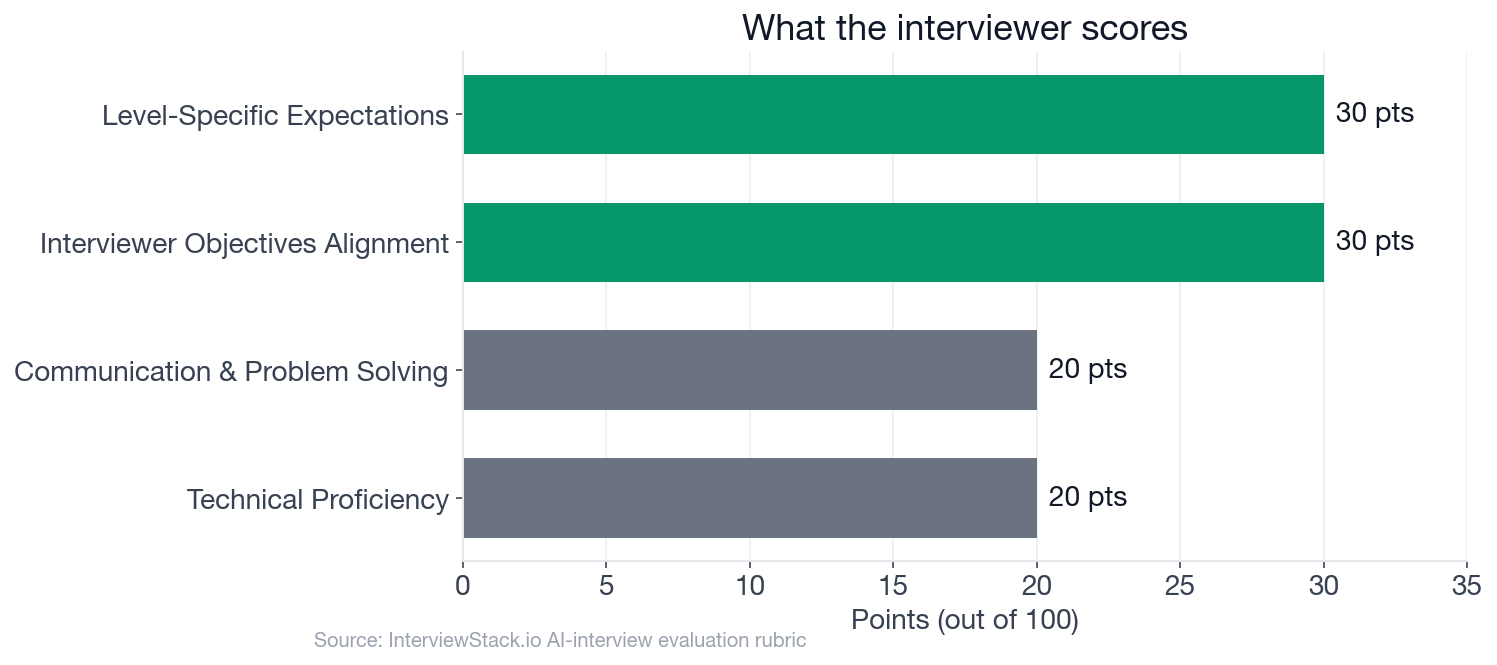
Interviewer Objectives Alignment and Level-Specific Expectations together hold 60 of 100 points, so acquisition sequencing and mid-level judgment outweigh raw tool knowledge.
What Does the Digital Forensic Examiner Digital Forensics Tools and Equipment Interview Ask?
Here is the scenario as it appears in the live blueprint:
The interview question
You are supporting an internal investigation at a large technology company. A security engineer reports that a corporate laptop used by a software developer may have been involved in unauthorized access to source code and potential exfiltration to a personal cloud account. The employee is currently on leave, the laptop is powered on but may lose power soon, the user also had a managed iPhone, and relevant activity may exist in the company's cloud collaboration and identity platforms. Legal wants defensible collection and documentation, and incident response wants fast answers within the same business day.
Assume you have access to standard enterprise forensic tooling, common commercial and open-source forensic software, hardware write blockers, imaging devices, and coordination support from IT and IR. Walk me through how you would approach tool and equipment selection, evidence acquisition, validation, and analysis for this investigation from the moment you receive the case.
The interviewer isn't grading tool-name recall. They're checking whether you can design a volatility-aware acquisition plan across endpoint, mobile, and cloud sources, hold chain of custody the entire time, explain when a commercial tool beats an open-source one (and vice versa), and stay honest about what a tool's output actually proves.
Where Do the Follow-Ups Actually Cost You Points?
Four follow-ups from the blueprint, picked to span all three phases: the live-acquisition call, tool validation, mobile limits, and the end-of-day report.
Turn 1: The One-Shot Encrypted Machine
Interviewer: "The laptop is encrypted and logged in right now, but you may only get one chance before it powers off. How would that change your acquisition sequence and tooling choices?"
Turn 2: The Tool Disagreement
Interviewer: "Suppose your primary forensic suite flags suspicious file transfers, but a second tool does not reproduce the result. How would you validate the output and decide what to report?"
Turn 3: The Partial Mobile Extraction
Interviewer: "If the managed iPhone cannot be fully unlocked and only partial extraction is possible, what tools or collection paths would you consider and what limitations would you communicate?"
Turn 4: The End-of-Day Brief
Interviewer: "You need to brief incident response by end of day with preliminary findings but preserve a path for deeper examination later. How would you balance speed versus completeness in your workflow?"
Catching the Mistake on the Page Isn't the Skill Being Tested
Every mistake above is obvious once it's labeled red. Spotting it while you're reading is not the same as catching yourself mid-sentence at minute 14, in a live case, on a follow-up you didn't rehearse. That gap between recognizing a pattern on the page and avoiding it under real time pressure only closes with reps.
The Full 30-Minute Blueprint, Phase by Phase
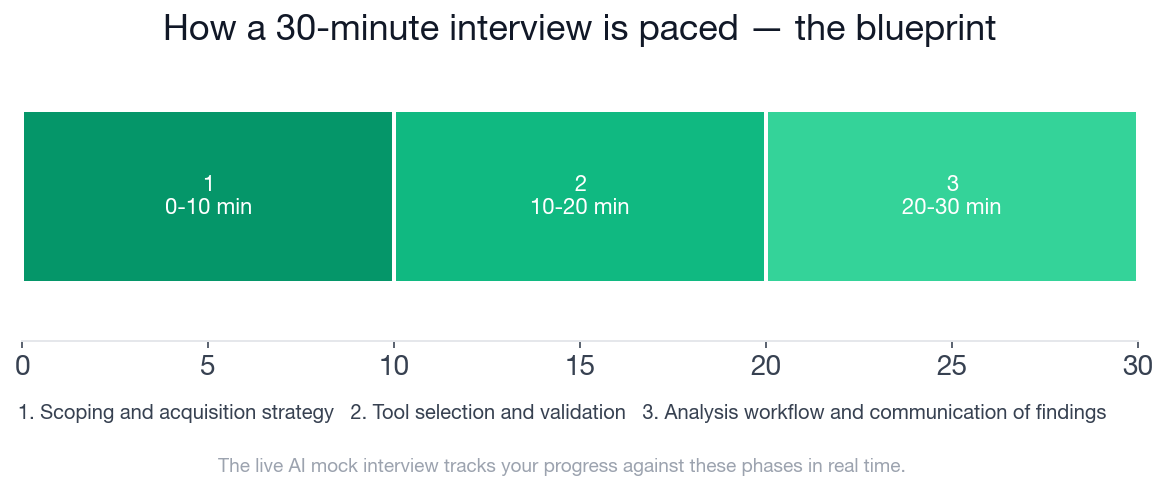
Phase 1 is short but decisive: 10 minutes to set the acquisition order before tool talk even starts, and it's the phase most candidates blow through on autopilot.
This is the blueprint a strong candidate covers end to end, and it's the exact structure the AI mock interview tracks you against in real time:
- ✓Clarifies investigative objective in practical terms such as confirming access, exfiltration path, scope, and actor actions
- ✓Identifies the powered-on state as critical and prioritizes volatile evidence before shutdown if justified
- ✓Discusses capturing memory and live state with appropriate tooling and notes reasons such as encryption keys, network sessions, running processes, and logged-in cloud access
- ✓Describes when to perform full disk imaging versus targeted logical collection and ties the choice to time, encryption, and business constraints
- ✓Mentions documentation, timestamps, hash verification where applicable, and chain of custody from the start
- ✓Names reasonable categories of tools for memory capture, disk imaging, artifact parsing, registry or file system review, timeline creation, mobile extraction, and cloud log collection
- ✓Explains when hardware write blockers or forensic duplicators are required and when live collection changes that model
- ✓Describes validating images or collections through hashes, logs, acquisition metadata, and repeatable procedures
- ✓Explains cross-checking suspicious findings with a second tool, raw artifacts, system logs, or manual review rather than trusting a single automated result
- ✓Acknowledges common tool limitations such as parser gaps, OS version support, partial mobile extraction, cloud API scope limits, or damaged media challenges
- ✓Prioritizes analysis paths tied to the allegation, such as USB usage, browser artifacts, sync clients, shell history, file access metadata, cloud login events, and outbound transfer indicators
- ✓Builds or describes a coherent timeline across endpoint, mobile if relevant, and cloud sources
- ✓Differentiates preliminary indicators from validated findings and states confidence carefully
- ✓Describes what would be included in an end-of-day update versus final report, including evidence basis and unresolved gaps
- ✓Shows awareness of preserving work product and notes for later peer review or testimony if needed
Run the Live Version of This Case
The InterviewStack.io AI mock interview for Digital Forensic Examiner digital forensics tools and equipment runs the live version of this exact case, follows up based on what you actually say, and scores you across all four rubric dimensions when the 30 minutes close. That's the only way to test whether your acquisition sequencing holds up when the follow-up isn't one you rehearsed.
For targeted drilling before the full simulation, the Digital Forensic Examiner question bank on tools and equipment breaks the same material into individual questions with worked answers. If you want to see how this topic sits inside a broader prep path, the InterviewStack.io preparation guide maps coverage by seniority level.
FAQ
Q. What does a mid-level Digital Forensic Examiner interview on tools and equipment actually test?
It tests whether you can build a defensible acquisition and analysis plan across endpoint, mobile, and cloud evidence in a live corporate case, not whether you can name forensic products. The 100-point rubric splits 30 points to Interviewer Objectives Alignment, 30 to Level-Specific Expectations, 20 to Technical Proficiency, and 20 to Communication & Problem Solving, across three phases: scoping and acquisition strategy (0-10 min), tool selection and validation (10-20 min), and analysis workflow and communication of findings (20-30 min).
Q. Why does it matter that the laptop is powered on in this scenario?
Because a live, unlocked, encrypted machine is a one-shot acquisition window. Once it loses power, the decryption state held in memory disappears, along with running processes and active cloud sessions, so Phase 1's checklist explicitly requires prioritizing volatile evidence capture before any shutdown or drive-imaging step.
Q. What is the biggest mistake candidates make when a forensic tool's output can't be reproduced by a second tool?
Reporting the first tool's finding as fact because it's the trusted or industry-standard product. Phase 2's checklist requires cross-checking any suspicious finding against a second tool, raw artifacts, or manual review before it's treated as confirmed, and skipping that step risks both Technical Proficiency and Interviewer Objectives Alignment points.
Q. Can you still collect useful evidence from a managed iPhone that won't fully unlock?
Yes. Even without a full filesystem extraction, a mid-level examiner should name MDM console data, a logical extraction of accessible app data, and iCloud data available through the company's identity platform, then explicitly document what's missing. Phase 2's checklist rewards acknowledging tool limitations like partial mobile extraction rather than dropping the source entirely.
Q. How should a Digital Forensic Examiner brief incident response by end of day without overcommitting to a conclusion?
Structure the update into what's confirmed with a verified artifact, what's a preliminary indicator awaiting corroboration, and what's still uncollected, each with a stated confidence level. Phase 3's checklist (20-30 min) specifically requires differentiating preliminary indicators from validated findings before the end-of-day report.
Q. What is the scoring rubric for this Digital Forensic Examiner interview?
Four dimensions totaling 100 points: Interviewer Objectives Alignment (30), Level-Specific Expectations (30), Technical Proficiency (20), and Communication & Problem Solving (20). The two highest-weighted dimensions reward acquisition sequencing and mid-level judgment, not just correct tool usage.
Q. How should I prepare for a Digital Forensic Examiner digital forensics tools and equipment interview?
Practice the acquisition order first: what you'd capture live before anything is powered off or imaged, and why. Then work through tool validation (cross-checking a flagged finding), mobile and cloud collection limits, and separating preliminary from validated findings in a time-boxed report. The InterviewStack.io AI mock interview for Digital Forensic Examiner digital forensics tools and equipment runs the live version of this exact blueprint and scores you against it in real time.
You Don't Get a Second Boot
Every tool named in this scenario is replaceable. The acquisition order isn't. A candidate who captures memory before the drive, cross-checks a flagged finding before reporting it, and keeps preliminary and validated findings in separate buckets is demonstrating judgment no product name can substitute for, and that judgment is exactly what the rubric is built to catch.
Topics
Ready to practice?
Put what you've learned into practice with AI mock interviews and structured preparation guides.