
The Hardest Call in This Incident Isn't Technical
It is 2 a.m. and a service account is reading a customer-data store in a way no automation should. Operations wants the credentials revoked this minute. Legal wants nothing touched. Leadership wants an update within the hour, and enterprise customers are already asking if their data is exposed. You are the Digital Forensic Examiner on rotation, and the interviewer is about to find out whether you can run this room.
This is a mid-level mock interview on security incident and breach response, built from a real InterviewStack.io AI-interview blueprint. A prepared candidate loses points here without noticing, and not on tooling. Marcus, our illustrative candidate, knows the forensics cold and still leaks points on ownership and disclosure. If you are targeting this work, start from current Digital Forensic Examiner openings.
Key Findings
- 60 of 100 rubric points (30 + 30) go to Interviewer Objectives Alignment and Level-Specific Expectations.
- Technical Proficiency is only 20 of 100 points; Communication & Problem Solving is the other 20.
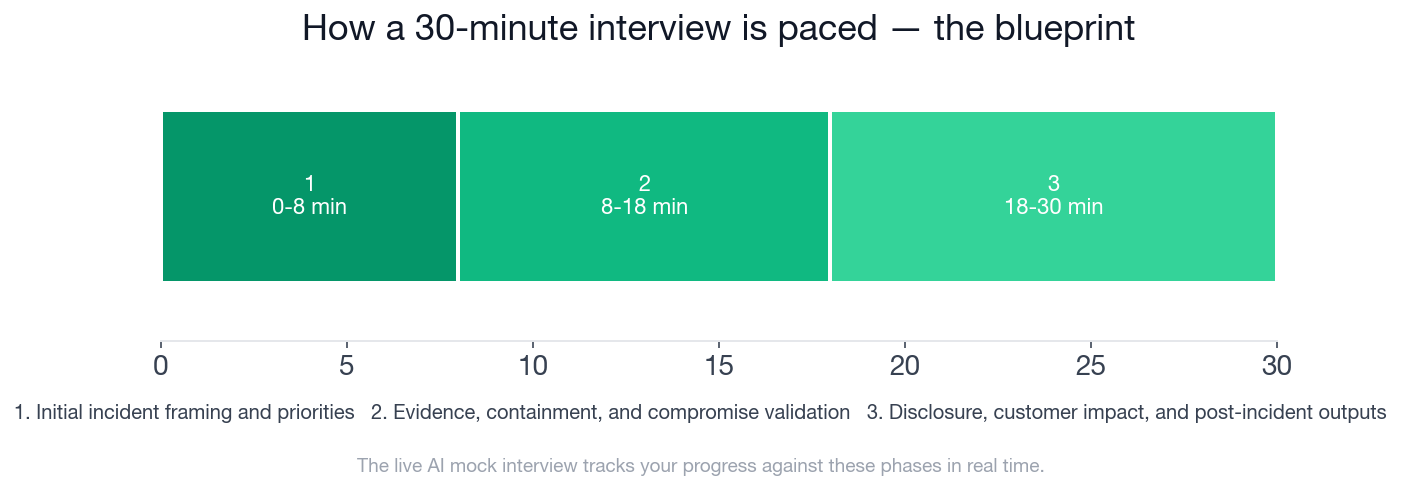
- The interview runs 30 minutes in 3 phases: 0-8, 8-18 and 18-30 minutes.
- 15 checklist items (5 per phase) define what a strong answer hits.
- 6 follow-up prompts are available; this walkthrough dramatizes 4 of them.
- 4 skill areas are explicitly out of scope, including malware reverse engineering and SIEM rule authoring.
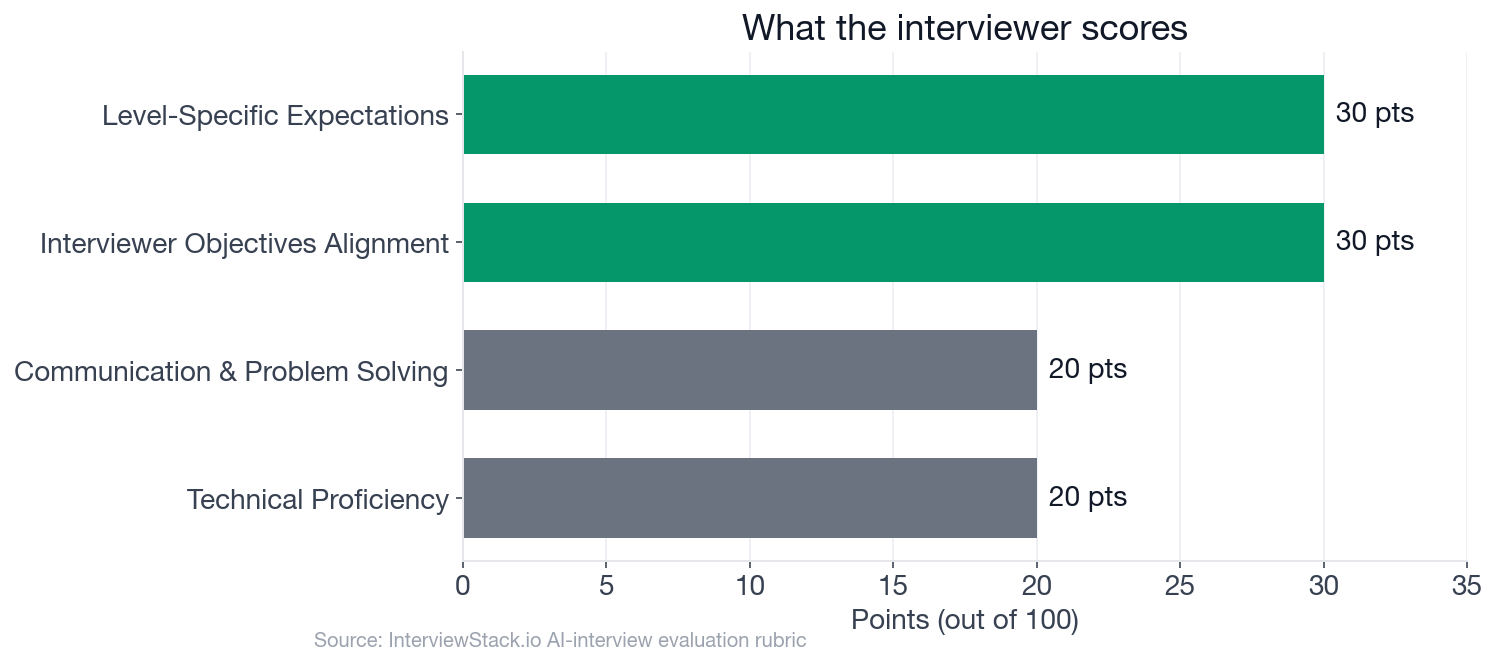
Coordination and judgment carry 60 points, so a perfect artifact walkthrough cannot rescue a vague answer about who decides.
What Does a Digital Forensic Examiner Breach Response Interview Actually Test?
You get the scenario below, then one open question.
The interview question
You are on the incident response rotation for a large cloud-based consumer platform. Overnight, an internal service account appears to have been used to access a customer-data store in a way that does not match normal automation patterns. At the same time, an engineering team reports they recently changed permissions on a Kubernetes-deployed internal tool, and there is disagreement about whether this is a real compromise or an operational mistake. Some of the affected systems run in cloud accounts that may themselves be part of the crime scene. Legal has asked not to disrupt potentially relevant evidence, while operations is pushing to revoke access immediately. Leadership wants an update within the hour, and several enterprise customers are already asking whether their data was exposed.
Walk me through how you would run the first several hours of this incident response.
The interviewer is probing whether you can structure an incident with incomplete facts, weigh rapid containment against preserving evidence in cloud and Kubernetes environments, separate a compromise from an operational mistake, and reason about who must be told what, by when. It is not a malware or artifact-parsing test. At mid-level you should also know when to escalate to the incident commander or privacy counsel rather than overreach.
Four Follow-Ups, Four Places Points Leak
Turn 1: Contain or Preserve
Interviewer: "If operations wants immediate containment but you believe the cloud account and Kubernetes nodes contain critical evidence, how would you decide what to do first and who makes that call?"
Turn 2: Breach or Mistake
Interviewer: "What would you do to separate a true security incident from a benign but harmful configuration mistake, and how much confidence would you need before telling leadership it is a breach?"
Turn 3: Scoping With Gaps
Interviewer: "Assume logs are incomplete and the internal tool may have exposed data to a much broader employee audience than intended. How would you scope likely exposure well enough to support legal and customer communications?"
Turn 4: Three Clocks
Interviewer: "If this incident may trigger different notification obligations for regulators, enterprise customers, and affected users on different timelines, how would you sequence decisions and communication?"
Would You Say "Wait" to an Operations Lead Live?
Spotting these mistakes on the page is easy. Avoiding them live is the real skill: the interviewer interrupts, a stakeholder pushes back, and the clock keeps running. Mistakes show up when you have to hold a position under pressure, and only repetitions make that automatic.
What Does the 30-Minute Blueprint Check?
This is the blueprint a strong candidate hits, and it is exactly what the AI mock interview tracks you against in real time.
- ✓States an immediate incident command structure or clear ownership model
- ✓Identifies parallel workstreams such as evidence preservation, containment evaluation, scoping, and communications
- ✓Calls out key unknowns without being blocked by them
- ✓Distinguishes actions that are reversible from those that may destroy evidence
- ✓Plans a leadership update with current facts, risks, and next checkpoints
- ✓Explains what evidence to preserve first in cloud accounts and Kubernetes-related systems at a procedural level
- ✓Mentions preserving logs, snapshots, IAM state, audit trails, timelines, and access histories before or alongside disruptive actions where feasible
- ✓Describes documenting who collected what, when, how, and under whose authority
- ✓Proposes a method to test competing hypotheses such as credential compromise versus misconfiguration
- ✓Chooses containment actions that reduce risk while minimizing unnecessary destruction of artifacts
- ✓Explains how to estimate affected data, audience, and time window despite incomplete logs
- ✓Recognizes that legal/privacy counsel should guide notifiability decisions while security provides technical facts and confidence levels
- ✓Sequences notifications thoughtfully across regulators, customers, and users when clocks differ
- ✓Provides a concise executive/customer update structure that avoids speculation
- ✓Names concrete post-incident deliverables such as evidence package, timeline, decision log, control gaps, and response-process improvements
Put Yourself on the Overnight Rotation
Run this incident against a live interviewer that follows up on whatever you say. Start the AI mock interview for this exact topic and see how you score against the blueprint above. To drill the underlying ideas first, use the Security Incident and Breach Response question bank, and browse our preparation guides for the wider role.
FAQ
Q. What does a Digital Forensic Examiner breach response interview test?
It tests coordination more than tooling. Interviewer Objectives Alignment and Level-Specific Expectations carry 30 points each, so 60 of 100 points reward structuring an ambiguous incident, balancing containment against evidence, and knowing who owns each decision.
Q. How long is the mock interview and how is it paced?
30 minutes in three phases: framing and priorities (0-8), evidence, containment and compromise validation (8-18), and disclosure, customer impact and post-incident outputs (18-30). Each phase has 5 checklist items, 15 in total.
Q. Do I need to name every breach notification law?
No. At mid-level you should recognize that legal and privacy counsel guide notifiability decisions while you supply technical facts and confidence levels. Naming every regime from memory is not required.
Q. Should I contain first or preserve evidence first?
Neither as a default. The blueprint rewards separating reversible actions from ones that destroy evidence, preserving logs, snapshots and IAM state before or alongside disruptive steps where feasible, and escalating the call to the incident commander.
Q. Will I be asked to analyze malware or parse artifacts by hand?
No. Malware reverse engineering, deep hands-on artifact parsing, generic vulnerability triage and detection engineering are out of scope for this blueprint. Technical Proficiency is 20 of 100 points.
Q. Is the walkthrough a real interview transcript?
No. The candidate answers are illustrative dramatizations, and the blueprint shows how a strong interview on this topic runs. It does not reflect any specific company's real questions.
The Score Lives in the Handoffs
Every turn rewarded the same habit: say who decides, say what you know and do not know, and keep evidence and containment from fighting each other. Practice it out loud until it sounds routine.
Topics
Ready to practice?
Put what you've learned into practice with AI mock interviews and structured preparation guides.