
The DFIR Role Has a $41K Ceiling Most Candidates Miss
The biggest salary gap in Digital Forensic Examiner hiring doesn't run between seniority levels. It runs between candidates who can script and automate their security workflows and those who can't: a $41,000 difference between the $180,100 US median for automation-fluent examiners and the $139,100 role baseline.
That gap stands out in a dataset where most skills cluster close to baseline. Incident Response, the role's only true table-stakes skill (present in 94.6% of postings), pays just $1,700 above the role median. Monitoring, Security Operations, and AWS are all within $900 of baseline. Automation is the lone outlier, and the size of the premium signals something specific: companies are paying for the examiner who doesn't just analyze evidence but architects and automates the pipeline that collects and processes it at scale.
The data comes from 667 distinct Digital Forensic Examiner postings active on the InterviewStack.io job board as of June 2026, with skills extracted from job descriptions and synonyms collapsed. The broader picture is that the role functions in practice as a DFIR (Digital Forensics and Incident Response) practitioner rather than a pure forensics specialist: incident response dominates the skill map, while "digital forensics" as an explicit skill appears in only 15.6% of postings, placing it firmly in the differentiator tier.
A note on dataset scope: The job-board classifier that surfaces postings under this role title captures a spectrum of cybersecurity professionals: incident response analysts, SOC leads, and security operations managers appear alongside dedicated forensics practitioners. Treat the skill and salary patterns as representative of the broader DFIR hiring ecosystem rather than a pure digital-forensics-only subset. The directional signals (IR as the entry ticket, automation commanding the largest premium, SIEM adding measurable salary uplift) hold across this spectrum.
Key Findings
- Incident Response appears in 94.6% of Digital Forensic Examiner postings (632 of 667), the only table-stakes skill by a wide margin.
- The median US base salary is $139,100 (n=172 US postings with salary disclosed). Automation earns $180,100, a $41,000 premium, the largest gap in the dataset.
- SIEM skills add roughly $18,900 above baseline ($158,000 US median, n=39 postings).
- "Digital Forensics" as an explicit skill appears in only 15.6% of postings, placing it in the differentiator tier below Windows (19%), EDR (19.6%), and Threat Intelligence (19%).
- Entry-level openings account for just 4.5% of postings (30 of 667); mid-level dominates at 67.8%.
- Only 14.8% of postings (99 of 667) are fully remote. Chain-of-custody requirements, secure facility access, and physical hardware analysis make this among the most location-bound roles in cybersecurity.
- The Linux + Windows skill pair has a co-occurrence lift of 4.45, signaling the cross-platform enterprise environment most examiner work operates in.
Which Skills Actually Move Pay for Digital Forensic Examiners?
Salary figures below are restricted to US postings only, where wage-transparency laws produce consistent disclosure across states. They capture base salary only: equity, bonuses, RSUs, and sign-on are not included in posting data, so total compensation at top employers, particularly in defense contracting and financial services, runs higher than what we report.
The overall median US base salary for Digital Forensic Examiner roles is $139,100 (n=172 postings with disclosed salary data).
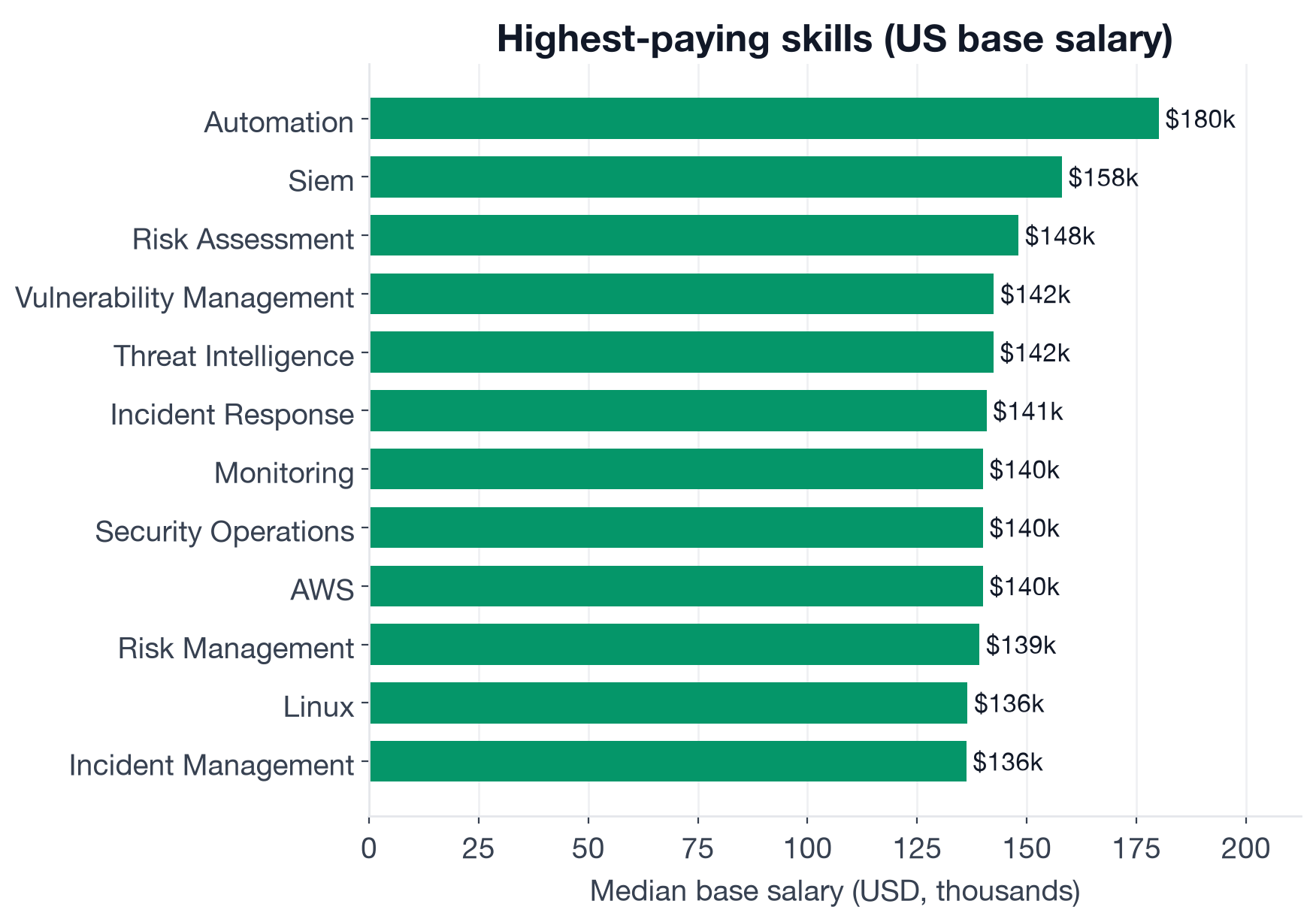
Median US base salary in USD for postings that mention each skill, among US Digital Forensic Examiner postings with structured salary data.
The skill-by-skill picture organizes into three distinct groups:
Premium tier (more than $10K above baseline):
Automation leads by a large margin. Postings listing security automation skills carry a median US base salary of $180,100 (n=32 US postings with salary disclosure, a meaningful premium on a modest sample; interpret directionally), roughly $41,000 above the role baseline. The premium likely reflects demand for examiners who can design SOAR-style workflows (SOAR stands for Security Orchestration, Automation and Response: platforms that connect SIEMs, EDR tools, and IR procedures into automated pipelines) rather than just operate existing toolchains case by case. That capability is scarce, and the $41,000 gap reflects it directly.
SIEM skills follow at $158,000 (n=39), about $18,900 above baseline. SIEM fluency at this premium tier isn't just knowing what a SIEM dashboard looks like; the postings paying this rate expect query authoring, correlation rule development, and alert tuning.
Moderate premium tier ($3K to $9K above baseline):
- Risk Assessment: $148,100 (n=32), +$9,000
- Vulnerability Management: $142,500 (n=26), +$3,400
- Threat Intelligence: $142,400 (n=25), +$3,300
These skills mark practitioners who go beyond reactive investigation into proactive risk identification and threat tracking, pushing the examiner profile closer to a threat analyst.
Baseline cluster:
Most commonly required skills pay near the $139,100 US median:
| Skill | US Median | vs. Baseline |
|---|---|---|
| Incident Response | $140,800 | +$1,700 |
| Monitoring | $140,000 | +$900 |
| Security Operations | $140,000 | +$900 |
| AWS | $140,000 | +$900 |
| Risk Management | $139,200 | +$100 |
| Linux | $136,500 | -$2,600 |
| Incident Management | $136,200 | -$2,900 |
Incident Response, present in 94.6% of postings, earns only $1,700 above baseline. When every candidate has it, it stops moving pay. Automation's $41,000 premium is what happens when a skill is genuinely valuable and genuinely scarce in the same labor pool.
The Breadth Behind the Digital Forensic Examiner Title
Group every skill into its broader family and count how many postings ask for at least one skill in that family. The role's shape emerges quickly.
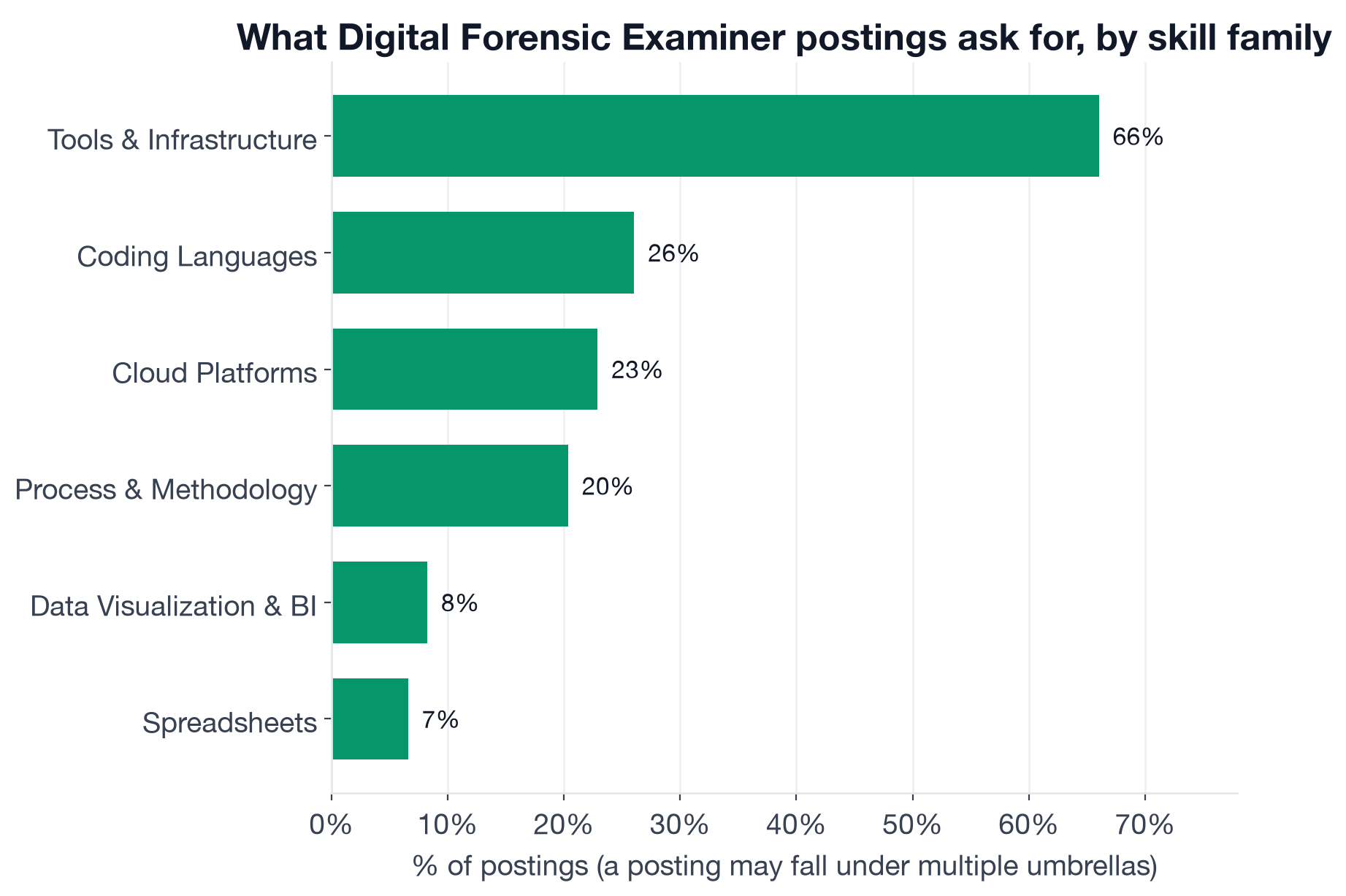
Share of Digital Forensic Examiner postings that ask for at least one skill in each family. A posting that mentions both Windows and Threat Intelligence counts once under the security domain family.
The key patterns by family:
- Security Domain: 99.3% of postings ask for at least one security-domain skill (incident response, threat intelligence, risk management, malware analysis, network security, and similar). This family is effectively the whole dataset.
- Tools and Infrastructure: 66% ask for operational tooling, including monitoring platforms, automation, Linux, EDR (Endpoint Detection and Response) systems, and scripting environments.
- Coding Languages: 26% require a scripting or programming language, primarily Python (16%) and Bash (8%). Neither reaches the common tier individually, but together they mark the examiners who can write investigative scripts rather than only operate existing tools.
- Cloud Platforms: 22.9% mention a cloud platform, with AWS (19.5%) leading Azure (16.2%) and Google Cloud (11.8%). Cloud forensics is still a differentiator rather than a baseline requirement, but the proportion is trending upward as more enterprise incidents involve cloud infrastructure.
- Machine Learning and AI: 4.5% of postings explicitly require AI or ML skills, which measures the small fraction of examiners hired to build or architect AI systems. The ambient adoption layer is far broader. A Cellebrite 2025 survey of 2,000+ forensics professionals found 90% believe AI positively impacts digital investigations, with 72% citing content classification and prioritization as the most valuable capability. The 4.5% explicit figure is a floor, not a measure of who uses AI tools day to day.
Three Tiers of Digital Forensic Examiner Skills in 2026
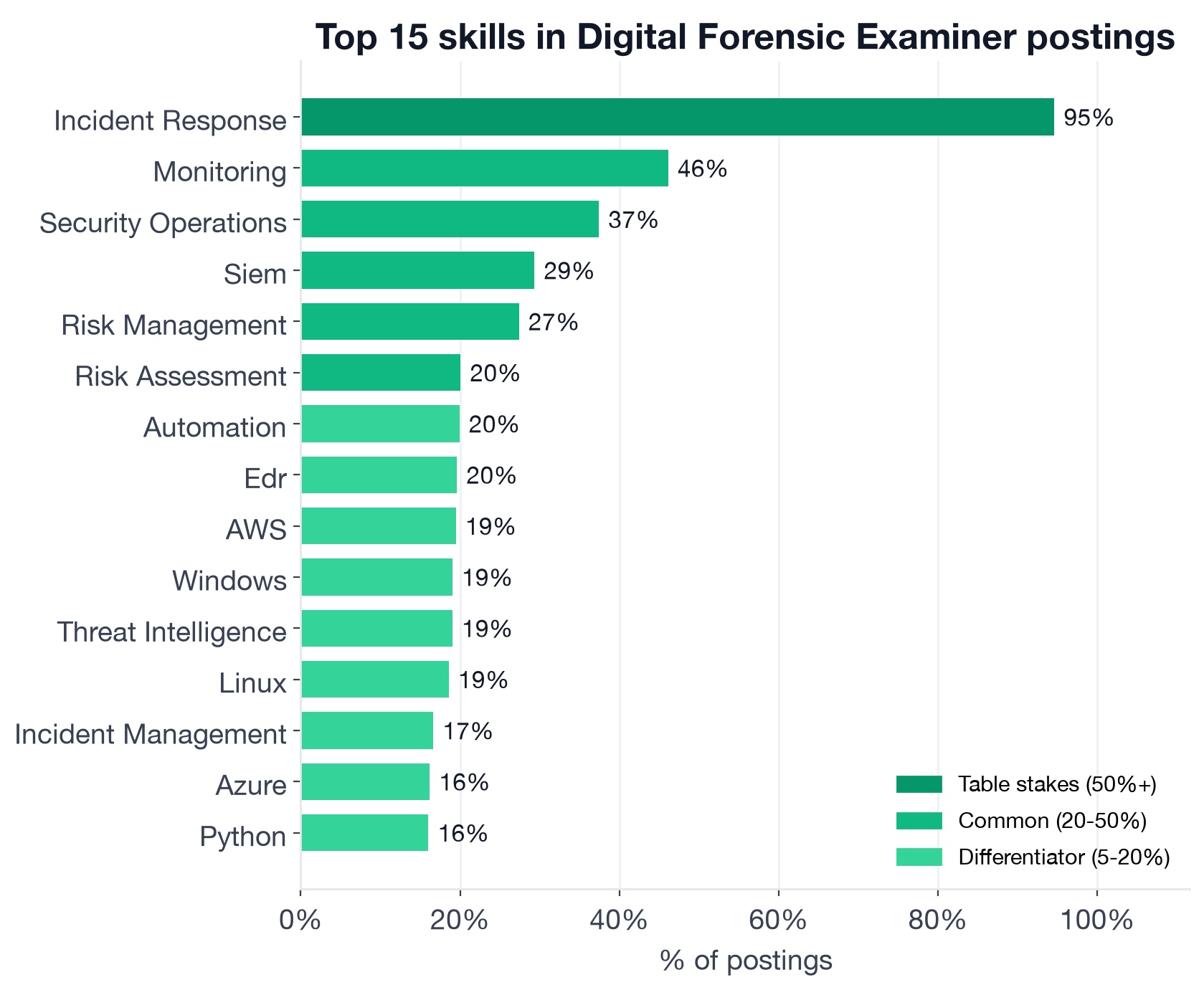
Top individual skills in Digital Forensic Examiner postings by share of listings. Skills above 50% are table stakes; 20-50% are common; 5-20% are differentiators.
Table Stakes (50% or more of postings)
One skill clears the 50% threshold, by an unusually wide margin:
- Incident Response: 94.6% (browse Digital Forensic Examiner roles requiring incident response)
Most roles have three or four table-stakes skills. This one has one. That concentration means every viable candidate needs a credible IR track record, and everything above that baseline is what separates candidates in screening. There is no version of this job that does not require documented incident response experience.
Common Expectations (20-50% of postings)
- Monitoring: 46.1%
- Security Operations: 37.4%
- SIEM: 29.3% (Digital Forensic Examiner roles with SIEM requirements)
- Risk Management: 27.4%
- Risk Assessment: 20.1%
SIEM at 29.3% is the common-tier skill with the best salary return: $18,900 above baseline despite appearing in fewer than a third of postings. Among the five common skills, it is the one worth developing past surface-level familiarity into genuine query and rule authorship.
Differentiators (5-20% of postings)
The differentiator tier is where the role's character branches:
- Automation: 19.9% (carries the $41K premium)
- EDR: 19.6%
- AWS: 19.5%
- Windows: 19.0%
- Threat Intelligence: 19.0%
- Linux: 18.6%
- Azure: 16.2%
- Python: 16.0%
- Digital Forensics (as an explicit skill): 15.6%
- Vulnerability Management: 13.9%
- Threat Hunting: 12.4%
- Malware Analysis: 12.1%
- Cloud Security: 11.5%
Two findings stand out. First, "digital forensics" as a named skill sits at 15.6%, below Windows, EDR, and Threat Intelligence. Employers label the role as a forensic examiner but write JDs that primarily describe an incident responder with forensic depth. That gap is real and worth understanding before you position your resume. Second, Python (16%) and Automation (19.9%) sit adjacent in the differentiator tier, and their proximity traces exactly the automation premium: the examiner who adds scripting fluency to an IR and SIEM foundation is the one commanding $41K above baseline.
How DFIR Tool Pairs Signal Employer Expectations
Co-occurrence analysis across the top 25 skills shows which tool combinations appear together more often than their individual frequencies would predict. A lift above 1 means the pair is over-represented; the higher the lift, the stronger the co-selection signal.
| Skill pair | Postings with both | % of postings | Lift |
|---|---|---|---|
| AWS + Google Cloud | 77 | 11.5% | 5.01 |
| Linux + Windows | 105 | 15.7% | 4.45 |
| AWS + Azure | 85 | 12.7% | 4.04 |
| EDR + SIEM | 107 | 16.0% | 2.78 |
| Risk Assessment + Risk Management | 81 | 12.1% | 2.21 |
| Automation + SIEM | 78 | 11.7% | 2.00 |
| Monitoring + Security Operations | 146 | 21.9% | 1.27 |
Each pair signals a distinct employer context or investigation scope:
- Linux + Windows (lift 4.45): Enterprise cross-platform IR coverage. A posting mentioning Windows is 4.45x more likely to also ask for Linux expertise, marking roles that operate across the full enterprise OS footprint rather than Windows-only corporate environments. This pairing is more diagnostic of the actual work than either skill alone.
- AWS + Google Cloud (lift 5.01) and AWS + Azure (lift 4.04): Multi-cloud investigation capability. These are the highest lifts in the dataset. Organizations running multi-cloud infrastructure need examiners who can collect evidence, follow audit trails, and preserve chain of custody across providers with different forensic tooling and log architectures.
- EDR + SIEM (lift 2.78): The core detection toolchain. EDR handles endpoint telemetry and response; SIEM aggregates, correlates, and alerts across the environment. Postings naming one almost always name the other because they form the operational spine of any SOC-adjacent forensic function.
- Automation + SIEM (lift 2.00): The SOAR signal. This pairing marks roles where the examiner is expected to build automated response workflows on top of the SIEM infrastructure, not just monitor dashboards. It is the downstream skill that explains the automation salary premium.
- Risk Assessment + Risk Management (lift 2.21): Compliance-oriented scope. Postings naming both tend to sit inside financial services, healthcare, or heavily regulated industries where forensic findings feed directly into audit reporting and regulatory response.
Who Actually Gets Hired, and at What Level?
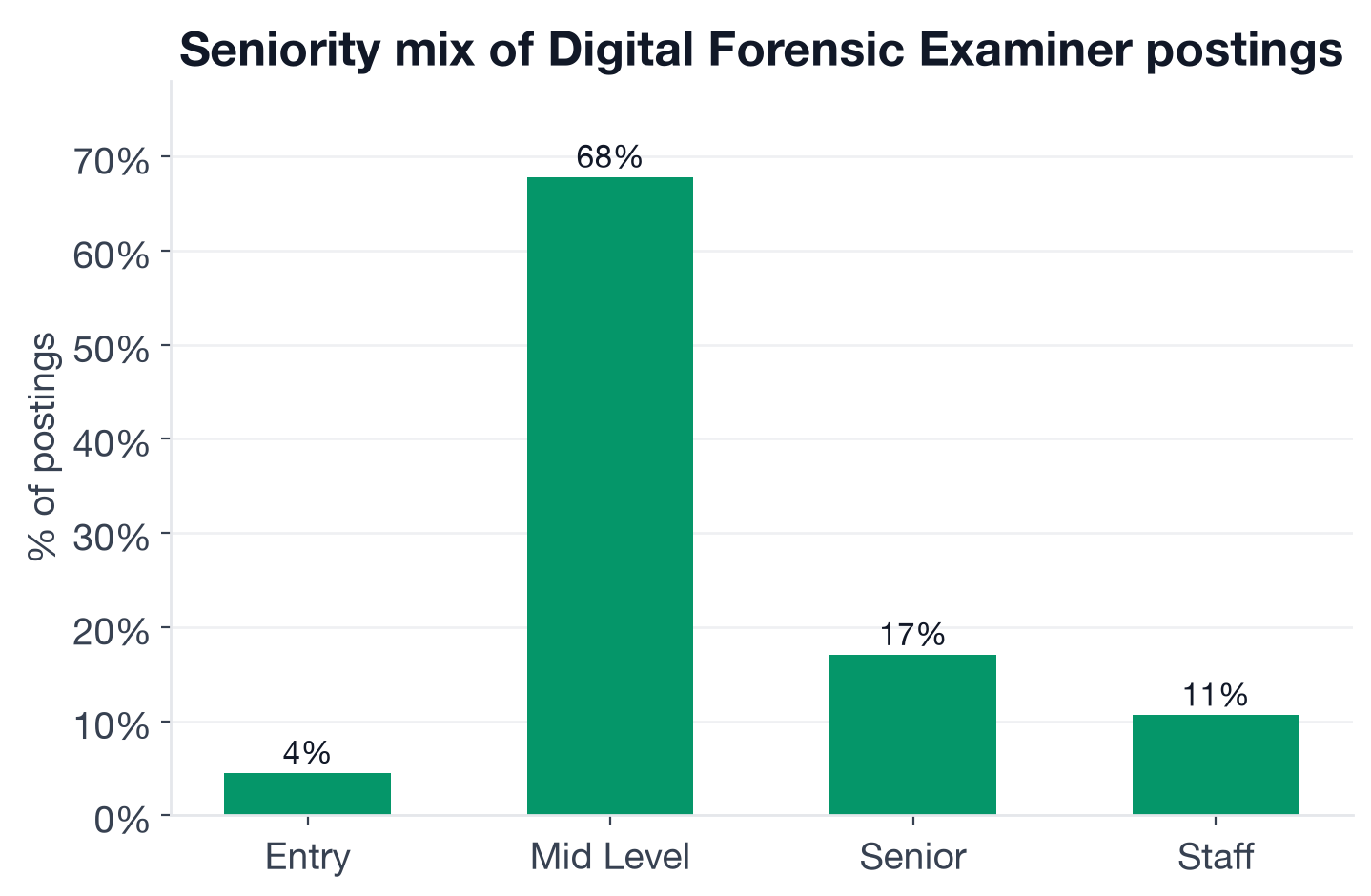
Seniority distribution of Digital Forensic Examiner postings based on title keywords.
- Mid-level: 67.8% (453 postings)
- Senior: 17.1% (114)
- Staff / Lead: 10.6% (71)
- Entry: 4.5% (30)
The mid-level concentration at 67.8% is higher than most technical roles. Companies want practitioners who have run actual incident investigations, but most openings don't require a decade of experience. Mid-level is the real hiring target in this market.
Entry-level is tight at just 4.5% (30 postings). Companies expect you to arrive with at least some IR track record, which typically means a prior stint as a SOC analyst, IT security specialist, or junior incident responder. If you're targeting this role early in your career, browsing entry-level DFIR openings will show available positions, but volume is limited and competition is concentrated.
Senior and staff roles together account for 27.7% of the market. The ladder is real: examiners who develop automation expertise, threat intelligence depth, or multi-cloud forensics capabilities have a clear path above mid-level. The differentiator skills are not just nice-to-haves at senior level; they become the bar.
Where the Jobs Are, and How Few Are Remote
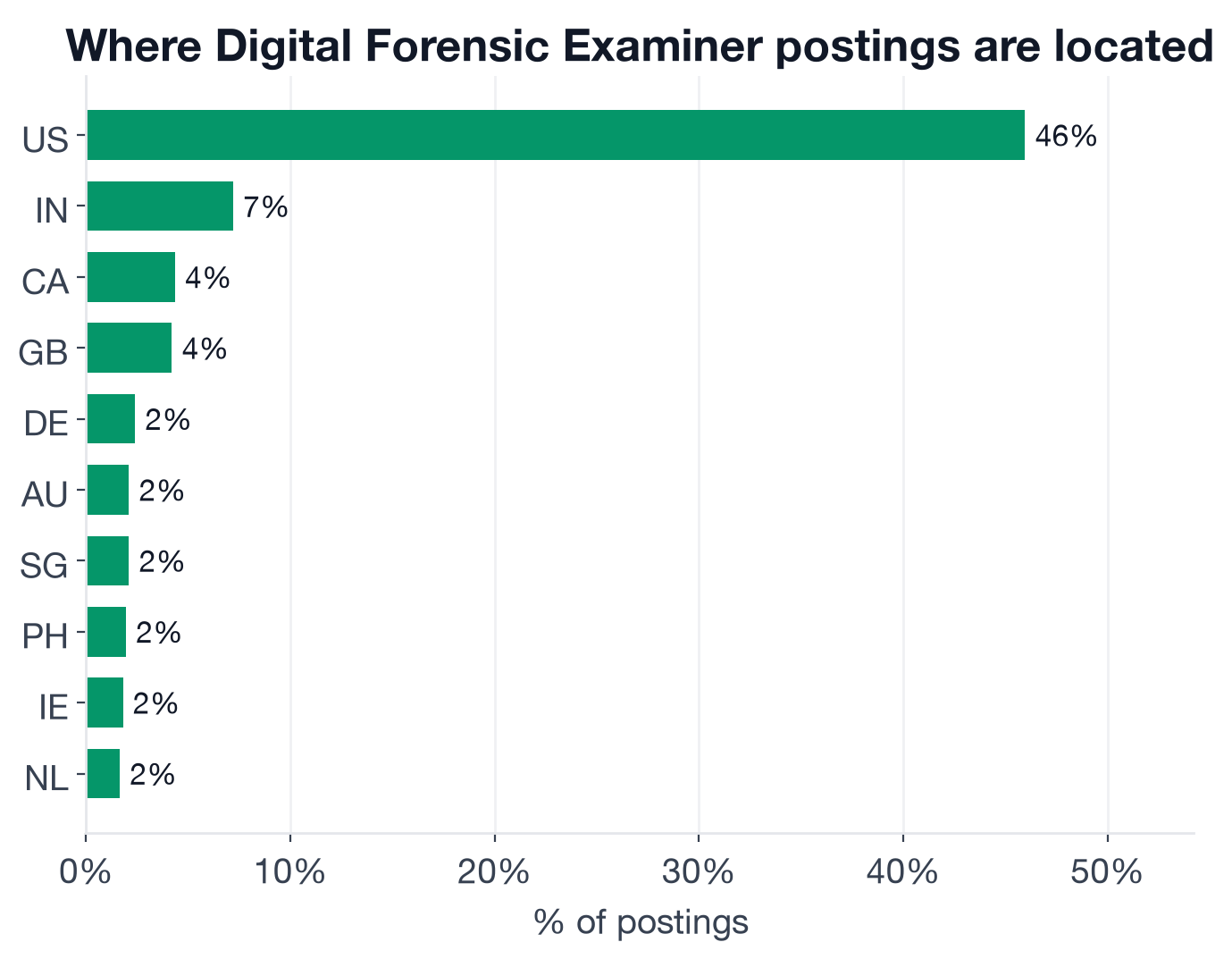
Top countries by share of Digital Forensic Examiner postings.
The US accounts for 46% of postings, a concentration noticeably higher than most cybersecurity roles. After the US, the distribution is diffuse: India at 7.2%, Canada at 4.3%, and the UK at 4.2%.
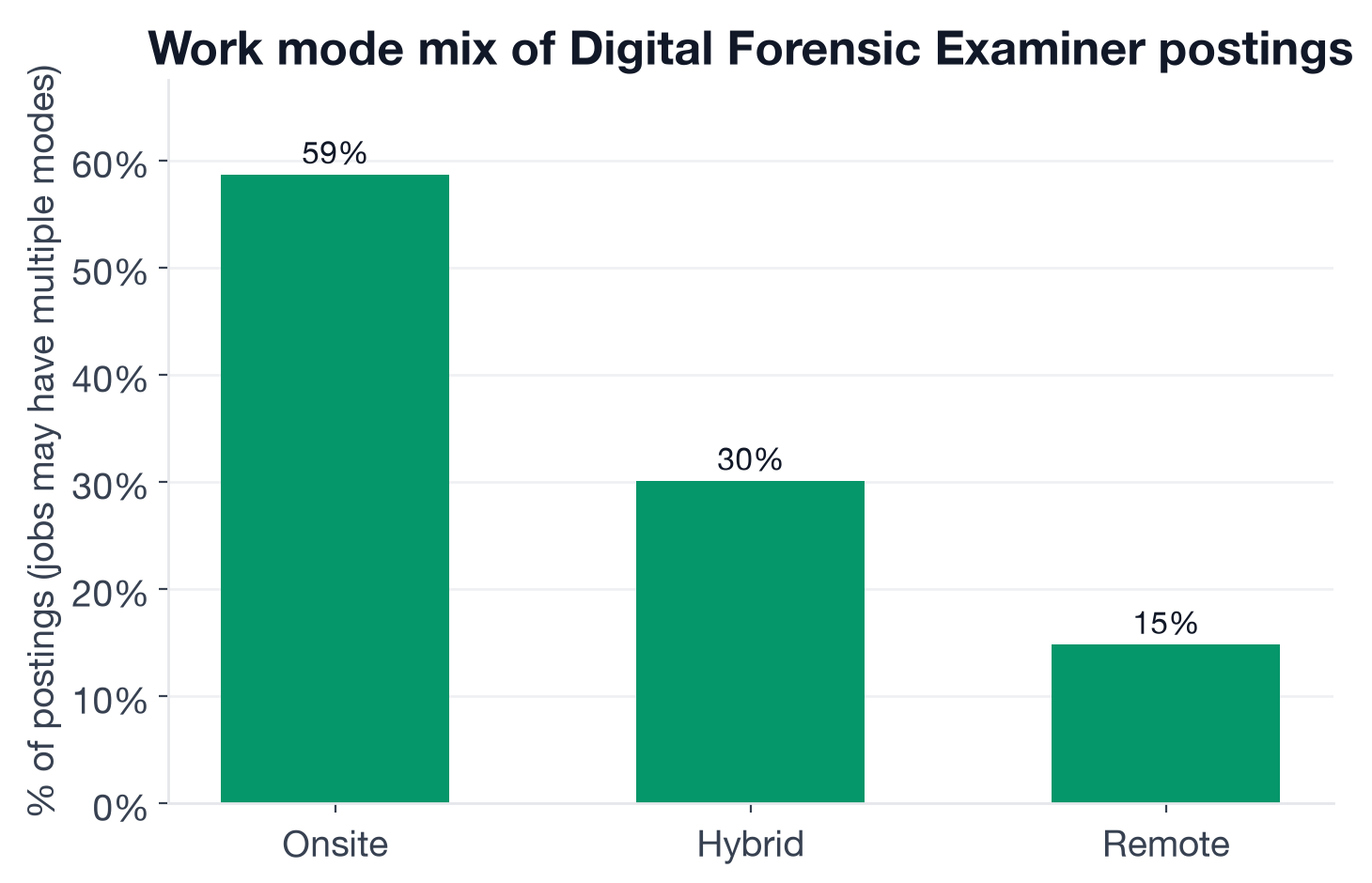
Share of Digital Forensic Examiner postings by work mode.
The remote numbers are decisive: only 14.8% of postings (99 of 667) are fully remote. At 58.7% onsite and 30.1% hybrid (some postings carry multiple work-mode tags, so these figures sum above 100%), this is one of the most location-anchored cybersecurity roles on the board. The reasons are structural, not preferential. Chain-of-custody requirements for digital evidence, secure facility access for government and defense work, physical hardware analysis, and law enforcement coordination all anchor the role to specific locations. Among US postings, fully remote Digital Forensic Examiner roles exist but represent a small fraction of the market.
Who's Hiring Digital Forensic Examiners in 2026?
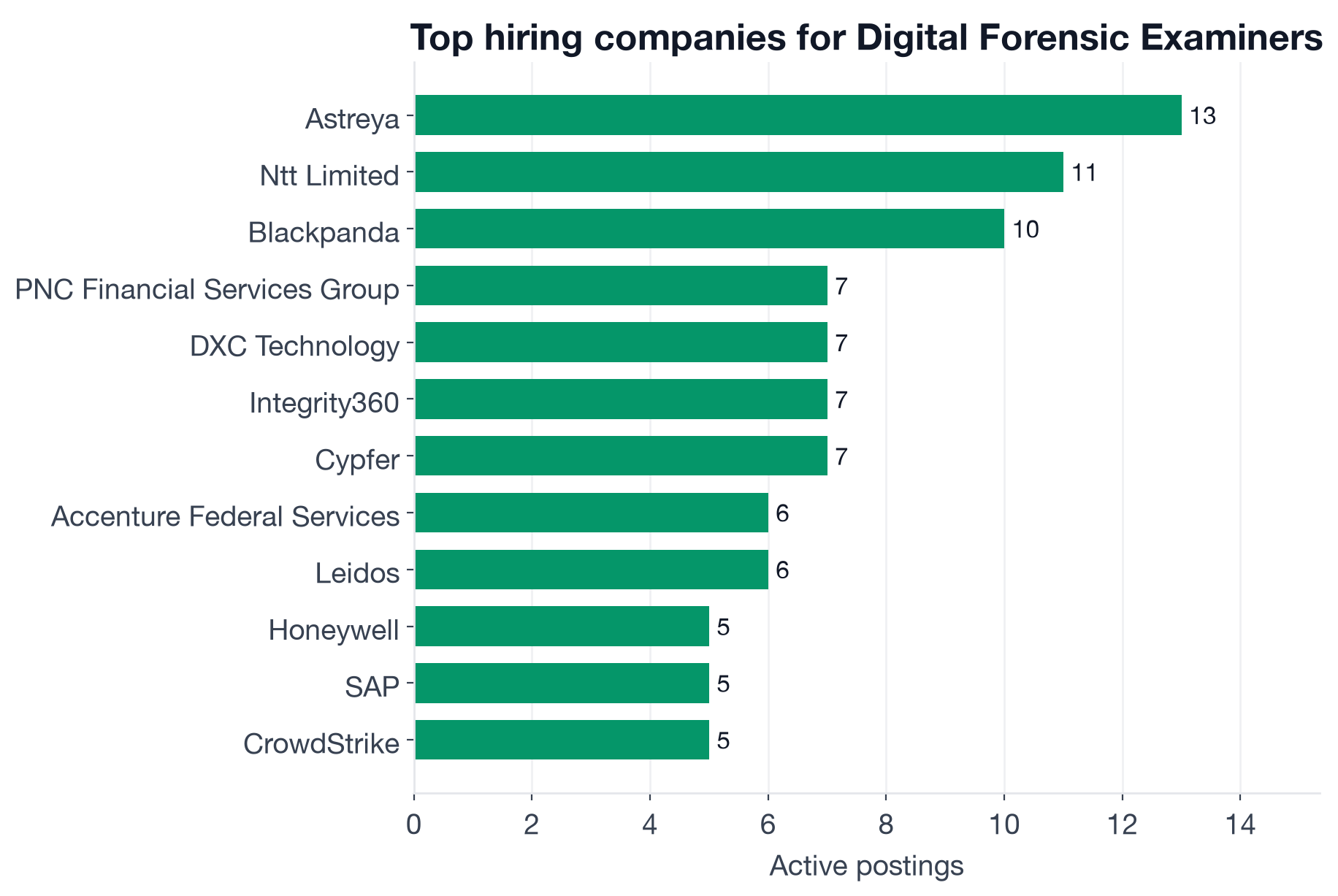
Top companies by distinct Digital Forensic Examiner openings as of June 2026. Honeywell (5) and SAP (5) also tie at the 5-opening level; see the segment breakdown below for all five tied employers.
The company roster breaks into five segments, each representing a different version of the role:
Specialized DFIR and incident response firms:
Blackpanda (10), Cypfer (7), Integrity360 (7), and CrowdStrike (5) are pure-play cybersecurity organizations where forensic examination is core to the product, not a supporting function. These firms offer the most forensics-intensive work and tend to recruit for technical depth over broad IT generalism.
US government and defense contractors:
Accenture Federal Services (6), Leidos (6), and Booz Allen Hamilton (5) dominate the cleared segment of the US market. Many of their Digital Forensic Examiner positions require active security clearances (Secret or TS/SCI), which are rare and intensify competition but also open a pipeline of roles that aren't visible in the commercial market.
Global IT and technology services:
Astreya (13), NTT Limited (11), DXC Technology (7), and Accenture (5) handle enterprise IR engagements at scale for global clients. These firms tend to offer broader geographic mobility, faster hiring timelines, and structured career paths in exchange for client-site work and variable travel requirements.
Financial services:
PNC Financial Services Group (7) reflects the broader trend of large banks building in-house forensic teams as cybersecurity regulatory requirements tighten. Financial services is one of the more stable hiring sectors for DFIR talent.
Industrial and enterprise technology:
Honeywell (5) and SAP (5) round out the five-way tie at the 5-opening level. Both represent in-house corporate security functions rather than forensics-as-a-service practices: Honeywell's postings skew toward industrial control systems and OT environment coverage; SAP's reflect enterprise software security operations. Their hiring context differs from the specialist and contractor segments above, but both are genuine employers at this tier.
The right segment depends on your goals. Government contractors offer clearance-track career development with strong compensation ceilings. Specialist DFIR firms offer the deepest technical exposure. IT services firms offer volume and client variety. For company-specific interview expectations, our interview preparation guides cover the major employers' hiring processes in detail.
How to Use This in Your Job Search
Build the IR foundation first. Incident Response in 94.6% of postings is the non-negotiable entry ticket. If you're building that foundation now, target junior SOC analyst or IT security roles that will create the documented track record employers expect. Our interactive courses cover security foundations, and the question bank lets you drill incident response, threat analysis, and risk management topics before technical screens.
Add SIEM depth next. Among common-tier skills, SIEM at 29.3% demand has the best premium-to-demand ratio: $18,900 above baseline for a skill that appears in fewer than a third of postings. Fluency in a major platform (Splunk appears in 9.4% of postings; Microsoft Sentinel is implied in many Azure-requirement listings) translates directly to investigation work and makes you a stronger candidate for DFIR roles with SIEM requirements.
Treat automation as the long-term investment. The $41K premium doesn't come from tool certification. It comes from Python scripting, SOAR platform familiarity, and the ability to automate collection and triage workflows at scale. Getting there takes time, but the salary data is unambiguous about the destination. AI mock interviews let you practice the technical dimensions of security engineering under realistic interview conditions, including problem-solving questions that probe automation and scripting reasoning.
Filter the board for your specific stack. Browse active Digital Forensic Examiner openings on the InterviewStack.io job board and combine skill and work-mode filters to match your profile: roles requiring Python, roles with SIEM requirements, or remote-eligible openings. Listings update daily.
FAQ
Q. What is the median salary for a Digital Forensic Examiner in 2026?
The median US base salary for Digital Forensic Examiner roles is $139,100, based on 172 US postings with disclosed salary data analyzed in June 2026. Equity and bonuses are not reflected in this figure; total compensation at top employers is meaningfully higher.
Q. Which skills pay the most in Digital Forensic Examiner roles?
Automation commands the largest premium at $180,100 US median (n=32), roughly $41,000 above the $139,100 role baseline. SIEM skills follow at $158,000 (+$18,900). Risk Assessment ($148,100, n=32), Vulnerability Management ($142,500, n=26), and Threat Intelligence ($142,400, n=25) round out the premium tier.
Q. What skills do Digital Forensic Examiner jobs require?
Incident Response appears in 94.6% of Digital Forensic Examiner postings (632 of 667 analyzed), the only true table-stakes skill. Common-tier skills (20-50% of postings) include Monitoring (46.1%), Security Operations (37.4%), SIEM (29.3%), Risk Management (27.4%), and Risk Assessment (20.1%). Digital Forensics as an explicit skill sits in the differentiator tier at just 15.6%.
Q. Is Digital Forensic Examiner a good entry-level role to break into?
Entry-level postings represent only 4.5% of the Digital Forensic Examiner market (30 of 667 listings analyzed). Mid-level roles dominate at 67.8%. Most employers expect demonstrated incident response experience before hiring into this role. The path typically runs through junior SOC analyst or IT security roles first.
Q. Are Digital Forensic Examiner jobs remote-friendly?
Remote work is limited in this field: only 14.8% of postings (99 of 667) offer fully remote work. The role is 58.7% onsite and 30.1% hybrid. Evidence-handling requirements, secure facility access, and law enforcement coordination keep most positions tied to physical locations.
Q. How is AI changing the Digital Forensic Examiner role?
Only 4.5% of Digital Forensic Examiner postings explicitly require AI or machine learning skills, meaning few companies are hiring forensic examiners to build AI systems. But a Cellebrite survey of 2,000+ forensics professionals found 90% believe AI positively impacts investigations, with 72% citing content classification and prioritization as the most valuable AI capability. AI-assisted triage is becoming standard practice for the data-volume problem: 69% of investigators report not having enough time to review all case data without assistance.
Q. Which companies hire the most Digital Forensic Examiners?
Top employers by distinct openings from June 2026 data: Astreya (13), NTT Limited (11), Blackpanda (10), PNC Financial Services Group (7), DXC Technology (7), Integrity360 (7), Cypfer (7), Accenture Federal Services (6), Leidos (6), Honeywell (5), SAP (5), CrowdStrike (5), Booz Allen Hamilton (5), and Accenture (5). Five companies tie at 5 openings; all are included.
The Bottom Line
The Digital Forensic Examiner market in 2026 is fundamentally an incident response market with forensic depth as the differentiating skill. Incident Response is the universal entry ticket. SIEM pays a meaningful premium for those who go beyond knowing the platform to actually building detection logic inside it. Automation is where the ceiling sits: $41,000 above baseline for examiners who can script and orchestrate their own workflows rather than execute them manually, case by case. The role is heavily US-concentrated, largely onsite, and mid-level-dominated. If you are positioning for this path, build the IR foundation first, add SIEM depth second, and treat automation fluency as the long-term investment that defines the upper end of the pay band.
Topics
Ready to practice?
Put what you've learned into practice with AI mock interviews and structured preparation guides.