
The Embedded Developer Assembly Language and Low-Level Debugging Interview Hinges on One Load Instruction
You're 90 seconds into a mid-level Embedded Developer interview. The prompt is a twelve-line C function: sum every positive byte in a buffer. It looks like a warm-up. Then the interviewer asks what happens to your assembly when a byte's value crosses 127, and the question quietly rewrites the whole interview. Half of every possible byte value just became the exam, and the loop you already sketched either survives it or doesn't.
This walkthrough follows one full 30-minute simulated interview, built on the same blueprint InterviewStack's AI mock interviewer uses to run and score real embedded systems candidates: a signed-versus-unsigned byte load, a callee-saved register convention, and a 100-point rubric spread across four dimensions. Watch where a well-prepared mid-level candidate still gives points away, then see the complete blueprint an interviewer is actually grading against.
Key Findings
- 128 of the 256 possible byte values (anything with the top bit set) silently break this function if the load instruction zero-extends instead of sign-extends.
- The 30-minute interview is paced into 3 phases: 0-7 minutes to frame the translation plan, 7-18 minutes for the assembly walk-through, and 18-30 minutes for optimization, failure modes, and validation.
- Phase 2 alone (11 minutes) carries 5 checklist items, more than either of the other two phases.
- Only 8 registers, r4 through r11, are callee-saved on this target; clobbering even one of them corrupts the caller silently, not the function that made the mistake.
- Scoring splits 30/30/20/20 across Interviewer Objectives Alignment, Level-Specific Expectations, Technical Proficiency, and Communication & Problem-Solving.
- At mid-level (2-5 years), the bar is producing a mostly correct assembly strategy without heavy prompting, not textbook-perfect syntax.
What Is the Interviewer Actually Testing With This Function?
The interview question
Target: a 32-bit ARM-like embedded system, little-endian, with int as 32 bits and char as 8 bits. Calling convention: r0-r3 hold the first four arguments, the return value comes back in r0, lr holds the return address, and the callee must preserve r4 through r11.
int accumulate_positive_bytes(const signed char *buf, int len) {
    int sum = 0;
    for (int i = 0; i < len; i++) {
        if (buf[i] > 0) {
            sum += buf[i];
        }
    }
    return sum;
}
Walk me through how you would translate the function above into assembly for this target, and explain the key choices you would make.
The interviewer isn't grading whether you can write assembly that merely runs. They're checking whether you can map ordinary C control flow (a loop, a signed comparison, an accumulator) onto real registers and real instructions, whether you follow the stated calling convention exactly (which registers hold the arguments, which one carries the return value, which ones you're required to leave untouched), and whether you reason like someone who has actually debugged code on hardware: aware of register pressure, instruction count, and how you would prove your answer is correct rather than just plausible.
Four Follow-Ups That Expose What the First Answer Skips
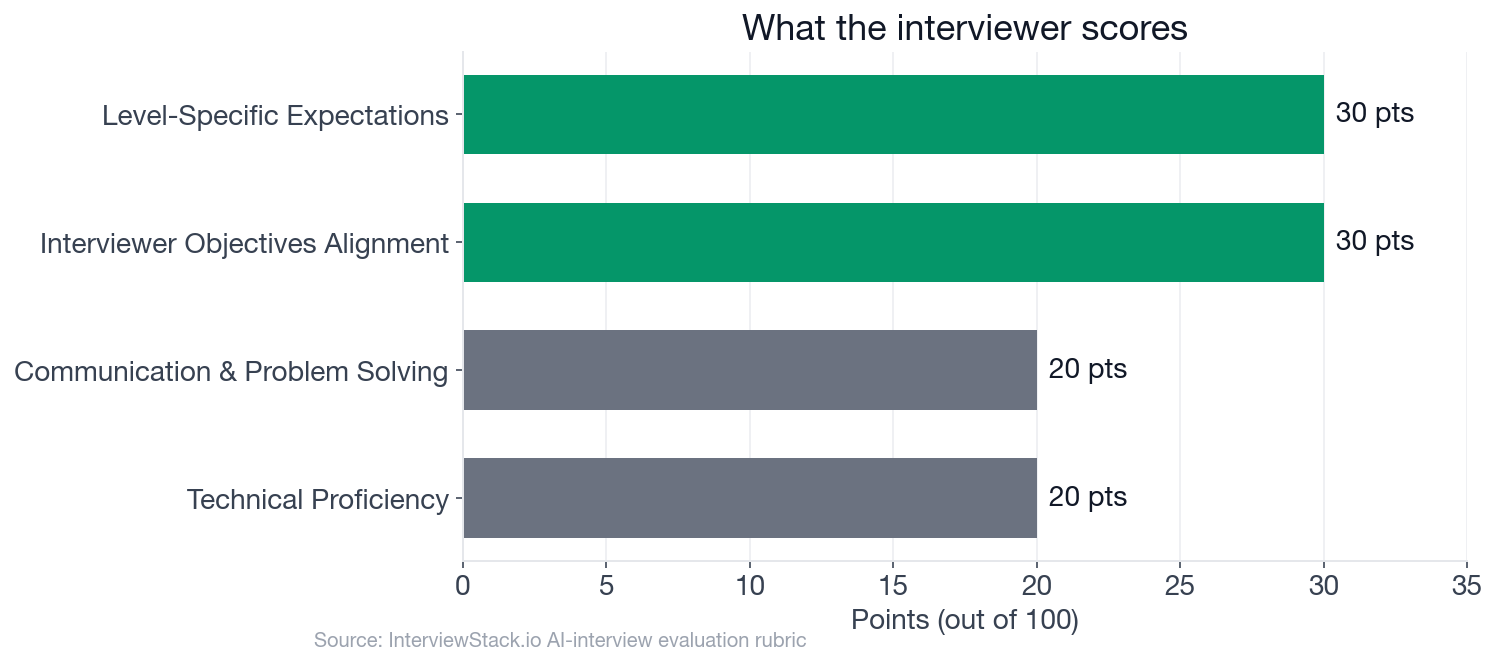
Interviewer Objectives Alignment and Level-Specific Expectations each carry 30 of the 100 points, more than Technical Proficiency and Communication & Problem-Solving combined. A syntactically clean first answer can still lose most of the interview in the follow-ups below, which is exactly where a candidate we'll call Leo starts giving points back.
Turn 1: Skip the Stack Frame, or Not?
Interviewer: "If you chose not to use a stack frame, under what conditions is that still correct on this target?"
Turn 2: The Silent r4 Clobber
Interviewer: "If another engineer rewrote this using r4 for the running sum without saving it, how would you explain the failure mode?"
Turn 3: Wrong Only Above Byte 127
Interviewer: "What bugs would you look for if the function returned the wrong answer only when bytes above 127 appear in the buffer?"
Turn 4: Proving It, Not Just Trusting It
Interviewer: "How would you verify on hardware or in a debugger that your assembly follows the calling convention and handles edge cases correctly?"
Why Doesn't Spotting the Bug on the Page Fix It Live?
Every mistake above is obvious once it's labeled in a red box. Under real interview pressure, with the interviewer waiting and Phase 2 handing you five checklist items in eleven minutes, catching your own signed-versus-unsigned bug before the interviewer has to ask about it is a different skill entirely. Reading this post teaches you to recognize the pattern after the fact. It does not teach you to hold a calling convention in your head while explaining a loop out loud, notice you're about to clobber r4 mid-sentence, and course-correct without losing your train of thought.
That gap only closes with reps. Start a live AI mock interview on assembly and low-level debugging and get scored against this same rubric while the clock is actually running, not after the fact.
What Does a Complete 30-Minute Answer Actually Cover?
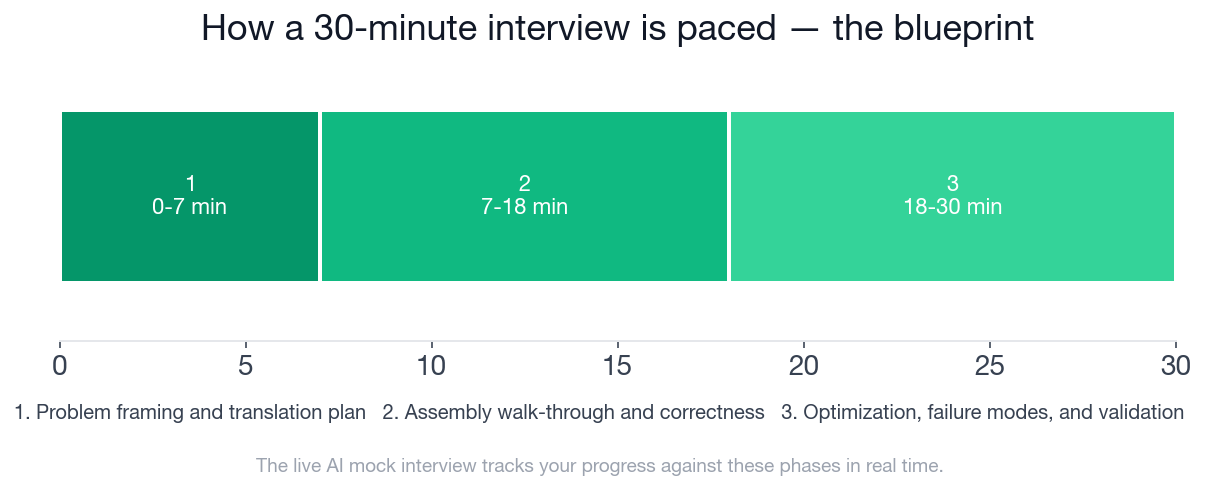
The chart paces the same 30 minutes into the three phases the interviewer is actually timing against, framing first, correctness second, optimization and validation last. The card below is the full checklist inside each phase, the exact thing the AI mock interviewer tracks against in real time as you talk.
- ✓States what inputs arrive in registers and where the return value goes
- ✓Explains the loop in terms of compare/branch and byte loads
- ✓Chooses either index-based or pointer-walk implementation and keeps it internally consistent
- ✓Identifies that only positive bytes contribute to the sum
- ✓Uses an appropriate signed-byte load conceptually equivalent to sign extension
- ✓Handles loop termination correctly for zero or negative length
- ✓Keeps live values in plausible registers without violating callee-saved rules
- ✓Explains whether a prologue/epilogue is needed based on chosen registers and whether any nested calls exist
- ✓Describes the branch or compare used for `buf[i] > 0` accurately enough to demonstrate understanding
- ✓Names at least one realistic optimization such as pointer increment, reducing memory accesses, or minimizing branches
- ✓Connects signedness bugs to specific load instructions or comparison behavior
- ✓Explains a concrete ABI failure mode from clobbering callee-saved registers
- ✓Proposes a practical validation method such as unit vectors covering negative/zero/positive bytes, disassembly review, register inspection, or stepping in debugger
Turn This Into Practice, Not Just a Read
You've now seen every mistake this scenario is built to catch and the full checklist behind it. The next step is doing this live, out loud, on the clock, with follow-ups you can't preview in advance. Start the AI mock interview for Embedded Developer assembly and low-level debugging and get scored against this exact rubric in real time.
Want to drill the individual concepts first, calling conventions, sign extension, stack frame discipline, before putting them together live? Work through the assembly and low-level debugging question bank, or browse company-specific prep guides if a specific interview process is next on your calendar.
FAQ
Q. What does an Embedded Developer assembly and low-level debugging interview actually test?
It tests whether you can translate ordinary C control flow into correct, calling-convention-compliant assembly for a real target, not whether you can recite instruction mnemonics from memory. The scoring rubric splits 100 points across four dimensions: Interviewer Objectives Alignment (30), Level-Specific Expectations (30), Technical Proficiency (20), and Communication & Problem-Solving (20), so how you reason and explain trade-offs counts as much as whether the assembly is technically correct.
Q. How is the 30-minute interview paced?
Three phases: minutes 0 to 7 for framing the translation plan (what's in which register, how the loop maps to compare-and-branch), minutes 7 to 18 for the detailed assembly walk-through and correctness, and minutes 18 to 30 for optimization, failure modes, and how you'd verify the code on real hardware.
Q. Why does this function only break for byte values above 127?
Because buf is declared as a signed char pointer, each byte has to be loaded with sign extension so a bit pattern like 0xFF is read as -1, not 255. If the assembly loads the byte as unsigned instead, every value with the high bit set (128 through 255 as raw bit patterns, exactly half of the 256 possible byte values) turns positive, passes the buf[i] greater than 0 check, and gets summed when it should have been excluded.
Q. What changes if buf is declared as an unsigned char pointer instead?
The load instruction changes from a sign-extending byte load to a zero-extending one, and the comparison logic simplifies: since every unsigned byte value is already non-negative, buf[i] greater than 0 effectively becomes 'is this byte nonzero,' and the signed-vs-unsigned bug in the original scenario disappears entirely because there's no negative interpretation left to get wrong.
Q. Which registers does this target's calling convention require the assembly to preserve?
r4 through r11 are callee-saved, meaning any function that uses them must push their original values in a prologue and restore them before returning. Skip that step and the bug doesn't show up in this function at all, it corrupts whatever the caller was keeping in that register and surfaces somewhere else entirely.
Q. Does a function like this need a stack frame?
Not necessarily. A function that makes no nested calls and either avoids callee-saved registers or properly preserves the ones it uses (r4-r11 on this target) can skip the stack frame entirely. The moment it calls another function or needs more live registers than it can safely preserve, a frame becomes necessary.
Q. What would you optimize first if this ran inside a tight interrupt-driven data path?
Start with the memory access pattern before instruction count: walking the buffer with a pointer increment instead of recomputing an index each iteration cuts address calculations, and minimizing branches inside the loop body reduces misprediction cost. But an interviewer at this level also wants to hear the other half of that answer, that optimizing a function whose correctness hasn't been verified yet, or optimizing before profiling shows it's actually the bottleneck, is its own mistake in an embedded codebase.
One Instruction, Two Outcomes
Everything in this interview, the register choices, the stack frame decision, the optimization discussion, funnels back to whether a single load instruction sign-extends or zero-extends. Get that one instruction right and the rest of the answer holds together. Miss it, and 128 of 256 possible inputs quietly produce the wrong number while your test suite says everything is fine. That's not a trivia question, it's the whole interview in miniature, and the only way to know you'd catch it live is to try it live.
Topics
Ready to practice?
Put what you've learned into practice with AI mock interviews and structured preparation guides.