
Nobody on these three teams reports to you, each has a committed roadmap, and one partner team is already hinting it will build its own version. This is a mid-level Engineering Manager cross-functional leadership interview, and a prepared candidate is about to lose points they never see coming. The scenario below comes from a real AI mock interview package; it is an illustrative blueprint of how a strong interview runs, not any company's actual question.
The twist is the weighting. Leadership judgment decides this round, because 60 of the 100 rubric points sit in objectives alignment and level-specific expectations.
Key Findings
- The interview runs 30 minutes in 3 phases: setup (minutes 0-8), alignment and disputes (8-18), execution and recovery (18-30).
- 60 of 100 rubric points reward objectives alignment (30) and level-specific judgment (30); Technical Proficiency is only 20.
- Each phase carries 5 checklist items, 15 in total, that a strong answer touches.
- The mid-level bar lists 5 expectations, one of which calls for simple tools: kickoff artifacts, RACI or DACI, dependency lists, and escalation thresholds.
- The scenario spans 3 peer teams plus 1 operations or compliance function, with zero line authority over the partner teams and a 2-quarter window.
- Escalation appears as a scored item in phase 2: it must carry a threshold and context, never be the first move.
- 6 follow-ups are available to the interviewer; this walkthrough dramatizes 4 of them.
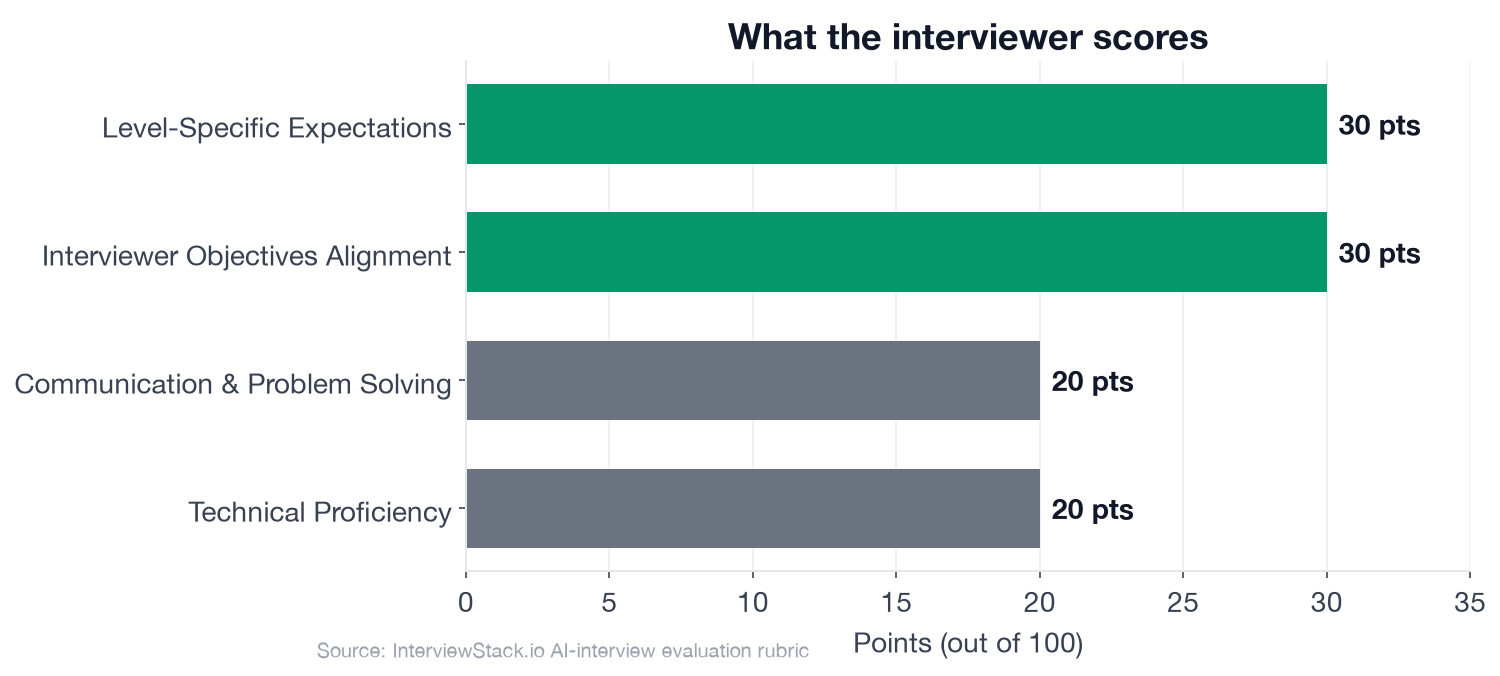
Leadership signals outweigh technical depth three to one, so spend your minutes on structure and judgment.
The Question Behind an Engineering Manager Cross-Functional Interview
The interview question
You recently became the engineering manager for a platform-adjacent team at a large consumer tech company. Leadership wants to launch a new internal service that will be used by Product Engineering, Data Infrastructure, and Trust & Safety within the next two quarters. The work depends on three peer engineering teams and one operations/compliance function. None of those teams report to you, and each already has committed roadmap work. There is already disagreement about who should own the shared service long term, and one partner team believes they can build a local version faster for their own org.
You are accountable for getting the cross-functional effort moving and giving senior leadership confidence that the program is under control, but you do not have authority to reassign headcount across teams.
How would you lead this initiative from kickoff through delivery?
The interviewer is probing whether you can set up a program, secure real commitments from peers, clarify decision rights, and recover when things slip. Designing the service itself is explicitly off the table.
Turn-by-Turn: Where Candidates Lose Points
The answers below are dramatized. A common answer here sounds like what Marcus, our illustrative candidate, says in each turn.
Turn 1: Capacity without commitment
Interviewer: "If two peer teams both say the work is important but neither will commit engineers this quarter, how would you handle that and when would you escalate?"
Turn 2: Who owns it after launch
Interviewer: "Suppose the teams disagree on who should own the shared service after launch. How would you drive that decision without stalling delivery?"
Turn 3: A dependency slips
Interviewer: "A month in, you discover one dependency is slipping and now threatens the launch date. How would you assess program health and recover the plan?"
Turn 4: The exception request
Interviewer: "One organization wants an exception so they can ship their own version instead of adopting the shared solution. How would you approach that tradeoff?"
Why Isn't Reading This Enough?
Spotting these mistakes on the page is easy. Avoiding them live, with a 30-minute clock and a follow-up you did not predict, is the real skill. Candidates who know what RACI stands for still say "I'd keep everyone aligned" when asked for a threshold. Only reps fix that, and the AI mock interview is built for exactly those reps.
How Should You Structure a Strong 30-Minute Answer?
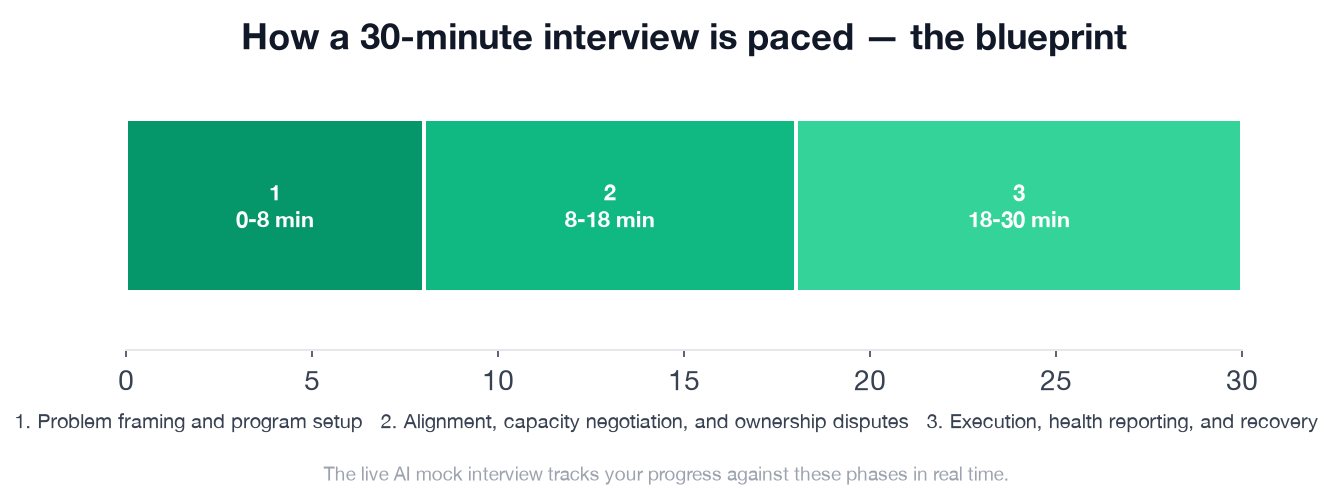
Setup gets 8 minutes, alignment 10, and execution 12, so the longest phase belongs to recovery, not kickoff. The card below is the blueprint a strong candidate hits, and exactly what the AI mock interview tracks you against in real time.
- ✓States a clear objective for the initiative and defines what success looks like across participating teams
- ✓Identifies key stakeholders and distinguishes contributors, approvers, and decision-makers
- ✓Proposes an initial kickoff or charter mechanism to align scope, timelines, and responsibilities
- ✓Introduces a lightweight decision model such as RACI or DACI, or an equivalent explicit decision-rights approach
- ✓Surfaces the need to map dependencies, approvals, and long-pole items early
- ✓Explains how they would secure explicit commitments from each team rather than relying on verbal support
- ✓Describes pragmatic options for constrained capacity, such as sequencing, scope reduction, shared staffing, or milestone-based commitments
- ✓Addresses ownership ambiguity directly with a decision process and timeline instead of leaving it unresolved indefinitely
- ✓Recognizes the risk of local one-off solutions and articulates how to evaluate or discourage fragmentation
- ✓Uses escalation as a tool with thresholds and context, not as the default first move
- ✓Describes a regular operating cadence such as working sessions, decision forums, and sponsor reviews with clear purpose for each
- ✓Tracks program health using concrete signals like dependency status, committed owners, milestone confidence, and unresolved decisions
- ✓Identifies critical path items and explains how they would replan when a dependency slips
- ✓Provides a credible recovery playbook such as narrowing scope, resequencing deliverables, raising staffing asks, or changing launch criteria
- ✓Shows ability to manage sideways and up by giving concise, decision-oriented updates to partner managers and senior leaders
Rehearse the Cross-Functional Scenario Out Loud
Run this exact scenario in the AI mock interview for Engineering Manager cross-functional leadership, get unscripted follow-ups, and see which checklist items you actually hit. To drill the surrounding concepts first, use the Engineering Manager question bank on cross-functional leadership. If you want the wider picture, read how Engineering Managers are hired in 2026 or browse current Engineering Manager openings. Company-specific loops live in the preparation guides.
FAQ
Q. What does an Engineering Manager cross-functional interview test?
It tests whether you can drive a multi-team initiative with no line authority. In this 30-minute blueprint, 30 of 100 points reward meeting the interviewer's objectives and 30 reward mid-level judgment: simple operating tools, honest escalation thresholds, and credible recovery plans.
Q. How is the 30-minute interview structured?
Three phases: problem framing and program setup (minutes 0-8), alignment, capacity negotiation, and ownership disputes (8-18), and execution, health reporting, and recovery (18-30). Each phase has 5 checklist items, 15 in total.
Q. Do I need to know RACI or DACI?
You need an explicit decision-rights approach, and RACI or DACI are the standard lightweight options. The checklist asks you to distinguish contributors, approvers, and decision-makers, so name who decides, not just who is involved.
Q. When should I escalate in a cross-team disagreement?
Escalate with a threshold and context, not as a first move. A strong answer sets a decision deadline, shows the options and trade-offs already tried with peers, and asks the sponsor for one specific decision.
Q. How technical should my answer be?
Light. Technical Proficiency is 20 of 100 points, and deep architecture design of the shared service is out of scope here. Spend your time on structure, ownership, dependencies, and communication.
Q. What happens if a partner team wants to build its own version?
Treat it as a trade-off to evaluate, not a fight to win. Name the fragmentation risk, compare the cost of adopting the shared service against the local build, and set a clear decision path and timeline.
Q. Can I practice this exact scenario with AI?
Yes. The AI mock interview runs this scenario as a 30-minute session, asks unscripted follow-ups, and tracks you against the same three-phase blueprint in real time.
Where Your Next Rep Goes
The round is won by simple tools used with discipline: explicit commitments, named decision-makers, thresholds before escalation, and a recovery plan built on the critical path. Practice saying them out loud under a clock.
Topics
Ready to practice?
Put what you've learned into practice with AI mock interviews and structured preparation guides.