
The Engineering Manager Leading Through Change and Ambiguity Interview Rewards a Plan for Not Knowing
You're three minutes into a mid-level Engineering Manager interview on leading through change and ambiguity, and the interviewer has just handed you a genuinely unresolved situation: a reorg, a senior engineer being pulled off your team, and a product org that has not decided what the new roadmap even is. The instinct is to fill that gap, to sound decisive by guessing what the new direction probably is and building your plan around the guess. That instinct is the trap. This walkthrough runs the real blueprint InterviewStack.io's AI interviewer uses for this exact role, topic, and level (see the Engineering Manager question bank for more on this topic), and nowhere in it does the checklist ask you to predict the enterprise pivot. It rewards the opposite: a plan that survives not knowing.
Key Findings
- 100 rubric points split 30/30/20/20 across four dimensions: Interviewer Objectives Alignment, Level-Specific Expectations, Technical Proficiency, and Communication and Problem Solving.
- The 30-minute interview runs three phases: 0-8 minutes on situation framing, 8-20 minutes on execution under ambiguity, 20-30 minutes on people leadership.
- 13 checklist items span the three phases (4 in Phase 1, 5 in Phase 2, 4 in Phase 3), and missing even one costs real points.
- The scenario locks in three hard constraints: a 7-engineer team, a delivery plan that was 10 weeks from launch, and one senior engineer being reassigned within a month.
- Technical Proficiency is worth only 20 of 100 points here; no framework or process name can rescue a weak plan.
- 4 skill areas are explicitly off-limits for this topic: system design deep dives, coding or algorithm implementation, formal organizational-transformation methodology, and personal wellness coaching detached from team leadership.
The interview question
You are managing a product engineering team of 7 engineers responsible for a customer-facing internal platform feature that is midway through delivery and was planned to launch in 10 weeks. Two weeks ago, leadership announced a reorganization: your team will move under a different org, one of your senior engineers is being reassigned next month, and the new org head wants the roadmap revisited because company priorities may shift toward enterprise customers. Product and design do not yet have a clear updated direction, but your team is asking what this means for scope, timelines, and ownership. Morale is starting to dip because people feel they are building toward a moving target.
How would you lead your team through this situation over the next several weeks?
The interviewer isn't checking whether you can predict the reorg's outcome. They're checking whether you can create clarity when priorities shift, communicate incomplete information credibly, keep a team motivated and executing, make practical trade-offs under real constraints, align with product, design, and new leadership, and adapt the plan as more information arrives, all without causing the kind of thrash that makes ambiguity worse.
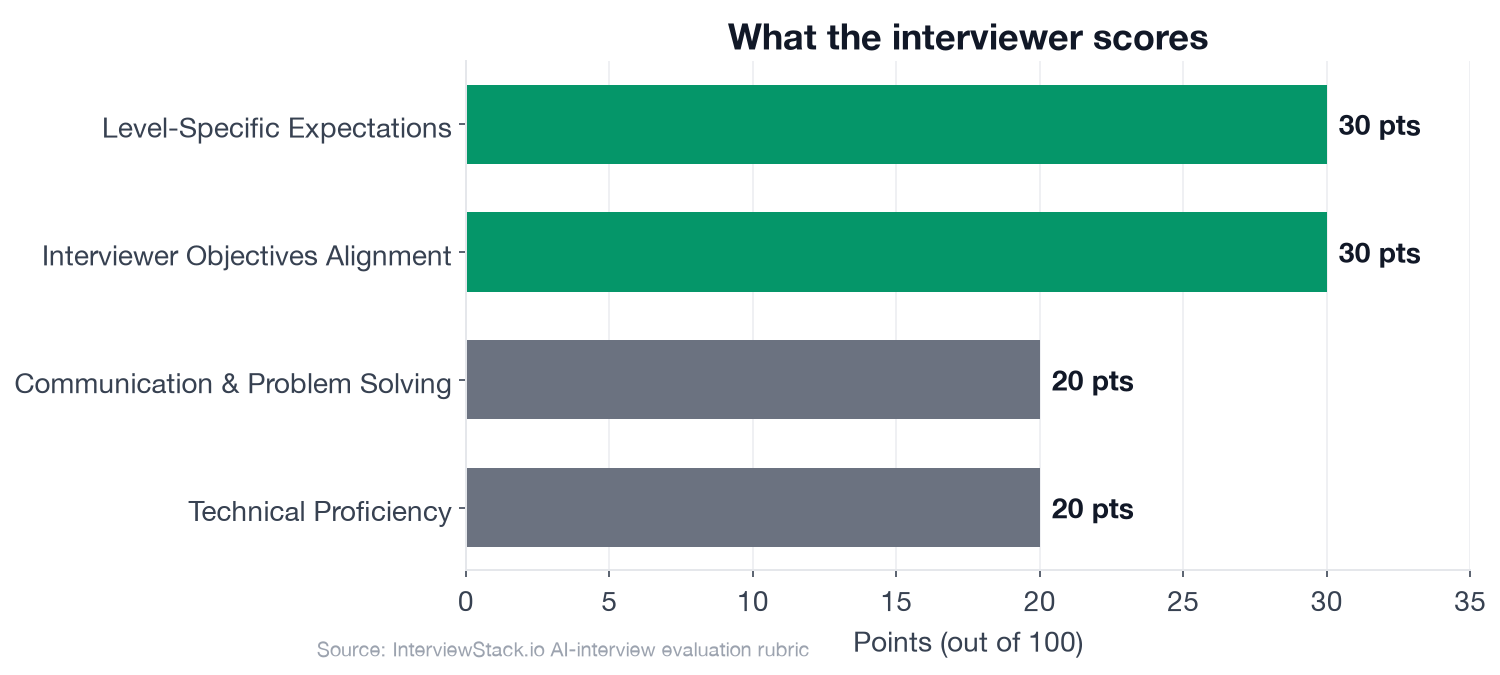 Interviewer Objectives Alignment and Level-Specific Expectations together account for 60 of the 100 points, three times what Technical Proficiency is worth on its own.
The Four Follow-Ups That Expose the Guess
We picked four follow-up prompts from the real blueprint that expose the most instructive mistakes: the first message, the invest-or-pause call, the Friday deliverable, and the two engineers reacting in opposite directions. A common answer at each turn below belongs to Renee, a stand-in for the mid-level candidates who look prepared on paper and still lose points live.
Turn 1: The First Message
Interviewer: "What would you say to the team in your first communication if leadership has not given you definitive answers yet?"
Turn 2: What Keeps Running
Interviewer: "How would you decide whether to keep investing in the current plan versus pausing or reducing scope before the new direction is fully clear?"
Turn 3: The Friday Deliverable
Interviewer: "If leadership asks for a revised delivery plan by the end of the week, what would that plan look like and what assumptions would you make explicit?"
Turn 4: Two Reactions, One Manager
Interviewer: "Suppose two engineers react very differently to the uncertainty: one becomes disengaged and another starts independently changing priorities with partner teams. How would you handle that?"
Naming the Trap Isn't the Same as Dodging It Live
Every mistake above reads as obvious once it is sitting in a red box with a label on it. Live, under a 30-minute clock, with a follow-up you did not see coming, it is a different exercise: you have to resist the urge to sound certain when you are not, notice which of two very different engineers needs which conversation, and keep a Friday deliverable honest about what you still do not know. Reading the fix is not the same skill as producing it in the room, and that gap only closes with reps against an interviewer that actually pushes back.
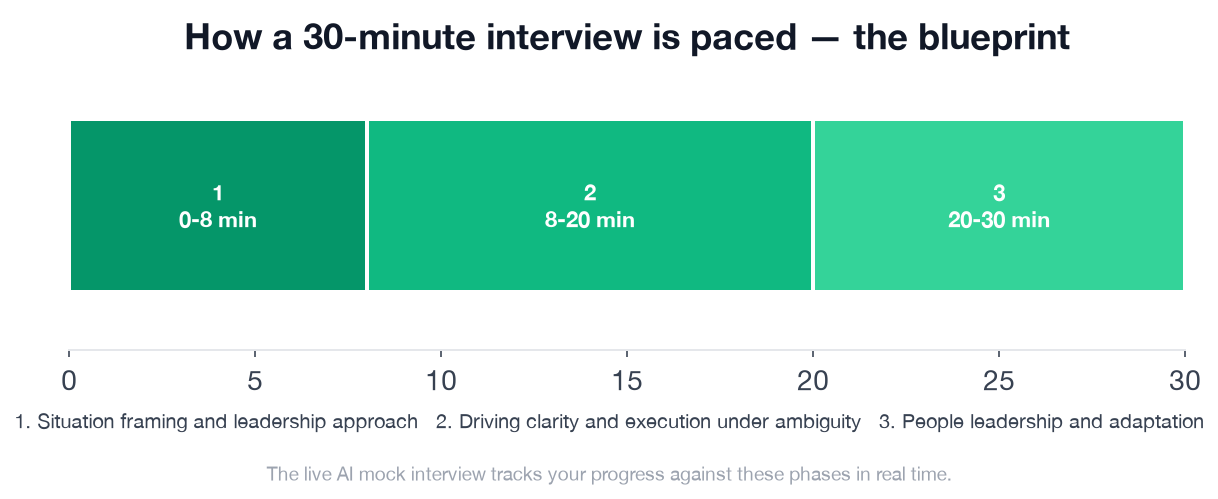 This is the pacing a strong candidate hits: a little over a quarter of the time on framing, the largest single share on execution under ambiguity, and the final third on people leadership.
The Complete Blueprint
This is the exact blueprint InterviewStack.io's AI interviewer tracks a candidate against in real time, phase by phase, checklist item by checklist item.
- ✓Clarifies the most important unknowns affecting delivery, ownership, and team morale
- ✓Outlines an immediate plan for the first few days rather than jumping straight to a final answer
- ✓Identifies separate workstreams for team communication, stakeholder alignment, and roadmap/risk review
- ✓Avoids claiming certainty where information is missing
- ✓Proposes a way to separate reversible from hard-to-reverse work
- ✓Suggests a scoped near-term plan such as preserving core platform work, pausing uncertain edge features, or defining decision checkpoints
- ✓Makes assumptions explicit and ties them to dates, owners, or trigger conditions
- ✓Describes how to get product/design/new leadership aligned enough for execution
- ✓Discusses trade-offs between continuing, pausing, or reducing scope
- ✓Describes specific communication mechanisms such as team syncs, 1:1s, written updates, or decision logs
- ✓Explains how they would respond to disengagement, anxiety, or unaligned behavior from individuals
- ✓Identifies signals to monitor for success or failure in morale and execution
- ✓Shows willingness to update the plan as new information arrives without causing repeated churn
Take This Exact Interview Live
Reading four turns is not the same as holding your own plan together across all three phases while an interviewer decides what to ask next. Start the AI mock interview scoped to this exact role, level, and topic, and it will score you against the same rubric and phase timing shown above. If you want to warm up on individual questions first, the Leading Through Change and Ambiguity question bank breaks the topic into focused drills, and the Engineering Manager preparation guide covers what else tends to come up around this topic.
FAQ
Q. What does an Engineering Manager interview on leading through change and ambiguity actually test?
It weighs Interviewer Objectives Alignment and Level-Specific Expectations at 30 points each, 60 of the 100-point rubric, so most of the score rewards building an operating plan for an unresolved reorg, not predicting what the new roadmap will be.
Q. How long is this interview and how is the time split?
30 minutes across three phases: situation framing and leadership approach (0-8 minutes), driving clarity and execution under ambiguity (8-20 minutes), and people leadership and adaptation (20-30 minutes).
Q. What's the biggest mistake candidates make in an ambiguity-and-change interview?
Trying to answer a question nobody asked, guessing what the new company direction will be, instead of building a concrete near-term plan for operating without that answer. Phase 1's checklist explicitly rewards avoiding claims of certainty where information is missing.
Q. What's expected from a mid-level Engineering Manager versus a more senior one here?
A mid-level candidate should structure a credible plan for their own team and show sound local judgment with leadership support where needed. Redesigning the broader org model or shaping executive portfolio strategy is explicitly not the bar at this level.
Q. How should a candidate handle a team member who disengages during uncertainty, versus one who starts making commitments on their own?
Phase 3's checklist expects a distinct response to each: individual attention for disengagement, and redirection, not suppression, for someone acting unilaterally, since unchecked independent commitments to partner teams can turn ambiguity into real scope risk.
Q. What topics are off-limits for this specific interview?
Four skill areas are explicitly out of scope: system design deep dives, coding or algorithm implementation, formal organizational-transformation methodology, and personal wellness or resilience coaching detached from team leadership.
Q. Where can I practice this exact scenario?
Start a live AI mock interview scoped to Engineering Manager, mid-level, Leading Through Change and Ambiguity, or drill individual questions first in the question bank.
Uncertainty Has a Playbook
The reorg in this scenario never resolves during the interview, and it is not supposed to. The candidates who score well are not the ones who guess right about the new roadmap; they are the ones who build a plan sturdy enough to survive not knowing, then adjust it in the open as real information arrives. Go find out where your own plan actually holds.
Topics
Ready to practice?
Put what you've learned into practice with AI mock interviews and structured preparation guides.