
The Code Is the Same. The Ceiling Is Not.
If you've spent time as a Full-Stack Developer wondering what actually changes when someone gets promoted into Engineering Manager, the data has a counterintuitive answer: less than you'd expect on the skill side, more than you'd expect on the pay side.
We looked at every active Engineering Manager and Full-Stack Developer posting on the InterviewStack.io job board as of June 2026 (8,878 and 6,972 postings respectively), with skills extracted from descriptions, synonyms collapsed, and salaries scoped to US postings for cross-role comparability.
The headline: these two roles share 58% of their top-30 skill profile. React, TypeScript, JavaScript, Python, AWS, CI/CD, and Agile appear in both. Yet Engineering Manager earns a $28,500 higher median US base salary. The pay gap is real. The skill gap is much smaller than the titles suggest.
Key Findings
- 58% skill overlap (Jaccard 0.58): 22 of 38 unique skills across both top-30 lists appear in both roles, including React, CI/CD, AWS, TypeScript, Python, Java, SQL, Kubernetes, and Docker.
- $28,500 salary premium (18.8%): Engineering Manager earns $180,000 median US base (n=2,182); Full-Stack Developer earns $151,500 (n=753).
- Engineering Manager has 27% more postings: 8,878 active vs. 6,972 for Full-Stack Developer (volume ratio 1.27x).
- Entry-level is scarce in both: 4.2% of EM openings are entry-level (372 postings); 2.7% of FSD openings (186 postings).
- Full-Stack Developer is nearly twice as remote-friendly: 28.8% remote vs. 16.5% for Engineering Manager.
- Engineering Manager is US-concentrated: 43% of EM postings are US-based vs. 24% for Full-Stack Developer.
- Differentiator skills push EM pay well above its $180K baseline: Distributed Systems reaches $231,400 (+$51K, n=214) and Machine Learning reaches $225,000 (+$45K, n=173).
- AI skills are the FSD differentiator: LLMs reach $187,500 median (+$36K, n=63); Generative AI and Machine Learning also hit $175,000.
| Engineering Manager | Full-Stack Developer | |
|---|---|---|
| Median US base salary | $180,000 | $151,500 |
| Active postings | 8,878 | 6,972 |
| Top-30 skill overlap (Jaccard) | 58% (joint metric) | 58% (joint metric) |
| Remote share | 16.5% | 28.8% |
| Entry-level share | 4.2% | 2.7% |
| US share of postings | 43% | 24% |
What Do Engineering Managers and Full-Stack Developers Actually Do?
Engineering Manager: An EM's primary deliverable is a high-functioning team, not individual features. Their week revolves around 1:1s, sprint planning, technical direction, and cross-functional alignment. They own system reliability, incident response, and hiring decisions. Many EMs write code; the defining questions on their plate are "why is this late?" and "how do we scale this team?" rather than "how do I build this feature?" The exclusive skills reflect that scope: Observability (10.3% of EM postings) and Distributed Systems (8.5%) signal systems-level accountability rather than hands-on development work.
Full-Stack Developer: The FSD owns the implementation. Their week is shipping features, reviewing pull requests, debugging production issues, and building APIs that other systems consume. The exclusive skills tell that story directly: Angular (26.9%), Git (22.1%), CSS (19.1%), HTML (16.3%), RESTful APIs (14.1%), and MySQL (13.4%) are all construction tools. If the EM asks "is this system healthy?", the FSD is the one making it healthy.
Which Skills Do Both Roles Share?
Both Engineering Manager and Full-Stack Developer regularly require React, CI/CD, AWS, TypeScript, Agile, Python, JavaScript, APIs, Java, SQL, Automation, Node.js, Docker, Azure, and PostgreSQL. These are the 15 most prominently shared skills by average frequency across both roles (the full shared set above 5% is broader, including Kubernetes, Monitoring, Scalability, Microservices, and Debugging).
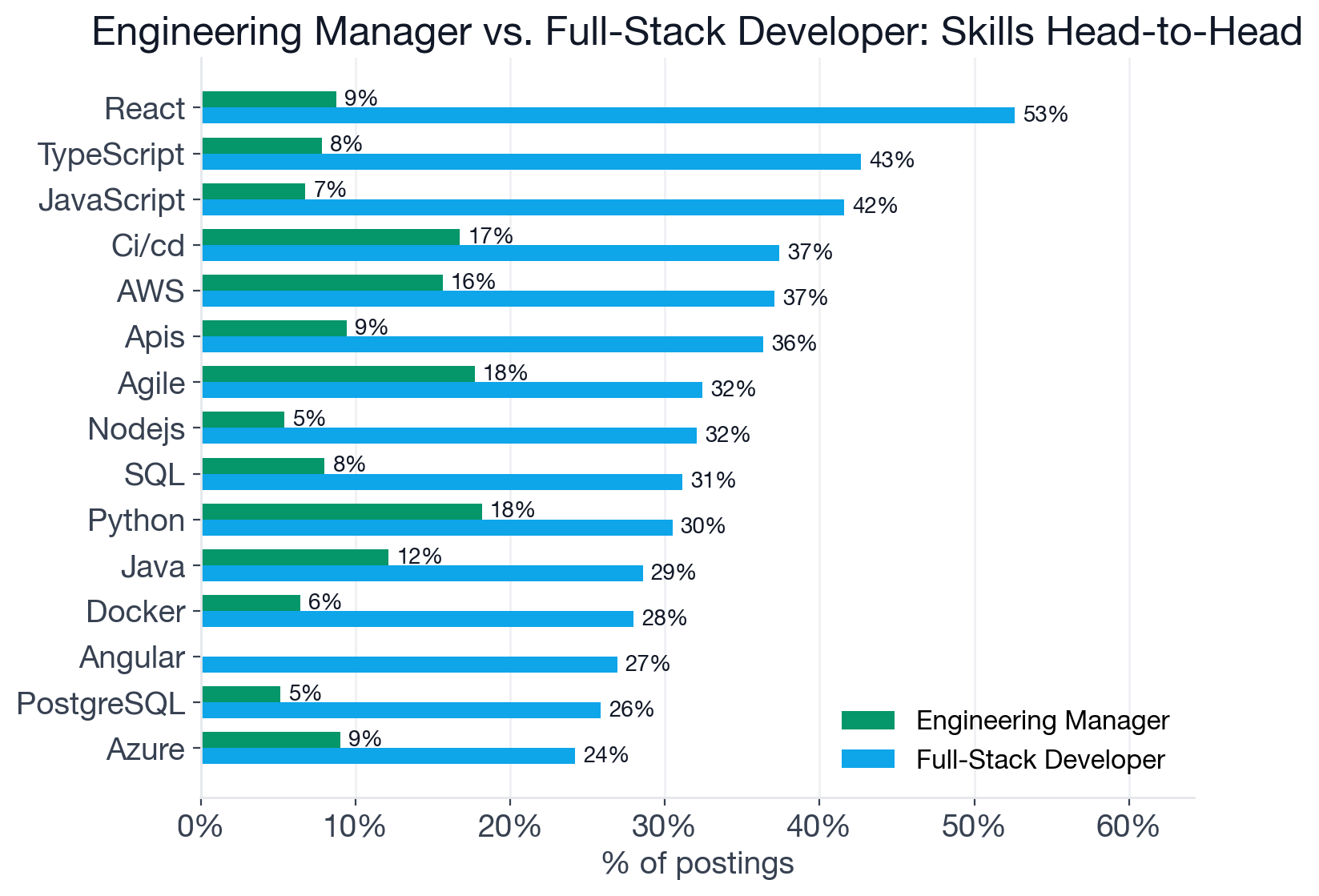
Frequency of top skills in Engineering Manager (teal) and Full-Stack Developer (blue) postings. Wide single-role bars indicate where the roles diverge; paired bars show the shared delivery foundation.
Dataset scope note: the Engineering Manager postings in this analysis span the full spectrum of engineering management (software, hardware, industrial, defense, and civil domains), not exclusively software EM. Automation is the single most-cited EM skill at 21%, a frequency that reflects manufacturing automation managers, test automation leads, and industrial process managers alongside software DevOps leaders. CI/CD (16.7%), AWS (15.6%), and Agile (17.7%) are more specifically software-context signals.
The critical caveat is intensity. React appears in 52.6% of Full-Stack Developer postings but only 8.8% of Engineering Manager postings. TypeScript shows 42.7% for FSD vs. 7.8% for EM. These shared skills are table stakes for one role and signals of technical fluency for the other. Moving from FSD to EM, you don't stop needing to understand React; you stop being the person primarily writing it.
Where the Skill Sets Part Ways
The exclusive skill clusters show what each job actually IS.
Engineering Manager exclusive skills: Observability (10.3%) and Distributed Systems (8.5%) are the two skills that appear meaningfully in EM postings but not in the FSD top-30. Both signal systems-scope thinking: Observability means you're accountable for whether the system is healthy at runtime; Distributed Systems means you're reasoning about architecture and reliability at scale. These are ownership signals, not implementation signals.
Full-Stack Developer exclusive skills: Angular (26.9%), Git (22.1%), CSS (19.1%), HTML (16.3%), RESTful APIs (14.1%), MySQL (13.4%), NoSQL (13.2%), and Spring (12.5%) are all implementation-layer tools. Frontend framework depth, version control discipline, markup, persistence layer options: this is the vocabulary of building, not managing what others build.
The divergence is clean: the EM role removes frontend specifics and replaces them with systems accountability. That scope shift is what the salary gap is pricing.
Which Pays More, and Where AI Fits In?
Engineering Manager earns a median $180,000 US base vs. Full-Stack Developer at $151,500, a $28,500 (18.8%) premium. These are base-only figures from US postings with disclosed salary; equity and bonus are not included, so total compensation at top employers runs meaningfully higher than these medians.
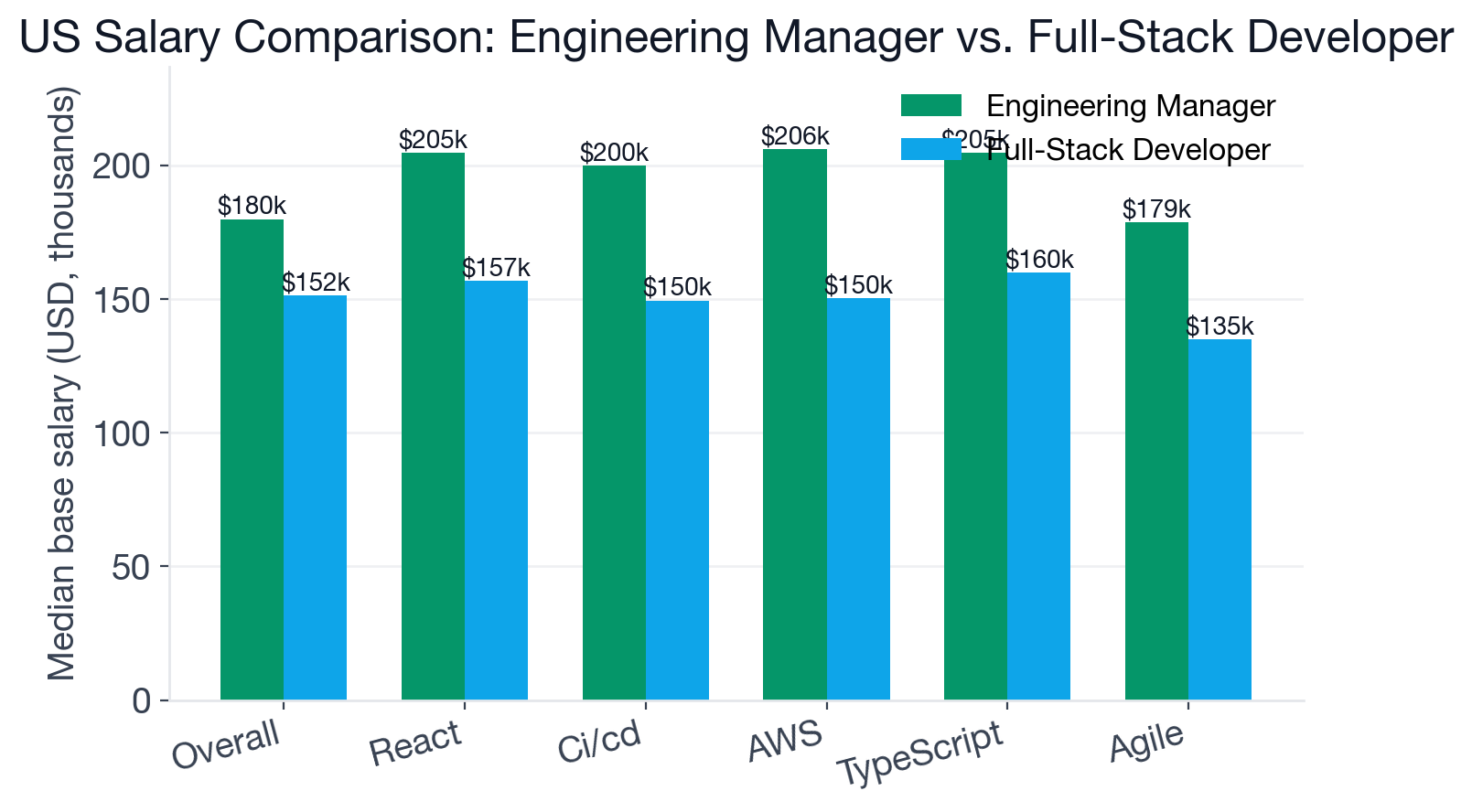
Median US base salary for Engineering Manager and Full-Stack Developer overall and for selected shared skills. EM commands a premium across nearly every comparison.
The skills that move salary above the EM baseline are systems and AI competencies: Distributed Systems ($231,400 median, n=214), Machine Learning ($225,000, n=173), and Observability ($213,500, n=201) represent $33-51K premiums above the $180,000 EM base. For Full-Stack Developer, AI skills command the outsized premium: LLMs ($187,500 median, n=63) and Generative AI ($175,000, n=57) sit $24-36K above the $151,500 baseline.
Those AI skill premiums are notable precisely because AI requirements are rare in the top-30 postings for both roles. Fewer than 5% of postings for either Engineering Manager or Full-Stack Developer explicitly list AI as a requirement. That percentage measures only who is hired specifically to build or manage AI systems. The ambient layer is a different story: the 2025 Stack Overflow Developer Survey found 84% of developers use or plan to use AI tools, with 51% using them daily. Full-Stack Developers, who represent roughly 34% of developer survey respondents, are driving much of that adoption through tools like GitHub Copilot, Cursor, and Claude Code.
For Engineering Managers, the accountability layer goes further than individual tool adoption. The responsibility is systemic: setting tooling standards for the team, measuring whether AI investments translate to actual shipping velocity, and closing the gap between what tools can do and what teams use consistently. These competencies are not consistently captured in job postings yet, but they increasingly define what organizations expect from their technical leaders.
Which Is Easier to Get Hired Into?
Engineering Manager postings outnumber Full-Stack Developer postings 8,878 to 6,972, a 1.27x volume advantage. Neither role opens easily at the entry level.
For Engineering Manager, mid-level dominates at 63.8% of postings. Senior (14.5%) and staff (17.5%) together make up nearly a third. Entry-level is 4.2%, roughly 1 in 24 openings. If you're not already leading a team, you're competing for a narrow slice of the market.
For Full-Stack Developer, the entry bar is even tighter: 2.7% entry-level (1 in 37 openings), with senior at 31.6% and mid-level at 57.5%. This is a role where the market expects you to arrive already able to ship across the full stack.
The remote and geography split diverges sharply between the two. Engineering Manager is US-concentrated (43% of postings) and onsite-dominant (59.3% onsite, 26.6% hybrid, 16.5% remote). Full-Stack Developer is more globally distributed: 24% US, with meaningful postings in India (14.6%), Germany (5.8%), Canada (4.5%), France, and Brazil, and nearly double the remote share at 28.8%. If remote flexibility or non-US markets matter in your search, Full-Stack Developer opens a broader door.
Which Path Is Right for You?
Choose Engineering Manager if:
- You get more satisfaction from setting technical direction and enabling others than from writing code daily.
- You have 3-5 years of engineering experience and have informally led or mentored a team.
- You're primarily targeting the US job market and can commit to significant onsite presence.
- You want the higher salary ceiling: $180,000 median base, with Distributed Systems and ML expertise pushing past $225,000.
Choose Full-Stack Developer if:
- You want to stay hands-on with implementation: shipping features, building APIs, debugging across the stack.
- Remote work or access to global job markets matters in your search.
- You're building toward AI-integrated product development (the $36,000 LLM salary premium signals where this role is heading).
- You're entering or re-entering the market and need access to a more geographically distributed pool of openings, with nearly double the remote share.
How to Use This in Your Job Search
Browse live Engineering Manager openings and Full-Stack Developer openings on the InterviewStack.io job board, filterable by skill, location, work mode, and seniority level.
Before interviews, the AI mock interview simulator covers system design and behavioral questions, both central to EM interviews and increasingly required at the senior FSD level. The question bank lets you drill the specific topics these roles test: Observability, Distributed Systems, and Scalability for EMs; React, TypeScript, and API design for FSDs. Company-specific preparation guides are available for any firms you're targeting directly.
FAQ
Q. What is the salary gap between Engineering Manager and Full-Stack Developer in 2026?
Engineering Manager earns a median US base salary of $180,000 (n=2,182 postings with salary disclosed) compared to $151,500 for Full-Stack Developer (n=753), a gap of $28,500 (18.8%). Both figures cover base pay only; equity and bonus are not reflected in posting data.
Q. How much do Engineering Manager and Full-Stack Developer skill sets overlap?
The two roles share 58% of their top-30 skill set (Jaccard overlap coefficient of 0.58). Both commonly require React, CI/CD, AWS, TypeScript, Agile, Python, JavaScript, APIs, Java, SQL, Automation, Node.js, Docker, Azure, and PostgreSQL, among others. The overlap reflects a shared infrastructure and delivery foundation.
Q. Which role is easier to break into?
Engineering Manager postings are 4.2% entry-level (roughly 1 in 24 openings, 372 postings); Full-Stack Developer postings are 2.7% entry-level (roughly 1 in 37, 186 postings). Neither is beginner-friendly, but the larger EM pool (8,878 postings vs. 6,972) provides more total openings across every seniority level.
Q. Is Full-Stack Developer more remote-friendly than Engineering Manager?
Yes. Full-Stack Developer postings are 28.8% remote vs. 16.5% for Engineering Manager, nearly double the remote share. Engineering Manager is more onsite-dominant at 59.3% onsite vs. 50.6% for Full-Stack Developer, reflecting the in-person demands of team leadership.
Q. Do Engineering Manager roles require coding skills?
Yes, software-focused EM postings regularly list technical requirements. Python appears in 18.2% of Engineering Manager postings, Java in 12.1%, Agile in 17.7%, and React in 8.8%. The technical bar is lower than for Full-Stack Developer. Note that this dataset captures engineering management broadly (including hardware, industrial, and defense roles alongside software EM), so technical skill frequencies vary by employer focus; pure software EM postings will lean heavier on cloud and framework skills.
Q. What AI skills pay a premium for Full-Stack Developers in 2026?
LLMs command the largest Full-Stack Developer salary premium: $187,500 median vs. $151,500 overall, a $36,000 gap (n=63). Generative AI and Machine Learning also reach $175,000 median. These explicit requirements appear in fewer than 5% of postings, but ambient AI tool use is now assumed across virtually all developer roles.
Q. How does the Engineering Manager role differ from Full-Stack Developer in terms of hiring geography?
Engineering Manager postings concentrate heavily in the US (43% of postings) while Full-Stack Developer postings are more globally distributed (24% US, with meaningful volume in India at 14.6%, Germany at 5.8%, Canada at 4.5%, France, and Brazil). Full-Stack Developer is the more internationally distributed role.
The Bottom Line
Engineering Manager and Full-Stack Developer share 58% of their skill profile. The $28,500 salary gap does not reflect two different technical universes; it prices the difference in accountability scope. The EM owns systems and teams. The FSD owns the implementation. Both are healthy markets with active global demand. Browse live Engineering Manager postings and Full-Stack Developer postings to see where your profile fits right now.
Topics
Ready to practice?
Put what you've learned into practice with AI mock interviews and structured preparation guides.