
The Frontend Developer Frontend Component and State Architecture Interview Rewards Knowing Where State Lives
A mid-level Frontend Developer sits down for a 30-minute interview on component and state architecture. The prompt sounds like ordinary product work: a task list, a detail panel, a few filters, nothing exotic. This walkthrough is built from a real InterviewStack.io AI mock interview blueprint for exactly that scenario, and most of the 100 points do not go to whichever state library gets named out loud. They go to where each piece of state actually lives.
The trap shows up early and quietly. A candidate who treats "which task is open" as ordinary component state looks completely fine for the first ten minutes, right up until the interviewer asks the one follow-up that was already implied in the original prompt: make this shareable and restorable on refresh. That single question exposes whether state was ever actually classified, or just assumed.
Key Findings
- The rubric splits 100 points across four dimensions, and 60 of them (30 plus 30) sit in Interviewer Objectives Alignment and Level-Specific Expectations alone.
- The interview runs 30 minutes across three phases: 8 minutes to frame the architecture, 12 minutes on state and data-flow design, and 10 minutes on scalability and trade-offs.
- The middle phase (minutes 8 to 20) and the closing phase (minutes 20 to 30) each carry 5 separate checklist items, one more than the opening phase's 4.
- Phase 1 (minutes 0 to 8) requires clarifying at least 2 to 3 assumptions, including deep-link and refresh expectations, before any decomposition is scored.
- Six follow-up questions probe state ownership, routing, data fetching, team scaling, optimistic updates, and rendering trade-offs; this walkthrough dramatizes 4 of them.
- Level-Specific Expectations (30 of 100 points) explicitly names "URL and state mismatches" as a failure mode a mid-level candidate is expected to catch.
- Backend database schema design and native mobile platform architecture are 2 of 4 skill areas explicitly out of scope, keeping all 30 minutes on frontend judgment.
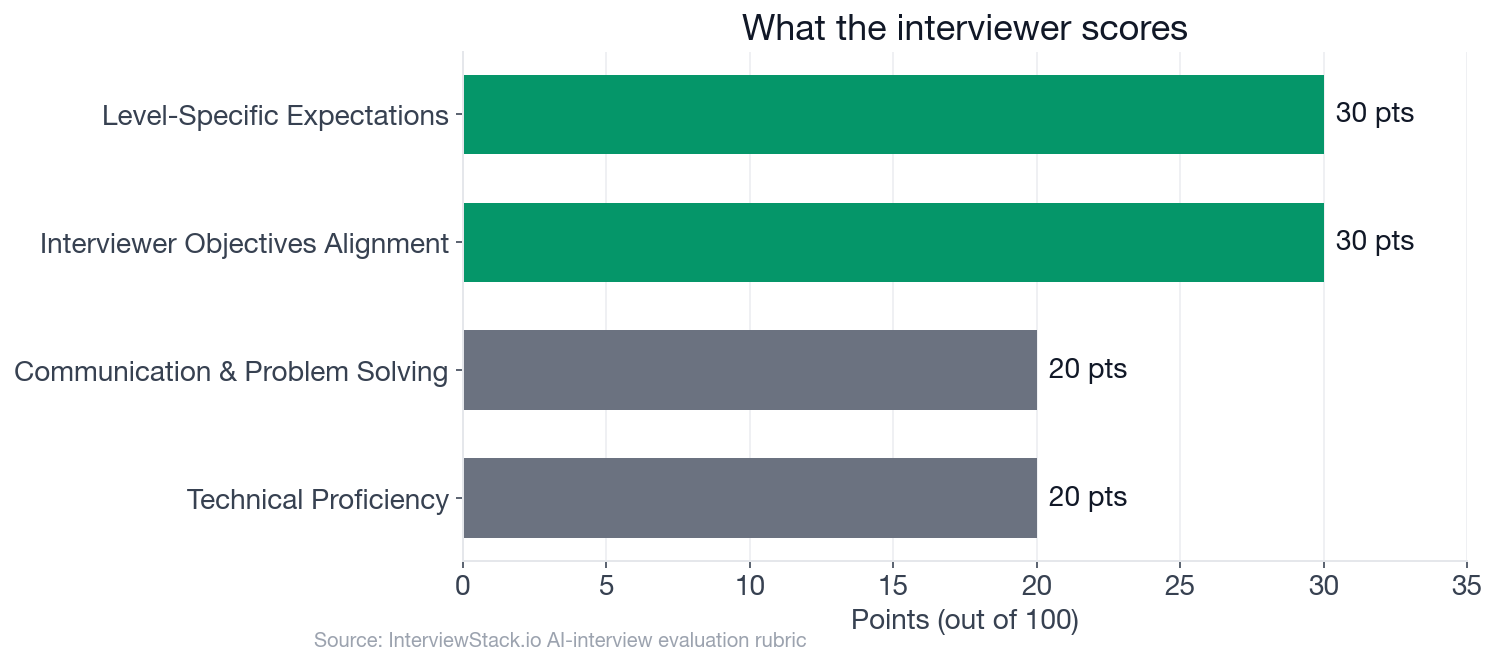 Interviewer Objectives Alignment and Level-Specific Expectations together hold 60 of the 100 points, three times the weight of Technical Proficiency or Communication on their own.
Inside the Project Workspace Scenario
The interview question
You are joining a team that owns the web experience for an internal collaboration product used across the company. One core surface is a Project Workspace page where users browse tasks, filter and sort them, open a task detail panel, edit task fields, and leave comments without navigating away from the page.
The page needs to support:
- a left navigation area with project sections
- a main task list with filtering, sorting, and pagination or incremental loading
- a right-side task detail panel that can open from the list
- optimistic UI for common task updates like status and assignee changes
- deep links so a specific task view can be shared
- multiple engineers contributing features over time
Assume this is a React-based frontend, but do not assume any required state library beyond what you think is appropriate. How would you architect this frontend so it stays maintainable as the product grows?
The interviewer is not grading whether you can render a task list. They are watching whether you can decompose a single, stateful product surface, decide where each piece of state actually lives, and reason about data flow, routing, and rendering trade-offs the way a mid-level engineer contributing to a shared codebase should.
Which Follow-Ups Decide a Frontend Developer State and Data Architecture Interview?
Four follow-ups from the real interview package carry most of the signal here. Here's how a candidate named Mira handles them, and where the mid-level bar actually sits.
Turn 1: Where State Actually Belongs
Interviewer: "How would you decide what state belongs in local component state, shared client state, the URL, or server-state management?"
Turn 2: The Deep Link Nobody Wired
Interviewer: "If opening a task in the right-side panel needs to be shareable and restorable on refresh, how would that change your routing and state design?"
This is the turn the whole interview pivots on. Everything Mira assumed was settled in Turn 1 comes due here, because a shareable link cannot be built on state that only exists inside one component's memory.
Turn 3: Optimistic, Then What?
Interviewer: "How would you handle optimistic updates for task status changes while avoiding inconsistent UI when a server request fails?"
Turn 4: Slow Page, Wrong Fix
Interviewer: "If this page starts to feel slow, what rendering or loading trade-offs would you consider before reaching for a larger architectural change like micro-frontends?"
Watching for Free Doesn't Count as Practice
Every mistake above is easy to catch on a page, with no clock running and no interviewer waiting on your next sentence. Live, in 30 minutes, with follow-ups you have not seen coming, the URL-state trap and the optimistic-rollback gap are exactly the kind of thing a prepared mid-level candidate still walks into. Recognizing someone else's mistake in a transcript and avoiding it yourself, under time pressure, are different skills, and the second one only comes from reps.
The Blueprint a Strong Candidate Hits
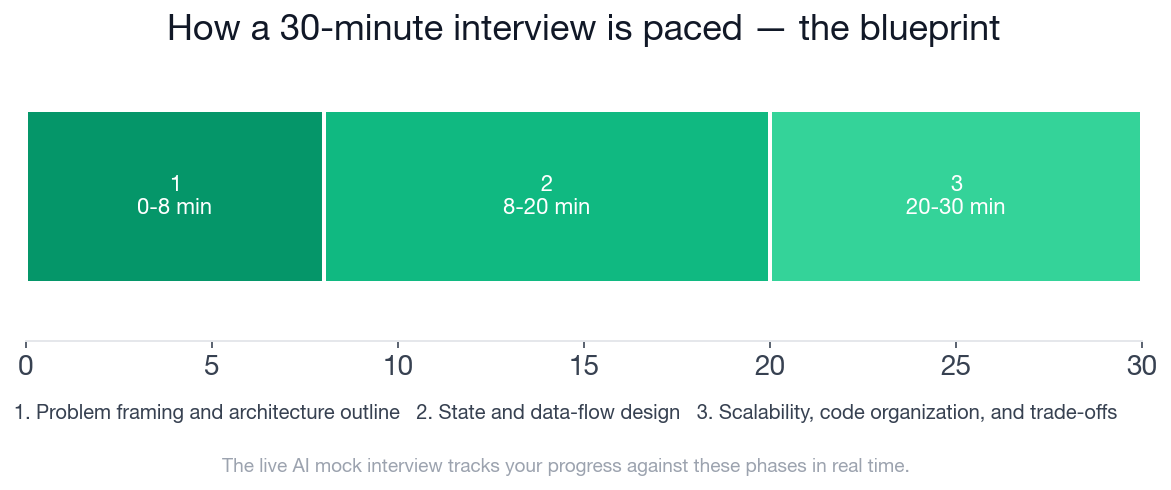 Each phase's checklist has to land inside its window, from an 8-minute framing phase through a 12-minute state and data-flow phase to a 10-minute close on scalability and trade-offs.
This is the blueprint a strong candidate hits, phase by phase, and it is the exact structure the AI mock interview tracks you against in real time as you answer.
- ✓Clarifies at least 2-3 important assumptions such as expected scale of tasks, collaboration behavior, refresh/deep-link expectations, or edit flows
- ✓Proposes a high-level decomposition such as page shell, navigation, task list area, task detail panel, filter/sort controls, and shared data layer
- ✓Distinguishes between feature components and reusable shared primitives instead of making everything globally shared
- ✓Mentions maintainability for future contributors, not just getting the page working
- ✓Classifies examples of state correctly: e.g. filter/sort/taskId in URL when appropriate, transient panel UI locally, fetched task data in server-state/cache
- ✓Explains how list and detail views share or reconcile task data without ad hoc duplication
- ✓Describes loading, error, empty, and refetch states in concrete UI terms
- ✓Covers optimistic update flow with rollback or reconciliation behavior on failure
- ✓Avoids overusing global client state for server-derived data unless justified
- ✓Suggests a practical code organization approach such as feature-based folders, colocated hooks/tests, and shared UI/data utilities
- ✓Identifies at least 1-2 likely performance issues such as unnecessary rerenders, large lists, or over-fetching and proposes concrete mitigations
- ✓Discusses when micro-frontends would be unnecessary complexity versus when team boundaries might justify them
- ✓Mentions testability at useful layers such as component behavior, hooks/data logic, and route-driven state behavior
- ✓Makes trade-offs explicit instead of claiming a single perfect architecture
Run This Interview Yourself
You have now watched four ways Mira gives points away on this exact scenario. The only way to find out whether you would catch them live, with the clock running and no page to scroll back through, is to run the interview yourself. Start the AI mock interview on frontend component and state architecture and get turn-by-turn, rubric-based feedback the moment you finish.
If you want to drill the underlying judgment calls first, state placement, URL-driven routing, optimistic rollback, before taking the full interview, the frontend component and state architecture question bank breaks the topic into individual questions. For broader Frontend Developer interview prep, browse the preparation guides.
FAQ
Q. What does a mid-level Frontend Developer state and data architecture interview actually score?
The rubric is worth 100 points across four dimensions: 30 for Interviewer Objectives Alignment (whether you designed a maintainable architecture for the actual scenario), 30 for Level-Specific Expectations (whether you showed a mid-level, 2 to 5 year bar of judgment), 20 for Technical Proficiency, and 20 for Communication and Problem Solving.
Q. Why should the ID of an open task panel live in the URL instead of local state?
Because the scenario explicitly requires deep links so a specific task view can be shared, an open task ID kept only in local component state disappears on refresh and cannot be shared. Putting it in the URL, as a route segment or query param, lets the panel reconstruct itself from the address bar alone, which is what the interview's state-classification checklist rewards.
Q. How should optimistic updates handle a failed request?
A strong answer keeps a snapshot of the task's prior state before applying the optimistic change, rolls the UI back to that snapshot and surfaces a visible error if the server request fails, and reconciles with the server's actual response on success instead of trusting the optimistic guess. The interview's checklist scores rollback and reconciliation behavior directly, not just the optimistic update itself.
Q. When do micro-frontends actually make sense for a page like this?
Micro-frontends solve a team-boundary problem, not a rendering-speed problem. The interview rewards naming concrete performance mitigations first, such as memoizing list rows, virtualizing or paginating the list, and fetching a slim summary shape for the list versus the full object for the detail panel, before reaching for an architectural change as heavy as micro-frontends.
Q. How do you keep the task list and task detail panel in sync without duplicating fetch logic?
Both views should read from the same server-state cache keyed by task ID instead of each fetching and storing its own copy. When a status or assignee changes, updating that shared cache entry keeps the list row and the open detail panel consistent without a second network call or ad hoc synchronization code.
Q. How long does the mock interview run and how many follow-up questions does it include?
The scenario runs 30 minutes across three phases: 8 minutes on problem framing, 12 minutes on state and data-flow design, and 10 minutes on scalability, code organization, and trade-offs, with the interviewer working through six scripted follow-up prompts across those phases.
The URL Is Part of the Architecture
None of this is exotic engineering. It is the discipline of deciding, before writing a single component, whether a value belongs in the URL, in local state, in a shared store, or in a server cache, and then handling the failure case for each one. That discipline is exactly what separates a demo from a maintainable Frontend Developer feature, and it is exactly what the blueprint above scores.
Topics
Ready to practice?
Put what you've learned into practice with AI mock interviews and structured preparation guides.