
State Modeling Comes Before Library Picking
Most mid-level Frontend Developer interviews on state management go wrong inside the first eight minutes. The candidate walks in having reviewed Redux, Zustand, and React Query and spends the opening talking about which one they would choose. The interviewer, who has a 4-item checklist just for the framing phase, watches the candidate skip it entirely.
That framing phase is where 60 of the 100 rubric points get set up. The Interviewer Objectives Alignment dimension (30 pts) and the Level-Specific Expectations dimension (30 pts) both look for evidence that you can diagnose a broken state architecture before you reach for a tool. Candidates who skip to tool selection effectively concede those points before the first follow-up is asked.
The AI mock interview at InterviewStack.io tracks you against a real blueprint used in Frontend Developer hiring. It surfaces exactly where in the 30 minutes you diverged from the expected checklist, so you can fix the gaps before a real interview.
Key Findings
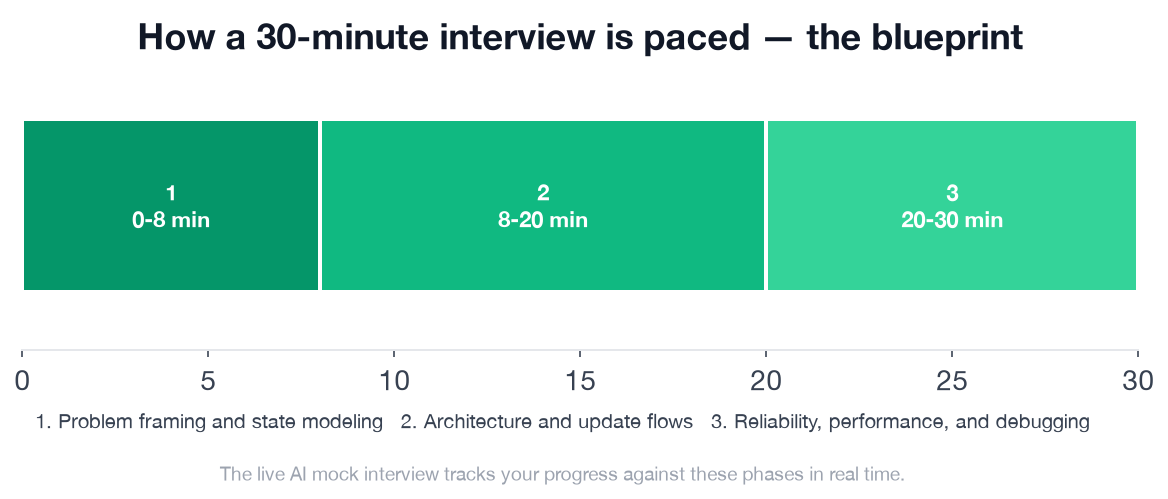
- The interview is 30 minutes across 3 scored phases: framing (0-8 min), architecture (8-20 min), reliability and debugging (20-30 min).
- The rubric allocates 30 points to Interviewer Objectives Alignment and 30 points to Level-Specific Expectations: 60 of 100 total points hinge on architectural reasoning, not syntax.
- Phase 1 has a 4-item expected checklist; skipping the framing phase risks the majority of those 60 points before the first follow-up is asked.
- Mid-level candidates must independently propose a reasonable architecture, recognize anti-patterns like duplicated server state and unjustified prop drilling, and explain optimistic update rollback without prompting.
- Optimistic update rollback is one of the most common Phase 3 misses: candidates describe the happy path but stop before addressing server disagreement or failure.
- At least one concrete performance consideration (unnecessary rerenders, state granularity, memoized selectors) must be named to complete the Phase 3 checklist.
What Does the Frontend Developer State Management Interview Ask?
The scenario gives you a concrete product with production symptoms already present, not a blank design problem.
The interview question
You are working on a web application for a large consumer product team. Users can browse a feed of posts, open a post detail panel, like or unlike posts, add comments, and save posts to a personal list. The feed can be filtered by category and sorted by recency or popularity. The same post may appear in multiple places at once: the main feed, a saved-items view, a trending sidebar, and the post detail panel.
The product team has reported recurring issues:
- Counts and saved state become inconsistent across different parts of the UI.
- Users on slow networks see flicker and confusing reversions after actions.
- Engineers have started duplicating server data in multiple components to make features faster to ship.
- Debugging production issues is getting harder as the app grows.
Assume this is a modern frontend application with client-side routing and server APIs for fetching and mutating post data. How would you design the state management and data flow for this feature set so that it stays predictable, performant, and maintainable as the product grows?
Each of the four reported symptoms is a direct signal of an anti-pattern the rubric targets: inconsistent counts point to duplicated entity state; network flicker points to missing optimistic update logic; data duplication across components is the prop-drilling and copy-paste anti-pattern the level-specific expectations call out by name; and poor debuggability is a Phase 3 checklist item. The question is asking you to diagnose, model, and design a fix, in that order.
The Frontend Developer State Management Interview, Turn by Turn
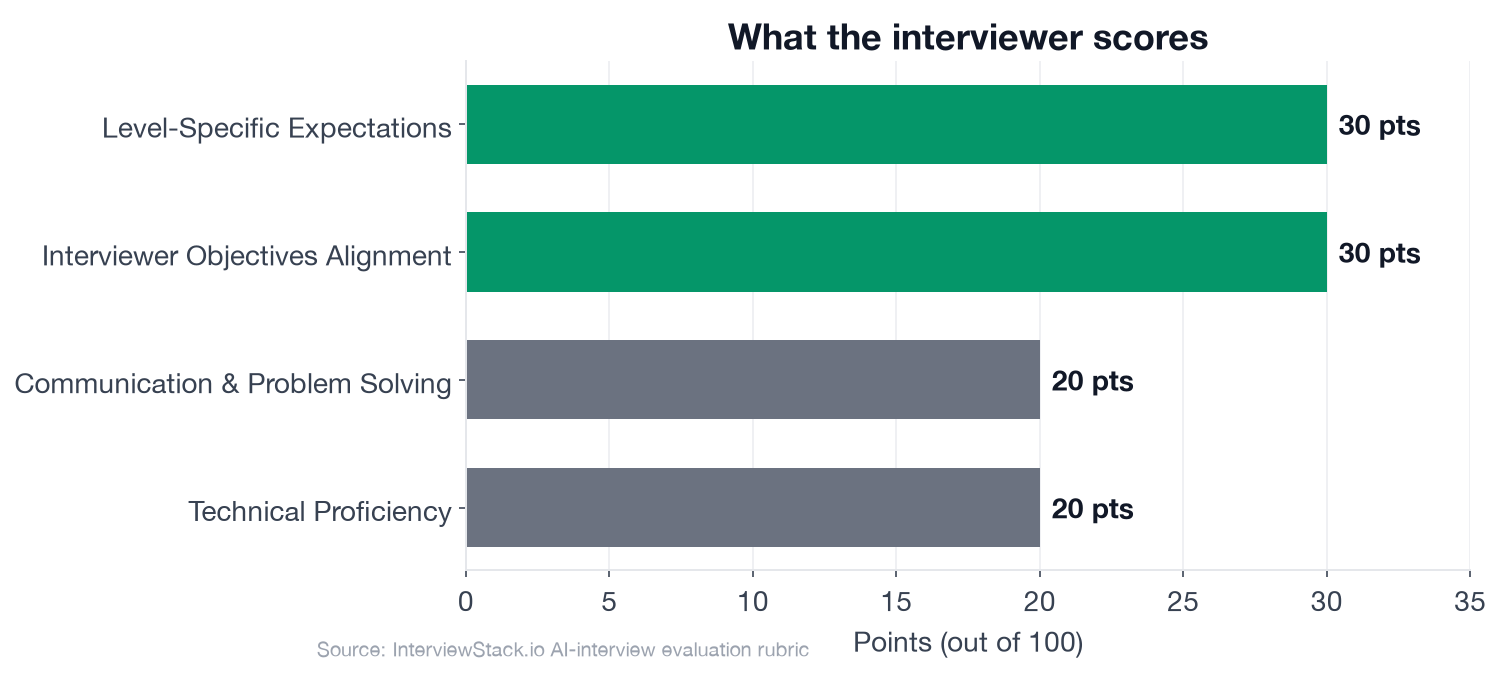
Each rubric dimension carries real weight. The four turns below cover the follow-ups the interviewer uses to probe across all three phases.
Turn 1: Cross-View Consistency
Interviewer: "If a user likes a post from the feed and the same post is visible in the detail panel and saved-items view, how would your design keep those views in sync?"
Turn 2: Optimistic Updates Under Network Uncertainty
Interviewer: "How would you handle optimistic updates for likes or comments on unreliable networks, including rollback or reconciliation when the server response differs?"
Turn 3: Library vs. Built-in Tools
Interviewer: "If the team is split between using built-in framework state tools and adding an external state library, how would you evaluate that decision for this case?"
Turn 4: Debugging and Observability
Interviewer: "What instrumentation or debugging patterns would you put in place so production state issues are easier to reason about?"
Why Reading This Walkthrough Is Not Enough
Spotting Maya's mistakes on the page is easy. You can see the rubric item she missed in each box. The hard part is avoiding the same mistakes live, when you don't know which follow-up comes next, when you're under time pressure, and when the interviewer's phrasing is slightly different from anything you rehearsed.
State architecture reasoning is a skill built through reps, not through reading. Start the Frontend Developer state management AI mock interview to work through this scenario with a live AI interviewer that adapts to what you actually say. Your scoring feedback maps directly to the checklist items you hit and the ones you missed. If you want to drill specific angles before going live, the state management question bank covers the full topic. You can also browse current Frontend Developer openings to see how state management skills show up in real postings. For company-specific prep, the preparation guides show how individual employers structure these rounds.
The Complete Blueprint
This is the blueprint a strong candidate hits across the 30 minutes. It is also what the AI mock interview tracks you against in real time.
- ✓Asks or states assumptions about data sources, mutation frequency, and whether multiple views show the same entities
- ✓Separates server-backed entity data from transient UI state such as open panels, selected filters, loading flags, or draft input
- ✓Calls out the risk of duplicated post data across feed, sidebar, saved-items, and detail views
- ✓Proposes a single source of truth or shared entity model for posts that can be consumed by multiple UI surfaces
- ✓Describes how reads and writes flow through the system in a unidirectional way
- ✓Explains what remains local versus lifted or globally shared, with concrete examples from the scenario
- ✓Provides a credible strategy to keep like state, save state, and counts synchronized across multiple mounted views
- ✓Discusses whether to use context, a reducer, or an external store/cache and gives reasons tied to application complexity and team maintainability
- ✓Mentions immutable updates, minimizing derived state, or normalization of shared entities
- ✓Explains a sensible optimistic or pessimistic mutation approach and what happens on failure or server disagreement
- ✓Discusses cache invalidation or refetch strategy for filtered or paginated feeds after mutations
- ✓Identifies at least one performance consideration such as reducing unnecessary rerenders, state granularity, memoized selectors, or list rendering concerns
- ✓Suggests practical debugging or observability mechanisms such as action tracing, devtools, structured logging, or reproducible state snapshots
- ✓Mentions how the design supports testing, for example through pure update logic, isolated hooks, or mockable data boundaries
FAQ
Q. How long is a Frontend Developer state management interview?
A standard mid-level Frontend Developer state management interview runs 30 minutes across three phases: problem framing and state modeling (0-8 min), architecture and update flows (8-20 min), and reliability, performance, and debugging (20-30 min). The first phase carries the most differentiation risk because many candidates skip it entirely.
Q. What is the most common mistake in a frontend state management interview?
The most common mistake is jumping to library selection (Redux, Zustand, React Query) before separating server-backed entity data from transient UI state. This skips the expected framing checklist and costs points under both the Interviewer Objectives Alignment (30 pts) and Level-Specific Expectations (30 pts) dimensions.
Q. Do I need to know Redux to pass a frontend state management interview?
No. The interview evaluates your ability to reason about state architecture, not your knowledge of a specific library. A strong answer explains why you would or would not reach for an external library given the complexity, team size, and performance needs, with concrete trade-offs. Library familiarity without architectural reasoning does not score well.
Q. What is the difference between server state and UI state in a frontend interview?
Server state is data fetched from an API and shared across views, such as post entities with their like counts and save status. UI state is transient and local: open/closed panels, active filter selections, loading flags, or draft text in a comment box. A strong candidate separates these categories explicitly and avoids storing server data redundantly in component-level state.
Q. What does the AI mock interview track during a state management session?
The AI interviewer tracks three phases against a live blueprint: whether you model state categories before choosing tools (0-8 min), whether your architecture handles cross-view consistency and trade-offs between local, context, and external state (8-20 min), and whether you address optimistic updates, cache invalidation, debugging, and performance concerns (20-30 min).
Q. How does optimistic UI affect scoring in a frontend state management interview?
Optimistic updates fall under the Reliability, Performance, and Debugging phase (20-30 min) and are explicitly listed in the expected checklist. A strong answer describes the mutation flow, how the UI shows the optimistic state immediately, and what happens on failure: rolling back to the previous entity state and surfacing an error. Answering only the happy path leaves checklist points unclaimed.
What the First 8 Minutes Actually Decide
The framing phase is where this interview is won or lost. Eight minutes is enough time to separate server state from UI state, name the duplication risk, and propose a shared entity model. Candidates who spend those 8 minutes explaining library trade-offs have already conceded the points that matter most. Get the mental model right first; the library choice becomes easy once the architecture is clear.
Topics
Ready to practice?
Put what you've learned into practice with AI mock interviews and structured preparation guides.