
The Easier Entry Point Isn't the Better-Paid One
Frontend Developer and Embedded Developer sit at opposite ends of almost every axis that matters to a job seeker: how many openings exist, how easy the first one is to get, how much of the work can happen from home, and what the job pays once you're in. We compared every active posting for both roles on the InterviewStack.io job board as of July 2026, 5,392 Frontend Developer listings against 3,370 for Embedded Developer, and the two titles turn out to share almost no skill footprint at all. What makes the comparison worth reading isn't the skill gap by itself; it's that the role with the wider door pays less, and the role with the narrower door pays more, in a way that tracks cleanly with who each employer actually is.
| Frontend Developer | Embedded Developer | |
|---|---|---|
| Median US base salary | $140,000 | $155,000 |
| Active postings | 5,392 | 3,370 |
| Top skill | JavaScript (49.7%) | C++ (48.4%) |
| Entry-level share | 12.2% | 2.6% |
| Remote share | 19.6% | 6.9% |
| Skill overlap (Jaccard) | 13% (pairwise) |
Key Findings
- Frontend Developer (5,392 active postings) outnumbers Embedded Developer (3,370) by 1.6x.
- Embedded Developer pays a median $155,000 US base salary versus $140,000 for Frontend Developer, a $15,000 (about 11%) gap.
- Entry-level share is 12.2% for Frontend Developer (roughly 1 in 8 postings) versus 2.6% for Embedded Developer (roughly 1 in 38), a 4.6x gap.
- The two roles share just a 0.13 Jaccard overlap on their top-30 skills, one of the lowest overlaps we've measured in this series.
- JavaScript, Frontend Developer's most common skill (49.7% of postings), pays exactly the role's own $140,000 median: zero premium. C++, Embedded Developer's top skill (48.4%), pays only $4,000 above its $155,000 baseline.
- Frontend Developer is 19.6% remote versus 6.9% for Embedded Developer; Embedded Developer is 74.1% onsite versus 59.0% for Frontend Developer.
- Embedded Developer's postings are 48.1% US-based versus 30.9% for Frontend Developer, and its top employers, including Qualcomm, NVIDIA, Northrop Grumman, and Anduril Industries, skew semiconductor and defense.
What Each Role Actually Builds
A Frontend Developer builds the layer a user actually touches: component libraries, page layouts, state management, and the API calls that hydrate them, mostly in JavaScript, TypeScript, and React or Angular. The feedback loop is fast (a browser refresh, a design review, a Lighthouse score) and the work is judged against a visual spec and a set of accessibility and performance targets.
An Embedded Developer builds the layer below the operating system, or sometimes below any operating system at all: firmware that talks directly to a microcontroller over SPI or I2C, drivers that a real-time OS schedules, and code that has to behave correctly on the very first boot because there's no browser refresh to fall back on. The title sample in this dataset pulls in more than pure firmware roles, though: alongside FPGA, digital design, and DSP work, it also catches hardware/electronics-engineering titles, semiconductor process and IC-mask design roles, aerospace controls specialists, engineering-management titles, and the occasional research or thesis posting that isn't a hands-on developer job at all. So "Embedded Developer" here is best read as a hardware-adjacent engineering market, not a pure software title, and the numbers below should be read with that breadth in mind.
What Skills Do Both Roles Actually Require?
Barely any of the same ones. Only seven skills clear the 5% threshold in both roles' postings, and even those don't point the same direction. Debugging (12.0% Frontend, 42.8% Embedded) and Python (11.3% Frontend, 42.6% Embedded) are nominally shared but are really an Embedded Developer skill that happens to clear Frontend's list too, at roughly a third the frequency. Agile, Git, CI/CD, and Code Review skew the other way, mildly toward Frontend's faster software-delivery cadence. Automation skews back toward Embedded, at more than double Frontend's rate.
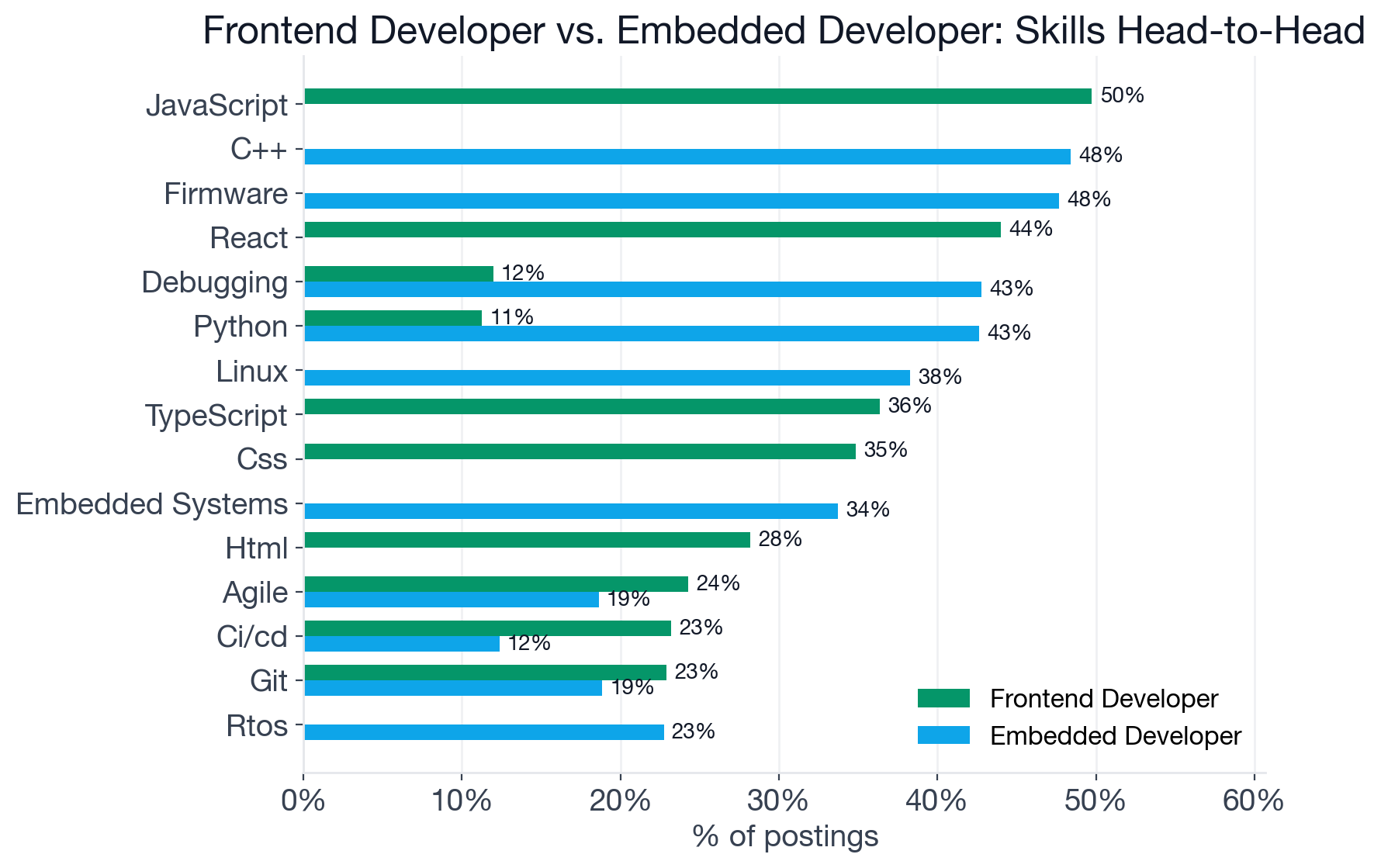 Top skills from each role's top-30 list. The two bars barely touch: this is close to the least overlapping pair we've compared.
That thin shared list produces a 0.13 Jaccard overlap across each role's full top-30 skill set, one of the lowest scores we've measured across this entire comparison series. If you already work in one of these roles, don't expect the other to feel like a lateral move: outside of Python, Git, and general software-delivery process, you're relearning almost the whole stack.
Neither role's top-30 list carries a distinct AI or LLM skill tag, which is expected: postings only name a skill when it's an explicit requirement, and few Frontend or Embedded postings frame AI tooling that way yet. That doesn't mean AI is absent from either job day to day. Developer surveys put ambient AI tool usage at 84% across the industry, with roughly half of developers using it daily, a floor that applies to both roles regardless of what their postings say. Where the two diverge is in how that usage maps onto the actual work: Frontend's React and TypeScript boilerplate is close to the exact use case general-purpose coding assistants were trained on, while embedded-specific surveys show AI adoption is already near-universal at the company level (89.3%) but leans on debugging and code review more than first-draft code generation, since general models see far less interrupt-safe, register-level C and C++ in training than they see web code.
Where the Two Skill Stacks Split
Frontend Developer's exclusive cluster, JavaScript (49.7%), React (44.0%), TypeScript (36.4%), CSS (34.8%), HTML (28.2%), User Experience (22.3%), APIs (22.0%), Angular (21.9%), Accessibility (15.9%), and HTML5 (15.3%), is a browser-rendering stack end to end: markup, styling, a component framework, and the UX judgment to use them well. Browse Frontend Developer postings asking for TypeScript to see that pattern directly.
Embedded Developer's exclusive cluster, C++ (48.4%), Firmware (47.7%), Linux (38.3%), Embedded Systems (33.7%), RTOS (22.7%), SPI (22.3%), I2C (19.7%), Firmware Development (17.5%), UART (16.0%), and Algorithms (15.4%), is a hardware-adjacent systems stack: a language built for control over memory and timing, a real-time OS, and the serial protocols (SPI, I2C, UART) that move data between a chip and the rest of the board. Browse Embedded Developer postings asking for Firmware Development to see it.
A narrow, rare tail also shows up only on Embedded's side: Computer Vision ($193,000 median, n=86) and Machine Learning ($178,500, n=58) appear in the salary data, each in the low single digits of postings, an edge-AI perception slice layered on top of firmware work rather than a general AI requirement. Nothing comparable appears anywhere in Frontend's data.
Does the Harder-to-Enter Role Actually Pay More?
Yes, but the premium isn't where the title suggests. Embedded Developer's median US base salary is $155,000 (n=1,124) versus $140,000 for Frontend Developer (n=599), a $15,000 gap, about 11% above Frontend's own median. These are base salaries only; equity, bonus, and sign-on aren't disclosed in postings, so total compensation at senior levels runs higher than either figure for both roles.
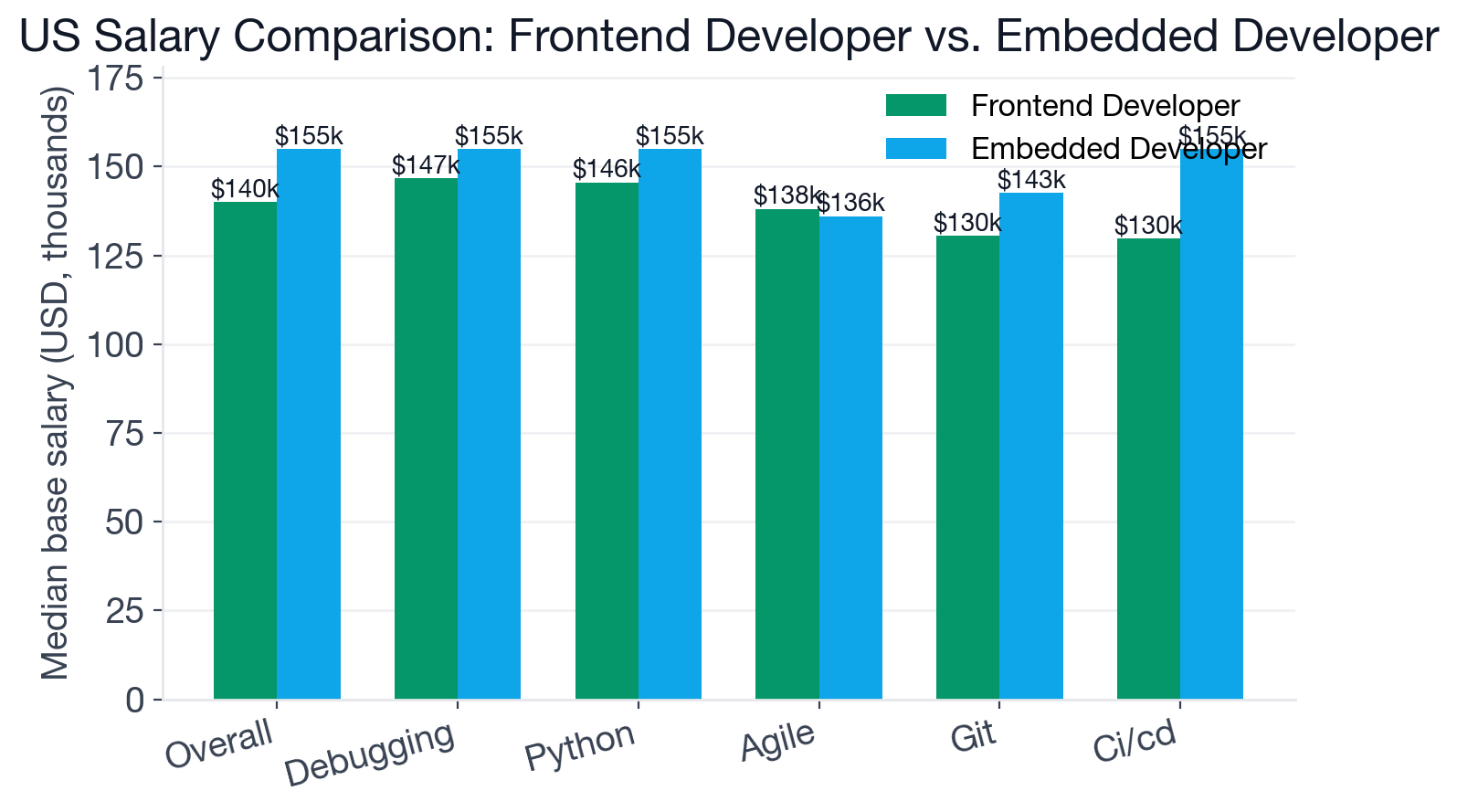 Median US base salary by role. Embedded Developer's baseline sits $15,000 above Frontend Developer's.
The more interesting number is what each role's own headline skill is worth. JavaScript, the single most common Frontend Developer skill (49.7% of postings), pays exactly $140,000 (n=273): zero premium over the role's own median. CSS (34.8%) also sits flat at $140,000 (n=177). The real Frontend premiums live one layer up, and Design Systems (+$42,500, n=79) tops that list, followed by Frontend Development (+$38,900, n=30), Prototyping (+$37,500, n=34), and Frontend Architecture (+$31,300, n=36). TypeScript and React (+$29,100 each, n=227 and n=237) pay less per posting than those but show up in far more of them, and User Experience (+$25,000, n=166), Figma (+$23,000, n=50), and Next.js (+$15,000, n=69) round out the list. (A "Compensation and Benefits" tag also surfaces at +$35,000, n=35, and a cluster of postings tagged "Customer Service," pulled in by a large retail employer in this dataset, pay far below the role's baseline; neither reflects software-focused Frontend work, so we've excluded both from this comparison.)
Embedded's own headline skills tell almost the same story. C++ (48.4%) pays $159,000 (+$4,000 over baseline, n=548) and Firmware (47.7%) pays $160,000 (+$5,000, n=561), both close to flat. The real premiums sit in adjacent specialization, and the highest of them aren't the protocol skills you'd expect: CUDA (+$27,900, n=30), Performance Optimization (+$27,800, n=36), SystemVerilog (+$25,000, n=31), Data Structures (+$24,000, n=39), and Android (+$24,000, n=43) all pay more per posting than PCIe. The skills with the most postings behind them are PCIe (+$22,500, n=121), Firmware Development (+$15,000, n=176), Device Drivers (+$12,500, n=145), System Design (+$12,300, n=100), and System Integration (+$12,200, n=89), which is why those are the more representative premiums for most Embedded candidates even though a few narrower skills technically pay more. (A few enterprise-style tags, UI Design, Data Privacy, Talent Acquisition, Intellectual Property, also surface in the raw salary data at $190K+, but they reflect generalist corporate postings tagged under this role rather than embedded engineering itself, so we've left them out.)
Read together, both roles reward the same shape of thing: the skill that gives the title its name is table stakes, not a premium, and the money sits in what you add on top of it.
Which Role Is Actually Easier to Break Into?
Frontend Developer, on every access dimension at once. 12.2% of Frontend Developer postings are explicitly entry-level, roughly 1 in 8, versus 2.6% for Embedded Developer, roughly 1 in 38. That's a 4.6 times gap, and it compounds with volume: Frontend Developer already carries 1.6x the total postings. (Frontend Developer's dataset also includes a large retail employer hiring web talent alongside store roles, which can nudge the entry-level count up slightly; even discounting for that, the access gap versus Embedded Developer's far more senior-skewed hiring is large.)
Flexibility follows the same pattern. Frontend Developer is 19.6% remote and 21.2% hybrid versus 6.9% remote and 20.7% hybrid for Embedded Developer, and Embedded Developer is 74.1% onsite against Frontend's 59.0%. Geography reinforces why: Embedded Developer is 48.1% US-concentrated versus 30.9% for Frontend Developer, and its major employers, including Qualcomm, NVIDIA, Northrop Grumman, and Anduril Industries, are semiconductor and defense firms where hardware access, export controls, and lab equipment make remote work close to impossible. Frontend Developer's largest single employer in this dataset is a national grocery retailer hiring web talent alongside its stores, a reminder that "Frontend Developer" here spans a wider range of company types than "Embedded Developer" does.
Seniority mix backs up the access story from the other direction: staff-level postings make up 17.6% of Embedded Developer's market versus 10.3% for Frontend Developer, so the role isn't just harder to enter, it's also weighted more toward people who've already spent years in it.
Deciding Between the Two
Choose Frontend Developer if you:
- Want the most accessible path in: a 1-in-8 shot at an explicitly entry-level posting, 1.6x the total job volume, and no hardware lab or clearance to work around.
- Want the option to work remotely or hybrid; Frontend Developer offers nearly 3x Embedded Developer's remote share.
- Can accept that your entry skills, JavaScript and CSS, pay at the role's baseline; your raise comes from adding TypeScript, React depth, and design-systems fluency, not from doing more of what you already do.
Choose Embedded Developer if you:
- Want to work closer to hardware: real-time constraints, serial protocols, and code that has to be correct on first boot, not a browser refresh away from a fix.
- Can work mostly onsite (74.1% of postings) at a semiconductor, aerospace, or defense employer, and are comfortable with a much narrower entry-level door (2.6% of postings, or roughly 1 in 38).
- Want your specialization to move your pay: PCIe, Firmware Development, and Device Drivers each clear a real premium over the role's own $155,000 baseline.
How to Use This in Your Job Search
Whichever direction you're leaning, practice with AI mock interviews built around the role you actually want. A Frontend Developer interview leans on React component design, accessibility, and performance trade-offs; an Embedded Developer interview leans on memory management, RTOS scheduling, and protocol-level debugging, and rehearsing the real questions is the fastest way to find out which one you can talk through confidently.
If your protocol or systems depth is thin, the Question Bank has focused drill sets for RTOS, SPI, and I2C topics. If you're earlier in either track, our interactive courses cover the web fundamentals and systems programming both roles build on.
Browse current openings for either role directly: Frontend Developer jobs or Embedded Developer jobs. For a deeper dive on skills, salary, and seniority within each role individually, see our Frontend Developer skills report and Embedded Developer skills report.
FAQ
Q. Does Frontend Developer or Embedded Developer pay more in 2026?
Embedded Developer pays more. The median US base salary is $155,000 for Embedded Developer versus $140,000 for Frontend Developer, a $15,000 (about 11%) gap, based on 1,124 and 599 postings with disclosed US salary data.
Q. Is it easier to land an entry-level Frontend Developer job than an entry-level Embedded Developer job?
Yes, by a wide margin. 12.2% of Frontend Developer postings are explicitly entry-level, roughly 1 in 8, versus just 2.6% of Embedded Developer postings, roughly 1 in 38. That is a 4.6 times gap.
Q. How much do Frontend Developer and Embedded Developer skill sets overlap?
Very little. The Jaccard overlap across each role's top 30 skills is just 0.13 (13%), one of the lowest overlaps measured across this comparison series. Only seven skills, Debugging, Python, Agile, Git, CI/CD, Code Review, and Automation, clear the 5% threshold in both roles.
Q. Do Embedded Developer's core defining skills, C++ and Firmware, actually pay a premium?
Barely. C++ pays $159,000 (+$4,000 over the role's $155,000 baseline, n=548) and Firmware pays $160,000 (+$5,000, n=561). The largest-volume premiums sit one layer down: Firmware Development (+$15,000, n=176), PCIe (+$22,500, n=121), and Device Drivers (+$12,500, n=145). Smaller-sample specialist skills like CUDA (+$27,900, n=30) and Performance Optimization (+$27,800, n=36) pay even more per posting, just across fewer of them.
Q. Do Frontend Developer's core defining skills, JavaScript and CSS, pay a premium?
No. JavaScript, the single most common Frontend Developer skill at 49.7% of postings, pays exactly $140,000, the role's own median: a $0 premium. CSS, at 34.8% of postings, also sits at $140,000. Design Systems tops the premium list at +$42,500, and Frontend Development (+$38,900), Prototyping (+$37,500), and Frontend Architecture (+$31,300) all out-earn TypeScript and React (+$29,100 each), though the latter two show up in far more postings.
Q. Which role offers more remote or flexible work, Frontend Developer or Embedded Developer?
Frontend Developer. 19.6% of Frontend Developer postings are remote versus 6.9% for Embedded Developer, nearly a 3x difference. Embedded Developer is also more onsite overall, 74.1% versus 59.0% for Frontend Developer.
Q. Do Frontend Developer or Embedded Developer postings explicitly require AI skills in 2026?
Rarely, in posting language. Neither role's top-30 skill list carries a distinct AI or LLM tag. Machine Learning and Computer Vision show up only in Embedded Developer's salary data, each in the low single digits of postings, while developer surveys put ambient AI tool usage above 84% for both roles regardless of what postings state outright.
Decide What You're Optimizing For
Frontend Developer and Embedded Developer aren't really two versions of the same career; they're two different bets. One gives you the widest door in this whole comparison series, a 1-in-8 entry rate and nearly 3x the remote flexibility, at a $140,000 median where the entry skill itself pays nothing extra. The other closes that door to roughly 1 in 38, keeps you mostly onsite at a semiconductor or defense employer, and pays $15,000 more for the trouble. Neither premium is really about the title's own headline skill; it's about what you build on top of it once you're in.
Topics
Ready to practice?
Put what you've learned into practice with AI mock interviews and structured preparation guides.