
The Smaller Role Sets the Shared Skill Bar
Frontend Developer and Mobile Developer read like two branches of the same tree: both build the software a user directly touches, both ship on a sprint cadence, both get lumped into the same "web or app" career fork. Comparing every active posting for each role on the InterviewStack.io job board as of July 2026 (5,276 Frontend Developer postings, 2,853 Mobile Developer postings), the skills the two roles genuinely share do not skew toward Frontend, the bigger, more general-sounding role. They skew toward Mobile.
Of the 15 skills that clear a 5% frequency floor in both roles, from Code Review and CI/CD to Git and APIs, 10 show up more often in Mobile Developer postings than in Frontend Developer postings. Frontend keeps the lead only on its own core language stack (JavaScript, React, TypeScript) plus Agile and, marginally, Scalability. Everything else in that shared column belongs more to the smaller role than the bigger one: code review, CI/CD, Git, debugging, even plain API work.
| Frontend Developer | Mobile Developer | |
|---|---|---|
| Median US base salary | $140,000 | $154,800 |
| Active postings | 5,276 | 2,853 |
| Top skill | JavaScript (50.2%) | Android (64.2%) |
| Remote share | 20.0% | 32.5% |
| Entry-level share | 10.7% | 2.2% |
| Skill overlap (Jaccard) | 33% shared (pairwise) | 33% shared (pairwise) |
Key Findings
- Of the 15 skills shared by both roles at meaningful frequency, 10 (including Code Review, CI/CD, Git, and APIs) appear more often in Mobile Developer postings than Frontend Developer postings.
- Mobile Developer's median US base salary is $154,800, $14,800 more than Frontend Developer's $140,000, a gap equal to 9.56% of Mobile's own baseline (n=330 vs. n=595 US postings).
- Frontend Developer postings outnumber Mobile Developer postings 1.85 to 1 (5,276 vs. 2,853 active postings).
- Only 2.2% of Mobile Developer postings are entry-level, versus 10.7% for Frontend Developer, roughly a 5x gap in first-rung access.
- Mobile Developer postings are more remote-friendly: 32.5% remote versus 20.0% for Frontend Developer.
- Design Systems is Frontend Developer's highest-paying skill ($183,000, +$43,000 over baseline, n=83); Observability is Mobile Developer's ($200,000, +$45,200, n=39).
- Frontend's own top skill, JavaScript (50.2% of postings), pays exactly the role's $140,000 baseline; three of Mobile's four platform languages (iOS, Kotlin, Swift) pay at or below its $154,800 baseline.
Two Different Products, One Overlapping Toolkit
Frontend Developers build the interface layer of a web product: the component library, the page that renders in a browser, the state that keeps a UI consistent as data changes. The job pulls in real backend range too: AWS, Node.js, SQL, and Python all clear meaningful frequency as exclusive-to-Frontend skills, more than markup and styling alone.
Mobile Developers build for one of two closed ecosystems, Google Play or the App Store, or bridge both with React Native. Browse current Mobile Developer openings and the skill list is unambiguous: Android, iOS, Kotlin, Swift, MVVM (a UI pattern separating screen logic from business logic), Jetpack Compose (Android's declarative UI toolkit), and SwiftUI (Apple's declarative UI framework) all sit exclusive to this role. App-store review, crash reporting, and platform API changes impose a release discipline that likely explains why code review and CI/CD skew toward Mobile despite Frontend being the larger role.
Neither role's top skills carry an explicit AI or ML tag, so postings are silent on that axis for both. That silence is not absence: Stack Overflow's 2025 Developer Survey puts Frontend Developers at the top of every role surveyed for AI-tool adoption (69%), Mobile Developers close behind (65%), both above the all-role daily-use baseline (51%). The 4-point gap is real but small: both roles have already normalized coding-assistant use as a baseline expectation, regardless of what any single posting states.
Which Skills Do Both Roles Actually Share?
Frontend Developer postings demand JavaScript in a majority of cases (50.2%) and lean heavily on React and TypeScript too; Mobile Developer postings mention all three, but as a meaningful minority rather than a leading share (JavaScript sits at 18.6% of Mobile postings, a React Native footprint rather than the role's center of gravity). Both roles expect Code Review, CI/CD, Git, User Experience, and API work as standard practice. The direct answer to what transfers if you switch roles: the general software-delivery layer transfers cleanly; the language-specific layer (JavaScript, React, TypeScript, Angular) does not.
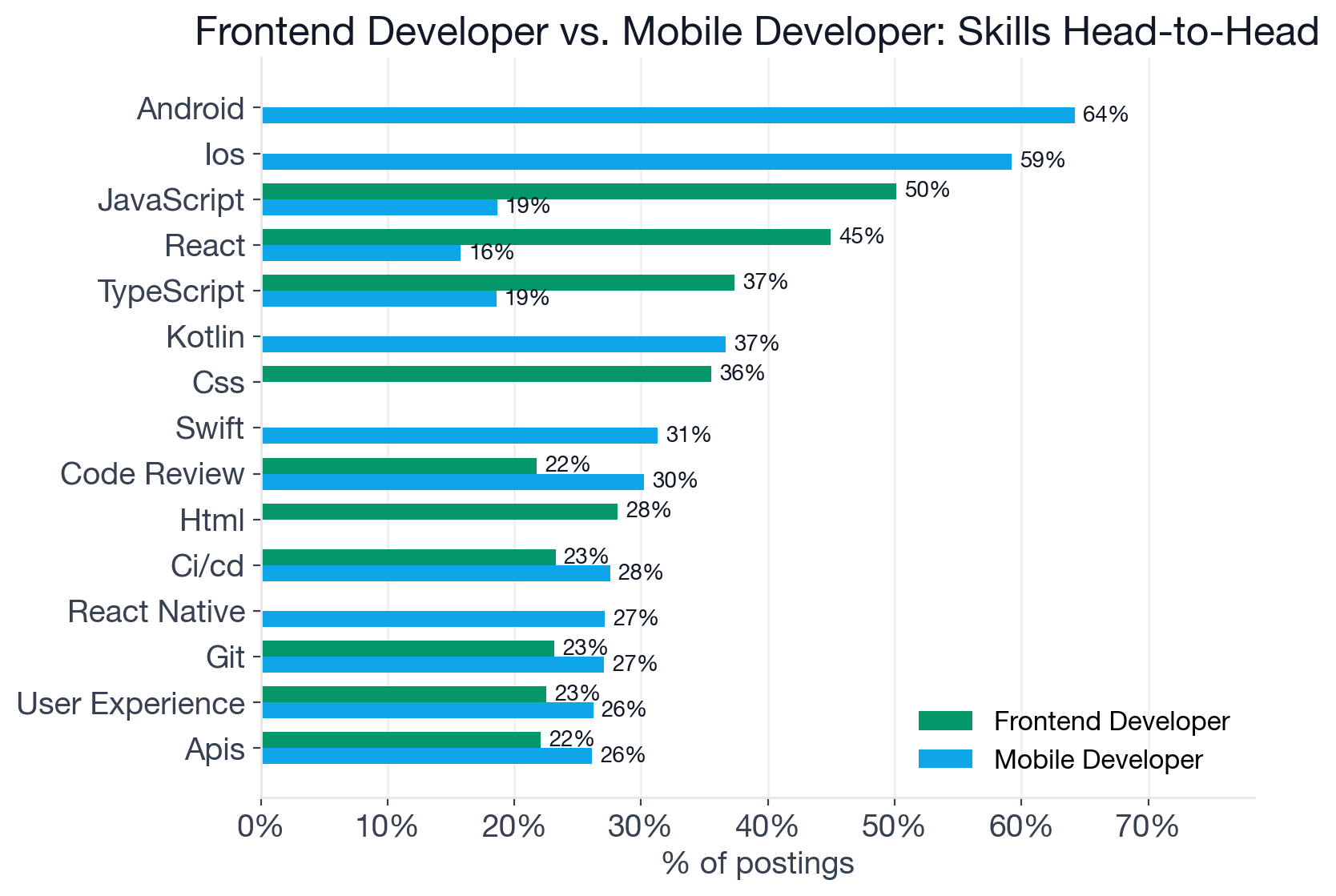 Frontend leads on the core web language stack; Mobile leads on most of the "shared" software-delivery practices.
| Skill | Frontend Developer | Mobile Developer | Leans toward |
|---|---|---|---|
| JavaScript | 50.2% | 18.6% | Frontend |
| React | 44.9% | 15.8% | Frontend |
| TypeScript | 37.4% | 18.6% | Frontend |
| Code Review | 21.8% | 30.2% | Mobile |
| CI/CD | 23.3% | 27.6% | Mobile |
| Git | 23.2% | 27.1% | Mobile |
| User Experience | 22.5% | 26.2% | Mobile |
| APIs | 22.1% | 26.1% | Mobile |
| Java | 11.2% | 22.4% | Mobile |
| Restful APIs | 9.8% | 23.1% | Mobile |
Java and Restful APIs are the sharpest splits inside the "shared" set: both appear roughly twice as often in Mobile postings, likely reflecting legacy Android codebases and backend-integration work that a Frontend role rarely touches directly. If you already work in Frontend and are considering Mobile, the code-review and CI/CD habits carry over; the language does not.
Where Do the Two Skill Sets Split?
Below the shared floor, the two roles look almost unrelated. Frontend's exclusive cluster is markup, styling, and web-platform concerns; Mobile's is two entire native ecosystems plus the bridge between them.
Exclusive to Frontend Developer: CSS (35.5%), HTML (28.2%), Angular (22.2%), Accessibility (16.3%), HTML5 (15.4%), AWS (15.2%), Node.js (15.1%), SQL (12.2%).
Exclusive to Mobile Developer: Android (64.2%), iOS (59.2%), Kotlin (36.7%), Swift (31.3%), React Native (27.1%), MVVM (18.1%), Android Development (17.3%), SwiftUI (13.0%).
The overlap coefficient across both roles' top-30 skill sets lands at 0.33, a mid-range figure, not an extreme in either direction. What it hides is composition: Mobile's exclusive list is one coherent platform stack; Frontend's spills into infrastructure and data skills that suggest broader role definitions at the companies posting these jobs.
Frontend Developer vs Mobile Developer: Which Role Pays More?
Mobile Developer pays more. Among US postings, where wage-transparency laws produce the most consistent salary disclosure, Mobile Developer's median base salary is $154,800 versus $140,000 for Frontend Developer, a $14,800 gap equal to 9.56% of Mobile's own baseline. These figures are base salary only; equity, bonus, and sign-on are not disclosed in job postings and are not reflected here, so total compensation at senior levels runs higher than either number suggests.
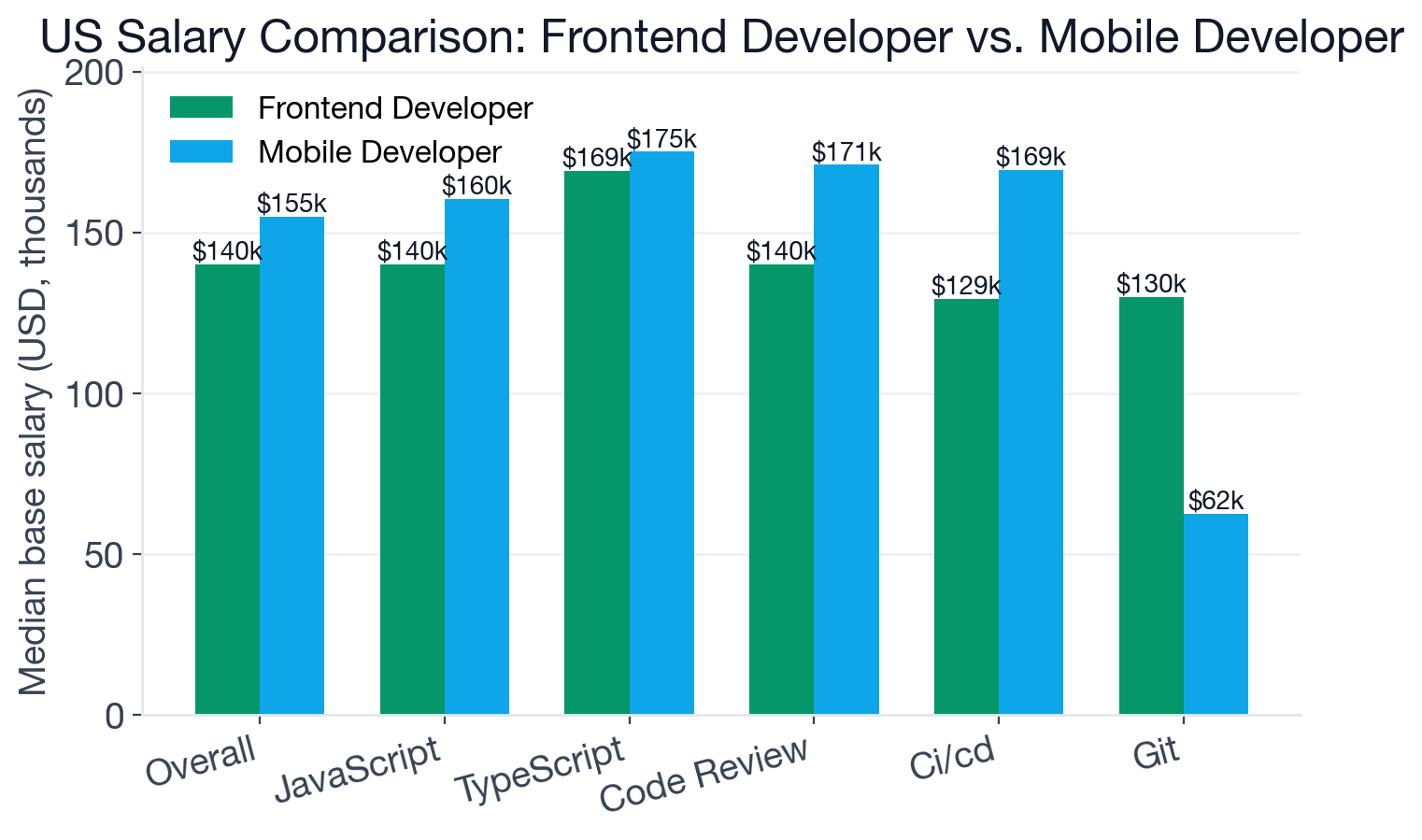 Mobile's US base salary baseline sits above Frontend's, but the highest-paid skills in both roles cluster well above either median.
Neither role's own headline skill is its best-paid one. Frontend's top skill, JavaScript (50.2% of postings), pays exactly the role's $140,000 baseline (n=278); CSS does too. Mobile's platform languages mostly sit at or below its $154,800 baseline (iOS -$3,500, Kotlin -$7,900, Swift -$2,500); only Android clears it, and just barely, at +$5,200.
Frontend Developer's highest-paying skills (US base salary, baseline $140,000):
| Skill | Median USD | Premium | Sample size |
|---|---|---|---|
| Design Systems | $183,000 | +$43,000 | 83 |
| Prototyping | $172,500 | +$32,500 | 38 |
| Frontend Architecture | $172,500 | +$32,500 | 38 |
| PostgreSQL | $170,000 | +$30,000 | 37 |
| React | $169,100 | +$29,100 | 243 |
| TypeScript | $169,100 | +$29,100 | 236 |
| Data Structures | $169,100 | +$29,100 | 28 |
| Tailwind | $166,300 | +$26,300 | 26 |
| User Experience | $165,000 | +$25,000 | 168 |
| Observability | $165,000 | +$25,000 | 39 |
This list excludes two entries that pay more per the raw data but aren't credible as frontend technical skills: "Frontend Development" ($180,000, n=31), which just restates the role title rather than naming a distinct skill, and "Compensation and Benefits" ($175,000, n=35), a non-technical HR tag that plausibly reflects the retail "front end" contamination noted below rather than genuine frontend engineering work. Every remaining entry down to the $165,000 tier clears a sample floor of at least 25 postings and is a real technical or design skill, including PostgreSQL and Data Structures, which shows this role's pay ceiling isn't purely a UI-layer story; some of the best-paid Frontend Developer postings expect data-layer and CS-fundamentals range on top of the component work. The ten entries above are the highest-paying skills that hold up as real frontend technical work.
Mobile Developer's highest-paying skills (US base salary, baseline $154,800):
| Skill | Median USD | Premium | Sample size |
|---|---|---|---|
| Observability | $200,000 | +$45,200 | 39 |
| Concurrency | $194,100 | +$39,300 | 28 |
| User Experience | $183,800 | +$29,000 | 78 |
| Jetpack Compose | $180,500 | +$25,700 | 57 |
| SwiftUI | $180,000 | +$25,200 | 55 |
| Monitoring | $177,500 | +$22,700 | 27 |
| TypeScript | $175,100 | +$20,300 | 38 |
| Automated Testing | $174,500 | +$19,700 | 26 |
| A/B Testing | $173,300 | +$18,500 | 28 |
| Code Review | $171,000 | +$16,200 | 73 |
| React Native | $170,000 | +$15,200 | 33 |
| CI/CD | $169,300 | +$14,500 | 66 |
| APIs | $169,100 | +$14,300 | 89 |
| JavaScript | $160,300 | +$5,500 | 28 |
| Android | $160,000 | +$5,200 | 219 |
| Automation | $160,000 | +$5,200 | 41 |
Observability and User Experience clear a real premium in both roles independently, evidence that production-monitoring literacy and design fluency pay off regardless of platform. Every Mobile Developer skill that prices above the $154,800 baseline is in the table above, sixteen entries in total, each backed by at least 26 postings; nothing above baseline was left out. A separate cluster of eight lower-frequency skills, including MVVM, Java, and Git, all report an identical $62,400 median, well under half the baseline. That flat, repeated value across otherwise-unrelated skills reads as a data artifact (a rounding or imputation collision) rather than a genuine signal that these particular skills pay less than the rest of the stack.
Which Role Has More Open Jobs?
Frontend Developer, by a wide margin: 5,276 active postings versus 2,853 for Mobile Developer, a 1.85x volume advantage. That larger pool comes with an easier door in, not just more of the same job: 10.7% of Frontend postings are tagged entry-level versus just 2.2% for Mobile, roughly a 5x gap. If you are trying to land a first engineering job, Frontend is the more forgiving market on paper.
Mobile compensates with flexibility. 32.5% of Mobile Developer postings are remote versus 20.0% for Frontend, and Frontend is markedly more onsite-heavy overall (57.8% versus 46.3%). Geographically, both roles concentrate in the US (29.6% Frontend, 21.1% Mobile) and India (13.2% Frontend, 10.1% Mobile), with Frontend slightly more US-weighted.
A data caveat on that volume and entry-level gap: "Front End" is a title collision, not just a skill collision. Albertsons Companies, a grocery and retail chain, is the single largest employer in this Frontend Developer dataset (356 postings, 6.8% of the role), and discount retailer Ollie's also appears in the top 15 (60 postings, 1.1%). In retail, "front end" commonly names the checkout and customer-service area of a store, not a software team, and this dataset shows the fingerprints: "customer service" is a top-30 Frontend Developer skill (10.1% of postings) and both "merchandising" and "compensation and benefits" appear in the salary-by-skill breakdown, none of which describe frontend engineering work. Some share of Frontend Developer's postings count, and plausibly its entry-level share specifically, reflects retail front-end staff swept in by the shared title rather than frontend software engineers. A smaller version of the same collision touches Mobile Developer: "mobile" also collides with facilities/property-management roles ("mobile engineer" as a roving maintenance title) in unrelated industries, and Jones Lang LaSalle, a commercial real-estate firm, appears among Mobile Developer's top employers (23 postings, 0.8% share). Treat the 1.85x volume gap and the 10.7%-vs-2.2% entry-level comparison as directionally right but not exact.
What This Decision Actually Hinges On
Choose Frontend Developer if you:
- Want the more accessible entry point. The job pool is 1.85x larger and the entry-level share (10.7%) is roughly 5x Mobile's.
- Already know JavaScript, React, or TypeScript and want to build on that foundation rather than start a new platform stack.
- Want room to grow sideways into backend-adjacent work; AWS, Node.js, SQL, and Python all show up at meaningful frequency in these postings.
Choose Mobile Developer if you:
- Want the higher salary ceiling and are willing to compete for a narrower entry door (2.2% entry-level share).
- Want to specialize in one native platform (Kotlin/Android, Swift/iOS) or the React Native bridge, rather than the broader web stack.
- Value remote flexibility. Mobile postings are remote 32.5% of the time versus 20.0% for Frontend.
How to Use This in Your Job Search
Whichever direction you're leaning, practice with AI mock interviews built around the actual skill stack for the role you're targeting, whether that's a component-architecture discussion for Frontend or a concurrency and memory-management deep dive for Mobile.
Both roles reward depth over breadth once you clear the table-stakes layer. Use the Question Bank to drill the topics that showed up as real salary differentiators here: design systems and frontend architecture for Frontend Developer, concurrency and platform-specific UI frameworks for Mobile Developer.
If you're starting from near zero on either stack, our interactive courses cover the foundations, React and modern JavaScript for Frontend, Kotlin and Swift fundamentals for Mobile, before you start interviewing.
Browse live Frontend Developer openings or Mobile Developer openings on InterviewStack.io, or filter further, such as Frontend roles asking for React. For a deeper per-role breakdown, see our Frontend Developer skills report and Mobile Developer skills report.
FAQ
Q. Does Frontend Developer or Mobile Developer pay more in 2026?
Mobile Developer's median US base salary is $154,800, about $14,800 more than Frontend Developer's $140,000, a gap equal to 9.56% of Mobile's own baseline, based on 330 and 595 postings respectively with US salary disclosed. Frontend Developer still posts 1.85 times more jobs overall.
Q. What skills do Frontend Developer and Mobile Developer postings share?
The two roles clear a 5% shared-skill threshold on 15 skills, including JavaScript, React, TypeScript, Code Review, CI/CD, Git, User Experience, and APIs. Ten of those 15 actually appear more often in Mobile Developer postings than in Frontend Developer postings, despite Mobile being the smaller role.
Q. Is Mobile Developer harder to break into than Frontend Developer?
Yes. Only 2.2% of Mobile Developer postings are tagged entry-level, versus 10.7% for Frontend Developer, roughly a 5x gap. Frontend Developer is the more accessible first job of the two.
Q. What skills are exclusive to Mobile Developer?
Android (64.2% of postings), iOS (59.2%), Kotlin (36.7%), Swift (31.3%), and React Native (27.1%) are Mobile Developer's most common exclusive skills, none of which clear meaningful frequency in Frontend Developer postings.
Q. What skills are exclusive to Frontend Developer?
CSS (35.5%), HTML (28.2%), Angular (22.2%), Accessibility (16.3%), and HTML5 (15.4%) are Frontend Developer's most common exclusive skills. Backend-adjacent skills like AWS, Node.js, SQL, and Python also show up at meaningful frequency, signaling that some Frontend Developer postings expect full-stack range.
Q. Which role offers more remote work?
Mobile Developer. 32.5% of Mobile Developer postings are remote versus 20.0% for Frontend Developer, and Frontend Developer is more onsite-heavy overall (57.8% versus 46.3%).
Q. Which role has more open jobs right now?
Frontend Developer, by a wide margin. It has 5,276 active postings versus 2,853 for Mobile Developer, a 1.85x volume advantage, even though Mobile pays more at the median.
The Bigger Role Doesn't Set the Bar
Frontend Developer is the larger, more accessible market; Mobile Developer is the smaller, better-paid, more remote-friendly one. But the skills the two roles supposedly share don't belong to the bigger role by default, they belong to whichever role's daily work demands more of them. Here, that's Mobile. Before assuming a "shared skill" transfers evenly in either direction, check which role actually leans on it more.
Topics
Ready to practice?
Put what you've learned into practice with AI mock interviews and structured preparation guides.