
You have 30 minutes, a message composer, and a spec that never says whether the "aa" inside "aaa" counts as a repeat. Most prepared candidates hear "repeated substrings," reach for a sliding window and a set, and start typing. Then they lose points they never see: the rubric is only 20 percent about code.
This is a dramatized mock interview for a mid-level Full-Stack Developer on arrays, strings, and hashing, built from one real InterviewStack.io AI interview blueprint. The answers below are illustrative ("a common answer here is..."), not a transcript of any real person or company.
Key Findings
- The rubric is 100 points: 30 for Interviewer Objectives Alignment, 30 for Level-Specific Expectations, 20 for Technical Proficiency, 20 for Communication & Problem Solving.
- 60 of 100 points reward judgment and seniority signals; only 20 reward the correctness of the code itself.
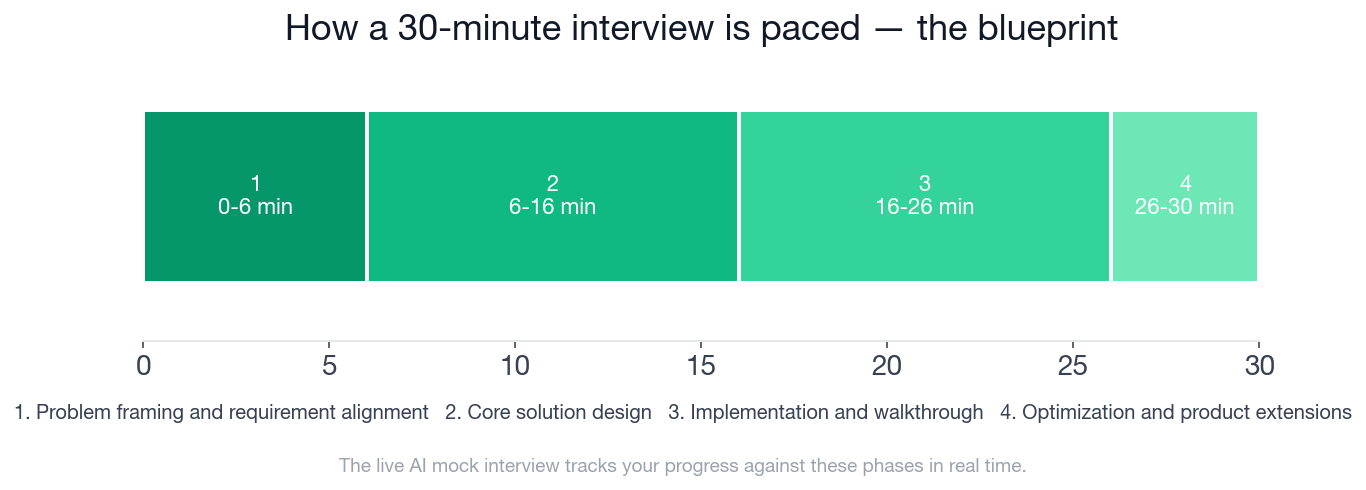
- The interview is paced into 4 phases over 30 minutes: 0-6, 6-16, 16-26, and 26-30.
- Requirement framing gets 6 minutes and 4 checklist items, starting with at least 1 clarifying question about normalization or substring boundaries.
- The target design is linear in normalized message length: 1 pass, 1 window of length k, 1 hash set or map.
- Optimization and product extensions get just 4 minutes, so any memory discussion has to be crisp.
- The blueprint lists 18 checklist items across the 4 phases; this post's 4 turns each miss one or more.
The Algorithm Is Worth 20 Points, the Conversation Around It Is Worth 80
The technical core here is a standard pattern, so interviewers use it as a vehicle. A Technical Proficiency score of 20 means you can write a flawless window loop and still finish well under 100.
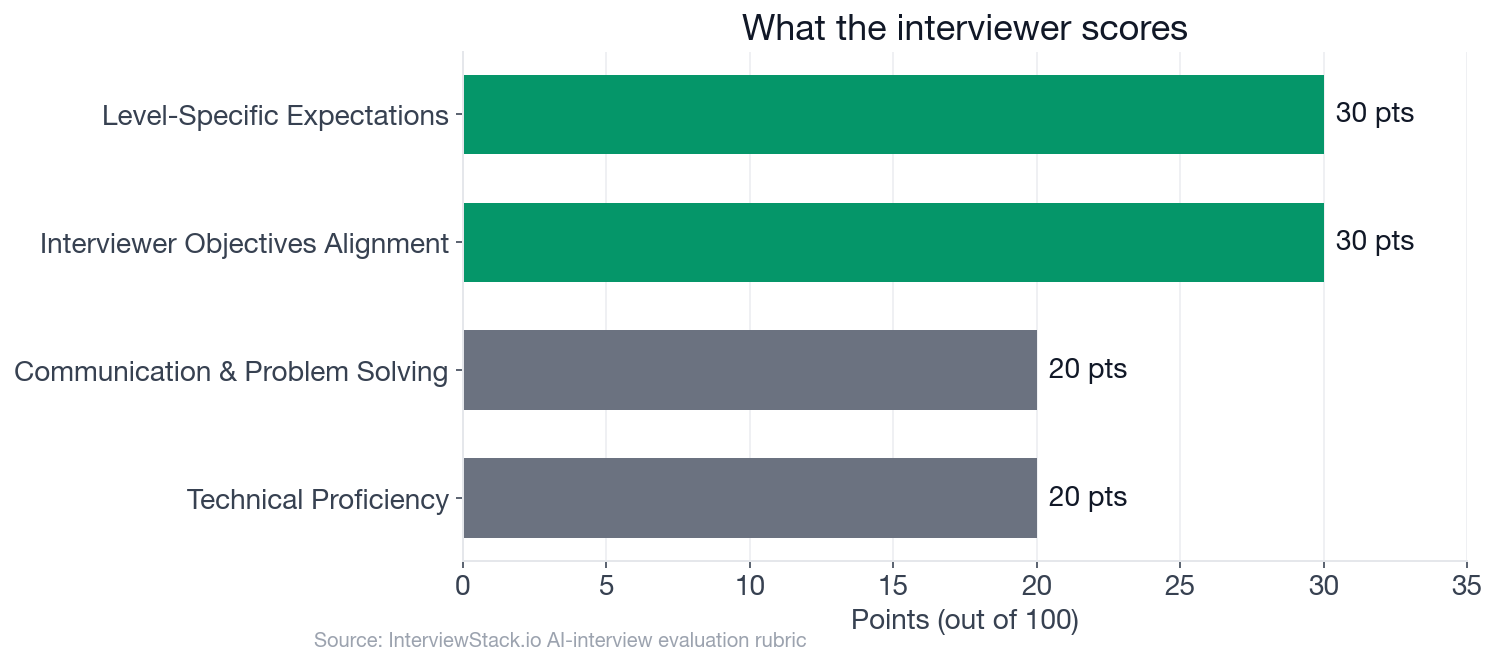
The weights tell you where the time goes: objectives and level expectations together outweigh everything else, which is why judgment calls, like settling the spec ambiguity out loud, matter more than they feel like they should.
What Is a Full-Stack Developer Arrays and Hashing Interview Really Asking?
It is asking whether you can own an ambiguous product rule. Here is the question, as the blueprint presents it.
The interview question
You are working on the messaging composer for a large consumer product. Before a message is sent, the client runs lightweight local checks to highlight suspicious repeated text patterns that often come from accidental paste loops or spammy edits. A message should be flagged if it contains any contiguous substring of length k whose normalized form appears more than once anywhere else in the same message.
Normalization: case-insensitive, ignore spaces and punctuation, treat only letters and digits as significant. For example, "Hi!! hi" with k = 2 should be flagged because "hi" appears twice after normalization. Assume the function runs on a single message at a time in memory.
Design and implement a function that determines whether the message should be flagged for a given k, and talk through the trade-offs in your approach.
The interviewer is probing four things: whether you clarify before coding, whether you pick an efficient array/string plus hash-lookup design, whether you handle edge cases, and whether you can discuss readability, memory, and index recovery as trade-offs. At mid-level, the bar is arriving at the linear-scan design with little prompting.
Four Follow-Ups, Four Quiet Point Losses
A common answer here is described for a candidate we will call Mira, who knows the pattern cold.
Turn 1: Where Boundaries Live
Interviewer: "How would you define the substring boundaries after normalization: based on the original message or based on the normalized character stream, and what are the product implications of each choice?"
Turn 2: Tiny and Odd k
Interviewer: "How would your implementation behave for k = 0, k = 1, or when the normalized message is shorter than k?"
Turn 3: Several Hundred Thousand Characters
Interviewer: "If messages can be several hundred thousand characters long, how would you keep the solution efficient in both runtime and memory?"
Turn 4: Highlighting the Match
Interviewer: "Suppose the design team wants highlighted ranges in the original message for the repeated match. How would that change your data structures?"
Would You Catch All Four Live With a Clock Running?
Reading these mistakes is easy, and that is the trap. In the room, each one arrives mid-sentence, after a follow-up you did not rehearse, with a timer on the other side of the screen. Clarifying first, stating the contract, naming the memory cost, and keeping indices all feel obvious on the page and vanish under pressure. The only fix is reps against an interviewer who does not follow your script.
What Does the 30-Minute Blueprint Check, Phase by Phase?
This is the blueprint a strong candidate hits, and it is exactly what the AI mock interview tracks you against in real time. Note how little room the last phase has.
- ✓Asks at least one clarifying question about normalization or substring boundaries
- ✓States a proposed function contract and expected output
- ✓Calls out behavior for short normalized inputs or unusual k values
- ✓Chooses a clear interpretation and proceeds without getting stuck in ambiguity
- ✓Proposes normalizing the message into a filtered character stream or equivalent representation
- ✓Uses a window of length k over the normalized representation
- ✓Uses a set or map to detect duplicates efficiently rather than nested comparisons
- ✓Explains expected time complexity and the main memory cost
- ✓Mentions overlap handling naturally without special-case confusion
- ✓Implements a coherent solution with correct normalization behavior
- ✓Correctly iterates windows and checks duplicates
- ✓Walks through at least one provided or self-created example step by step
- ✓Avoids obvious off-by-one mistakes in window bounds
- ✓Returns the correct result for repeated and non-repeated cases
- ✓Discusses memory implications of storing many substrings
- ✓Mentions possible optimization such as rolling hash, storing indices, or avoiding repeated substring materialization
- ✓Explains what would change to return the first match or original-message highlight ranges
- ✓Balances optimization ideas with implementation complexity appropriately for a client-side feature
Run This Composer Check Against a Live Interviewer
The fastest way to find out which of these four mistakes is yours is to start the AI mock interview for this exact scenario. It follows the blueprint above, asks unscripted follow-ups, and scores you on the same four dimensions. When you want more volume first, drill the arrays, strings, and hashing question bank, or browse current Full-Stack Developer openings to see which stacks hire for this skill.
FAQ
Q. What does a mid-level Full-Stack Developer arrays and hashing interview test?
It tests whether you can turn a vague product requirement into a linear-time solution using normalization, a sliding window, and a hash set or map. In this blueprint, 60 of 100 rubric points sit on interviewer objectives and level-specific expectations, and only 20 on raw technical proficiency.
Q. How long is the interview and how is it paced?
The blueprint runs 30 minutes in four phases: requirement framing (0-6), core solution design (6-16), implementation and walkthrough (16-26), and optimization and product extensions (26-30). Optimization gets only 4 minutes, so strong candidates keep earlier phases tight.
Q. What time complexity should the repeated-substring solution reach?
Linear in the normalized message length is the target: one pass with a window of length k and a hash set. Copying every window costs extra memory (and hashing work) proportional to the number of windows times k, which is why a rolling hash or stored start indices come up as optimizations.
Q. Which edge cases should I mention before coding?
State what happens when k is less than 1, when the normalized message is shorter than k, and when the message is empty or all punctuation. Also decide whether overlapping matches such as aa inside aaa count, and say your choice out loud.
Q. Do I need to explain how hash tables work internally?
No. Collision resolution and resizing mechanics are explicitly out of scope for this topic. Use a hash set as a tool, explain why lookups are fast enough, and spend your time on correctness and trade-offs.
Q. How do I practice this under realistic conditions?
Run it as a timed, unscripted conversation. The InterviewStack.io AI mock interview follows this 30-minute blueprint, asks follow-ups you have not seen, and scores you on the same four rubric dimensions.
The Window Is Easy, the Contract Is Hard
Anyone can slide a window across a string. What separates mid-level from stuck is deciding what the string means, saying it out loud, and keeping the door open for the next product ask. Practice that part live, and the code takes care of itself.
Topics
Ready to practice?
Put what you've learned into practice with AI mock interviews and structured preparation guides.