
The Full-Stack Developer End-to-End Feature Development Interview Rewards Connecting Layers, Not Depth
A mid-level Full-Stack Developer interview on end-to-end feature design does not ask you to be the best backend engineer in the room. It asks you to hold four layers, user flow, API contract, backend logic, and data model, in your head at the same time and keep them consistent with each other for 30 straight minutes. This walkthrough follows one such interview at a leading tech company, built from the same interview_package structure the AI mock interviewer runs against, so you can see exactly where a well-meaning candidate gives away points before the design is even wrong.
The scenario is a feature called Save Job Alert: a user saves a job search and gets notified when new postings match it. Simple to describe, deceptively easy to design badly. If you'd rather browse structured, company-style practice first, the preparation guides are a good place to start.
Key Findings
- The interview runs exactly 30 minutes across 4 phases: 7 minutes to scope the MVP, 10 minutes on the API and data model, 10 minutes on the matching pipeline, and 3 minutes on launch readiness.
- Interviewer Objectives Alignment and Level-Specific Expectations carry 60 of the 100 rubric points combined, more than Technical Proficiency (20) and Communication & Problem Solving (20) combined.
- Phase 3, the matching pipeline and edge cases, packs 5 expected-checklist items into its 10 minutes, more than any other phase.
- Phase 1 explicitly checks for 2 to 4 focused clarifying questions before any design work starts.
- Only 3 of the interview's 30 minutes are reserved for metrics and launch readiness, the shortest of the 4 phases.
- Building a custom search or ranking engine from scratch is on the interview's forbidden-skills list; the bar is a practical, shippable MVP, not distributed-systems depth.
What Is the Interviewer Actually Asking You to Build?
The interview question
You are working on a professional networking product similar to LinkedIn. The team wants to ship a new feature called Save Job Alert: when a user saves a job search, they should receive notifications when newly posted jobs match that search.
Assume web and mobile clients already exist, user accounts, companies, and job postings already exist, a basic notification service already exists that can send email and push notifications, jobs can be created, updated, expired, or deleted, and saved searches do not exist yet. You are designing the first production version for a large but not internet-scale launch.
How would you design and build the Save Job Alert feature end to end?
The interviewer isn't grading whether you know what a message queue is. They're checking whether you can clarify an ambiguous product ask, make trade-offs that stay consistent from the UI down to the schema, catch the edge cases a real launch would hit, and say all of it clearly in half an hour. Coding platform tools such as Question Bank offer focused reps on the API design and data modeling questions this topic tends to raise, if you want to warm up before the full simulation.
Four Turns, Four Phases
We picked 4 of the 6 real follow-up prompts from this interview's blueprint, one from each scoring phase, so you can see where a mid-level candidate named Noah loses points and what a stronger answer sounds like instead. The follow-ups on duplicate notifications and 10x scale growth aren't covered turn by turn here, but they're real reps you'll still need before you sit the live version.
Turn 1: Scoping the MVP
Interviewer: "What assumptions would you make about the user flow and what would the minimum shippable version include?"
Turn 2: Designing the API and Data Model
Interviewer: "How would you design the API and data model for saving a search and managing a user's alert preferences?"
Turn 3: The Write-Path Trap
Interviewer: "When a new job is posted, how would your backend determine which saved searches match it without making the write path too slow?"
Turn 4: Proving It Works After Launch
Interviewer: "What metrics, logs, or operational signals would you use after launch to know whether the feature is working correctly and providing value?"
Spotting the Mistake Isn't the Same as Avoiding It
Every mistake above is obvious once it's sitting on a page in red and green boxes with time to think. Under real interview pressure, with a follow-up you didn't expect and a clock running, the write-path trap in particular is easy to walk straight into, because "check for a match when the job is created" is the first sentence that comes to mind. Recognizing it here doesn't mean you'd catch it live. That gap is exactly what the AI mock interview is built to pressure-test: unscripted follow-ups, a real clock, and scoring against the same rubric used above.
What Blueprint Is the Interview Actually Scoring?
This is the full blueprint a strong candidate hits, phase by phase, and the exact structure the AI interviewer tracks you against in real time as you talk.
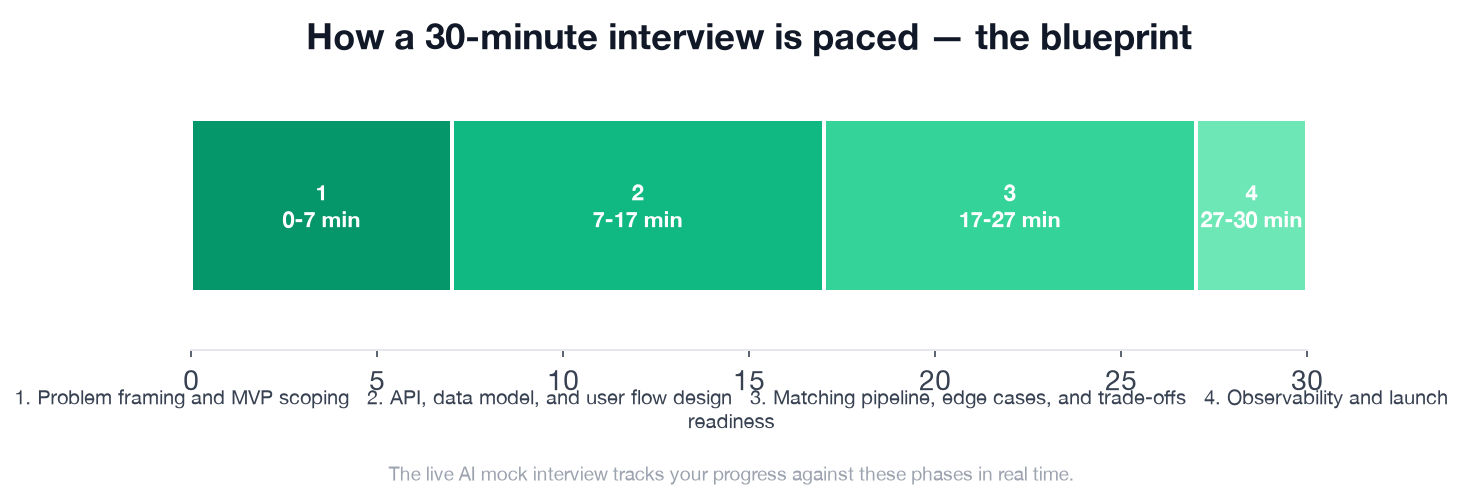 Problem framing gets 7 minutes, API and data model design gets 10, the matching pipeline gets 10, and launch readiness closes out the last 3.
- ✓Asks 2-4 focused clarifying questions about user behavior, notification timing, and controls
- ✓Defines a plausible MVP such as save a search, enable alert channel/frequency, and notify on new matching jobs
- ✓States core assumptions explicitly rather than silently inventing requirements
- ✓Keeps scope appropriate for a first launch and avoids unnecessary advanced features
- ✓Describes the main user actions such as create saved search, list saved searches, update alert settings, and delete/disable alerts
- ✓Proposes concrete resource shapes or endpoints with key fields like keywords, location, filters, frequency, channel, and status
- ✓Introduces a reasonable schema for saved searches and notification delivery tracking or dedup state
- ✓Explains how the client would represent and edit saved searches in a way that aligns with the API
- ✓Chooses a reasonable trigger model, such as async processing on job creation/update instead of blocking the job write path
- ✓Explains matching logic at a practical level, for example normalized filters and querying candidate saved searches before applying match rules
- ✓Addresses duplicate prevention or idempotency at least at the user-job or user-search-job level
- ✓Discusses how updates, expirations, deletions, and preference changes affect whether notifications should be sent
- ✓Identifies one or two scale bottlenecks and suggests pragmatic next steps such as indexing, batching, or moving matching to a dedicated worker
- ✓Names a few concrete product metrics such as saved searches created, alerts sent, open/click rate, or apply-through rate
- ✓Mentions technical signals such as match job latency, notification failure rate, queue backlog, or duplicate send rate
- ✓Suggests basic validation approaches like logs, dashboards, or limited rollout
The four-dimension rubric behind that blueprint weights framing and level-appropriate judgment above raw technical execution:
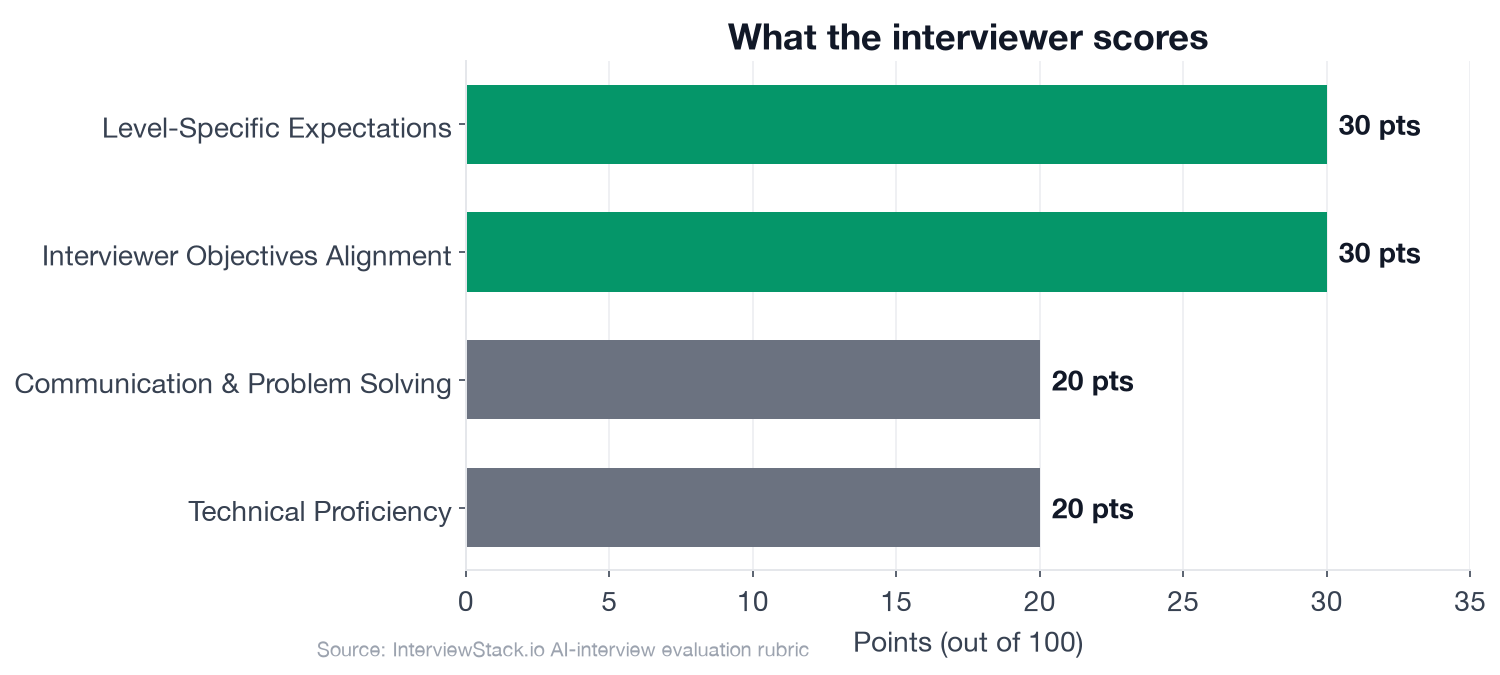 Interviewer Objectives Alignment and Level-Specific Expectations each carry 30 points, together outweighing Technical Proficiency and Communication & Problem Solving combined.
Ready to Run This Interview Yourself?
The fastest way to find out if you'd catch the write-path trap live is to sit the same interview under the same clock. Start the AI mock interview for Full-Stack Developer, End-to-End Feature Design and Development, at the mid-level, and you'll get unscripted follow-ups plus scored feedback against this exact rubric. If you want to build up the underlying vocabulary first, the question bank for this topic is the lower-pressure place to start.
FAQ
Q. What does the Full-Stack Developer end-to-end feature development interview test?
It tests whether a mid-level candidate can design one feature, in this case a Save Job Alert notification system, across the full stack: user flow, API contract, backend processing, and data model, in a single coherent 30-minute conversation. The rubric explicitly rewards consistency across layers over depth in any single layer.
Q. How is this interview scored?
On a 100-point rubric split across four dimensions: Interviewer Objectives Alignment (30 points), Level-Specific Expectations (30 points), Technical Proficiency (20 points), and Communication & Problem Solving (20 points). The two framing dimensions alone account for 60 of the 100 points.
Q. What is the most common mistake candidates make in this interview?
Checking every saved search against a new job inside the same request that writes the job to the database. That blocks the job write path as the saved-search table grows and misses the checklist item calling for async processing on job creation or update instead.
Q. How much time should I spend scoping the MVP before designing the API?
The blueprint allocates the first 7 of 30 minutes to problem framing and MVP scoping, expecting 2 to 4 focused clarifying questions and an explicit MVP statement before any API or schema design begins.
Q. Do I need to design a custom search or ranking engine for this interview?
No. Building a custom search engine or relevance ranking algorithm from scratch is explicitly outside the scope of a mid-level version of this interview, along with deep distributed systems theory and low-level infrastructure tuning.
Q. What should I say about metrics after launch?
Name both product and technical signals: product metrics like saved searches created, alerts sent, and click or apply-through rate, and technical signals like match job latency, notification failure rate, queue backlog, and duplicate send rate, plus a plan for limited rollout before wide release.
Q. How can I practice this exact interview?
Run the same Save Job Alert scenario as a live AI mock interview, timed to the same 30-minute blueprint and scored against the same rubric, or drill the underlying end-to-end feature design questions in the question bank first.
The Write Path Was Never Just a Detail
Noah's design wasn't wrong in the way most people expect a wrong answer to look. It had a schema, an API, and a notification plan. It failed because one decision, checking matches inline on the job write path, quietly broke the trade-off the rubric cares about most: keeping every layer consistent under real load. That's the kind of mistake you only stop making after you've made it once, ideally somewhere that doesn't count.
Topics
Ready to practice?
Put what you've learned into practice with AI mock interviews and structured preparation guides.