
Full-Stack and Embedded Share a Job Title Word. Not Much Else.
Both roles have "Developer" in the title. Past that, the overlap mostly stops. Full-Stack Developer and Embedded Developer share just 13% of their top-30 skill sets, a Jaccard similarity of 0.13, the lowest overlap we have measured across dozens of role-comparison pairs on the InterviewStack.io job board. We pulled 8,911 active Full-Stack Developer postings and 3,005 active Embedded Developer postings as of July 2026 and compared skills, pay, and hiring patterns side by side.
The pay story runs against the usual pattern, too. Embedded Developer is the smaller job market by nearly 3x, and it is the most onsite-heavy role we have compared, yet it pays $11,900 more at the median than Full-Stack Developer. Fewer openings and less flexibility, but a bigger paycheck. That inversion, and what it says about how each labor market prices scarcity, is the thread running through this post.
| Full-Stack Developer | Embedded Developer | |
|---|---|---|
| Median US base salary | $148,100 | $160,000 |
| Active postings | 8,911 | 3,005 |
| Top skill | React (53.6%) | C++ (53.3%) |
| Remote share | 28.6% | 7.4% |
| Entry-level share | 3.0% | 3.4% |
| Skill overlap (Jaccard) | 13% shared | (pairwise) |
Key Findings
- Full-Stack Developer and Embedded Developer share just 13% of their top-30 skills (Jaccard 0.13), the lowest overlap in this comparison series so far.
- Embedded Developer pays an $11,900 (7.4%) premium over Full-Stack Developer at the US median: $160,000 vs. $148,100.
- Full-Stack Developer has 2.97x more active postings: 8,911 vs. 3,005 for Embedded Developer.
- Embedded Developer is overwhelmingly onsite (71.7% of postings) with a remote share of just 7.4%, versus 49.9% onsite and 28.6% remote for Full-Stack Developer.
- The two roles' single most-demanded skills don't touch: React leads Full-Stack at 53.6%, C++ leads Embedded at 53.3%.
- Python is the one skill both roles lean on at real frequency: 32.2% of Full-Stack postings, 41.0% of Embedded postings.
- Entry-level access is similarly narrow for both: 3.0% of Full-Stack postings and 3.4% of Embedded postings are explicitly entry-level.
- Embedded Developer postings are far more US-concentrated (49.6%) than Full-Stack Developer postings (29.1%).
Two Completely Different Workdays
A Full-Stack Developer spends most of a week moving between a browser, an API, and a database, shipping features across the whole request path: a React component, the Node.js or Java endpoint behind it, and the PostgreSQL query underneath. The unit of work is usually a ticket that touches three or four layers of the same web application, reviewed and deployed through CI/CD multiple times a week.
An Embedded Developer spends most of a week closer to the metal: writing and debugging C++ or firmware that runs directly on a microcontroller, talking to sensors over SPI, I2C, or UART (the low-level protocols microcontrollers use to exchange data with peripheral hardware), and validating behavior against real-time constraints an operating system can't paper over. The unit of work is a chip, a board, or a device, not a web request, and a bug often means a debugger attached to physical hardware, not a browser console.
What Skills Do Both Roles Actually Share?
Both roles lean on Python, but past that, "shared" doesn't mean "equal." Seven skills clear the 5% frequency bar in both postings sets, and five of them (Agile, CI/CD, Code Review, Git, Monitoring) skew roughly 2x toward Full-Stack's software-delivery culture rather than sitting at parity.
| Skill | Full-Stack | Embedded |
|---|---|---|
| Python | 32.2% | 41.0% |
| Agile | 35.3% | 18.1% |
| CI/CD | 39.6% | 12.9% |
| Code Review | 31.8% | 15.4% |
| Git | 22.9% | 19.7% |
| Automation | 17.6% | 20.3% |
| Monitoring | 16.8% | 7.8% |
Use the chart below to see the full skill comparison, then read the table above as the story: Python is genuinely mutual ground, and slightly Embedded-leaning at that. Everything else that's "shared" is process and tooling vocabulary borrowed from software engineering broadly, present in Embedded postings but at roughly half the rate. That gap traces back to release cadence: web teams ship continuously and lean hard on CI/CD and code review as daily habits, while embedded teams work in longer validation cycles gated by hardware availability, not sprint velocity.
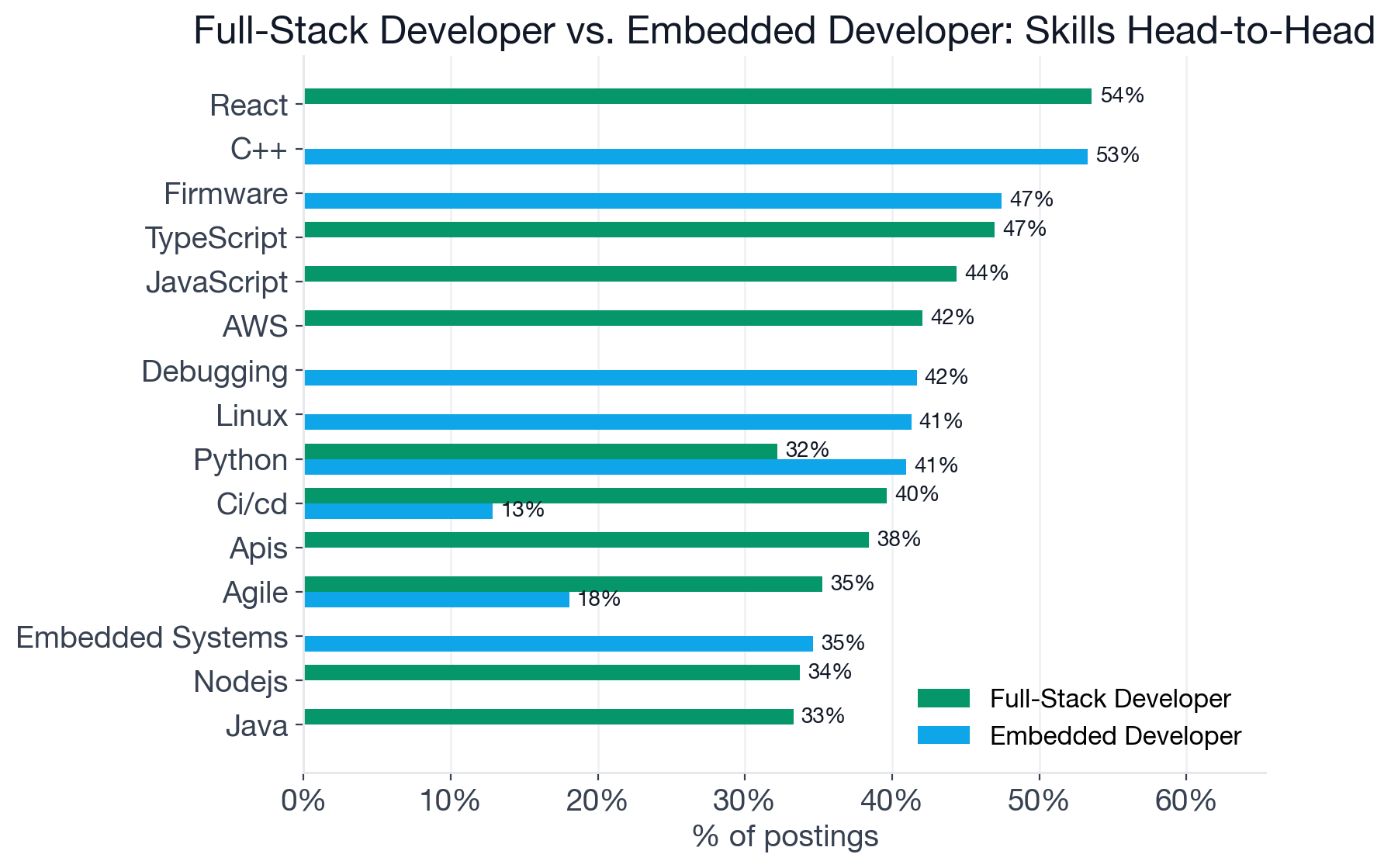 Full-Stack Developer skills cluster around the web stack (React, TypeScript, AWS); Embedded Developer skills cluster around hardware interfaces (C++, firmware, RTOS). The two bars barely overlap.
Where the Stacks Split Completely
Full-Stack Developer's exclusive skills read like a modern web stack: React (53.6%), TypeScript (47.0%), JavaScript (44.4%), AWS (42.0%), and APIs (38.4%). This is a role built to move fast across a browser-to-cloud pipeline, and every one of those skills exists to make that pipeline ship faster.
Embedded Developer's exclusive skills read like a hardware bring-up checklist: C++ (53.3%), Firmware (47.4%), Debugging (41.7%), Linux (41.3%), and Embedded Systems (34.6%) as the domain label itself. RTOS (a real-time operating system built to guarantee response times, unlike general-purpose Linux) appears in 23.4% of postings, alongside protocol-level skills like SPI (23.5%) and I2C (21.7%) that never show up in Full-Stack postings at all. Debugging deserves a second look: it doesn't even register in Full-Stack's top-30 list, but it's Embedded's third most-common skill at 41.7%, a signal that diagnosing hardware behavior, not writing new features, eats a real share of the embedded workweek.
Which Role Pays More, and Why?
Embedded Developer wins on pay. Among US postings with disclosed salary (base salary only, since equity and bonuses aren't reported in job listings), Embedded Developer's median is $160,000 against Full-Stack Developer's $148,100, an $11,900 (7.4%) premium in a market with a third of the openings.
Part of the explanation is seniority mix: 44.4% of Embedded postings are senior or staff level versus 40.9% for Full-Stack, a modest but real tilt toward experienced hires. The rest is scarcity. Fewer engineers can debug real-time firmware on physical hardware than can build a React front end, and the salary data reflects it directly. Differentiator skills carry a clear premium in both roles: Full-Stack postings that ask for System Design, Next.js, or Distributed Systems pay $21,900 to $26,900 above the role's own baseline, and postings asking for LLMs or Generative AI pay $30,200 to $36,900 above it. Embedded postings that ask for FPGA (a reconfigurable hardware chip used for custom logic) or Algorithms pay $10,000 above baseline, and Computer Vision, SystemVerilog (a hardware description language used to design and verify chips), or CUDA push $25,000 to $33,000 above it. In both roles, the further a posting pulls toward specialized, hard-to-hire-for work, the more it pays.
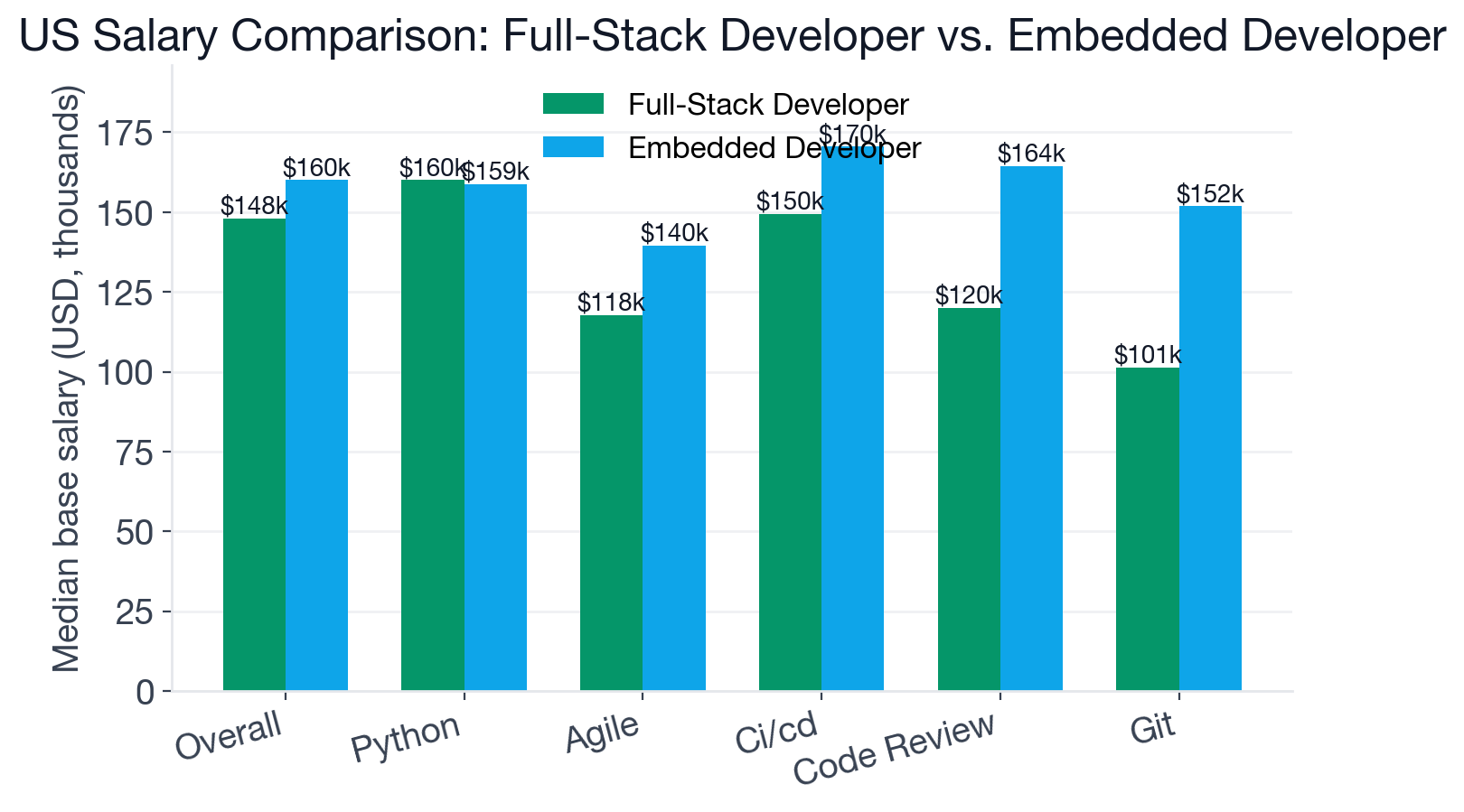 Embedded Developer's US base salary median sits above Full-Stack Developer's, and the gap holds across the skills both roles share.
Do Either of These Roles Require AI Skills?
Not by job-posting frequency, in either role. AI and ML terms don't crack the top-30 skill list for Full-Stack Developer or Embedded Developer; the closest signals, LLMs and Generative AI on the Full-Stack side, Computer Vision and CUDA on the Embedded side, only show up in the smaller, salary-disclosed subsample at roughly 3% to 9% of postings. Read at face value, that looks like "most postings in either role don't need AI." That's the wrong takeaway.
Job postings only list AI as a skill when it's an explicit build requirement, engineers hired specifically to construct or operate AI systems. They don't capture the ambient layer: Copilot, ChatGPT, Claude, and AI-assisted code review that most employers now assume without writing it into a job description. Stack Overflow's 2025 Developer Survey puts overall AI-tool usage at 84% (up from 76% in 2024) and daily use at 51%. Full-Stack Developer's JS/TypeScript/React stack is the best-supported target for nearly every mainstream AI coding assistant, so ambient adoption there is likely at or above that industry average. Embedded is adopting more cautiously: engineers report using AI for boilerplate HAL (hardware abstraction layer) code and interrupt-handling suggestions, but microsecond-level timing constraints mean every AI-generated line still needs a human hardware-aware review before it ships. In both roles, "builds AI systems" stays a minority specialization, worth a real salary premium where it appears, while "uses AI tools" is close to a baseline expectation.
Which Role Has More Job Openings, and Where?
Full-Stack Developer's job market is nearly 3x larger: 8,911 active postings versus 3,005 for Embedded Developer, a 2.97x volume advantage. That gap reflects who's hiring: Full-Stack roles exist at almost any company that ships a web product, while Embedded roles concentrate in hardware, semiconductor, aerospace, and defense companies, a structurally smaller employer pool. (Because those same companies also post pure electrical-engineering and hardware-design roles alongside firmware and embedded-software openings, the Embedded Developer dataset includes some adjacent hardware titles; the C++, firmware, and RTOS skill signal above stays intact since those adjacent roles don't dilute it.)
Entry access is roughly identical and narrow for both: 3.0% of Full-Stack postings and 3.4% of Embedded postings are explicitly entry-level, so neither role offers an easy first-job ramp. Where they diverge sharply is geography and flexibility. Embedded Developer postings are far more US-concentrated (49.6%) than Full-Stack Developer postings (29.1%), and remote work is close to nonexistent for Embedded: 7.4% remote and 71.7% onsite, versus 28.6% remote and 49.9% onsite for Full-Stack. Hardware debugging benches and lab access don't travel well, and that structural constraint, not employer preference, is most of the reason why.
Which Role Should You Choose?
Choose Full-Stack Developer if you:
- Want the larger, faster-moving job market (8,911 postings vs. 3,005) and don't want your search to hinge on a niche specialization.
- Want remote or hybrid flexibility: 54.6% of Full-Stack postings are hybrid or remote, versus 29.2% for Embedded.
- Have, or want to build, web-stack skills (React, TypeScript, Node.js, AWS) that transfer across nearly every industry, not one vertical.
Choose Embedded Developer if you:
- Are drawn to hardware-adjacent work: firmware, RTOS, device drivers, and debugging code that runs on physical silicon, not just in the cloud.
- Are comfortable working onsite most of the time (71.7% of postings) at a lab, fab, or hardware bench.
- Want the higher median paycheck and are willing to invest in C++, RTOS, and protocol-level skills like SPI, I2C, and UART that are scarcer to hire for.
If you're weighing the switch, browse current Full-Stack Developer openings or current Embedded Developer openings to see how your existing skills line up against real postings. Drill the side you're less confident on in the question bank, then use AI mock interviews to pressure-test your answers before you commit to the switch.
FAQ
Q. What is the salary difference between Full-Stack Developer and Embedded Developer in 2026?
Embedded Developer earns more: a median US base salary of $160,000 (n=966 postings with disclosed salary) versus $148,100 for Full-Stack Developer (n=1,486), an $11,900 (7.4%) premium. Both figures are base salary only; equity, bonuses, and sign-on are not disclosed in job postings, so total compensation at top employers in both fields runs higher than these numbers.
Q. How much do Full-Stack Developer and Embedded Developer skills overlap?
Very little: a Jaccard similarity of 0.13 across each role's top-30 skills, one of the lowest overlaps we've measured between two developer titles. The roles share Python, Agile, CI/CD, Code Review, Git, Automation, and Monitoring, but at very different frequencies. Beyond that, the stacks (React, TypeScript, and JavaScript versus C++, firmware, and RTOS) don't intersect.
Q. Which role has more job openings, Full-Stack Developer or Embedded Developer?
Full-Stack Developer, by a wide margin: 8,911 active postings versus 3,005 for Embedded Developer, a 2.97x volume advantage. Full-Stack roles exist at nearly every company that ships software; Embedded roles concentrate in hardware, semiconductor, aerospace, and defense companies, a structurally smaller employer pool.
Q. Is Embedded Developer a remote-friendly role?
No. Only 7.4% of Embedded Developer postings are remote, compared to 28.6% for Full-Stack Developer, and 71.7% of Embedded postings are onsite versus 49.9% for Full-Stack. Embedded work typically requires lab access and physical proximity to the hardware being built, which limits remote options structurally, not just by employer preference.
Q. Why does Embedded Developer pay more despite having fewer job openings?
The smaller, more specialized labor pool for hardware-level skills (C++, RTOS, device drivers, PCIe, FPGA) commands a scarcity premium that offsets the lower posting volume. Embedded postings also skew slightly more senior, 44.4% are senior or staff level versus 40.9% for Full-Stack, and differentiator skills like Computer Vision ($193,000 median) and FPGA ($170,000 median) pay well above the role's own baseline.
Q. Do either of these roles require AI skills?
Rarely, at least explicitly. Neither AI nor ML terms crack either role's top-30 skill list; skills like LLMs, Generative AI, or Computer Vision only surface in the smaller, salary-disclosed subsample at single-digit-percent frequency for both roles. That doesn't mean AI is absent from the day-to-day. Stack Overflow's 2025 Developer Survey reports 84% of developers now use AI coding tools regularly and 51% use them daily, and Full-Stack's JS/TS/React stack is the best-supported target for tools like Copilot, while Embedded teams are adopting AI more cautiously for boilerplate and driver scaffolding, with a human hardware-aware review pass still required.
Q. Should I become a Full-Stack Developer or an Embedded Developer?
Choose Full-Stack Developer if you want the larger, faster-moving job market, remote flexibility, and web-stack skills that transfer across nearly every industry. Choose Embedded Developer if you're drawn to hardware-adjacent work, don't mind onsite lab time, and want a smaller but higher-paying specialization in C++, RTOS, and firmware. The two skill sets barely overlap, so this is closer to picking a different engineering discipline than picking a variant of the same job.
Decide by the Work, Not the Title
"Developer" is the only thing these two roles have in common on paper. One builds the browser-to-cloud pipeline most companies run on; the other builds the firmware that makes physical hardware work at all. Full-Stack Developer wins on volume and flexibility, Embedded Developer wins on pay and specialization, and a 13% skill overlap means almost none of that expertise transfers between them. Pick based on the kind of problem you want to debug, a request that times out or a device that won't boot, not the job title both roles happen to share.
Topics
Ready to practice?
Put what you've learned into practice with AI mock interviews and structured preparation guides.