
Mobile Pays More, and Scarcity Isn't Why
Full-Stack Developer posts nearly three and a half times as many active jobs as Mobile Developer on the InterviewStack.io job board, 9,251 versus 2,628 as of July 2026. If job-market pricing worked the simple way, the smaller pool would need to pay more to pull talent away from the much bigger one, and Mobile Developer does pay more: $166,500 at the US median against $149,600 for Full-Stack Developer, a $16,900 premium. But pull the seniority data and the tidy "scarcity premium" story falls apart. Mobile Developer skews toward experienced hires (16.5% staff-level versus 8.7% for Full-Stack), and that seniority mix, not a shortage of mobile engineers, is what is actually pulling the median up.
We compared every active posting for both roles as of July 2026 (skills merged from posting text and structured fields, synonyms collapsed) across skills, pay, and hiring patterns. Role tagging is keyword-based, and a small share of the Mobile Developer sample turned out to be adjacent roles that mention "mobile" without being app development work (a Starlink antenna engineer role, for instance); at a sample of 2,628 postings the effect on the aggregates below is negligible, but it's worth knowing the tagging isn't perfectly clean. The skill overlap looks moderate at first glance, a Jaccard similarity of 0.40, but most of what counts as "shared" skews 1.3x to 6.6x toward Full-Stack. What each role actually pays for, and who gets hired into it, turns out to be the more useful story than the headline overlap number.
| Full-Stack Developer | Mobile Developer | |
|---|---|---|
| Median US base salary | $149,600 | $166,500 |
| Active postings | 9,251 | 2,628 |
| Top skill | React (53.1%) | Android (59.4%) |
| Remote share | 27.4% | 22.3% |
| Entry-level share | 3.7% | 2.8% |
| Skill overlap (Jaccard) | 40% shared | 40% shared |
Key Findings
- Mobile Developer earns $166,500 at the US median versus $149,600 for Full-Stack Developer, a $16,900 (10.2%) premium, despite 3.52x fewer active postings (2,628 vs. 9,251).
- Staff-level hiring is nearly 2x higher in Mobile (16.5%) than Full-Stack (8.7%), a more likely driver of the pay gap than scarcity alone.
- Skill overlap (Jaccard) sits at 0.40, but only 3 of 15 "shared" skills, Code Review, Git, and RESTful APIs, sit at genuinely comparable frequency; the rest skew 1.3x to 6.6x toward Full-Stack.
- Full-Stack's top skill is React (53.1% of postings); Mobile's is Android (59.4%), with iOS close behind at 55.9%.
- Full-Stack carries an explicit AI-building tier, LLMs, Generative AI, RAG, and Prompt Engineering, paying $25,400 to $33,400 above baseline; no AI or ML term appears anywhere in Mobile's top-30 or salary-disclosed skill data.
- Core Mobile skills (Android, iOS, Kotlin) pay right around the role's own baseline; Mobile's real premium comes from breadth skills like Observability and Concurrency, $27,600 to $35,800 above baseline.
- Both roles are onsite-first and hard to break into without experience: 50.8% onsite and 3.7% entry-level for Full-Stack, 55.8% onsite and 2.8% entry-level for Mobile.
Two Different Products, Two Different Debug Loops
A Full-Stack Developer spends the week moving across the whole request path of a web product: a React or Angular component, the Node.js, Java, or C# endpoint behind it, and the PostgreSQL or SQL Server query underneath. The unit of work is usually a ticket that touches three or four layers of the same application, shipped through CI/CD multiple times a week and reviewed with a browser and a terminal open side by side.
A Mobile Developer spends the week inside a single platform: writing Kotlin or Swift against Android's or iOS's own frameworks (Jetpack Compose, SwiftUI), wiring the app to a backend API someone else owns, and debugging against real device behavior, battery drain, offline state, background execution limits, that a browser tab never has to think about. The unit of work is a screen or a flow inside one app, and "ship" means an app-store review cycle, not a deploy button. For a deeper look at either role on its own, see our breakdowns of Full-Stack Developer skills and Mobile Developer skills.
Which Skills Do Both Roles Actually Require?
Fifteen skills clear the 5% frequency bar in both postings sets, giving the pair a Jaccard similarity of 0.40, on paper a moderate overlap. In practice, only three of those fifteen sit at genuinely comparable frequency: Code Review, Git, and RESTful APIs. Every other "shared" skill, CI/CD, Agile, React, TypeScript, JavaScript, AWS, Node.js, skews 1.3x to 6.6x toward Full-Stack. React is the extreme case: it clears the shared-skill threshold at 8.0% of Mobile postings, mostly React Native crossover work, but it is Full-Stack's single most-demanded skill at 53.1%, a 6.6x gap hiding inside one "shared" line item. One skill runs the other direction: User Experience shows up in 22.5% of Mobile postings against 14.7% for Full-Stack, the only shared skill where Mobile leans harder than Full-Stack, a sign that interface polish sits closer to the center of mobile work than of web work.
| Skill | Full-Stack | Mobile |
|---|---|---|
| Code Review | 30.6% | 28.8% |
| Git | 22.9% | 21.7% |
| RESTful APIs | 16.5% | 17.1% |
| CI/CD | 39.8% | 29.6% |
| React | 53.1% | 8.0% |
| User Experience | 14.7% | 22.5% |
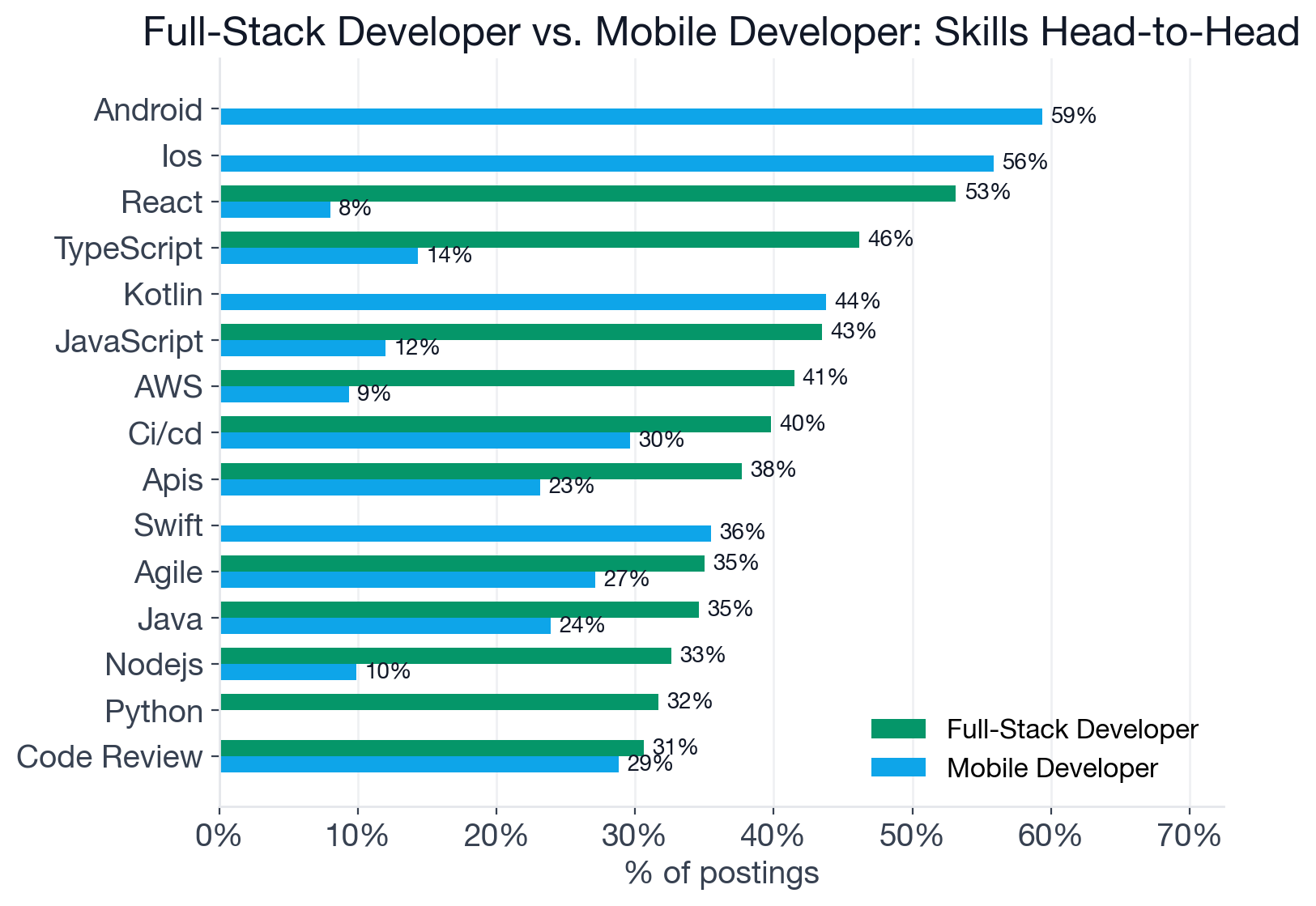 Full-Stack Developer skills cluster around the web stack (React, TypeScript, AWS); Mobile Developer skills cluster around the two native platforms (Android, iOS, Kotlin, Swift). The bars that do overlap mostly overlap unevenly.
Where Full-Stack Developer and Mobile Developer Skills Split
Full-Stack's exclusive skills read like a backend-and-data stack layered under the shared front-end tools: Python (31.7%), SQL (30.5%), Docker (29.4%), Angular (29.3%), Azure (26.0%), and PostgreSQL (25.1%). This is a role built to own a request from browser to database, and every one of those skills exists somewhere along that path.
Mobile's exclusive skills read like a platform checklist: Android (59.4%) and iOS (55.9%) anchor the role, with Kotlin (43.8%) and Swift (35.5%) as the languages built on top of them. MVVM (the Model-View-ViewModel architecture pattern most native apps are structured around) shows up in 25.5% of postings, and React Native (23.7%) marks the cross-platform alternative to writing two separate native codebases. Debugging is worth a second look: it barely registers for Full-Stack, but it is Mobile's seventh most common skill at 17.8%, a sign that diagnosing device-specific, hard-to-reproduce behavior eats a real share of the mobile workweek in a way that ticket-based web debugging usually does not.
Which Role Pays More, and Why?
Mobile Developer wins on pay. Among US postings with disclosed salary (base salary only, since equity, bonus, and sign-on aren't captured in job listings), the median is $166,500 (n=459) against $149,600 for Full-Stack Developer (n=1,503), a $16,900 (10.2%) premium.
Seniority mix explains more of that gap than scarcity does. Staff-level hires make up 16.5% of Mobile postings versus 8.7% for Full-Stack, nearly double, while senior-level share sits close between the two (29.5% vs. 31.0%). Look at what each role's core skills actually pay and the picture sharpens further: Android ($167,300), iOS ($166,500), and Kotlin ($164,000) all land within a few thousand dollars of Mobile's own baseline, they define the role, they do not pay a premium for it. Mobile's real premium comes from breadth skills layered on top: Observability ($202,300), Scalability ($201,200), Prototyping ($198,300), and Concurrency ($194,100) all sit $27,600 to $35,800 above baseline, the kind of platform-engineering depth that shows up more often in senior hiring than in an entry-level Android or iOS req. Each of those breadth-skill medians is built on a modest 25-34 disclosed salaries, so treat the exact dollar gaps as directional rather than precise, even though the pattern (breadth pays, platform names don't) holds up.
Full-Stack's premium runs through a different lane. LLMs ($180,000, n=105), Embeddings ($183,000), Generative AI ($178,300), Prompt Engineering ($175,800), and RAG ($175,000) all sit $25,400 to $33,400 above the $149,600 baseline, an explicit AI-building tier that does not exist anywhere in Mobile's skill data, not in its top-30 list, not in its salary-disclosed skills. That is a real difference in who is explicitly hired to build AI systems, but it is not the same as who uses AI day to day. Job postings only name AI as a required skill when it is a build requirement; they do not capture ambient tool use. Stack Overflow's 2025 Developer Survey puts overall developer AI-tool usage at 84% and daily use at 51%, and that baseline almost certainly reaches Mobile engineers too, just delivered differently: modern IDEs on both platforms increasingly ship AI coding assistants built directly in, so the tool arrives through the platform itself instead of through a job description.
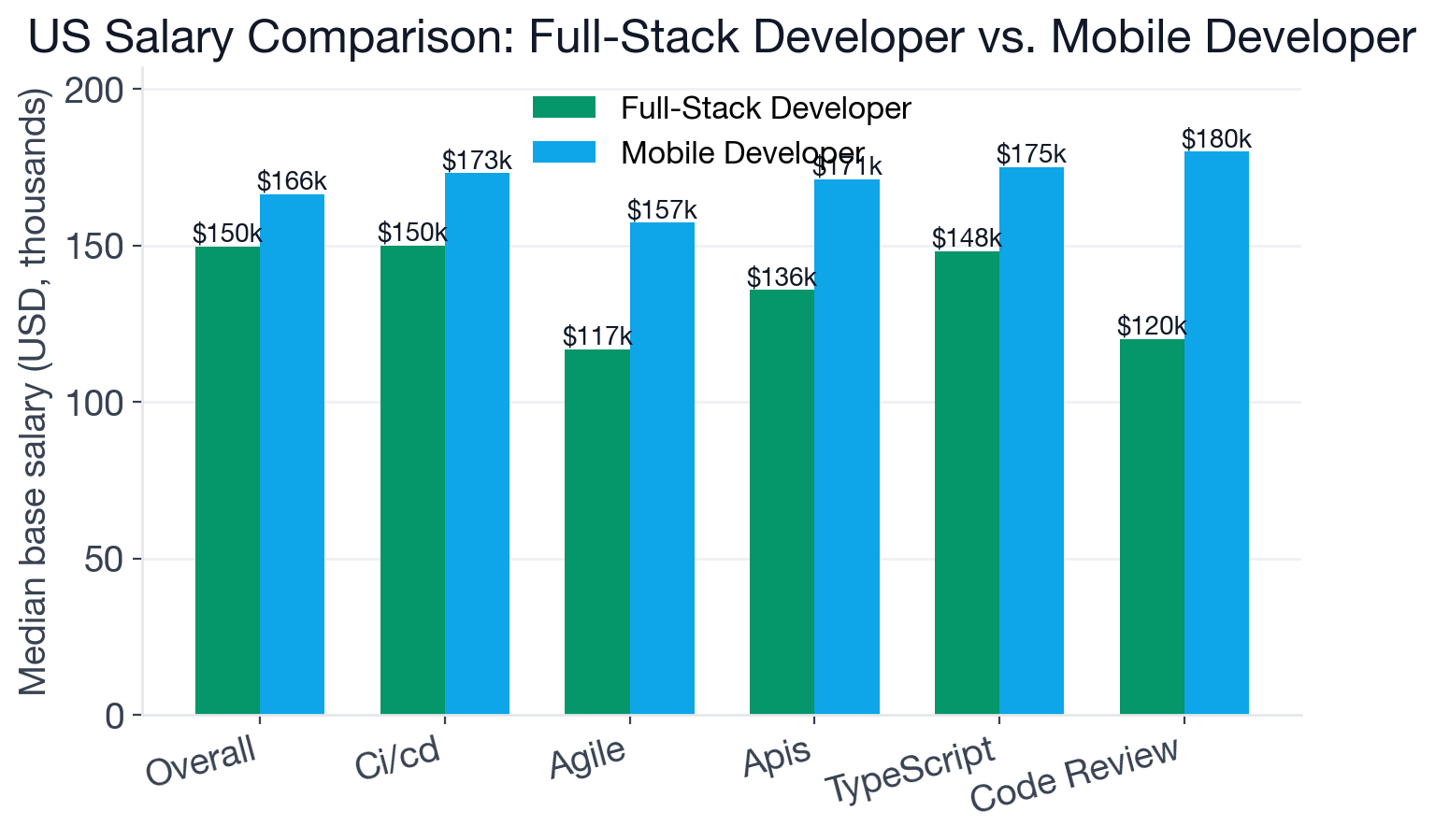 Mobile Developer's US base salary median sits above Full-Stack Developer's, but the premium lives in breadth skills, not in Android or iOS themselves.
Which Role Has More Openings, and Who Gets Hired?
Full-Stack Developer's job market is 3.52x larger: 9,251 active postings versus 2,628 for Mobile Developer. That gap reflects who is building what: nearly every company with a web product needs Full-Stack coverage, while Mobile roles concentrate at companies shipping a dedicated iOS or Android app, a structurally smaller slice of employers.
Neither role is easy to break into without experience. Entry-level share sits at 3.7% for Full-Stack and 2.8% for Mobile, both far below what a career switcher would want to see. Geography and flexibility track closely too: the US leads both roles' postings (28.2% Full-Stack, 27.1% Mobile), with India second in both (13.5% and 10.6%). Full-Stack is somewhat more remote-friendly, 27.4% remote and 50.8% onsite, versus 22.3% remote and 55.8% onsite for Mobile, though the gap is modest, not the stark divide seen in some role comparisons.
Which Role Should You Choose?
Choose Full-Stack Developer if you:
- Want the larger, faster-moving job market, 9,251 postings versus 2,628, and don't want your search to hinge on one platform.
- Have, or want to build, a backend-and-data foundation (Python, SQL, Docker, Kubernetes) that transfers across nearly any company shipping a web product.
- Want an explicit path into AI-building work: LLMs, RAG, and Generative AI are named, salary-differentiated skills in this role's data today.
Choose Mobile Developer if you:
- Want to go deep on a single platform, iOS or Android, rather than spread across a full request path.
- Are comfortable that the biggest pay jumps come later, from platform-engineering breadth (observability, concurrency, scalability) rather than from the core Android, iOS, or Kotlin skills themselves.
- Value a slightly higher pay ceiling and can be patient with a smaller, more specialized employer pool (2,628 postings).
If you're weighing the switch, browse current Full-Stack Developer openings or Mobile Developer openings to see how your existing skills line up against real postings. Drill whichever side you're less confident on in the question bank, then pressure-test your answers with AI mock interviews before you commit to the switch.
FAQ
Q. What is the salary difference between Full-Stack Developer and Mobile Developer in 2026?
Mobile Developer earns more: a median US base salary of $166,500 (n=459 postings with disclosed salary) versus $149,600 for Full-Stack Developer (n=1,503), a $16,900 (10.2%) premium. Both figures are base salary only; equity, bonuses, and sign-on aren't disclosed in job postings, so total compensation at top employers in both fields runs higher than these numbers.
Q. How much do Full-Stack Developer and Mobile Developer skills overlap?
Moderately on paper (a Jaccard similarity of 0.40 across each role's top-30 skills) but less in practice. Only three skills sit at genuinely comparable frequency in both roles: Code Review, Git, and RESTful APIs. The rest of the "shared" list, including React, TypeScript, JavaScript, AWS, and Node.js, is Full-Stack vocabulary that a minority of Mobile postings also mention, skewed 1.3x to 6.6x toward Full-Stack.
Q. Which role has more job openings, Full-Stack Developer or Mobile Developer?
Full-Stack Developer, by a wide margin: 9,251 active postings versus 2,628 for Mobile Developer, a 3.52x volume advantage. Full-Stack roles exist at nearly any company shipping a web product; Mobile roles concentrate at companies that ship a dedicated iOS or Android app, a structurally smaller pool of employers.
Q. Why does Mobile Developer pay more despite having fewer job openings?
Mostly seniority mix, not scarcity alone. Staff-level hires make up 16.5% of Mobile postings versus 8.7% for Full-Stack, nearly double. Core Mobile skills (Android, iOS, Kotlin) actually pay right around the role's own baseline; the real premium comes from breadth skills like Observability, Scalability, Prototyping, and Concurrency, which sit $27,600 to $35,800 above baseline and show up more often in senior mobile hiring. Those breadth-skill medians rest on modest samples of 25-34 disclosed salaries each, so the exact dollar gaps are directional.
Q. Do either of these roles require AI skills?
Full-Stack shows an explicit AI-building tier that Mobile does not. Skills like LLMs, Generative AI, RAG, and Prompt Engineering appear as named, salary-differentiated skills in Full-Stack postings, paying $25,400 to $33,400 above baseline, while none of Mobile's top-30 or salary-disclosed skills include an AI or ML term at all. That doesn't mean mobile engineers use AI less. Modern IDEs for both platforms increasingly ship AI coding assistants built directly in, so the tool arrives through the platform itself instead of through a job description.
Q. Is Mobile Developer a remote-friendly role?
Less than Full-Stack, but not by a huge margin. 22.3% of Mobile Developer postings are remote and 55.8% are onsite, versus 27.4% remote and 50.8% onsite for Full-Stack Developer. Both roles default to onsite more often than not, but Full-Stack offers a modestly larger remote and hybrid footprint.
Q. Should I become a Full-Stack Developer or a Mobile Developer?
Choose Full-Stack Developer if you want the larger, faster-moving job market and skills (React, TypeScript, Node.js, cloud infrastructure) that transfer across nearly every industry, including a path into AI-building work. Choose Mobile Developer if you want to specialize in a single platform, don't mind a smaller pool of employers, and are willing to build toward the breadth skills, observability, concurrency, and scalability, that raise its senior-level pay ceiling. The two roles share only a thin layer of process tooling, so this is closer to picking a specialization than picking a level of the same job.
Depth Pays More Than Scarcity Does
Full-Stack Developer and Mobile Developer share a job title word and not much else, only three skills genuinely overlap at comparable frequency, and the rest of the "shared" list is either a Full-Stack skew or, in the case of user experience, a Mobile one. Full-Stack wins on job-market size and offers a clearer path into AI-building work today. Mobile wins on median pay, but that premium sits on top of platform-engineering breadth, not on top of Android or iOS themselves. Whichever you pick, the ceiling comes from the depth you build after the core skills, not from how many other people are competing for the same seat.
Topics
Ready to practice?
Put what you've learned into practice with AI mock interviews and structured preparation guides.