
Dashboards Were Just the Beginning
The Business Intelligence Analyst has long been the translator between raw data and the business decisions that depend on it: write the SQL, build the dashboard, explain the trends to the stakeholders who cannot read a pivot table. It is a role defined by its ability to make data legible, and for years that translation was the whole job.
AI is not eliminating that function. It is moving it up a level. Gartner predicts that 75% of all analytics content will be generated via GenAI by 2027, and industry research cited by The Reporting Hub finds that 93% of business leaders say they would make better decisions if they could ask data questions in plain language. The question for every Business Intelligence Analyst in 2026 is not "will AI replace me?" It is "who will govern the AI that answers those questions?"
We analyzed 2,045 active Business Intelligence Analyst postings on the InterviewStack.io job board as of June 2026, with AI skills extracted and normalized across all descriptions. The headline is counterintuitive: explicit AI requirements sit at just 10% of postings, but those roles carry a nearly $24K salary premium in the US and concentrate overwhelmingly at the staff level. The shift is underway. It just has not reached the middle of the market yet.
Key Findings
- 2,045 active Business Intelligence Analyst postings analyzed on the InterviewStack.io job board as of June 2026.
- 10.0% of postings explicitly require new-wave generative AI skills (205 of 2,045), including AI Agents, LLMs, and Generative AI. Expand to any AI including traditional Machine Learning and the share rises to 17.5%.
- AI Agents (4.4%) is the top new-wave AI skill in BI postings, outranking LLMs (3.5%) and Generative AI (2.3%), placing the agentic tier ahead of the broader generative AI category.
- Staff-level BI Analysts are nearly 3x more likely to be in AI-requiring roles: 26.7% of staff postings versus 9.4% at senior level and 10.8% at mid-level.
- The US median salary rises from $121,000 to $144,940 for AI-skill postings: a $23,940 premium (n=57 AI postings; directional given the sample size). US base salary only; equity is excluded.
- Technology (18.9%), Software (14.9%), and Healthcare (12.4%) lead AI adoption rates among BI Analyst postings.
- Gartner forecasts 75% of analytics content will use GenAI by 2027 and 84% of analytics leaders say their data strategies need an overhaul for AI, pointing to a much higher explicit adoption rate within two years.
What the Role Looked Like Before 2023
Three years ago, the Business Intelligence Analyst job description was a settled document. SQL, a major BI platform (Tableau, Power BI, or Qlik), and the ability to build dashboards that non-technical stakeholders could use without a data degree. The role sat at the intersection of data and communication: enough technical depth to query the warehouse, enough business judgment to know which metrics told the right story.
The ambient toolset was Excel and a BI platform. Advanced practitioners layered in Python for data cleaning or more flexible analysis. Machine Learning appeared in some postings at data-forward companies, but for most BI Analysts the term was aspirational rather than a hiring requirement.
That baseline is largely intact in today's job descriptions. What has changed is the layer of expectation sitting above it. The Stack Overflow Developer Survey 2025 found that 84% of developers use or plan to use AI tools, with 51% doing so daily. The JetBrains State of Developer Ecosystem 2025 report puts regular AI tool adoption at 85% among professional developers. These surveys weight toward software engineers, but the signal extends broadly: technical professionals across functions are expected to be AI-fluent, even when their posting says nothing about it. BI Analysts writing SQL, building data pipelines, and working inside Power BI or Tableau, both of which now ship native AI features, are not exempt from that expectation.
Salesforce's 2026 Data and Analytics research adds a BI-specific signal: 84% of analytics leaders say their current data strategies need a fundamental overhaul to accommodate AI, and 67% feel organizational urgency to move faster than they are comfortable with. The tools shifted first. The postings are catching up.
What Do Business Intelligence Analyst Postings Actually Require for AI?
As of June 2026, 10.0% of Business Intelligence Analyst postings on the InterviewStack.io job board explicitly require new-wave generative AI skills: the tools and frameworks that accelerated after 2023, including LLMs, AI Agents, Generative AI, prompt engineering, and RAG. An overlapping 10.8% require traditional Machine Learning or Deep Learning (3.4% of postings mention both categories), bringing the combined any-AI share to 17.5%.
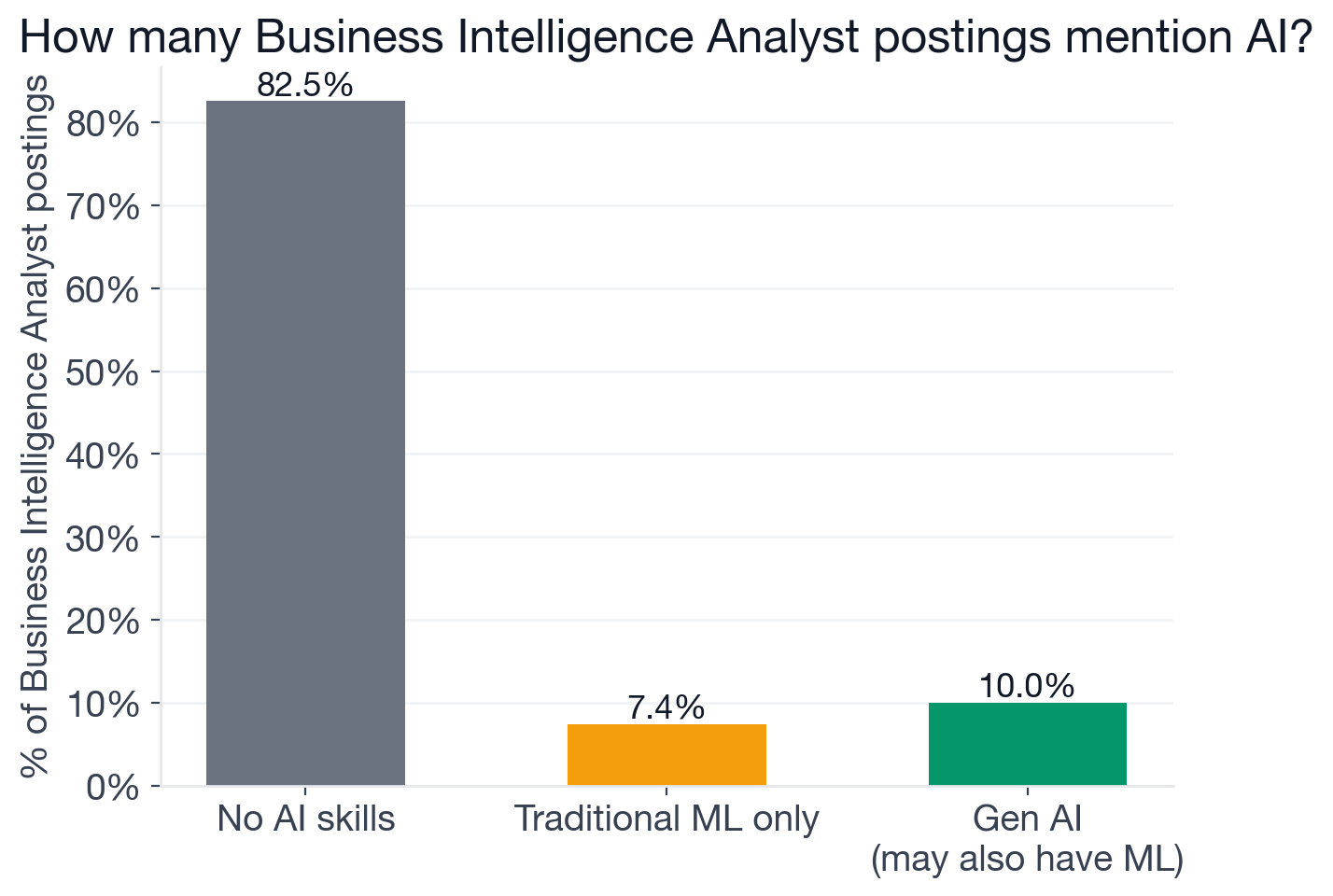
Share of 2,045 active Business Intelligence Analyst postings by AI requirement type, June 2026. "New-wave" covers generative AI, LLMs, AI Agents, and post-2023 tools; "Traditional ML" covers Machine Learning and Deep Learning.
The 10% figure measures one specific hiring signal: the company needs a BI Analyst who will design, integrate, or govern AI-powered analytics systems. Think of building the LLM pipeline behind a natural-language reporting interface, integrating autonomous data agents into an analytics workflow, or owning the validation layer for AI-generated dashboards. That is the "Build AI" layer, and the posting makes it explicit.
The "Use AI" layer is a different story, and it does not appear in postings for the same reason that internet access was never listed as a skill in 2005 job ads. Power BI Copilot, Tableau's Einstein Analytics, Looker's AI-powered narratives, and ChatGPT-assisted SQL debugging are now part of how BI Analysts work, regardless of whether the job description says so. Salesforce's acquisition of Waii (an NLP-for-data-management startup) in August 2025 is a vendor-tier signal that conversational analytics is becoming infrastructure, not a differentiator.
The practical read: the 10% requires you to build AI into analytics systems. Virtually the other 90% expects you to be fluent in using AI tools as part of the daily workflow. These are related but distinct expectations, and missing either one is a real gap in 2026.
Which AI Skills Are BI Analyst Postings Actually Asking For?
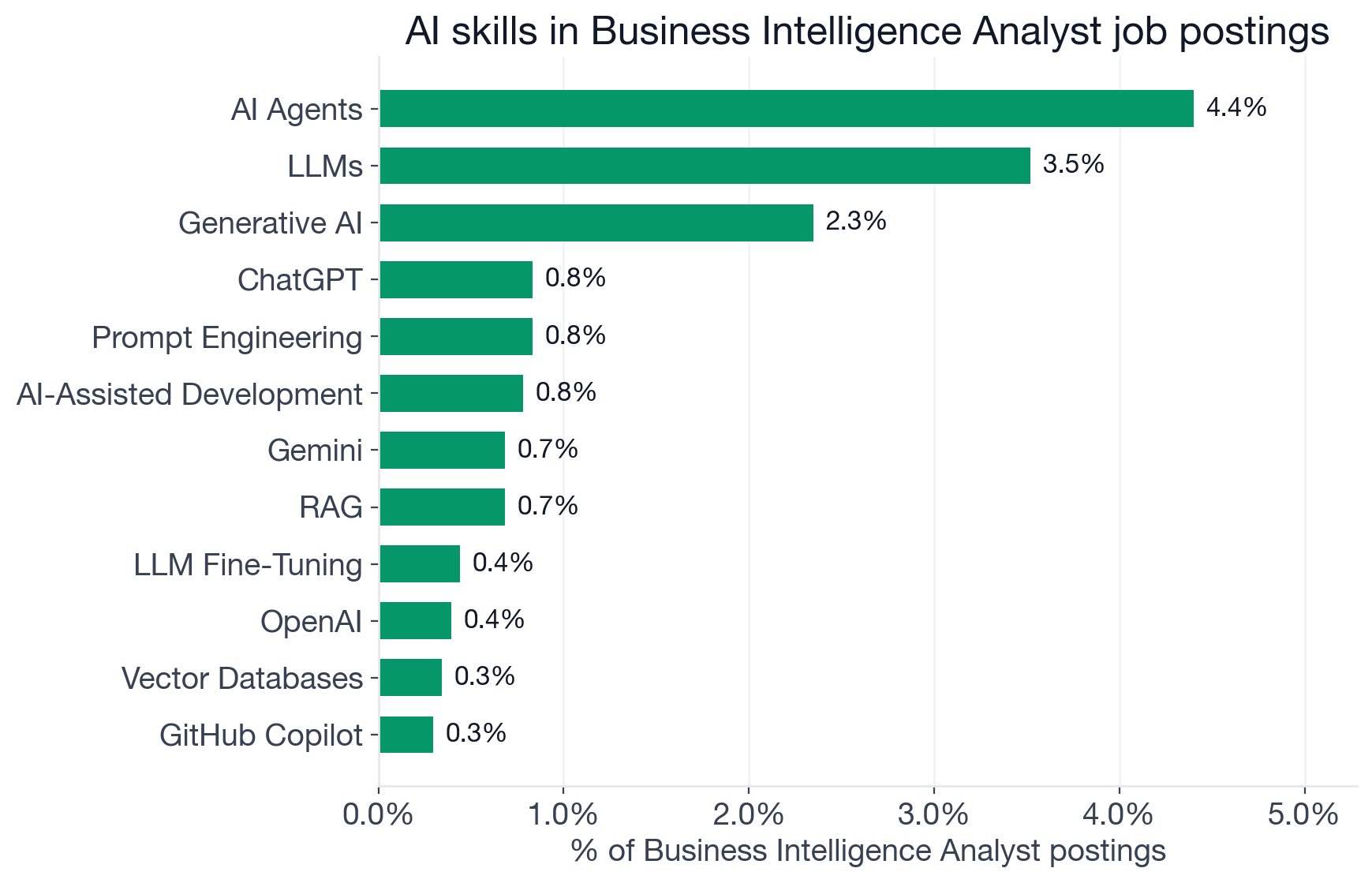
Percentage of active Business Intelligence Analyst postings mentioning each AI skill. All 2,045 postings form the denominator.
Traditional Machine Learning (10.7%, 219 postings) leads the full list. That is the established tier: BI Analysts at data-mature organizations have been expected to understand predictive modeling for several years, and it shows up consistently at the top of any BI AI skill chart.
The new-wave signal is more telling. AI Agents (4.4%, 90 postings) is the most-demanded generative AI skill in BI job descriptions, outranking LLMs (3.5%, 72 postings) and Generative AI (2.3%, 48 postings). The ordering matters. In a BI context, AI Agents typically means orchestrating autonomous data agents: systems that inspect schemas, identify data quality issues, and validate their own outputs without human intervention at each step. Recent analytics industry research found 23% of organizations are already scaling agentic AI for analytics, with 39% in active experimentation. The postings reflect the leading edge of that adoption.
Prompt Engineering (0.8%, 17 postings) and RAG (retrieval-augmented generation, 0.7%, 14 postings) appear in targeted postings: companies building natural-language-to-SQL pipelines or document-grounded analytics systems, where the BI Analyst's job is to own the query design layer rather than just consume the output.
The practical map is two-tiered. Machine Learning is the established demand, a competency that top-tier BI roles have expected for years. AI Agents and LLMs are the emerging demand, growing fastest among organizations that are furthest into AI-native analytics workflows.
Does AI Knowledge Pay Off in the BI Analyst Market?
Among US postings with disclosed salary data, the answer is yes, with appropriate caveats on sample size. These figures cover US base salary only; equity, bonuses, and sign-on are not disclosed in job postings, so total compensation at top employers runs meaningfully higher.
Business Intelligence Analysts in roles requiring new-wave AI skills show a median US base of $144,940. Those without AI requirements show $121,000. That is a $23,940 premium (n=57 postings for the AI group, n=281 for the non-AI group). Treat the AI-group figure as directional rather than definitive, consistent with what a 10% adoption rate produces in terms of salary-disclosed sample size.
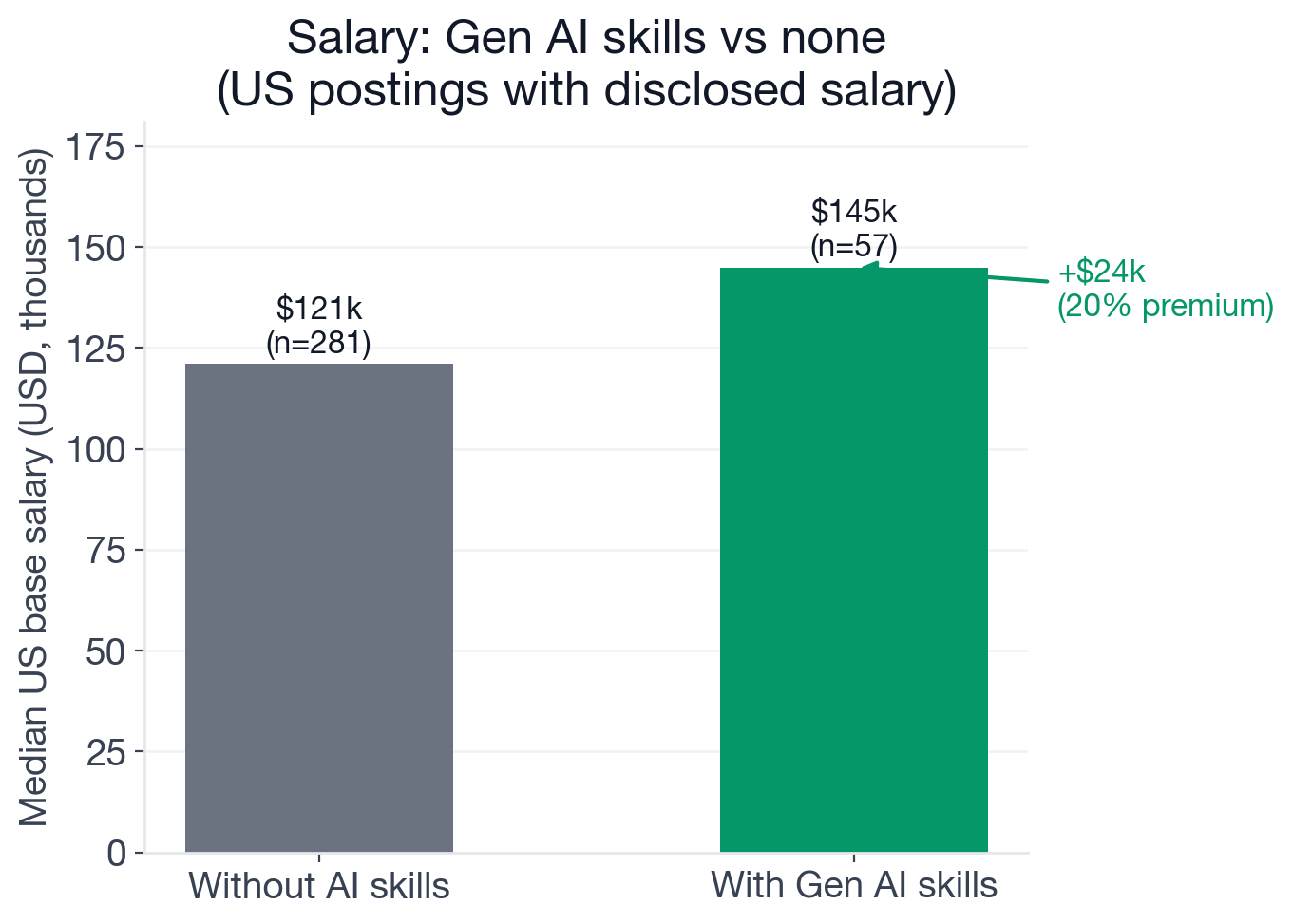
Median US base salary for Business Intelligence Analyst postings with and without new-wave AI skill requirements, June 2026. US postings with disclosed salary data only; n=57 (AI-requiring) and n=281 (non-AI).
A $24K premium on a $121K baseline is a 20% uplift. That is consistent with what the market pays when AI shifts from a nice-to-have to a core requirement. The underlying logic is straightforward: a BI Analyst building or governing an AI-powered analytics system, at a company where business leaders are demanding natural-language query interfaces, is doing a more complex job than one building dashboards in Power BI. The market prices that complexity, and the gap will likely widen as agentic analytics becomes more standard.
Which BI Analyst Roles and Industries Are Hiring for AI First?
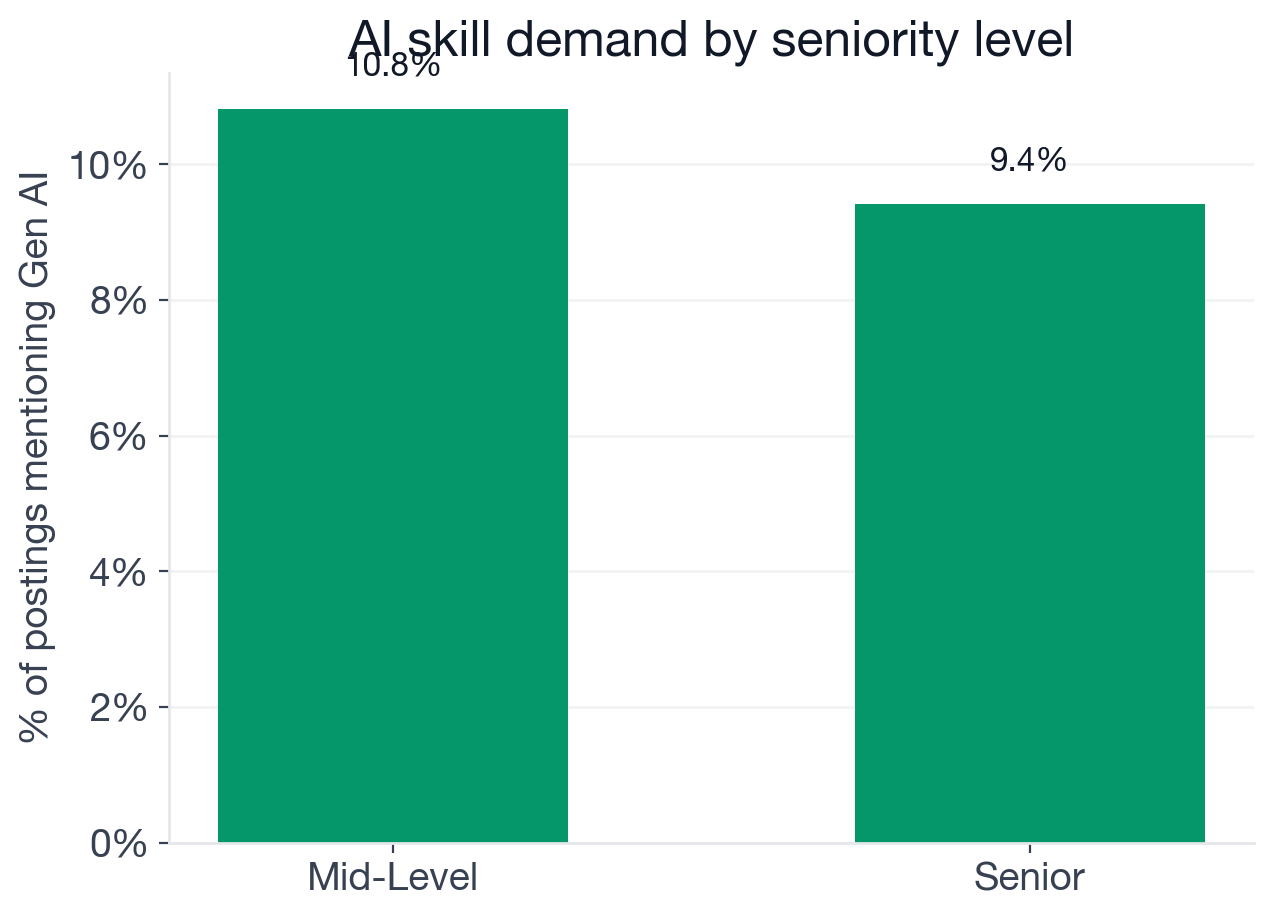
Percentage of Business Intelligence Analyst postings mentioning AI, by seniority level. Total N by level: entry 64, junior 106, mid-level 444, senior 1,371, staff 60.
The seniority data is the sharpest finding in this dataset. Staff-level BI Analysts are nearly three times as likely to be in AI-requiring roles as senior-level ones: 26.7% of staff postings versus 9.4% at senior. Mid-level sits at 10.8%, essentially flat with senior. With 60 staff postings and 1,371 senior ones, the divergence is not noise. It reflects a genuine structural distinction in what organizations expect from different tiers.
The interpretation: AI in BI is currently a strategic leadership competency, not a baseline one distributed uniformly across the workforce. Companies are looking to their most senior individual contributors to own the architecture and governance of AI-powered analytics. The entry and junior tiers show lower AI rates (4.7% and 8.5% respectively) not because AI is irrelevant there, but because junior BI roles still emphasize the foundational skills before layering in AI system design.
If you are in a senior BI role wondering where AI fits your trajectory, the data shows the answer clearly: staff-level is where the concentration is, and AI fluency appears to be a primary differentiator between the two tiers.
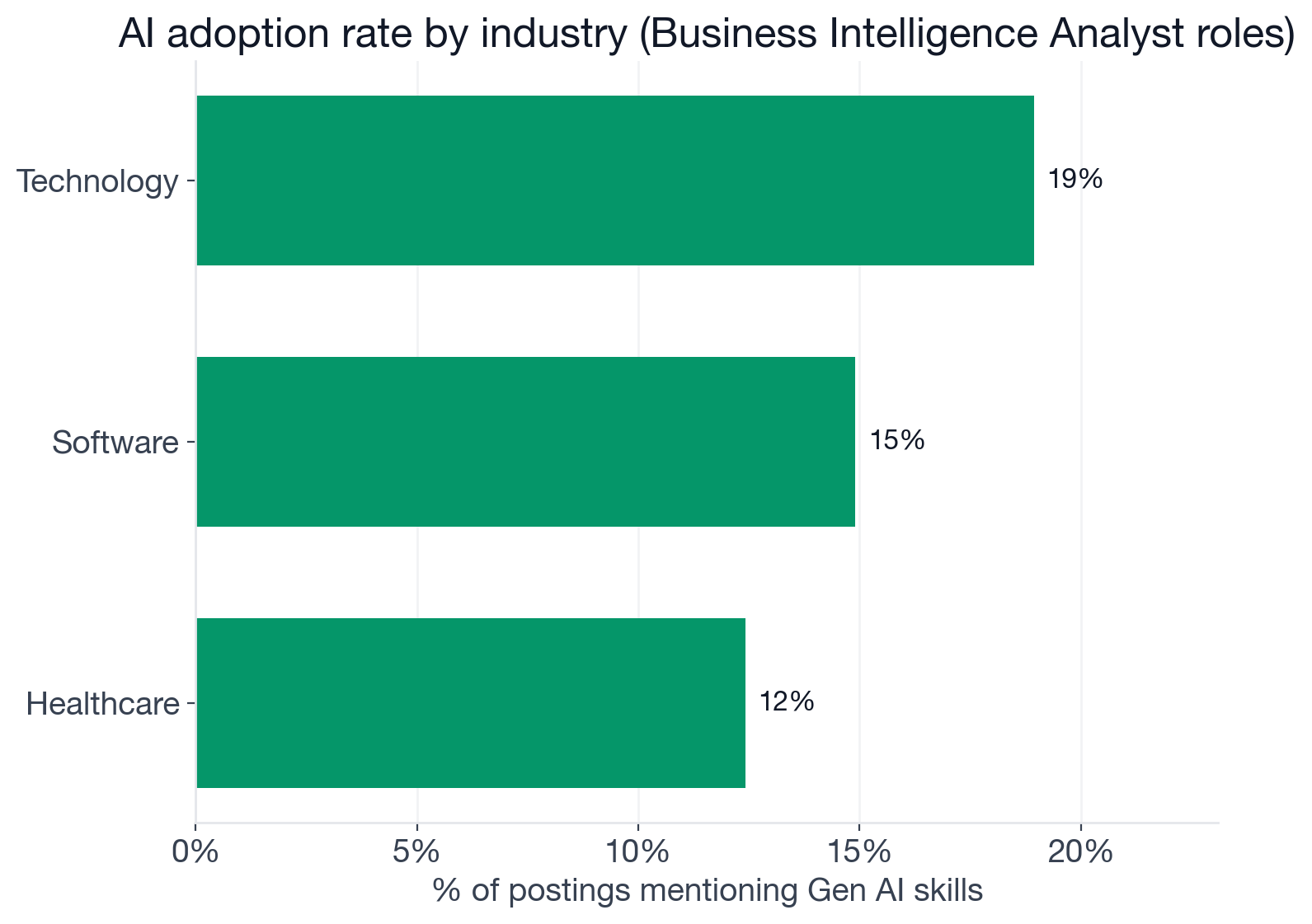
AI adoption rate among Business Intelligence Analyst postings by industry, June 2026. Industries with at least 100 BI Analyst postings shown.
By industry, Technology leads at 18.9% of BI Analyst postings requiring AI (25 of 132 postings), followed by Software at 14.9% (24 of 161) and Healthcare at 12.4% (18 of 145). All three sit above the 10% overall rate. Healthcare's presence is notable: it reflects the sector's push toward AI-augmented clinical and operational analytics, where BI Analysts increasingly own the validation layer for predictive outputs rather than just the reporting layer.
The roughly two-thirds of BI Analyst postings outside these three sectors sit at or below the 10% AI threshold. That gap is not a signal that AI is less important in those industries. It is the expected lag between when AI tools become standard practice and when job descriptions reflect the change. The Gartner 75%-by-2027 forecast and the Salesforce data on analytics-leader urgency both point to a narrowing gap over the next 18 to 24 months.
How to Use This in Your Job Search
The data points to two parallel tracks for BI Analysts positioning for 2026.
For the ambient AI layer: Start with the AI features already embedded in your current tools. Power BI Copilot, Tableau's AI-assisted analysis, and Looker's AI-generated narratives are production features now, not experiments. Add prompt engineering to your day-to-day workflow for SQL debugging, data narrative drafting, and ad-hoc analysis. This layer rarely shows up in postings, but it shapes every technical screen and hiring conversation in the sector.
For the explicit AI layer (and the $24K premium): The skills to build are AI Agents and the underlying LLM integration knowledge. Understanding how autonomous data agents work, how to prompt-engineer them reliably for data tasks, and how to validate and govern their outputs is what staff-level BI roles are hiring for. Browse Business Intelligence Analyst postings requiring Machine Learning or AI Agents to see which companies and sectors are building in this direction now.
To prepare for BI Analyst interviews that include AI topics, InterviewStack's AI mock interviews let you simulate technical and behavioral rounds with immediate feedback. For drilling specific BI and analytics question types, the question bank covers the topics most commonly tested at the roles and companies you are targeting. The interactive courses cover the foundational statistics, data modeling, and analytics concepts that underpin both classic BI work and AI-augmented analytics. For the full picture of live openings, browse current Business Intelligence Analyst openings on the job board.
FAQ
Q. How many Business Intelligence Analyst postings explicitly require AI skills?
About 10% of the 2,045 active Business Intelligence Analyst postings analyzed in June 2026 explicitly require new-wave generative AI skills (LLMs, AI Agents, prompt engineering, and similar). Broaden to any AI including traditional Machine Learning and the share rises to 17.5%. The explicit percentage measures roles where you are expected to build or integrate AI systems; virtually all BI Analyst roles now expect ambient AI tool use through platforms like Power BI Copilot, ChatGPT, and AI-assisted SQL workflows.
Q. What is the salary premium for AI skills in Business Intelligence Analyst roles?
Among US postings with disclosed salary data, Business Intelligence Analysts in new-wave AI-requiring roles show a median base of $144,940 versus $121,000 for non-AI roles, a $23,940 premium (n=57 AI-skill postings; treat as directional given the sample size). Equity and bonuses are not disclosed in postings, so total compensation at top employers runs higher than these figures.
Q. Which AI skills appear most in Business Intelligence Analyst postings?
Machine Learning leads at 10.7% of postings (219 of 2,045), reflecting long-standing demand for predictive modeling on top of BI foundations. Among new-wave generative AI skills, AI Agents (4.4%, 90 postings) outranks LLMs (3.5%) and Generative AI (2.3%), signaling that the agentic tier is growing fastest in explicit BI demand.
Q. Are senior or staff Business Intelligence Analysts more likely to need AI skills?
Staff-level BI Analysts are significantly more likely to require AI skills: 26.7% of staff postings mention AI versus 9.4% of senior postings and 10.8% at mid-level. AI in BI is currently a leadership competency concentrating in roles that design analytics architectures and govern data strategies rather than a baseline expectation at every level.
Q. Which industries have the highest AI adoption for Business Intelligence Analyst roles?
Technology leads at 18.9% of BI Analyst postings requiring AI (25 of 132), followed by Software at 14.9% (24 of 161) and Healthcare at 12.4% (18 of 145). All three sit above the 10% overall new-wave adoption rate, consistent with sectors where data-driven decision-making is a competitive differentiator.
Q. Is the Business Intelligence Analyst role being automated away by AI?
Not based on current job posting data. The 2,045 active Business Intelligence Analyst postings in this analysis reflect a role that is expanding rather than contracting, with AI as an additive competency. Gartner predicts 75% of analytics content will be generated via GenAI by 2027, which is a productivity shift rather than a headcount reduction: BI Analysts will query and govern AI-generated analytics rather than hand-craft every dashboard. The 89% of data leaders who report inaccurate AI outputs confirms that human validators remain in the loop.
Q. How should Business Intelligence Analysts prepare for AI integration in 2026?
Start by distinguishing two tracks. For ambient AI use (faster SQL, natural language queries, AI-assisted narrative generation), priority skills are prompt engineering and familiarity with AI features in Power BI, Tableau, and Looker. For building AI-powered analytics infrastructure and earning the salary premium, focus on Machine Learning, AI Agents, and LLM integration. Practice with mock interviews covering BI and AI topics, drill analytics questions in the question bank, and filter the job board for BI postings that pair your target skills.
The Strategic Bet for BI Professionals
The 10% of BI Analyst postings that explicitly require AI are not the tail end of a trend. They are the early signal of one. The staff-level concentration (26.7% vs. 9.4% at senior) means the first wave of BI professionals stepping into AI-forward architecture roles is already in motion. The $24K salary premium means the market is already pricing the capability. And Gartner's 75% GenAI analytics prediction means the window between "early mover" and "expected baseline" is measured in months, not years. The role is not being replaced. It is being restructured around a higher-value function, and the opportunity to position yourself inside that restructuring is open right now.
Topics
Ready to practice?
Put what you've learned into practice with AI mock interviews and structured preparation guides.